
仙坛股份

Search documents
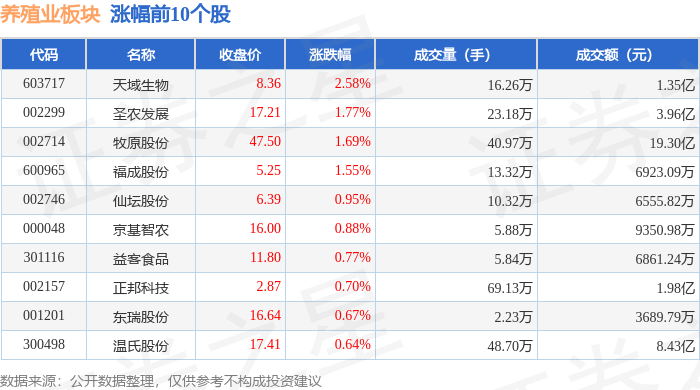
养殖业板块8月20日涨0.91%,天域生物领涨,主力资金净流出2.32亿元
Zheng Xing Xing Ye Ri Bao· 2025-08-20 08:37
Group 1 - The aquaculture sector increased by 0.91% on August 20, with Tianyu Biological leading the gains [1] - The Shanghai Composite Index closed at 3766.21, up 1.04%, while the Shenzhen Component Index closed at 11926.74, up 0.89% [1] - Key stocks in the aquaculture sector showed various performance, with Tianyu Biological closing at 8.36, up 2.58%, and Muyuan Foods at 47.50, up 1.69% [1] Group 2 - The aquaculture sector experienced a net outflow of 232 million yuan from institutional investors, while retail investors saw a net inflow of 178 million yuan [2] - The stock *ST Tianshan saw a significant decline of 16.07%, closing at 9.09 [2] - The trading volume and turnover for major stocks in the aquaculture sector varied, with Muyuan Foods having a turnover of 1.93 billion yuan [2] Group 3 - Major stocks like Muyuan Foods and Shengnong Development had mixed net inflows from different investor types, with Muyuan Foods seeing a net outflow of 81.64 million yuan from retail investors [3] - The net inflow for Shengnong Development from retail investors was 979.36 million yuan, indicating strong retail interest despite overall sector outflows [3] - The data indicates a complex flow of funds within the aquaculture sector, highlighting varying investor sentiments across different stocks [3]


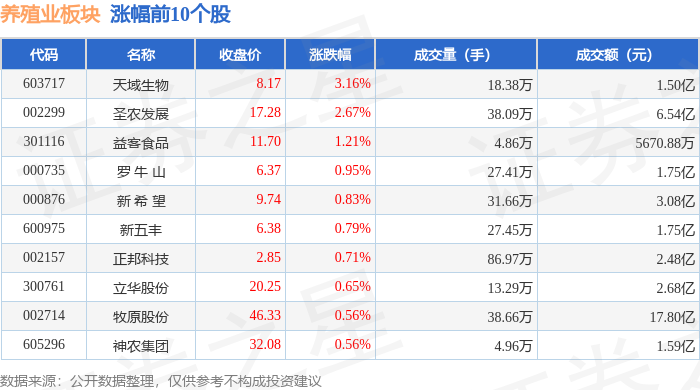
养殖业板块8月18日涨0.41%,天域生物领涨,主力资金净流出9708.7万元
Zheng Xing Xing Ye Ri Bao· 2025-08-18 08:38
Market Overview - On August 18, the aquaculture sector rose by 0.41% compared to the previous trading day, with Tianyu Biological leading the gains [1] - The Shanghai Composite Index closed at 3728.03, up 0.85%, while the Shenzhen Component Index closed at 11835.57, up 1.73% [1] Stock Performance - Key stocks in the aquaculture sector showed varied performance, with Tianyu Biological closing at 8.17, up 3.16%, and Shennong Group at 32.08, up 0.56% [1] - Other notable performers included Shengnong Development at 17.28, up 2.67%, and Yike Food at 11.70, up 1.21% [1] Trading Volume and Value - The trading volume for Tianyu Biological was 183,800 shares, with a transaction value of 150 million yuan [1] - Shengnong Development had a trading volume of 380,900 shares, with a transaction value of 654 million yuan [1] Capital Flow - The aquaculture sector experienced a net outflow of 97.087 million yuan from institutional investors, while retail investors saw a net outflow of 124 million yuan [2] - Conversely, speculative funds recorded a net inflow of 221 million yuan [2] Individual Stock Capital Flow - Muyuansheng had a net inflow of 43.3368 million yuan from institutional investors, while it faced a net outflow of 38.4479 million yuan from speculative funds [3] - Shengnong Development also saw a net inflow of 24.6627 million yuan from institutional investors, with a net outflow of 10.6830 million yuan from speculative funds [3]



股指放量冲高,但经济边际走弱
Dong Zheng Qi Huo· 2025-08-17 11:44
1. Report Industry Investment Rating - The investment rating for stock indices is "oscillation" [1][4] 2. Core View of the Report - The stock market is at a high level, and attention should be paid to the risks after the amplification of volatility. The macro - fundamentals deviate from the rising stock market. The "front - running" of the A - share market has gradually turned into a "deviation". With few relatively low - valued sectors in the A - share market and increasing retail capital inflows, there is a need to watch out for potential market bubbles. Currently, risks outweigh opportunities [2][10] 3. Summary According to the Table of Contents 3.1 One - Week View and Overview of Key Macro Events - **Next - week View**: The stock market is at a high level, and attention should be paid to the risks after the amplification of volatility. The macro - fundamentals deviate from the rising stock market, and the "front - running" of the A - share market has turned into a "deviation" [10] - **This - week Key Events**: - On August 11, the Ministry of Finance and the State Taxation Administration solicited public opinions on the implementation regulations of the Value - Added Tax Law. Many listed companies planned to invest idle funds in the securities market [11][12] - On August 12, China and the US announced a 90 - day suspension of 24% reciprocal tariffs. Multiple departments issued policies on consumer loan and service industry business loan interest subsidies [13][14][16] - On August 13, China's M1 growth rate in July reached 5.6%, and 188 billion yuan of special ultra - long - term treasury bond funds for equipment renewal was fully allocated [17][18] - On August 14, a new K - type visa was added for foreign young scientific and technological talents [19] - On August 15, most of China's economic data in July fell short of expectations. The central bank's second - quarter monetary policy report emphasized balanced development [20][22] 3.2 One - Week Market Overview - **Global Stock Market Weekly Overview**: From August 11 - 15, the global stock market denominated in US dollars rose. The MSCI Global Index increased by 1.22%, with emerging markets (+1.49%) > frontier markets (+1.42%) > developed markets (+1.19%). Japan's stock market led the global rise with a 3.99% increase, while Saudi Arabia's stock market had the worst performance, falling 0.65% [23] - **Chinese Stock Market Weekly Overview**: Chinese equity assets rose significantly. A - shares > Chinese concept stocks > Hong Kong stocks. The average daily trading volume of the Shanghai, Shenzhen, and Beijing stock markets reached 2.1022 trillion yuan, a 405.6 - billion - yuan increase from last week. Most indices rose by over 1%, with the ChiNext Index rising 8.58%, while the micro - cap stock index fell 0.75% [26] - **Weekly Overview of GICS Primary Industries in Chinese and Foreign Stock Markets**: Most global GICS primary industries rose. The leading industry was materials (+4.15%), and the underperforming industry was healthcare (-0.44%). In the Chinese market, materials led the rise (+3.53%), and healthcare led the decline (-0.72%) [29] - **Weekly Overview of Chinese A - share Citic Primary Industries**: Among Chinese A - share Citic primary industries, 22 rose (28 last week) and 8 fell (2 last week). The leading industry was comprehensive finance (+7.07%), and the industry with the largest decline was banking (-3.22%) [30] - **Weekly Overview of Chinese A - share Styles**: The growth style outperformed the value style, and the small - cap style was dominant [35] - **Overview of Stock Index Futures Basis**: Information on the basis of IH, IF, IC, and IM in the past six months was presented [40][41] 3.3 Index Valuation and Earnings Forecast Overview - **Broad - based Index Valuation**: Valuation data such as PE and PB of various broad - based indices were provided, along with their eight - year percentile and changes since the beginning of the year [43] - **Primary Industry Valuation**: Valuation data such as PE and PB of various primary industries were provided, along with their eight - year percentile and changes since the beginning of the year [44] - **Broad - based Index Equity Risk Premium**: The ERP of the CSI 300, CSI 500, and CSI 1000 declined rapidly this week [45][50] - **Consensus Earnings Growth Forecast for Broad - based Indices**: The expected earnings growth rates of the CSI 300, CSI 500, and CSI 1000 in 2025 were adjusted downwards, while those in 2026 were adjusted upwards [51] 3.4 Liquidity and Fund Flow Tracking - **Interest Rates and Exchange Rates**: The 10 - year and 1 - year bond yields rose, and the spread widened. The US dollar index was 98, and the offshore RMB exchange rate was 7.19 [59] - **Tracking of Trading - type Funds**: The average daily northbound trading volume increased by 64 billion yuan compared to last week, and the margin trading balance increased by 45.7 billion yuan [61] - **Tracking of Funds Flowing in through ETFs**: The share of ETFs tracking the CSI 300 increased by 400 million, the share of ETFs tracking the CSI 500 increased by 180 million, the share of ETFs tracking the CSI 1000 increased by 1.2 billion, and the share of ETFs tracking the CSI A500 decreased by 1.6 billion [65][67] 3.5 Tracking of Domestic Macro High - frequency Data - **Supply Side**: The coking plant operating rate rebounded [70] - **Consumption Side**: Real estate transactions remained sluggish, but the year - on - year growth rate of passenger car wholesale sales rebounded, and the crude oil price dropped to around $68 per barrel [78][87] - **Inflation Observation**: The prices of production materials rebounded from a low level, while agricultural product prices reached a new low for the year [89][90]
上市公司巨资炒股|方大炭素主业不振拟拿最高24亿元“炒股”今年上半年扣非净利润预计大降95%
Xin Lang Cai Jing· 2025-08-15 21:04
Core Viewpoint - At least seven companies have announced plans for significant investments in securities, with amounts exceeding 1 billion RMB, highlighting a trend of companies turning to stock investments amid declining core business performance [1] Group 1: Company Performance - Fangda Carbon's net profit for the first half of 2025 is projected to be between 50.02 million and 60 million RMB, representing a year-on-year decrease of 65.13% to 70.93% [2] - The company's net profit excluding non-recurring items for the first half of 2025 is expected to be only around 1 million RMB, indicating a risk of losses if performance declines further [2] - Fangda Carbon's net profit has significantly dropped from 5.526 billion RMB in 2018 to just 46 million RMB in 2024, showcasing a severe decline over seven years [1] Group 2: Investment Strategy - Fangda Carbon plans to invest up to 2.4 billion RMB of its own funds in securities, with the ability to roll over these funds and reinvest any returns [1] - The company has reported non-recurring losses from stock investments of -197 million RMB in 2022, -226 million RMB in 2023, and a gain of 115 million RMB in 2024, indicating volatility in investment performance [3] - The reliance on securities investment to supplement earnings raises concerns about financial stability, especially when core business growth is uncertain [3]

上市公司巨资炒股|利欧股份拟拿最高30亿元“炒股” 去年因投资理想汽车亏损数亿元
Xin Lang Zheng Quan· 2025-08-15 19:09
Group 1 - At least seven companies have announced investments exceeding 1 billion RMB since 2025, with Liou Co. planning to invest up to 3 billion RMB [1] - Liou Co. reported investment returns of 371 million RMB, 1.261 billion RMB, and 286 million RMB for the years 2022 to 2024, respectively [1] - The company's net profit attributable to shareholders for the same years were -443 million RMB, 1.966 billion RMB, and -259 million RMB [1] Group 2 - In 2023, Liou Co. achieved a profit of nearly 2 billion RMB, primarily due to non-recurring gains from holding and disposing of Ideal Auto shares, amounting to 1.757 billion RMB [2] - The company faced a loss in 2024 due to fluctuations in Ideal Auto's stock price, resulting in a recognized loss of 820 million RMB [2] - The reliance on non-recurring gains indicates a need for the company to strengthen its core business profitability [2] Group 3 - Regulatory improvements are needed to manage the dual-edged nature of stock trading by listed companies, including clear investment ratio limits and disclosure requirements [3] - Companies should focus on their main business and treat investments as a supplementary strategy, establishing sound decision-making and risk control mechanisms [3] - Investors should prioritize the competitiveness and sustainability of a company's core business over short-term performance fluctuations [3]

上市公司巨资炒股|方大炭素主业不振拟拿最高24亿元“炒股” 今年上半年扣非净利润预计大降95%
Xin Lang Zheng Quan· 2025-08-15 19:05
Group 1 - At least seven companies have announced plans to invest over 1 billion RMB in securities since 2025, with Liou Co., Fangda Carbon, Qipilang, Tapai Group, Lianfa Co., Xiantan Co., and Zhejiang Yongqiang among them [1] - Fangda Carbon plans to invest up to 2.4 billion RMB of its own funds in securities, with the ability to roll over funds and reinvest returns within this limit [1] - Fangda Carbon has experienced a significant decline in profits, with net profit dropping from 5.526 billion RMB in 2018 to only 46 million RMB in 2024, indicating a severe downturn in financial performance [1][2] Group 2 - In the first half of this year, Fangda Carbon's net profit attributable to shareholders is projected to decrease by 65.13% to 70.93%, with a non-recurring net profit of only around 1 million RMB, indicating a risk of losses [2] - The company attributes its poor performance to macroeconomic conditions, reduced market demand, and intensified competition, raising concerns about the wisdom of investing billions in securities at this time [2] - Fangda Carbon's past stock investments have led to significant non-operating losses, with figures of -197 million RMB, -226 million RMB, and 115 million RMB in 2022, 2023, and 2024 respectively, highlighting the volatility and risks associated with such strategies [2] Group 3 - To mitigate risks associated with stock investments by listed companies, regulatory bodies should establish clear guidelines on investment limits and require full disclosure of investment rationale and risk management [3] - Companies should focus on their core business and treat investments as a supplementary strategy, developing sound decision-making and risk control mechanisms to avoid speculative behavior [3] - Investors are encouraged to assess the competitiveness and sustainability of a company's core business rather than being misled by short-term fluctuations in investment returns [3]
上市公司巨资炒股|七匹狼拟用最高20亿元“炒股”不务正业?去年投资收益远超主业
Xin Lang Zheng Quan· 2025-08-15 19:02
Group 1 - At least seven companies have announced plans to invest over 1 billion RMB in securities, with Liou Co. planning the highest investment of 3 billion RMB [1] - Seven Wolves plans to use idle funds for securities investment, with a maximum limit of 2 billion RMB, effective from the approval date at the 2024 annual shareholders' meeting until the 2025 meeting [1] - In 2024, Seven Wolves reported a net profit of 285 million RMB, a year-on-year increase of 5.35%, but the non-recurring net profit dropped by 60.86% to 73 million RMB [1] Group 2 - Seven Wolves' net profit is heavily reliant on non-core business activities, with 74% of its 2024 net profit coming from non-main business sources [1] - The company reported a fair value change gain of 236 million RMB from financial assets and liabilities in 2024 [1] - Seven Wolves' stock holdings include major companies like Tencent and Kweichow Moutai, contributing significantly to its profits [2] Group 3 - Seven Wolves' revenue has stagnated, with a reported revenue of 3.14 billion RMB in 2024, a decline of 8.84% year-on-year, remaining at a similar level to 2017 [2] - The company has seen a net decrease of 27 stores in 2024, with a total of 1,804 stores [2] - The decision to allocate 2 billion RMB for securities investment raises concerns about the company's strategic focus shifting away from its core business [2][3] Group 4 - Industry experts note that while stock trading can supplement earnings during periods of weak core business growth, it also introduces performance volatility risks [3] - There is a call for regulatory measures to limit the proportion of securities investments by listed companies and to ensure transparency in investment logic and risk control [3] - Companies should prioritize their main business while using investments as a supplementary strategy, establishing sound decision-making and risk management systems [3]

上市公司巨资炒股|塔牌集团拟用最高12亿元“炒股” 过去三年营收三连降
Xin Lang Zheng Quan· 2025-08-15 18:57
Core Viewpoint - Several companies are significantly increasing their investments in securities, with at least seven companies planning to invest over 1 billion RMB, indicating a trend of reliance on financial investments to bolster financial performance [1][2]. Group 1: Company Investment Plans - Seven companies, including Liou Co., Fangda Carbon, and Qipilang, are planning to invest over 1 billion RMB in securities, with Liou Co. leading at 3 billion RMB [1]. - Tapa Group plans to invest up to 1.2 billion RMB in securities, despite experiencing a decline in main business revenue for three consecutive years [1]. Group 2: Financial Performance Analysis - Tapa Group's revenue decreased by 21.76%, 8.29%, and 22.71% from 2022 to 2024, while its net profit showed fluctuations, with a significant drop of 85.50% in 2022, a rise of 178.55% in 2023, and a decline of 27.46% in 2024 [1]. - In the first half of 2025, Tapa Group reported a revenue of 2.056 billion RMB, a year-on-year increase of 4.05%, and a net profit of 435 million RMB, up 92.47% [1]. Group 3: Impact of Financial Investments - Tapa Group's fair value change income from trading financial assets reached 141 million RMB in the first half of 2025, a 546.17% increase year-on-year, indicating a strong impact from stock trading on net profit [2]. - The company faced significant losses from its investments in funds and stocks in 2022, and while losses decreased in 2023, they still persisted, highlighting the risks associated with high-stakes trading [2]. Group 4: Regulatory and Strategic Recommendations - To maximize the benefits of stock trading, regulatory bodies should establish clear investment limits and require companies to disclose their investment strategies and risk management practices [3]. - Companies should focus on their core business and treat investments as a supplementary strategy, establishing robust decision-making and risk control systems to avoid speculative behaviors [3].

上市公司巨资炒股|联发股份主业萎靡拟拿最高12亿元“炒股” 盈利暴增“功臣”竟为非经常性损益
Xin Lang Zheng Quan· 2025-08-15 18:37
Group 1 - At least seven companies have announced plans to invest over 1 billion RMB in securities, with Liou Co. leading at 3 billion RMB and Fangda Carbon and Qipilang at 2 billion RMB each [1] - Lianfa Co. plans to use up to 1.2 billion RMB of its idle funds for securities investment, effective for 12 months post-approval from the 2024 annual shareholders' meeting [1] - The investment returns are highly uncertain due to macroeconomic factors, and Lianfa Co.'s experience in securities investment is limited, posing risks of poor investment decisions [1] Group 2 - Lianfa Co.'s revenue over the past five years has shown minimal growth, with figures of 3.873 billion, 3.897 billion, 4.207 billion, 4.261 billion, and 4.179 billion RMB, indicating a direct impact from shrinking market demand [2] - Non-recurring gains have significantly influenced Lianfa Co.'s profits, with expected net profits for the first half of 2025 between 165 million and 185 million RMB, a year-on-year increase of 235.09% to 275.71%, but core textile business growth is much lower [2] - The contribution from trading financial assets to non-recurring gains was approximately 60 million RMB, which increased by 138 million RMB year-on-year, highlighting the reliance on investment income for profit growth [2] Group 3 - The practice of stock trading by listed companies can enhance financial performance but also introduces volatility risks, leading to significant fluctuations in reported earnings [3] - Regulatory measures are needed to set limits on securities investments by listed companies, requiring transparency in investment logic and risk management [3] - Companies should focus on their core business while using investments as a supplementary strategy, establishing sound decision-making and risk control mechanisms [3]

上市公司巨资炒股|浙江永强拟拿最多10亿元“炒股” 主业真实盈利能力被掩盖
Xin Lang Zheng Quan· 2025-08-15 18:34
Core Viewpoint - At least seven companies have announced plans to invest over 1 billion yuan in securities, with Liou Co. leading at 3 billion yuan, followed by Fangda Carbon and Qipilang at 2 billion yuan each [1] Group 1: Company Investment Plans - Zhejiang Yongqiang plans to invest up to 1 billion yuan of its own funds in the securities market, which has sparked significant controversy [1] - The company's decision to invest in the securities market is viewed as a high-risk gamble due to market volatility risks [1] - In 2024, Zhejiang Yongqiang reported a net profit surge of 808% to 462 million yuan, primarily driven by non-recurring gains [1] Group 2: Investment Performance and Risks - In 2024, Zhejiang Yongqiang achieved investment income of 27.2 million yuan from securities investments and reported a fair value change gain of 161.4 million yuan [2] - The initial investment cost for the company's stock account was 625.8 million yuan, with a reported gain of 188.6 million yuan during the reporting period [2] - Industry experts highlight that while securities investment can enhance financial performance, it also introduces significant earnings volatility risks [2] Group 3: Regulatory and Strategic Recommendations - To maximize the benefits of securities investment, regulatory frameworks should be improved to set clear limits on investment proportions and require full disclosure of investment logic and risk control measures [2] - Companies should focus on their core business and treat investments as a supplementary strategy, establishing sound decision-making and risk management systems [2] - Investors are advised to focus on the core competitiveness and sustainable development of companies rather than being misled by short-term performance fluctuations [2]
