老板电器

Search documents
罗世锋2025年三季度表现,诺德周期策略混合基金季度涨幅52.47%
Sou Hu Cai Jing· 2025-10-27 23:31
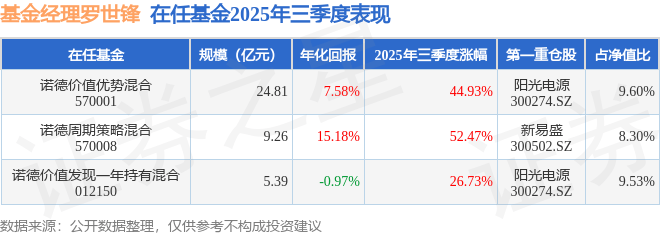
Core Insights - The best-performing fund managed by fund manager Luo Shifeng is the Nord Cycle Strategy Mixed Fund (570008), which achieved a quarterly net value increase of 52.47% by the end of Q3 2025 [1] Fund Performance Summary - The Nord Value Advantage Mixed Fund (570001) has a total fund size of 24.81 billion, with an annualized return of 7.58% and a Q3 2025 increase of 44.93%, with its top holding being Sungrow Power [2] - The Nord Cycle Strategy Mixed Fund (570008) has a fund size of 9.26 billion, an annualized return of 15.18%, and a Q3 2025 increase of 52.47%, with its top holding being NewEase [2] - The Nord Value Discovery - Annual Holding Mixed Fund (012150) has a fund size of 5.39 billion, with a negative annualized return of -0.97% and a Q3 2025 increase of 26.73%, with its top holding also being Sungrow Power [2] Stock Trading Cases - Notable stock trading cases managed by Luo Shifeng include: - Sungrow Power: Bought in Q3 2020 and sold in Q1 2021, with an estimated return of 300.71% and a company performance growth of 25.15% during the holding period [3] - Longi Green Energy: Held from Q1 2018 to Q2 2023, with an estimated return of 231.97% and a company performance growth of 488.96% [3] - Midea Group: Held from Q2 2016 to Q4 2017, with an estimated return of 136.18% and a company performance growth of 51.35% [3] Underperforming Stock Cases - Underperforming stock cases include: - Opcon Vision: Bought in Q3 2021 and sold in Q1 2024, with an estimated return of -76.32% despite a company performance growth of 40.04% [4] - Tongce Medical: Held from Q3 2021 to Q2 2023, with an estimated return of -63.37% and a company performance growth of 2.37% [4] - Sanan Optoelectronics: Held from Q4 2017 to Q2 2019, with an estimated return of -51.40% [4]






京东启动2025暖阳行动升级适老供应链 联合松下、小米等发布适老化战略新品
Sou Hu Wang· 2025-10-27 10:11
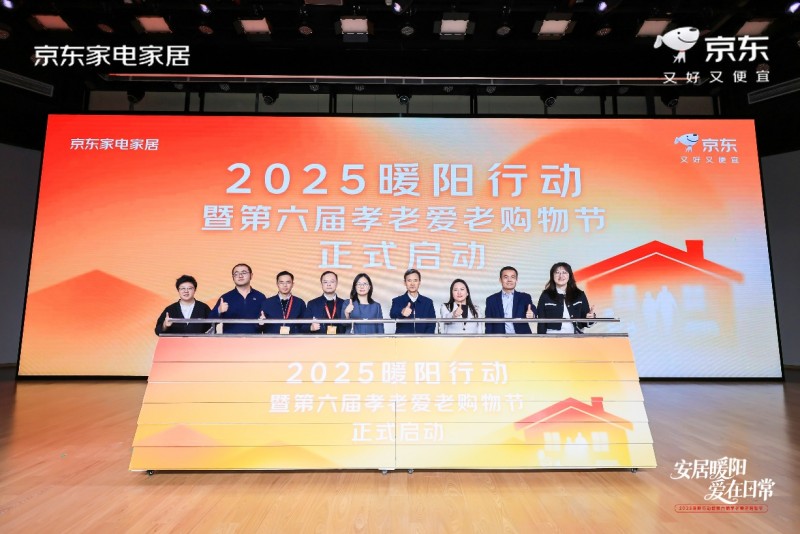
Core Insights - JD.com is launching the 6th "Filial Piety and Elderly Care Shopping Festival" to address the rapidly growing demand for elderly-friendly products and services, aiming to enhance the quality of life for seniors [1][11] Group 1: Elderly Care Initiatives - JD.com has introduced four core initiatives for elderly care, including the establishment of elderly-friendly standards, supply chain upgrades, targeted marketing for elderly users, and improved offline experience [1][3] - The company has expanded its elderly-friendly product categories to 87, covering over 3,000 brands and more than 500,000 products, with a projected supply growth of over 100% by 2025 [3][4] Group 2: Marketing and Promotions - During the shopping festival, JD.com is collaborating with major brands to distribute 100 million yuan in "Warm Sun Filial Piety Coupons," facilitating easy home upgrades for seniors [3][6] - JD.com has seen a 228% year-on-year increase in transactions for elderly-friendly products, indicating a growing consumer preference for its offerings in this category [3] Group 3: Standards and Product Development - JD.com has released the "2025 Elderly-Friendly Home Living Blue Book," outlining the real pain points and core needs of the elderly across seven life scenarios [4] - The company is working with the China Standardization Association to develop group standards for elderly products and upgrade national standards, ensuring consumer protection and government subsidy support [4][6] Group 4: Supply Chain and Cost Efficiency - JD.com leverages its supply chain advantages to reduce production costs for elderly-friendly products, aiming to provide high-quality and affordable options for senior households [6][11] - The company plans to procure over 1 million units of elderly-friendly products, with a procurement value exceeding 500 million yuan [6] Group 5: Community Engagement and Social Responsibility - JD.com is enhancing public awareness of elderly-friendly renovations through targeted marketing and offline experience zones in major cities [9] - The company has initiated the "Warm Sun Assistance for the Elderly" public welfare action in collaboration with the China Aging Development Foundation, focusing on providing material and financial support to vulnerable elderly groups [9][11]

厨卫电器板块10月27日涨0.67%,亿田智能领涨,主力资金净流出533.43万元
Zheng Xing Xing Ye Ri Bao· 2025-10-27 08:25
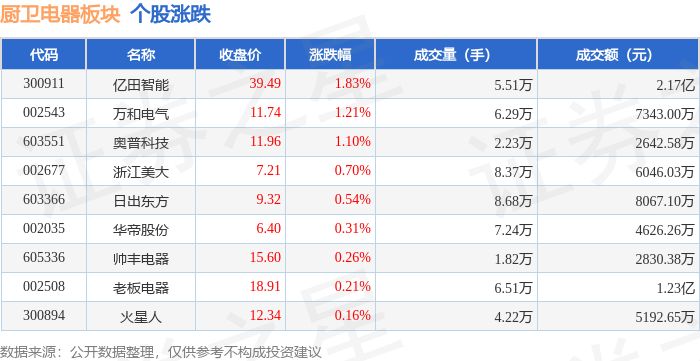
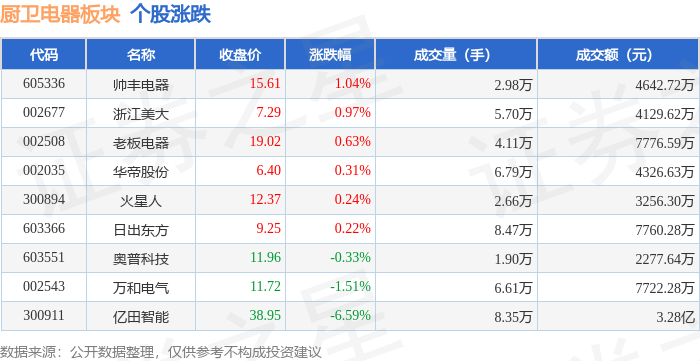
Market Overview - The kitchen and bathroom appliance sector increased by 0.67% on October 27, with Yitian Intelligent leading the gains [1] - The Shanghai Composite Index closed at 3996.94, up 1.18%, while the Shenzhen Component Index closed at 13489.4, up 1.51% [1] Stock Performance - Key stocks in the kitchen and bathroom appliance sector showed varied performance, with Yitian Intelligent (300911) closing at 39.49, up 1.83% [1] - Other notable performers included Wanhe Electric (002543) at 11.74, up 1.21%, and Aopu Technology (603551) at 11.96, up 1.10% [1] Capital Flow - The kitchen and bathroom appliance sector experienced a net outflow of 5.33 million yuan from institutional investors, while retail investors saw a net inflow of 3.66 million yuan [1] - The detailed capital flow for individual stocks indicates that Boss Electric (002508) had a net inflow of 8.47 million yuan from institutional investors, but a net outflow of 14.02 million yuan from retail investors [2]



从工厂到爆款:京东携手老板松下打造“中国超级供应链”样本
Sou Hu Cai Jing· 2025-10-27 03:21
Core Insights - The article highlights the successful collaboration between JD.com and various home appliance brands in preparation for the 11.11 shopping festival, showcasing the effectiveness of the "exclusive co-creation model" in driving sales and product innovation [2][3][6] Group 1: Sales Performance - JD.com reported that over 2,000 home appliance brands achieved a transaction growth of over 100% year-on-year from the start of 11.11 until October 20, with new product sales increasing by 84% [2] - Specific product categories saw significant growth, such as self-cleaning range hoods with over 200% growth, and zero-coating rice cookers with a growth of 188% [2] Group 2: Product Development and Innovation - The development of the Boss E1P range hood was based on deep insights into user needs, leading to a sales figure of 7 million yuan within 28 hours of its launch on JD.com [3] - Panasonic's Xtra zero-coating rice cooker was developed in response to consumer demands for health, taste, and aesthetics, utilizing innovative technology to address common issues like sticking [3][4] Group 3: Consumer-Centric Approach - The Panasonic Q6 smart toilet focuses on essential user needs by eliminating redundant features while maintaining practical functionalities, priced competitively at 1,999 yuan [4] - JD.com and brands worked closely on marketing and operational strategies to maximize sales potential, with the Q6 achieving over 2,500 units sold within 28 hours of its launch [5] Group 4: Supply Chain Efficiency - The collaboration between JD.com and brands has led to the establishment of a highly efficient and transparent "Chinese Super Supply Chain," enhancing visibility across all production stages [5][6] - The exclusive co-creation model has evolved beyond traditional supply relationships, fostering a strategic partnership that integrates technology, product development, and logistics [5] Group 5: Future Outlook - The article suggests that the co-creation model may become a mainstream approach for collaboration between brands and platforms, optimizing user experience and enhancing product value [5][6]
高端厨电,为什么卖不动了?
3 6 Ke· 2025-10-24 13:08
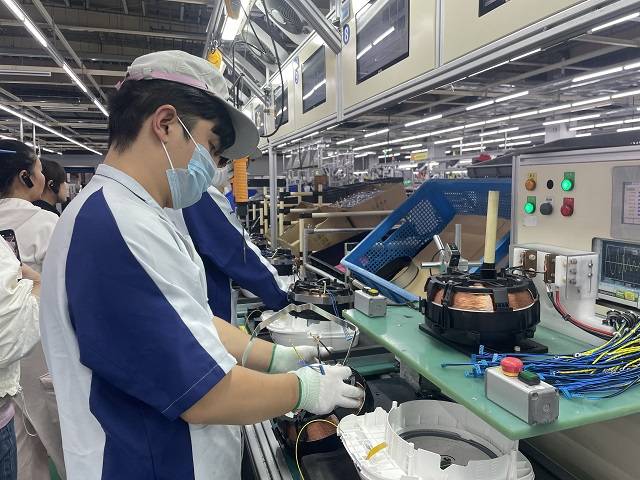
Core Insights - The high-end kitchen appliance market is witnessing a divergence between foreign brands maintaining traditional craftsmanship and domestic brands innovating to meet local demands [1][2] - The perception of foreign high-end kitchen appliances as status symbols is diminishing due to high repair costs and low adaptability to local cooking needs [1][2] - The value proposition in high-end kitchen appliances has shifted from brand premium to user experience and scene adaptability [1][8] Market Dynamics - Foreign brands face a "cost-performance crisis" as high repair costs (15%-20% of product price) contrast with domestic brands (5%-8%) [1] - The market is currently in a transitional phase, struggling with a collective "selling difficulties" due to mismatched supply and demand [2][11] - The definition of high-end kitchen appliances has evolved through three key phases: from foreign-led standards to local innovation and ecosystem integration [3][4][5][6] Phases of Development - **Phase 1 (2015-2019)**: High-end defined by product parameters, dominated by foreign brands like Gaggenau and Miele, with over 40% market share [4] - **Phase 2 (2020-2023)**: Shift to scene integration, with local brands innovating to address specific Chinese kitchen needs, leading to the rise of integrated cooking solutions [5] - **Phase 3 (2024-present)**: Focus on ecosystem experience, where brands like Xiaomi and Huawei leverage smart connectivity to redefine high-end offerings [6] Consumer Preferences - Chinese consumers prioritize technology and scene adaptability over mere brand prestige, leading to a faster product iteration cycle compared to Europe [8] - The average kitchen size in China is less than 10 square meters, necessitating integrated and space-efficient solutions [8] - There is a growing demand for products that address specific cooking habits, with consumers willing to pay for technology that solves pain points rather than for brand prestige [8] Challenges for Domestic Brands - Domestic high-end kitchen appliances face challenges due to the industry's unique characteristics, requiring a comprehensive restructuring of consumer perception, technology ecosystem, and distribution channels [9] - The high-endization process for domestic brands has evolved through three stages: from OEM to localized innovation, and now to full scene upgrades [9] - The market is divided into three factions: technology-driven, ecosystem-driven, and price-upgrade driven, each facing unique challenges in establishing high-end recognition [9][10] Future Outlook - The current high-end kitchen appliance market is characterized by a structural imbalance between homogeneous supply and personalized demand [11][12] - Companies are encouraged to shift from broad product offerings to focused, precise competition to address the fragmented consumer needs [11] - The future competition will center around ecosystem solutions rather than individual products, marking a transition from scale competition to value competition [14]
厨卫电器板块10月24日跌0.66%,浙江美大领跌,主力资金净流出1741.41万元
Zheng Xing Xing Ye Ri Bao· 2025-10-24 08:21
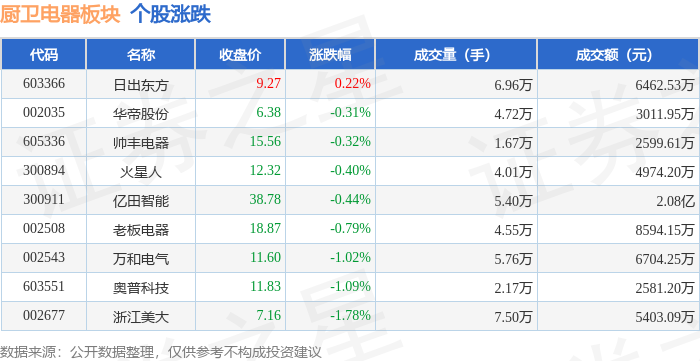
Core Insights - The kitchen and bathroom appliance sector experienced a decline of 0.66% on October 24, with Zhejiang Meida leading the drop [1] - The Shanghai Composite Index closed at 3950.31, up 0.71%, while the Shenzhen Component Index closed at 13289.18, up 2.02% [1] Sector Performance - The following companies in the kitchen and bathroom appliance sector showed varied performance: - Sunrise Oriental (603366) closed at 9.27, up 0.22% with a trading volume of 69,600 shares and a turnover of 64.63 million yuan - Baosheng Co. (002035) closed at 6.38, down 0.31% with a trading volume of 47,200 shares and a turnover of 30.12 million yuan - Shifeng Electric (605336) closed at 15.56, down 0.32% with a trading volume of 16,700 shares and a turnover of 25.60 million yuan - Mars Man (300894) closed at 12.32, down 0.40% with a trading volume of 40,100 shares and a turnover of 49.74 million yuan - Yitian Intelligent (300911) closed at 38.78, down 0.44% with a trading volume of 54,000 shares and a turnover of 208 million yuan - Boss Electric (002508) closed at 18.87, down 0.79% with a trading volume of 45,500 shares and a turnover of 85.94 million yuan - Wanhe Electric (002543) closed at 11.60, down 1.02% with a trading volume of 57,600 shares and a turnover of 67.04 million yuan - Aopu Technology (603551) closed at 11.83, down 1.09% with a trading volume of 21,700 shares and a turnover of 25.81 million yuan - Zhejiang Meida (002677) closed at 7.16, down 1.78% with a trading volume of 75,000 shares and a turnover of 54.03 million yuan [1] Capital Flow - The kitchen and bathroom appliance sector saw a net outflow of 17.41 million yuan from institutional investors, while retail investors contributed a net inflow of 13.38 million yuan [1] - The following capital flows were noted for specific companies: - Boss Electric (002508) had a net inflow of 7.70 million yuan from institutional investors, but a net outflow of 11.83 million yuan from retail investors - Wanhe Electric (002543) saw a net inflow of 6.38 million yuan from institutional investors, with a net outflow of 6.28 million yuan from retail investors - Shifeng Electric (605336) had a net inflow of 1.76 million yuan from institutional investors, but a net outflow of 3.05 million yuan from retail investors - Mars Man (300894) experienced a net outflow of 1.13 million yuan from institutional investors, while retail investors contributed a net inflow of 0.44 million yuan - Aopu Technology (603551) had a net outflow of 1.80 million yuan from institutional investors, but a net inflow of 0.44 million yuan from retail investors - Baosheng Co. (002035) saw a net outflow of 1.88 million yuan from institutional investors, with a net inflow of 0.35 million yuan from retail investors - Zhejiang Meida (002677) experienced a net outflow of 4.95 million yuan from institutional investors, while retail investors contributed a net inflow of 0.30 million yuan - Yitian Intelligent (300911) had a significant net outflow of 21.58 million yuan from institutional investors, with a net outflow of 18.38 million yuan from retail investors [2]

老板电器10月23日获融资买入276.08万元,融资余额2.08亿元
Xin Lang Cai Jing· 2025-10-24 01:45
Core Viewpoint - The performance of Boss Electric Appliances shows a mixed trend in financing activities and stock performance, with a notable decrease in net buying and a high level of margin trading [1][2]. Financing Activities - On October 23, Boss Electric had a financing buy amount of 2.76 million yuan, with a net financing buy of -4.69 million yuan, indicating more repayments than new purchases [1]. - The total margin trading balance for Boss Electric as of October 23 is 212 million yuan, with the financing balance at 208 million yuan, accounting for 1.16% of the circulating market value [1]. - The margin trading activities are at a high level, with the financing balance exceeding the 50th percentile of the past year [1]. Stock Performance - On October 23, Boss Electric's stock price increased by 0.63%, with a trading volume of 77.77 million yuan [1]. - The stock's margin selling activity included a repayment of 34,100 shares and a sale of 2,900 shares, with a selling amount of 55,200 yuan [1]. - The margin balance for short selling is 3.43 million yuan, which is above the 80th percentile of the past year, indicating a high level of short selling activity [1]. Company Overview - Boss Electric, established on November 7, 2000, specializes in kitchen appliances, with major products including range hoods (47.86% of revenue), gas stoves (25.10%), and dishwashers (7.33%) [2]. - As of June 30, 2025, the company reported a revenue of 4.608 billion yuan, a year-on-year decrease of 2.58%, and a net profit of 712 million yuan, down 6.28% year-on-year [2]. Shareholder Information - The total number of shareholders for Boss Electric as of June 30, 2025, is 61,600, an increase of 45.19% from the previous period [3]. - The average circulating shares per person decreased by 31.12% to 15,149 shares [3]. - The second-largest circulating shareholder is Hong Kong Central Clearing Limited, holding 90.89 million shares, a decrease of 27.10 million shares from the previous period [3].
厨卫电器板块10月23日跌0.64%,亿田智能领跌,主力资金净流出5363.4万元
Zheng Xing Xing Ye Ri Bao· 2025-10-23 08:20
| 代码 | 名称 | 主力净流入(元) | 主力净占比 游资净流入 (元) | | 游资净占比 散户净流入 (元) | | 散户净占比 | | --- | --- | --- | --- | --- | --- | --- | --- | | 002508 老板电器 | | 862.31万 | 11.09% | -427.90万 | -5.50% | -434.41万 | -5.59% | | 002543 万和电气 | | 270.81万 | 3.51% | 392.35万 | 5.08% | -663.15万 | -8.59% | | 002677 浙江美大 | | -110.21万 | -2.67% | 9.39万 | 4 0.23% | 100.82万 | 2.44% | | 603551 奥普科技 | | -114.30万 | -5.02% | -26.61万 | -1.17% | 140.91万 | 6.19% | | 605336 帅丰电器 | | -160.12万 | -3.45% | 123.21万 | 2.65% | 36.91万 | 0.80% | | 300894 | 火星人 | - ...
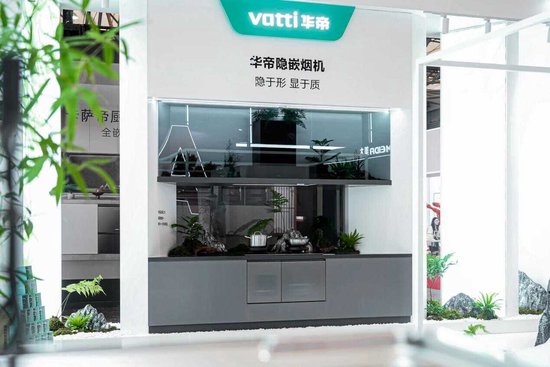
厨房“头等大事”解决了!华帝全隐烟机告别“碰头”与“压抑”
Xin Lang Zheng Quan· 2025-10-22 08:43
Core Insights - The kitchen is evolving into a significant space for lifestyle and social interaction, with embedded kitchen appliances seeing a sales increase of over 120% in certain regions during the recent holiday period [1] - The market for embedded kitchen appliances is growing, with their share in bundled orders rising from 28% in 2024 to 35% in 2025 [1] Group 1: Industry Trends - The trend of "everything can be embedded" is gaining momentum, reflecting a shift in consumer preferences towards aesthetic integration in home design [1] - The emergence of hidden range hoods is transforming kitchen experiences, with brands like Vatti leading the charge in promoting a new aesthetic for embedded kitchens [1][4] Group 2: Consumer Pain Points - Traditional range hoods are increasingly seen as problematic, particularly in small kitchens where they occupy valuable overhead space, leading to a cramped cooking environment [3] - 80% of Chinese households have kitchens smaller than 6 square meters, and 78% of users report that traditional range hoods create a sense of spatial oppression [3] Group 3: Product Innovation - Vatti's "full hidden zero embedded" range hood addresses these pain points with a design that seamlessly integrates into cabinetry, enhancing the overall aesthetic of the kitchen [4][6] - The range hood features a powerful suction capacity of 35m³/min, effectively managing smoke and odors even during high-heat cooking [6] Group 4: Health and Maintenance Features - The new oxygen function in Vatti's range hood improves air quality by monitoring PM2.5 levels and activating purification when necessary [8] - Vatti's fifth-generation surf washing technology allows for deep cleaning of the range hood, addressing common maintenance issues and extending the product's lifespan [8] Group 5: Market Positioning - Vatti's commitment to a "clean kitchen" and "new Chinese stylish health" philosophy aligns with the evolving consumer focus on quality, aesthetics, and health in kitchen appliances [8] - The brand's innovative approach and dedication to quality are crucial in a competitive market landscape [8]
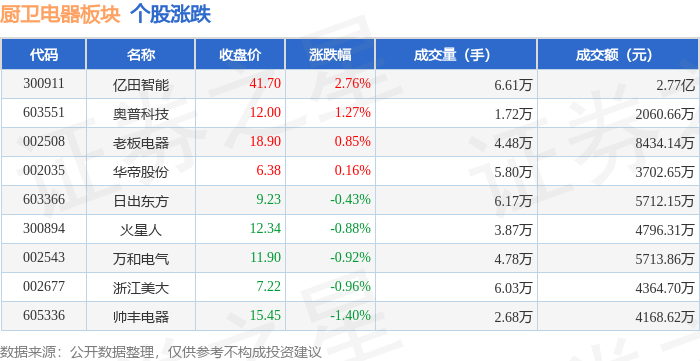
厨卫电器板块10月22日涨0.32%,亿田智能领涨,主力资金净流出48.33万元
Zheng Xing Xing Ye Ri Bao· 2025-10-22 08:19
Core Viewpoint - The kitchen and bathroom appliance sector experienced a slight increase of 0.32% on October 22, with Yitian Intelligent leading the gains, while the overall market indices showed a decline [1]. Market Performance - The Shanghai Composite Index closed at 3913.76, down 0.07% - The Shenzhen Component Index closed at 12996.61, down 0.62% [1]. Individual Stock Performance - Yitian Intelligent (300911) closed at 41.70, up 2.76% with a trading volume of 66,100 shares and a transaction value of 277 million yuan - Aopu Technology (603551) closed at 12.00, up 1.27% with a trading volume of 17,200 shares and a transaction value of 20.61 million yuan - Boss Electric (002508) closed at 18.90, up 0.85% with a trading volume of 44,800 shares and a transaction value of 84.34 million yuan - Other stocks such as Vatti (002035) and Sunrise Oriental (603366) showed minor fluctuations, while Mars Man (300894) and Zhejiang Meida (002677) experienced declines [1]. Capital Flow Analysis - The kitchen and bathroom appliance sector saw a net outflow of 483,300 yuan from institutional investors and a net outflow of 30.50 million yuan from speculative funds, while retail investors had a net inflow of 30.99 million yuan [1]. - Specific stock capital flows indicated that Boss Electric had a net inflow of 10.24 million yuan from institutional investors, while Yitian Intelligent experienced a net outflow of 12.34 million yuan from speculative funds [2].