乐聚机器人

Search documents
美顶级投行改了,“最新情况表明,中国还要翻一番”
Xin Lang Cai Jing· 2026-01-30 22:15
Core Insights - Morgan Stanley has raised its forecast for China's humanoid robot sales in 2026, expecting a 133% increase this year to 28,000 units, doubling the previous estimate of 14,000 units [1] - The humanoid robot market in China is projected to grow exponentially, from approximately 12,000 units in 2024 to 262,000 units by 2030, and reaching 2.6 million units by 2035 [1] Industry Growth and Cost Reduction - The production costs for robots are expected to decline, lowering the purchase threshold; raw material costs for robot production in China are anticipated to decrease by 16% this year [3] - By 2035, global component prices are expected to drop by about 70%, leading to significant price reductions for humanoid robots [3] - Prices for humanoid robots in middle and low-income countries, including China, are projected to fall from $50,000 in 2024 to approximately $21,000 by 2050 [3] Market Penetration and Application - By 2036, the number of humanoid robots in use globally is expected to reach 25.4 million, accounting for 2% of the overall robot market, with this share increasing to 13% by 2040 and 42% by 2044 [3] - By 2050, the global deployment of humanoid robots may exceed 1 billion units, with over half of these applications in middle and high-income countries [3] China's Dominance in Humanoid Robotics - China is currently the largest market for humanoid robot applications, with over 80% of the global deployment expected by 2025 [3] - The domestic humanoid robot industry has begun extensive market promotion, with several manufacturers partnering with the CCTV Spring Festival Gala to showcase their products [4][5] Investment and Industry Trends - The increasing presence of robot manufacturers at the Spring Festival Gala reflects three major industry trends: focus on consumer-level applications, reaching the C-end market, and transitioning from experimental technology to commercial deployment [7] - A report by IDC indicates that the humanoid robot market will experience explosive growth in 2025, with an estimated shipment of 18,000 units and sales of approximately $440 million, marking a year-on-year increase of about 508% [7] Government Support and Competitive Landscape - Since 2015, the Chinese government has prioritized robotics as a key industry, leading to rapid development and the establishment of over 150 humanoid robot companies [8] - The government has implemented policies to support the robotics industry, aiming for China to achieve international leadership in robotics by 2035 [8] - Elon Musk has acknowledged that China's humanoid robot sector poses the most significant competition for Tesla, highlighting China's manufacturing capabilities and advancements in AI technology [9]


摩根士丹利上调数据,“中国机器人销量还要翻一番”
Xin Lang Cai Jing· 2026-01-30 17:26
Core Insights - Morgan Stanley has raised its forecast for China's humanoid robot sales in 2026, expecting a 133% increase this year to 28,000 units, doubling the previous estimate of 14,000 units [1] - The humanoid robot sales in China are projected to grow exponentially, from approximately 12,000 units in 2024 to 262,000 units by 2030, and reaching 2.6 million units by 2035 [1] Group 1: Market Growth and Projections - The production cost of robots is expected to decline, lowering the purchase threshold for humanoid robots, with raw material costs in China projected to decrease by 16% this year [3] - By 2035, global prices for related components are expected to drop by about 70%, leading to significant price reductions for humanoid robots [3] - The average price of humanoid robots in middle and low-income countries, including China, is expected to fall from $50,000 in 2024 to approximately $21,000 by 2050 [3] - In developed countries like the U.S., the average price is projected to decrease from $200,000 to $75,000 in the same timeframe [3] - By 2036, the number of humanoid robots in use globally is expected to reach 25.4 million, accounting for 2% of the overall robot market, with this share increasing to 13% by 2040 and 42% by 2044 [3] Group 2: Industry Trends and Developments - The humanoid robot industry in China is entering a phase of market promotion, with several manufacturers collaborating with the CCTV Spring Festival Gala to showcase their products [4][5] - The participation of multiple robot manufacturers in the Spring Festival Gala reflects three key industry trends: focus on consumer-level applications, reaching the C-end market, and transitioning from experimental technology to commercial deployment [7] - A report by IDC indicates that the humanoid robot market will experience explosive growth in 2025, with an estimated shipment of 18,000 units and sales revenue of approximately $440 million, marking a year-on-year increase of about 508% [7] - Chinese manufacturers are leading the market, with companies like Zhiyuan Robotics and Yushutech being significant players in terms of shipment volume [7] Group 3: Competitive Landscape - Since 2015, when China prioritized robotics as one of its top ten key industries, the sector has seen rapid development, with over 150 humanoid robot companies currently operating [8] - Government support has been crucial, with policies aimed at enhancing R&D and promoting the integration of robots into economic and social frameworks [8] - China possesses unique advantages in manufacturing application scenarios and data collection capabilities, which are critical for the development of embodied intelligence [9] - Elon Musk has acknowledged that China's humanoid robot sector represents the most formidable competition for Tesla, highlighting China's strengths in large-scale manufacturing and AI technology [9]

仙工智能董事长赵越入选“2025年度机器人行业十大杰出人物”
Sou Hu Cai Jing· 2026-01-28 06:19
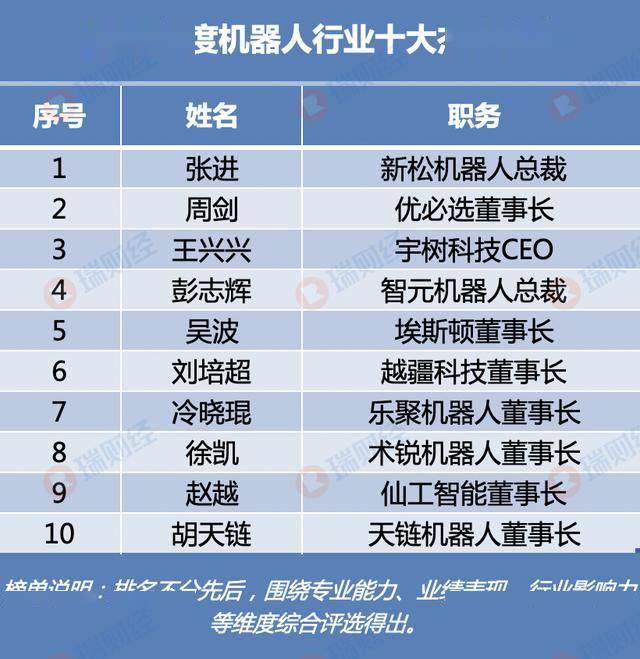
"2025年度机器人行业十大杰出人物"榜单围绕专业能力、业绩表现、行业影响力等维度综合评选得出。 赵越,36岁,于2020年4月及2020年9月分别获委任为仙工智能董事及董事长,2025年5月调任为执行董 事。其自2020年6月起担任公司首席执行官,亦于集团若干附属公司担任多个职位,负责集团整体战略 规划及重大业务与运营决策。赵越在机器人及智能技术领域拥有丰富经验。2015年4月至2015年12月, 其担任福物(上海)机器人科技有限公司总经理。其后于2016年1月至2020年5月,其担任上海仙知机器人 科技有限公司董事长兼总经理。赵越分别于2011年7月及2015年3月在中国获得浙江大学电子信息工程学 士学位及 控制科学与工程硕士学位。 2025年,赵越带领仙工智能实现AI技术与机器人深度融合,强化机器人自主运行能力,在多行业应用 中展现技术领先优势。 瑞财经1月28日,由瑞财经推出的"2025年度机器人行业十大杰出人物"榜单揭晓,仙工智能董事长赵越 入选。 | 序号 | 姓名 | 职务 | | --- | --- | --- | | T | 张讲 | 新松机器人总裁 | | 2 | 周剑 | 优必选董事长 ...
术锐机器人董事长徐凯入选“2025年度机器人行业十大杰出人物”
Sou Hu Cai Jing· 2026-01-28 06:19
| 序号 | 姓名 | 职务 | | --- | --- | --- | | T | 张讲 | 新松机器人总裁 | | 2 | 周剑 | 优必选董事长 | | 3 | 无法E | 宇树科技CEO | | 4 | 彭志辉 | 智元机器人总裁 | | 5 | 吴波 | 埃斯顿董事长 | | 6 | 刘培超 | 越疆科技董事长 | | 7 | 冷晓琨 | 乐聚机器人董事长 | | 8 32 | 徐凯 | 术锐机器人董事长 | | 9 | 走X走成 | 仙工智能董事长 | | 10 | 胡天链 | 天链机器人董事长 | 徐凯为美国哥伦比亚大学博士,师从"医疗机器人之父"Russell Taylor教授。在读博期间,他曾参与研制 全球首台单孔腹腔镜手术机器人。归国后,徐凯任职于上海交通大学机械与动力工程学院,带领团队开 发出"可变形对偶连续体机构"等原创结构设计。2014年,其创立术锐机器人。 2025年,徐凯带领术锐机器人在单孔手术领域实现了重大突破,完成1亿美元D轮融资。 瑞财经1月28日,由瑞财经推出的"2025年度机器人行业十大杰出人物"榜单揭晓,术锐机器人董事长徐 凯入选。 "2025年度机器人行业十大杰出人 ...
宇树科技CEO王兴兴入选“2025年度机器人行业十大杰出人物”
Sou Hu Cai Jing· 2026-01-28 06:19
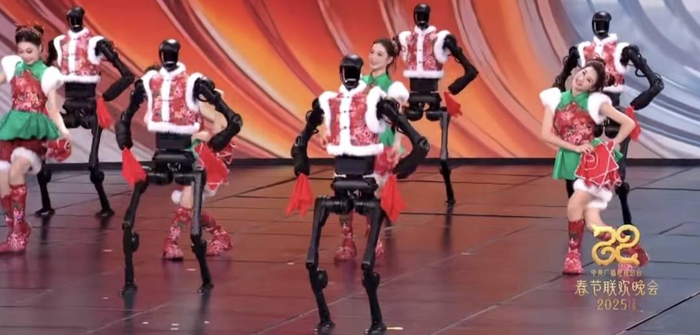
王兴兴,1990年出生于浙江宁波余姚,机械工程硕士,Unitree Robotics(宇树科技)创始人、CEO、 CTO。王兴兴本科就读于浙江理工大学机械与自动控制学院机电专业,毕业后进入上海大学攻读机械工 程专业研究生。2015年在读研二时带着他的XDog参加国际智能"星创师"大赛获得二等奖;2016年6月毕 业后入职大疆(DJI);8月从大疆离职,在获得天使轮融资后,创立了宇树科技。 2025年,王兴兴带领宇树科技人形机器人成功实现规模化量产并登上春晚舞台,这一年,宇树人形机器 人实际出货量超5500台。 瑞财经1月28日,由瑞财经推出的"2025年度机器人行业十大杰出人物"榜单揭晓,宇树科技CEO王兴兴 入选。 "2025年度机器人行业十大杰出人物"榜单围绕专业能力、业绩表现、行业影响力等维度综合评选得出。 | 序号 | 姓名 | 职务 | | --- | --- | --- | | T | 张进 | 新松机器人总裁 | | 2 | 周剑 | 优必选董事长 | | 3 | 无兴兴 | 宇树科技CEO | | 4 20 | 彭志辉 | 智元机器人总裁 | | 5 | 吴波 | 埃斯顿董事长 | | 6 | ...
天链机器人董事长胡天链入选“2025年度机器人行业十大杰出人物”
Sou Hu Cai Jing· 2026-01-28 06:19
瑞财经1月28日,由瑞财经推出的"2025年度机器人行业十大杰出人物"榜单揭晓,天链机器人董事长胡 天链入选。 "2025年度机器人行业十大杰出人物"榜单围绕专业能力、业绩表现、行业影响力等维度综合评选得出。 胡天链,男,1981年9月生,无境外永久居留权,毕业于西南科技大学模式识别与智能系统专业,研究 生学历。2004年获得全国大学生机器人大赛冠军,代表国家参赛获得国际亚军及最佳技术奖。2004年9 月至2015年3月担任西南科技大学高级教师;2012年7月至2015年8月担任绵阳福德机器人有限责任公司 执行董事、总经理;2015年9月至2024年9月担任四川天链机器人股份有限公司董事长、总经理;2024年 9月至今担任四川天链机器人股份有限公司董事长、总经理、董事会秘书。 2025年,胡天链带领天链机器人实现从核心部件到整机的全栈技术突破,以及面向家庭和工业场景的商 业化产品布局。 | 序号 | 姓名 | 职务 | | --- | --- | --- | | T | 张进 | 新松机器人总裁 | | 2 | 雷剑 | 优必选董事长 | | 3 | 无兴兴 | 宇树科技CEO | | 4 | 彭志辉 | 智 ...
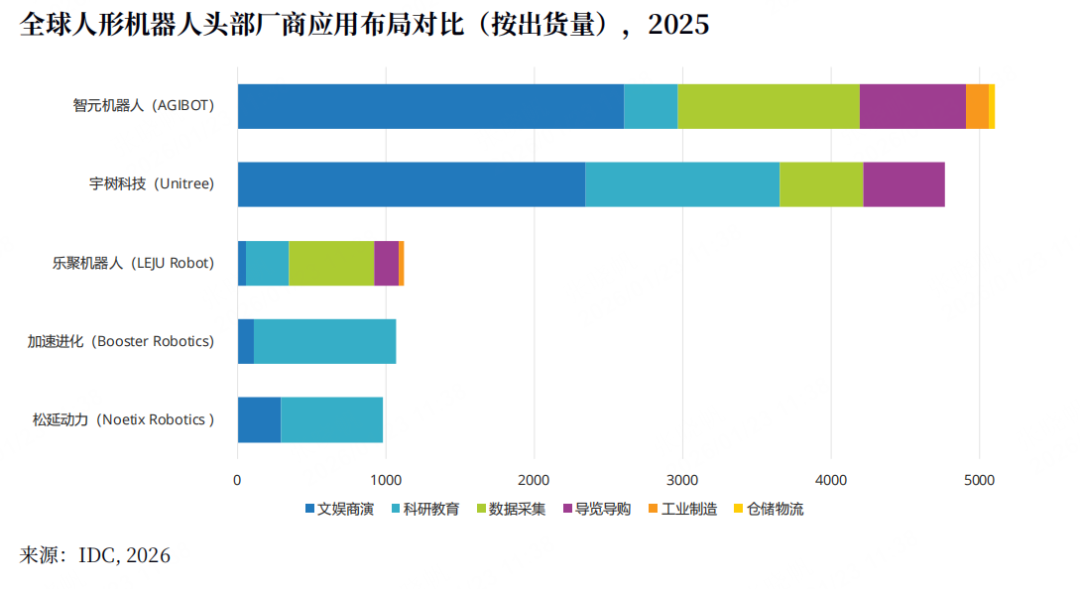
IDC报告:人形机器人已在六大场景规模商用,中国厂商引领行业
Guan Cha Zhe Wang· 2026-01-26 02:39
相关报告指出,人形机器人(Humanoid robot)是指在外观上模仿人类(具备躯干、头部和双臂等关键结 构),并在功能上具备类人的感知、学习、决策与执行能力的机器人系统。人形机器人是具身智能通用 机器人的高阶形态,代表了机器人技术在形态通用性、任务泛化能力以及人机协同水平上的最高追求。 从行业方向上看,当前的人形机器人正由实验室验证向工程化落地过渡。本体、小脑(运动控制)、大脑 (认知与决策)协同发展,上肢系统的精细灵活性是核心突破点,下肢系统在通用能力与工程效率间寻求 平衡。模块化、轻量化设计提升系统稳定性与可部署性。大小脑融合的端到端具身智能大模型,实现多 模态感知、任务理解与动作执行闭环,推动复杂场景自主作业与人机协同。 从应用来看,文娱商演、教育科研、数据采集和导览导购是2025年主要落地场景;商业模式正由一次性 硬件销售向RaaS、运维服务和平台化生态演进,实现"产品+服务+生态"并行发展。 IDC预测,从全球市场来看,人形机器人产业正经历由"广泛参与"向"头部集中、梯队分化"的加速演 进。随着技术成熟度提升及应用场景快速落地,全球人形机器人市场正进入多场景商业化的加速阶段, 头部厂商与中小厂商 ...

从生产线到产业链,从“制造”到“智造” 广东“AI+制造”炼成万亿元级新基座
Xin Lang Cai Jing· 2026-01-26 00:26
Core Insights - The integration of artificial intelligence (AI) into manufacturing is reshaping the competitive landscape in Guangdong, marking a significant shift towards becoming a manufacturing powerhouse [1][8] - The Guangdong provincial government is actively aligning its policies with the national "AI+" action plan, emphasizing the importance of AI in enhancing manufacturing capabilities [1][2] Policy Framework - Guangdong is transitioning from merely providing policies to creating opportunities, establishing a collaborative system that aligns national strategies with provincial deployments and local implementations [2] - The effectiveness of policies is reflected in the rapid transformation of AI initiatives into industrial momentum, supported by a closed-loop system of top-level design, mid-level refinement, and grassroots execution [2] Manufacturing Ecosystem - Guangdong boasts the most comprehensive manufacturing ecosystem in China, with over 3,700 AI and robotics companies, including more than 2,000 core AI enterprises [3] - The province's industrial landscape serves as an ideal testing ground for AI applications, providing diverse and real-world scenarios for validation [3][6] Future Directions - The focus for the next 2-3 years will be on integrating large models with robotics, with the belief that success in real-world applications will define the next generation of products [4] - The shift from "functioning" to "thinking" in AI-driven manufacturing is crucial, emphasizing a problem-oriented approach that prioritizes practical value [5] Collaborative Innovation - The integration of academia, industry, and application is creating a positive feedback loop in Guangdong's industrial parks, significantly shortening the technology transfer cycle [6] - Successful case studies in areas like industrial visual recognition and smart welding equipment highlight the tangible benefits of AI in addressing production challenges [6] Competitive Landscape - Future competition will hinge not only on technology but also on ecosystem and standards, necessitating a leap in three dimensions: opening high-value scenarios, enhancing core technology autonomy, and expanding global influence [7] - Guangdong's development logic for "AI+ manufacturing" is clear: leveraging manufacturing strength with intelligent applications and innovative practices [7]
人形机器人成本相差近3倍,国内的供应链正在吊打海外
具身智能之心· 2026-01-25 03:00
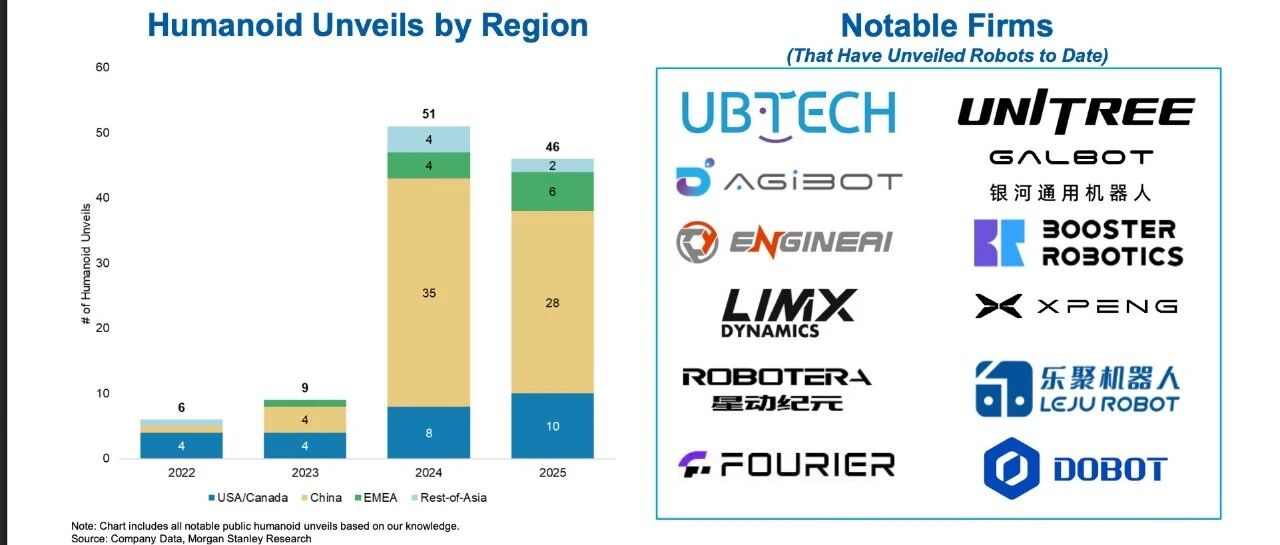
Group 1 - The core viewpoint is that China's supply chain has a significant cost advantage in the humanoid robot sector, with material costs for a single robot projected at $46,000 in 2025, compared to $131,000 if sourced from non-Chinese supply chains, resulting in a nearly threefold difference [2] - Morgan Stanley predicts that by 2034, as global annual sales exceed one million units, the cost of humanoid robots using the Chinese supply chain will further decrease to $16,000, enhancing the cost-performance advantage [2] - A breakdown of core component costs reveals substantial differences, with actuators costing $22,000 in the Chinese supply chain versus $58,000 elsewhere, highlighting the competitive edge in key components [3] Group 2 - China has emerged as a dominant force in the global humanoid robot market, with Chinese companies accounting for a significant share of new robot releases [5] - In 2024, 51 types of humanoid robots were released globally, with 35 originating from Chinese companies; in 2025, 46 robots were released, with 28 from China [9] - Notable Chinese companies in the humanoid robot sector include UBTECH, Yushutech, Galaxy General Robotics, Xiaopeng Robotics, and Leju Robotics, which are leading in technology implementation and supply chain integration [8]
IDC报告:智元人形机器人整体和全尺寸出货量全球第一
Zhong Guo Zheng Quan Bao· 2026-01-23 12:21
1月23日,知名市场研究机构IDC发布的《全球人形机器人市场分析》报告提到,2025年人形机器人市场迎来爆发式增长,中国厂商整体在引领行业的规 模化商用进程。 其中,智元(AGIBOT)一举斩获 "五大主流场景出货量第一""全球整体出货量第一"与"全尺寸细分领域出货量第一"三重桂冠,以显著优势引领产业规模 化商用。 报告提到,目前,人形机器人市场的应用场景呈现出多元化发展的趋势,需求主要来自文娱商演、科研教育、数据采集、导览导购、工业智造与仓储物流 六大场景,其中智元在五个场景出货量均位列第一。 IDC表示,智元不仅有多元的应用场景布局,既注重交互展示,也兼顾服务型应用;同时引入机器人租赁RaaS(Robot-as-a-Service)创新模式,降低用户 使用门槛,加快人形机器人在多场景中落地普及,推动商业模式由单一硬件交付向"产品+平台+服务"演进。 全球出货量荣登榜首 规模化交付实力凸显 根据IDC数据,2025年,全球人形机器人出货量约1.8万台,同比增长约508%,中国厂商占主导,智元以5200台的出货量稳居全球榜首,市场份额显著领 先。这一数据标志着智元不仅完成了从技术研发到产品量产的关键跨越,更在 ...