
LinkedIn

Search documents
Microsoft (NASDAQ:MSFT) Price Target and Strategic Moves
Financial Modeling Prep· 2026-01-22 02:10
Group 1 - Microsoft has a current stock price of $444.11, reflecting a decrease of 2.29% or $10.41, with a market capitalization of approximately $3.3 trillion [4] - The stock has fluctuated between a low of $438.69 and a high of $452.69 during the trading day, and over the past year, it reached a high of $555.45 and a low of $344.79 [4] - Alex Haissl from Redburn Partners has set a price target of $450 for Microsoft, indicating a slight potential increase from its current trading price [5] Group 2 - Microsoft is integrating LinkedIn data into its Copilot and Work IQ tools to enhance productivity and hiring processes [5] - LinkedIn's transformation is expected to drive its fiscal 2026 revenues to approximately $19.57 billion, marking a 9.9% year-over-year growth [2][5] - LinkedIn's professional network exceeds 1.2 billion members, providing Microsoft with a unique dataset that offers a competitive edge [3]



刚刚,马斯克开源基于 Grok 的 X 推荐算法:Transformer 接管亿级排序
Sou Hu Cai Jing· 2026-01-20 20:23
Core Viewpoint - Elon Musk's company has open-sourced the X recommendation algorithm, which supports the "For You" feed by combining in-network and out-of-network content using a Grok-based Transformer model [1][9][12]. Group 1: Algorithm Functionality - The recommendation algorithm generates content for users' main interface from two primary sources: content from accounts they follow (In-Network) and other posts discovered on the platform (Out-of-Network) [3][4]. - The algorithm filters out low-quality, duplicate, or inappropriate content to ensure that only valuable candidates are processed for ranking [4][6]. - The core of the algorithm is a Grok-based Transformer model that scores each candidate post based on user behavior such as likes, replies, and shares, predicting the probability of various interactions [4][20]. Group 2: Historical Context - This is not the first time Musk has open-sourced the X recommendation algorithm; a previous release occurred on March 31, 2023, which included parts of the Twitter source code [9][11]. - Musk's commitment to transparency in the algorithm is seen as a response to criticism regarding the platform's content distribution mechanisms, which have been accused of bias [12][18]. Group 3: User Reactions - Users on the X platform have summarized key points about the recommendation algorithm, noting that engagement metrics like replies significantly impact visibility, while links in posts can reduce exposure [14][15]. - Some users have observed that while the architecture is open-sourced, certain elements remain undisclosed, indicating that the release is more of a framework than a complete engine [17]. Group 4: Importance of Recommendation Systems - Recommendation systems are crucial to the business models of major tech companies, with significant percentages of user engagement driven by these algorithms: Amazon (35%), Netflix (80%), and YouTube (70%) [18]. - The complexity of traditional recommendation systems has led to a desire for a unified model that can handle multiple tasks, a goal that large language models (LLMs) may help achieve [21][22]. Group 5: Technical Insights - The open-sourced algorithm lacks specific weight parameters and internal model parameters, which limits understanding of its decision-making processes [20]. - The introduction of LLMs into recommendation systems allows for a more abstract approach to feature engineering, enabling the model to understand and process user preferences without explicit instructions [22][23].
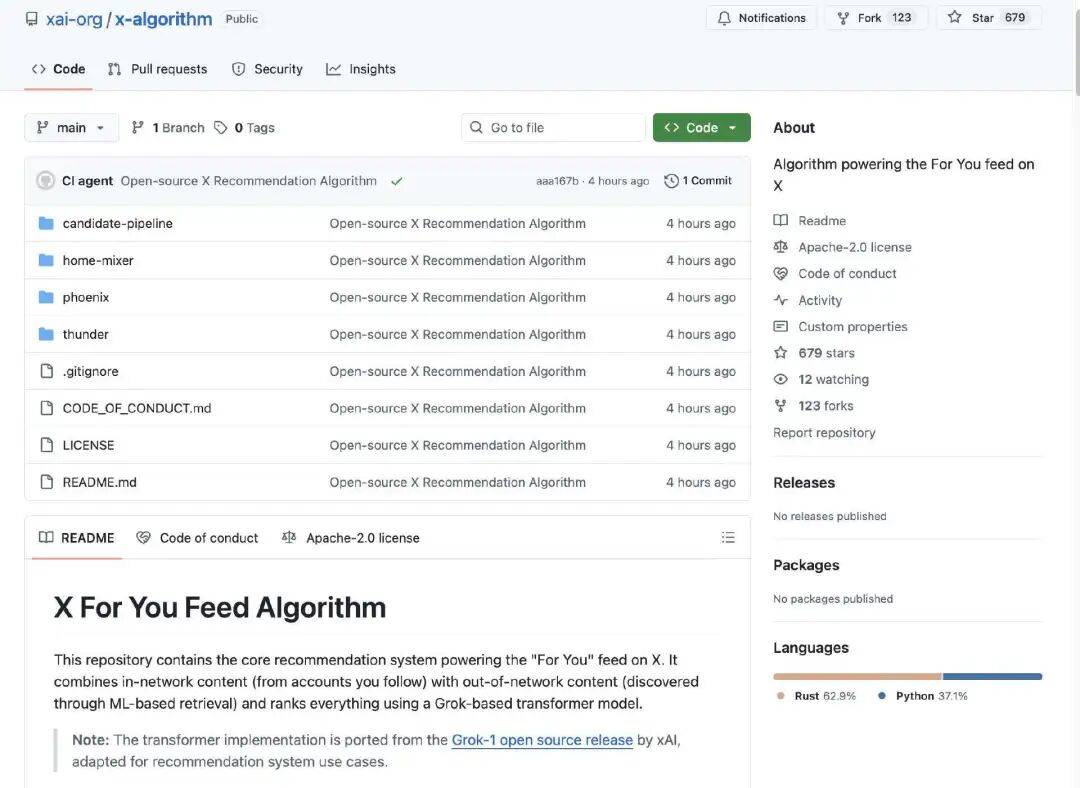
刚刚,马斯克开源基于 Grok 的 X 推荐算法!专家:ROI 过低,其它平台不一定跟
AI前线· 2026-01-20 09:36
Core Viewpoint - Elon Musk has open-sourced the X recommendation algorithm, which combines in-network content from followed accounts and out-of-network content discovered through machine learning, using a Grok-based Transformer model for ranking [3][12][18]. Summary by Sections Algorithm Overview - The open-sourced algorithm supports the "For You" feed on X, integrating content from both followed accounts and broader network sources, ranked by a Grok-based Transformer model [3][5]. - The algorithm fetches candidate posts from two main sources: in-network content (from accounts users follow) and out-of-network content (discovered through machine learning) [9][10]. Algorithm Functionality - The system filters out low-quality, duplicate, or inappropriate content to ensure only valuable candidates are processed [7]. - A Grok-based Transformer model scores each candidate post based on user interactions (likes, replies, shares, clicks), predicting the probability of various user actions [7][8]. Historical Context - This is not the first time Musk has open-sourced the X recommendation algorithm; a previous release occurred on March 31, 2023, which garnered over 10,000 stars on GitHub [12][14]. - Musk aims to enhance transparency in the algorithm to address criticisms regarding bias in content distribution on the platform [18][19]. User Reactions - Users on the X platform have summarized key insights about the recommendation algorithm, emphasizing the importance of engagement metrics like replies and watch time for content visibility [22][23]. Importance of Recommendation Systems - Recommendation systems are crucial to the business models of major tech companies, with significant percentages of user engagement driven by these algorithms (e.g., 35% for Amazon, 80% for Netflix) [25][27]. - The complexity of traditional recommendation systems often leads to high maintenance costs and challenges in cross-task collaboration [28]. Future Implications - The introduction of large language models (LLMs) presents new opportunities for recommendation systems, potentially simplifying engineering and enhancing cross-task learning [29][30]. - The open-sourcing of the X algorithm may not lead to immediate changes across other platforms, as they may lack the resources to implement similar systems [39].

想成为下一个 Manus,先把这些出海合规问题处理好
Founder Park· 2025-12-31 10:11
Core Insights - Meta's acquisition of Manus highlights the rapid growth and potential of AI companies in the global market, showcasing a successful transition from product launch to acquisition in under a year [1] - The relocation of Manus to Singapore is a strategic move for compliance and market integration, serving as a model for other AI startups aiming for international expansion [2] Group 1: Compliance and Regulatory Challenges - Key compliance issues for AI companies expanding internationally include data, regulation, storage, and organizational structure, which must be prioritized alongside product growth [3] - A recent workshop with experienced lawyers addressed typical compliance challenges such as cross-border data transfer and user data training [4] - The "sandwich structure" commonly used by companies poses significant risks, as it involves processing overseas user data in China, leading to potential compliance issues regarding data sovereignty [12][13] Group 2: Market Entry Strategies - There are two primary models for international expansion: capital-driven, focusing on high valuations and overseas listings, and business-driven, aiming for revenue generation in foreign markets [7][9] - Business-driven companies must proactively address compliance issues, as rapid user growth can lead to significant risks if data architecture and team relocation are not planned in advance [9] Group 3: Regional Regulatory Differences - The regulatory landscape varies significantly across the U.S., EU, and China, with each region having distinct compliance requirements [14] - The U.S. emphasizes market entry risks, where minor violations can lead to extensive penalties and litigation [15] - The EU's GDPR sets strict data protection standards, requiring explicit user consent for data usage and imposing heavy fines for non-compliance [18][19] - China's regulatory framework focuses on data exit assessments and AI service registrations, necessitating compliance with multiple laws [21] Group 4: Data Storage and Management - A foundational global data storage strategy should cover at least four nodes: the U.S., EU, Singapore, and China, especially for sensitive data types [22][26] - Local data storage is mandatory for sensitive data categories, including financial, healthcare, and biometric data, to comply with various national regulations [22] Group 5: Data Usage and Training Compliance - The use of training data must be carefully managed, with clear distinctions between public data, proprietary user data, and open-source datasets to mitigate legal risks [27][28] - Companies must ensure compliance with user consent and data protection laws when utilizing their own user data for model training [28] Group 6: AI-Generated Content and Copyright Issues - The ownership of AI-generated content remains legally ambiguous, with current consensus indicating that AI cannot be considered an author [31][32] - Companies must establish clear user agreements regarding the rights to AI-generated content to navigate the complexities of copyright law [32] - AI-generated content may infringe on third-party rights, necessitating robust management practices to mitigate liability [33] Group 7: Operational Strategies for Compliance - Companies with teams in different countries must implement strict data access controls and maintain clear logs of data interactions to comply with local regulations [37][38] - Establishing operations in regions like Singapore can enhance compliance and operational efficiency for companies targeting international markets [40][39]

LinkedIn如何重新定义他们的“产品人才”?| 首席人才官
红杉汇· 2025-12-24 00:59
要点速览 · 在推进"全栈构建者"的过程中,LinkedIn通过重构内部核心平台、开发深度集成的专用Agent、训练适配企业系 统的AI等方式,让 AI 深度介入产品开发;LinkedIn将"AI熟练度"纳入绩效考核,推动组织形成善用AI的文化。 · 未来产品人需成为"善用AI的复合型选手",核心竞争力聚焦判断力、创造力和推动力,以适应更小、更快、更 灵活的团队模式。 到2030年,你完成当前工作所需的技能将改变70%。无论你是否打算换工作,你的工作本身都在发生剧变。 基于此,LinkedIn正在进行一场激进的组织变革实验:他们正在废除传统的"产品经理"和"APM(助理产品 经理)"项目,转而推行一种全新的角色——"全栈构建者"(Full Stack Builder),将"怎么写代码、怎么做 设计、怎么做产品"——三件事一起学。 在近期的播客节目中,领英CPO Tomer Cohen详细拆解了这一模式:为什么大多数公司的产品开发变得过于 复杂? LinkedIn如何利用Agents搭建一支只有"人类+AI"的特种部队?如何在庞大的组织中重构代码库以适 应AI? 你的角色正在悄悄变化 一项来自LinkedIn ...

IAS APPOINTS MELISSA FURZE AS HEAD OF DATA SCIENCE
Prnewswire· 2025-12-22 13:00
Core Insights - Integral Ad Science (IAS) has appointed Melissa Furze as the Head of Data Science, who will lead the company's global data science, AI, and analytics strategy [1][2] - Melissa Furze brings over two decades of experience in data, analytics, AI, and customer insights, previously serving as Global Vice President of Customer Science at LinkedIn [2][4] - IAS aims to enhance its AI-first strategy to leverage deep data insights for new advertising solutions, focusing on trust, transparency, and performance in digital media [2][5] Company Overview - Integral Ad Science is a leading global media measurement and optimization platform that provides actionable data to improve results for advertisers, publishers, and media platforms [5] - The company's software ensures ads are seen by real people in safe environments, enhancing return on ad spend for advertisers and yield for publishers [5] - IAS's mission is to establish itself as the global benchmark for trust and transparency in digital media quality [5]


X @TechCrunch
TechCrunch· 2025-12-18 18:46
LinkedIn’s profile verification push is accelerating — and India is leading the charge in 2025 https://t.co/Wnx9VkfAnp ...
DIRTT Reports Continued Year-End Commercial Momentum and Project Wins
Globenewswire· 2025-12-16 13:00
Core Insights - DIRTT reported steady late-year commercial activity, supported by accelerating customer decision-making and consistent project volume [1] - The company secured over $15 million in orders in November from clients including Visa, Bechtel Corporation, PGA Superstore, and ExxonMobil, indicating strong momentum with blue-chip clientele [2] - The Dodge Momentum Index increased by 35% year-to-date, reflecting a broader market trend of increased planning activity in the interior construction industry [3] - CEO Benjamin Urban noted that customer decision-making has accelerated, positively impacting current activity and the outlook for 2026 [4] Company Overview - DIRTT is a leader in industrialized construction, providing a system of physical products and digital tools that enable organizations to create adaptable interior environments [4] - The company's solutions are designed for various sectors, including workplace, healthcare, education, and public markets, offering flexibility and certainty in cost, schedule, and outcomes [4]

X @mert | helius.dev
mert | helius.dev· 2025-12-16 08:53
@ ppl thinking this is a marketing or non-technical rolewrongthe storyteller is the ceoif you can not tell the story better than anyone else as the ceo, you should not be ceothis is not a joke, "I'm technical" is not an excuse, people's families rely on youNatalie Sportelli (@N_Sportelli):The hot new job at tech companies is leading "storytelling."The term doubled on LinkedIn job posts in the U.S since last year. The WSJ writes:"Compliance technology firm Vanta this month began hiring for a head of storytel ...
LinkedIn联创Reid Hoffman:Web 2.0时代把钱赚得太容易了,硅谷已经不太会做「难而正确」的事
Xi Niu Cai Jing· 2025-12-16 06:18
Core Insights - The article emphasizes that the most valuable opportunities in the AI era may not be in the obvious sectors favored by Silicon Valley, but rather in areas that are often overlooked and difficult to articulate [1][2][3] - It highlights the importance of understanding which elements of industries will change and which will remain constant, suggesting that traditional business logic will still apply despite technological advancements [1][2] - The discussion points to the potential of high-friction sectors such as healthcare, automation, and education, which are less attractive to investors but may offer significant long-term opportunities [2][3] Group 1: Investment Opportunities - The article suggests that while sectors like chatbots and productivity tools are visible and attract capital, they may lead to commoditization and shorter competitive windows [1][2] - It identifies healthcare and medical research as areas where AI can enhance efficiency but cannot eliminate the inherent complexities and regulatory challenges [2][3] - The potential for automation in physical tasks is noted, with the article arguing that seemingly simple tasks may be harder to automate due to cost structures and operational uncertainties [2][3] Group 2: Silicon Valley's Blind Spots - The article discusses Silicon Valley's tendency to undervalue opportunities in slower, more regulated sectors, which may not fit the typical tech narrative [2][3] - It points out that the traditional focus on software solutions may overlook significant advancements that can be made in the physical world, particularly in healthcare and labor [2][3] - The conversation highlights the need for a shift in perspective to recognize the value in high-friction areas that are not easily scalable or replicable [2][3] Group 3: Future of AI and Work - The article posits that AI will not replace professions like medicine but will transform them, requiring professionals to adapt to new tools and methodologies [11][20] - It emphasizes the importance of human oversight in AI applications, particularly in critical fields like healthcare, where AI can assist but not fully replace human judgment [11][20] - The discussion suggests that the future of work will involve a collaboration between AI and human professionals, enhancing productivity without completely displacing jobs [20][21]