Samsung

Search documents
Breaking Up With U.S. Stocks? SPDW Offers Lower Costs and Higher Yield Than ACWX.
The Motley Fool· 2026-01-25 16:40
Core Viewpoint - The SPDR Portfolio Developed World ex-US ETF (SPDW) and iShares MSCI ACWI ex US ETF (ACWX) offer distinct investment strategies, with SPDW providing lower fees and higher yields, while ACWX offers broader non-U.S. equity exposure and a higher technology allocation [1][2]. Cost and Size Comparison - SPDW has an expense ratio of 0.03%, significantly lower than ACWX's 0.32% [3][10]. - As of January 9, 2026, SPDW's one-year return is 37.84%, compared to ACWX's 35.89% [3][10]. - SPDW has a dividend yield of 3.3%, higher than ACWX's 2.83% [3][10]. - Assets under management (AUM) for SPDW is $33.45 billion, while ACWX has $7.87 billion [3]. Performance and Risk Comparison - Over the past five years, SPDW has a maximum drawdown of -30.23%, slightly worse than ACWX's -30.03% [4]. - An investment of $1,000 would have grown to $1,304 in SPDW and $1,251 in ACWX over five years [4]. Holdings and Sector Allocation - ACWX holds 1,751 stocks, with a sector allocation of 25% in financial services, 15% in technology, and 15% in industrials [5]. - Major holdings in ACWX include Taiwan Semiconductor Manufacturing (3.9%), ASML (1.53%), and Tencent Holdings (1.4%) [5]. - SPDW focuses on developed markets, with a sector allocation of 23% in financial services, 19% in industrials, and 11% in technology [7]. - Key positions in SPDW include ASML (1.73%), Samsung (1.65%), and Roche (0.98%) [7]. Investment Implications - Investors seeking exposure to emerging markets and technology may prefer ACWX, particularly due to its holdings like TSMC, which has seen significant growth [12]. - Conversely, those looking for lower-cost access to developed markets and higher dividend yields may find SPDW more appealing [12].


International ETFs: Low-Cost SPDW vs. Values-Based NZAC
Yahoo Finance· 2026-01-24 15:45
Core Insights - The article compares two global equity ETFs: SPDR Portfolio Developed World ex-US ETF (SPDW) and SPDR MSCI ACWI Climate Paris Aligned ETF (NZAC), highlighting their differing investment strategies and target audiences [2][3] Cost and Size Comparison - NZAC has an expense ratio of 0.12% and a 1-year return of 15.4%, while SPDW has a lower expense ratio of 0.03% and a higher 1-year return of 31.3% [4] - SPDW also offers a higher dividend yield of 3.3% compared to NZAC's 1.9%, with SPDW's assets under management (AUM) at $33.4 billion versus NZAC's $180 million [4] Performance and Risk Analysis - Over a 5-year period, NZAC experienced a maximum drawdown of -28.29%, while SPDW had a slightly deeper drawdown of -30.20% [5] - The growth of a $1,000 investment over 5 years would yield $1,501 for NZAC and $1,321 for SPDW, indicating that NZAC has outperformed in terms of growth [5] Portfolio Composition - SPDW focuses on developed international equities outside the U.S., with major sectors including financial services (23%), industrials (19%), and technology (11%), featuring 2,390 holdings [6] - NZAC, on the other hand, emphasizes a climate-focused ESG mandate with a significant technology allocation of 35%, including major companies like Nvidia, Apple, and Microsoft [7] Investment Implications - SPDW is positioned as a more cost-effective option with a higher yield and stronger recent returns, while NZAC appeals to investors prioritizing technology and ESG criteria [9] - Both ETFs provide access to international stocks but define "international" differently, with SPDW focusing on developed markets excluding the U.S. and NZAC including American tech giants while adhering to climate criteria [10]
This Stock Is Quietly Becoming a Cornerstone of the Artificial Intelligence Boom
The Motley Fool· 2026-01-24 09:22
Core Insights - Micron Technology is becoming a crucial player in the AI semiconductor market, particularly in the memory chip segment that supports Nvidia's GPUs [1][2] - The demand for DRAM and HBM memory chips significantly exceeds supply, benefiting Micron in both the short and long term [9] Company Overview - Micron Technology specializes in memory chips, including DRAM and HBM, which are essential for AI computations due to their high data retrieval speeds [7] - The company has a market capitalization of $450 billion and a gross margin of 45.53% [8] Market Dynamics - Only three companies, including Micron, dominate the global supply of DRAM and HBM, leading to limited supply and massive demand [9] - Micron has already committed its entire supply of HBM for the 2026 calendar year, indicating strong future revenue prospects [10] Expansion Plans - Micron is investing over $200 billion to enhance its U.S. manufacturing capacity, including expansions in Virginia and new facilities in Idaho and New York [12] - The company has also signed a letter of intent to acquire a semiconductor fabrication site in Taiwan for $1.8 billion [12] Valuation and Investment Outlook - Despite a significant stock price increase in 2025, Micron's valuation remains reasonable at 5.5 times forward sales and 11 times forward earnings [13] - Micron is positioned as a long-term player in the AI sector, making it a solid investment opportunity for an AI-driven future [13]

This ETF Almost Doubled Last Year and It's Nearly Twice as Cheap as the S&P 500. Is It a Buy?
The Motley Fool· 2026-01-24 04:55
Group 1: Market Performance - South Korean stocks have experienced significant growth, with the iShares MSCI South Korea ETF (EWY) up 19.3% year-to-date as of January 23, 2026, and having jumped 92% in the previous year [3][10] - The overall stock market performed well in 2025, but the EWY notably outperformed the broader market [2][10] Group 2: Drivers of Growth - The surge in South Korean stocks is attributed to the AI boom and the breakout performance of major memory chipmakers, SK Hynix and Samsung, due to increased demand and rising memory prices [5][6] - A weak Korean won has also favored exports, contributing to the positive market performance [6] Group 3: Valuation and Policies - As of January 23, the EWY trades at a price-to-earnings ratio of 17, significantly lower than the S&P 500's ratio of 28, indicating a potentially undervalued market [6] - Recent shareholder-friendly policies from President Lee Jae Myung, including improved corporate governance and reduced tax rates on dividends, are expected to enhance valuations further [6] Group 4: ETF Composition - The EWY is heavily weighted towards Samsung and SK Hynix, which together account for 45% of the fund, with Samsung at 26.8% and SK Hynix at 18.3% [8] - Other notable holdings include Hyundai Motor, Kia, Hanwha Aerospace, and Naver, indicating a diverse portfolio within the ETF [9] Group 5: Future Outlook - The EWY is positioned for continued success, particularly with strong trends in the memory chip sector, although it carries risks due to the volatility of that subsector [10][11] - The fund's low valuation and strong performance suggest it may be a smart investment choice for those looking to diversify internationally [10][11]
Tech Investor Dan Niles talks what to expect from Big Tech earnings
Youtube· 2026-01-23 22:43
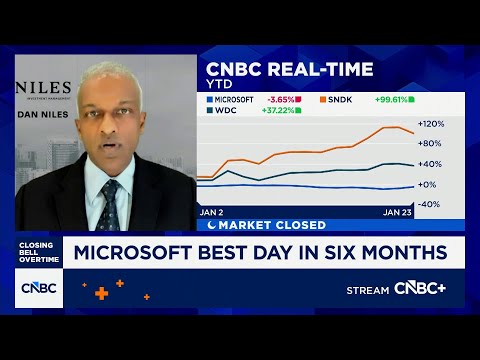
Group 1: Apple - Apple is expected to launch an AI-enabled iPhone and a foldable model by the end of the year, which could drive a significant upgrade cycle [3][5] - Concerns exist regarding the impact of rising memory prices on Apple's margins, but the company may pass these costs onto its wealthier customer base [4][5] - Historical data shows that major product upgrades, like the transition from the iPhone 4 to 6, resulted in substantial revenue growth, indicating potential for similar outcomes with the upcoming products [3] Group 2: Microsoft - Microsoft is anticipated to report solid numbers, driven by the growth of OpenAI, which is projected to increase its revenue run rate from $6 billion in 2024 to $44 billion in the current year [8][10] - The company holds a 27% stake in OpenAI, which is influencing its stock performance amid concerns about funding for OpenAI's expansion [8][9] - Rising memory costs are expected to impact Microsoft's sales, particularly in its profitable Windows and Office segments, similar to the effects seen with Intel [10][11]



Overlooked Stock: LIF 20% Rally on Boosted Guidance
Youtube· 2026-01-23 22:29
Core Viewpoint - Life 360 has experienced a significant stock rally of 23% following an increase in its annual revenue guidance, indicating strong growth potential and market interest [2][5]. Company Overview - Life 360 operates as a comprehensive app and device ecosystem focused on family safety applications, location sharing, and tracking for people, pets, and items [3][4]. - The company has expanded its offerings to include credit score monitoring and identity theft protection, contributing to its growth [4]. Financial Performance - Life 360 raised its preliminary revenue guidance for the fiscal year by approximately $3 million, projecting revenues between $486 million and $489 million, up from around $400 million in the previous four quarters [5]. - The company reported a year-over-year growth of about 20% in monthly active users, reaching approximately 95.8 million, with notable increases of 16% in the U.S. and 26% internationally [6]. Competitive Landscape - Competitors include major tech companies like Apple, Samsung, and Google, which offer similar tracking technologies [7]. - Life 360 differentiates itself by providing a more operationally agnostic solution that can be used across various platforms, enhancing its appeal to privacy-conscious consumers [8][9]. Growth Metrics - Life 360 is projected to continue its revenue growth at close to 30% for the next year, with adjusted earnings growth expected to be around 80% [13][14]. - The company achieved its first net income positive year in the last four quarters, marking a significant milestone in its financial history [12][13]. Valuation Insights - Despite the positive growth metrics, the stock has seen a pullback from its October highs, which may be attributed to valuation concerns, as it is currently trading at 116 times the expected earnings for 2026 [15][16].


Tech Investor Dan Niles talks what to expect from Big Tech earnings
CNBC Television· 2026-01-23 22:13
and the NASDAQ 100, which Mega Cap has more to prove and which matters most to the markets. Joining us now, Dan Niles, founder and portfolio manager of Niles Investment Management. Dan, great to have you with us.>> My pleasure. >> You are most excited about Apple, but it seems like they have to deliver a lot in order for you to be vindicated here. Um, bigger form factor.So, an AI enabled iPhone. That's >> Yeah. And with Apple, it's more of a call for this year, not this quarter.I mean, obviously into this q ...
This Tech Stock Is a Blast From the Past -- and Just Hit All-Time Highs
Yahoo Finance· 2026-01-23 17:22
Company Overview - Rambus initially specialized in memory chips, significantly contributing to the PC revolution of the 1980s and 1990s by eliminating bottlenecks in memory access with its RDRAM technology, which performed up to 10 times better than standard DRAM chips [4] - The company primarily generated revenue through licensing its intellectual property to semiconductor manufacturers, but faced challenges after the tech boom ended, leading to a decline in growth and legal battles over patent infringements with major industry players [5] Recent Developments - As of 2020, Rambus shares were trading below $10, down 90% from their highs in 2000, but the company's leadership recognized its potential and implemented a new strategic vision to capitalize on long-term growth opportunities [6] - Rambus has diversified its business successfully, with products like the DDR5 dual in-line memory module (DIMM) meeting the latest memory chip standards and playing a crucial role in data servers, alongside low-power compression attached memory modules (LPCAMM2) designed for laptops and portable devices [7] Market Position - The company, once a favorite during the 1990s tech boom, experienced a significant decline but has recently rebounded to all-time highs due to increasing demand for data center applications [8]

This Semiconductor Stock Could Be at the Center of the Artificial Intelligence Spending Boom
Yahoo Finance· 2026-01-23 17:05
Group 1: AI Infrastructure and Capital Expenditure - The artificial intelligence (AI) infrastructure boom is ongoing, with Taiwan Semiconductor Manufacturing (TSMC) significantly increasing its capital expenditure budget, indicating early stages of growth [1] - TSMC faces risks of overbuilding, which could lead to underutilized facilities, crushing gross margins and resulting in unprofitable operations [1] Group 2: Memory Component Demand - Micron Technology is positioned to benefit from the AI infrastructure boom, as the demand for high-bandwidth memory (HBM) is rising due to the need for optimal GPU performance [3][4] - The HBM market is expected to grow at a 40% compound annual growth rate (CAGR) through 2028, with Micron's current HBM supply already booked for the year [5] - Approximately 80% of Micron's revenue comes from the DRAM market, with the remaining 20% from NAND flash memory, both of which are currently in short supply [6]
TSM Stock: The Highest Conviction Play In The Semiconductor Stack
Forbes· 2026-01-23 11:30
Core Insights - TSMC is positioned as a dominant player in the AI semiconductor industry, benefiting from its advanced manufacturing capabilities regardless of the competition among chip designers [2][10][15] Industry Overview - The AI semiconductor sector is entering a competitive phase, with companies like Nvidia, Broadcom, and Marvell focusing on different aspects of chip design and efficiency [3][5] - The shift from performance maximization to cost efficiency is influencing demand for general-purpose GPUs, which may face challenges in large-scale inference tasks [6][7] Company Analysis: TSMC - TSMC holds over 90% of the advanced-node market for cutting-edge AI chips, making it the primary manufacturing partner for major chipmakers [10][11] - The company reported a 21% year-over-year revenue increase to $33.7 billion in Q4 2025, with 77% of wafer revenue coming from 7-nanometer and smaller circuits [10] - Advanced nodes (3nm, 5nm, and 7nm) constitute nearly 74% of TSMC's output, reinforcing its leadership in AI chip manufacturing [11] Financial Performance - TSMC's balance sheet is strong, with over $90 billion in cash and marketable securities, and gross margins around 62% [12] - Operating margins increased by 500 basis points year-over-year to nearly 54%, indicating pricing power and operational efficiency [12][13] - The company's market valuation surpassed $1.5 trillion in early 2026, trading at a forward P/E of approximately 19x to 20x, which is considered a value play in a high-growth sector [14] Competitive Landscape - While Nvidia leads in AI computing, TSMC's manufacturing dominance provides a critical advantage that competitors struggle to match [4][15] - TSMC's ability to implement price increases on its 2nm wafers allows it to capture profits in a competitive environment [14]