
重庆银行

Search documents
地方消费贷“红包”来了,川贵渝多家银行已发公告
Bei Jing Ri Bao Ke Hu Duan· 2025-12-10 08:52
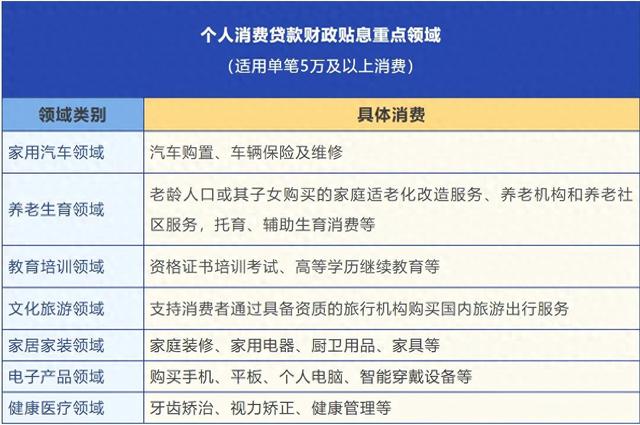
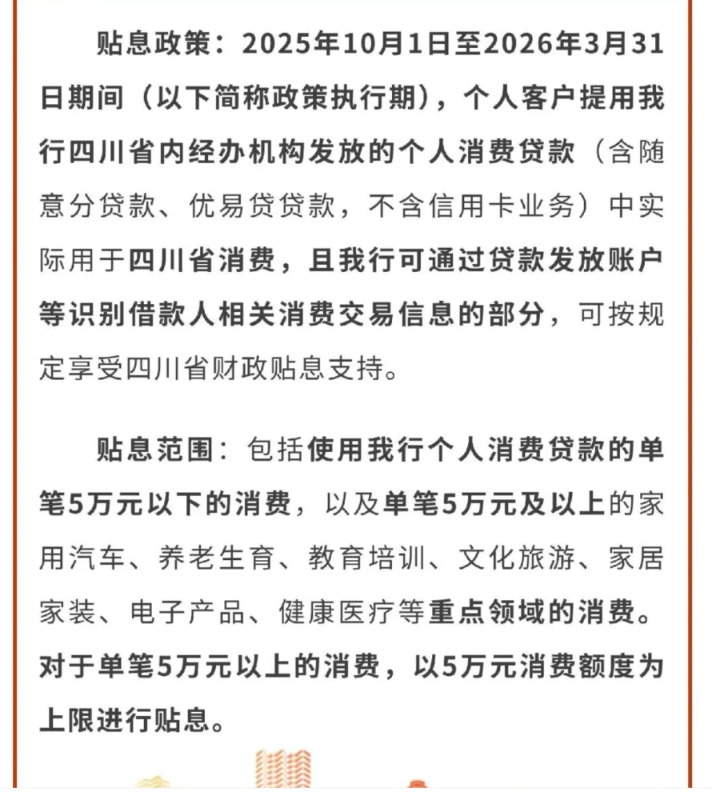
转自:北京日报客户端 继消费贷"国补",近日四川省、贵州省以及重庆市相继落地个人消费贷款财政贴息政策,三地均设定1 个百分点的年贴息比例,且该比例不超过贷款合同利率的50%。 据中新经纬不完全统计,截至发稿时,贵州银行、贵阳银行、成都银行、成都农商行等银行已发布相关 业务受理公告,重庆银行、重庆三峡银行也表示,正在制定贴息细则、实施系统改造。这也意味着,消 费贷贴息的主体进一步扩容至区域性银行。 地方接力消费贷补贴 今年8月,财政部、中国人民银行、国家金融监督管理总局联合印发《个人消费贷款财政贴息政策实施 方案》(下称实施方案),也被称为金融领域的"国补"。自9月1日正式落地以来,已实施三个月有余。近 期,多地跟进出台地方个人消费贷款贴息政策。 12月3日,重庆市财政局、中国人民银行重庆市分行、国家金融监督管理总局重庆监管局联合发布《关 于做好个人消费贷款财政贴息工作的通知》(下称通知)。其中提到,2025年9月1日至2026年8月31日期 间,居民个人使用贷款经办机构发放的个人消费贷款(不含信用卡业务)中实际用于消费,且贷款经办机 构可通过贷款发放账户等识别借款人相关消费交易信息的部分,可按规定享受贴息政策 ...

11月金融数据前瞻(2025.11.10-2025.12.09):新增信贷和社融或延续同比少增
China Post Securities· 2025-12-10 08:48
Investment Rating - The industry investment rating is "Outperform" and is maintained [1] Core Insights - The report indicates that the credit demand remains weak, with November's new credit expected to decrease by approximately 250 billion yuan year-on-year, totaling around 330 billion yuan [3][12] - The social financing scale for November is projected to be about 2.1 trillion yuan, reflecting a year-on-year decrease of approximately 200 billion yuan [25][30] - The report suggests that the upcoming months will see a significant amount of fixed-term deposits maturing, which may lead to a further decline in risk-free interest rates for residents [5][30] Summary by Sections Industry Overview - The closing index is at 4215.44, with a 52-week high of 4670.31 and a low of 3730.31 [1] Credit Market Analysis - New credit in November is expected to be around 330 billion yuan, with a year-on-year decrease of about 250 billion yuan [12][19] - The demand for corporate loans is slightly improving, but overall credit demand remains low, particularly for residential loans due to weak consumer confidence [4][21] - The PMI for November shows slight improvement but remains below the threshold, indicating ongoing pressure in the corporate sector [12][19] Investment Recommendations - The report recommends focusing on banks with significant maturing deposits and potential for margin improvement, such as Chongqing Bank, China Merchants Bank, and Bank of Communications [5][30] - It also suggests paying attention to city commercial banks that will benefit from improvements in fixed asset investments, including Jiangsu Bank, Qilu Bank, and Qingdao Bank [5][30]
重庆银行:个人存款规模突破3000亿元 经营质效持续提升
Jin Rong Jie· 2025-12-10 08:40
Core Insights - Chongqing Bank announced that its personal deposit balance has surpassed 300 billion yuan, marking a historic high and reflecting the vitality of regional finance [1][2] - The bank has achieved double-digit growth in both revenue and net profit, with increases of 10.40% and 10.42% respectively, reaching 11.74 billion yuan and 5.196 billion yuan [1] - The non-performing loan ratio stands at 1.14%, a decrease of 0.11 percentage points since the beginning of the year, while the provision coverage ratio has improved by 3.03 percentage points to 248.11% [1] Business Performance - The bank's focus on local markets and commitment to serving the local economy, small and medium-sized enterprises, and urban and rural residents have driven the growth in personal deposits [1] - The bank operates over 200 branches, creating a comprehensive physical network that covers urban and rural areas [1] - Financial literacy initiatives, such as the "Happiness Classroom," have enhanced customer interaction and trust [1] Product and Service Innovation - The bank offers a range of deposit products, including "Happiness Deposit" and "Monthly Enjoyment Deposit," which balance liquidity, yield, and safety to meet diverse customer needs [1] - Digital transformation efforts, including mobile banking, allow for 24/7 business transactions and enable customers to manage their assets remotely [1] Future Outlook - The bank views the achievement of surpassing 300 billion yuan in personal deposits as a milestone in the high-quality development of its retail business and a testament to customer trust [2] - Future strategies will focus on deepening retail transformation, product innovation, and enhancing comprehensive financial service capabilities [2]
“国补”引路,“地补”接力!个人消费贷财政贴息精准扩围
2 1 Shi Ji Jing Ji Bao Dao· 2025-12-10 08:36
Core Viewpoint - The personal consumption loan interest subsidy policy is accelerating from a national level to local implementation, with regions like Sichuan, Guizhou, and Chongqing actively rolling out their own subsidy measures to stimulate consumption and reduce financing costs for residents [1][2][7]. Group 1: Policy Implementation - The "local subsidy" policies in Sichuan, Guizhou, and Chongqing have been rapidly launched since December, creating a regional synergy effect [2]. - Chongqing's policy emphasizes broad coverage and a long execution period, with a subsidy cap of 3,000 yuan for eligible cumulative consumption of 300,000 yuan [3]. - Sichuan's approach focuses on short-term precision, with a subsidy cap of 1,500 yuan for the same cumulative consumption amount, and funds must be used within the province [4]. - Guizhou's policy offers high subsidies, matching the national standard with a cap of 3,000 yuan, but has a shorter execution period [5]. Group 2: Market Impact - The collaboration between national and local subsidy policies is expected to enhance the competitiveness of regional banks, stimulate local consumption, and lower financing costs for residents [7][9]. - The introduction of local policies is anticipated to create structural changes in the consumer finance market, leading to a reduction in consumer loan interest rates and stimulating demand [10]. - Local banks are expected to leverage the policy to attract price-sensitive customers and expand their coverage in the inclusive finance sector [8]. Group 3: Risk Management - Financial institutions are advised to implement multiple risk control measures to prevent potential arbitrage, including automatic identification of eligible transactions and setting limits on subsidy amounts [5][6]. - The operational guidelines for subsidy agreements emphasize the need for borrowers to provide valid proof of consumption transactions to ensure compliance [6].
行业点评报告:测算:BCBS调整利率冲击幅度对ΔEVE的影响
KAIYUAN SECURITIES· 2025-12-10 05:45
Investment Rating - The industry investment rating is "Positive" (maintained) [1] Core Insights - The report highlights the adjustment of the interest rate shock scenario by the Basel Committee (BCBS), reducing the parallel upward shift from 250 basis points (BP) to 225 BP, which is expected to improve the ΔEVE (Economic Value of Equity) to Tier 1 Capital ratio for major banks [4][5] - It is estimated that this adjustment could release approximately CNY 1 trillion in capacity for 30-year local government bonds and CNY 1.5 trillion for 15-year bonds [6][8] - The report anticipates that the regulatory requirements for interest rate risk indicators may be relaxed in 2026, potentially alleviating the pressure on banks [7] Summary by Sections Interest Rate Shock Adjustment - The BCBS has revised the interest rate shock scenario, reducing the parallel upward shift from 250 BP to 225 BP, which is expected to enhance the ΔEVE/Tier 1 Capital ratio by 0.92% to 1.57% for major banks [4][12] - Major banks such as ICBC, CCB, ABC, and BOC are projected to see improvements in their ΔEVE ratios, with specific improvements of 1.13%, 1.36%, 1.57%, and 0.92% respectively [5][12] Capacity Release for Local Government Bonds - The adjustment in interest rate shock is expected to release approximately CNY 870 billion for 30-year local government bonds and CNY 1.16 trillion for 15-year bonds [5][14] - If the Ministry of Finance injects capital into ICBC and ABC in 2026, it could further improve their ΔEVE ratios and release additional capacity for local government bonds [6][15] Regulatory Environment - The report suggests that regulatory constraints on banks may be relaxed, with a potential reduction in the required shock levels and a possible easing of the upper limit on risk indicators [7] - The report notes that major banks sold approximately CNY 740 billion in 7-10 year bonds and CNY 850 billion in 20-30 year bonds from January to November 2025, indicating a shift in their bond portfolio strategy [16] Investment Recommendations - The report recommends a bottom-up approach focusing on large state-owned banks, with specific beneficiaries identified as Agricultural Bank of China and Industrial and Commercial Bank of China [8] - Core investments are suggested in leading comprehensive banks, with China Merchants Bank and Industrial Bank highlighted as key beneficiaries [8]






上市银行超2600亿元分红在途
2 1 Shi Ji Jing Ji Bao Dao· 2025-12-09 23:28
Core Viewpoint - The announcement of mid-term dividends by major state-owned banks indicates a robust financial performance and a commitment to returning value to shareholders, with a total cash dividend distribution of approximately 762 billion yuan planned for December 15, 2025 [1][2]. Group 1: Dividend Announcements - Industrial and Commercial Bank of China (ICBC) plans to distribute a cash dividend of 0.1414 yuan per share, totaling approximately 503.96 billion yuan, with A-shares accounting for about 381.23 billion yuan [1]. - Agricultural Bank of China (ABC) will distribute a cash dividend of 0.1195 yuan per share, amounting to approximately 418.23 billion yuan, with A-shares also around 381.50 billion yuan [1]. - As of now, 32 listed banks have announced mid-term dividends, an increase of 8 banks compared to 2024, with an average dividend payout ratio of 24.9% and a total dividend amount of 264.57 billion yuan, reflecting a 2.55% increase from last year [2][3]. Group 2: Market Trends and Analyst Insights - The mid-term dividend distribution by state-owned banks is occurring earlier this year, with four major banks having already announced their plans, compared to the previous year [2][3]. - Analysts indicate that the increase in the number of banks planning to distribute dividends and the stability of dividend rates reflect the banking sector's solid dividend value, which is expected to attract long-term capital [3]. - The average dividend yield for listed banks is currently 4.48%, with 12 banks yielding over 5% and 26 banks exceeding 4% [3]. Group 3: Shareholder and Executive Actions - There have been 15 instances of share buyback plans disclosed by 13 banks this year, indicating strong confidence from major shareholders and executives in the banks' strategic direction and long-term value [6][7]. - Notable buybacks include Nanjing Bank, which saw an increase of over 1.28 billion shares by foreign shareholder BNP Paribas, raising its stake to 18.06% [7]. - The banking sector has attracted significant buyback amounts, totaling approximately 90.30 billion yuan, ranking first among 31 industries [7][8].

银行跌幅居前,大消费、医疗紧随其后,互联网和恒生科技均平盘收官
Ge Long Hui· 2025-12-09 20:49
低开低走后全天震荡下行,截至收盘恒生指数下跌1.23%。银行跌幅居前,大消费、医疗紧随其后,互 联网和恒生科技均平盘收官。 大消费小幅高开后快速回调,随后全天弱势,截至收盘下跌1.18%。其中泡泡玛特大跌8.49%,信达生 物下跌6.96%,巨子生物、思摩尔等多股跌幅在4%上方。 恒生互联网全天围绕中轴弱势盘整,最终平盘收官。其中快手下跌1.37%,阿里巴巴下跌1.03%,腾讯 控股、京东集团、网易等各均小幅收到;百度集团逆势大涨3.45%,商汤上涨1.4%。 内容只是个人观点,仅供参考,不作为投资依据!欢迎关注交流,互相学习、共同探讨! 银行低开低走大跳水,截至收盘大跌2.21%,其中建设银行下跌4.01%,招商银行下跌3.54%,工商银行 下跌3.48%,重庆农村商业银行、中国银行、重庆银行等个跌幅均值2%上方。 ...
上市银行中期分红阵营扩容 高股息价值催生“资产引力”
Zhong Guo Zheng Quan Bao· 2025-12-09 20:27
Core Viewpoint - The announcement of interim dividends by major banks reflects their robust operational resilience and mature shareholder return mechanisms, which may act as catalysts for valuation recovery in the banking sector [1][5][6] Group 1: Dividend Announcements - Industrial and Commercial Bank of China and Agricultural Bank of China announced interim dividends totaling CNY 503.96 billion and CNY 418.23 billion respectively, with both distributing over CNY 300 billion in cash dividends [1] - As of December 9, 26 A-share listed banks have disclosed their 2025 interim or quarterly dividend plans, with a total proposed payout exceeding CNY 260 billion [1][2] - The six major state-owned banks are the primary contributors to dividends, proposing a total cash dividend of CNY 2,046.57 billion, accounting for over 70% of the total disclosed dividends [2] Group 2: Trends in Dividend Distribution - The six major banks, including ICBC, CCB, ABC, and BOC, have maintained a stable dividend payout ratio around 30% [2] - Regional banks are increasingly participating in dividend distributions, with several institutions like Ningbo Bank and Changsha Bank announcing their first interim dividends [2] - The introduction of interim dividends by banks like Industrial Bank marks a significant step in enhancing the high-dividend landscape among joint-stock banks [2] Group 3: Regulatory and Market Influences - The expansion of the interim dividend landscape is attributed to regulatory policies, solid operational fundamentals, and market demand [3] - Recent policies encourage listed banks to optimize their dividend strategies, with measures to enhance dividend stability and predictability [3] - The Shanghai Stock Exchange is actively promoting higher dividend payouts and increased frequency of distributions to enhance company valuations [3] Group 4: Investment Implications - Bank stocks are characterized by stable performance, low valuations, high dividends, and low volatility, making them attractive for institutional investors seeking low-risk dividend assets [4] - The recent stability in bank stock performance and the appeal of high-dividend stocks are expected to attract more long-term capital, reinforcing the positive cycle of management, dividends, and valuation recovery [5][6] - Analysts believe that the ongoing high dividend policies and stock buybacks will continue to attract long-term investors, enhancing the overall investment value of bank stocks [6]


上市银行中期分红阵营扩容高股息价值催生“资产引力”
Zhong Guo Zheng Quan Bao· 2025-12-09 20:22
Core Viewpoint - The mid-term dividend announcements from major Chinese banks reflect a robust financial performance and a commitment to shareholder returns, with a total proposed payout exceeding 2,600 billion yuan across 26 listed banks, indicating a trend towards higher dividends in the banking sector [1][2][4] Group 1: Major Banks' Dividend Announcements - Industrial and Commercial Bank of China and Agricultural Bank of China announced mid-term dividends of 503.96 billion yuan and 418.23 billion yuan respectively, with both distributing over 300 billion yuan in cash dividends [1] - The six major state-owned banks are the primary contributors to the dividend payouts, collectively proposing cash dividends of 2,046.57 billion yuan, accounting for over 70% of the total disclosed dividends [1] - The dividend payout ratio for these major banks remains stable at around 30%, continuing their tradition of high and stable returns [1] Group 2: Participation of Other Banks - Industrial Bank introduced its first mid-term dividend plan, proposing a payout of 119.57 billion yuan, which is 30.02% of its net profit for the first half of 2025 [2] - Other regional banks, such as Ningbo Bank and Changsha Bank, have also joined the mid-term dividend initiative, indicating a growing trend among smaller banks [2] - Chongqing Bank plans to distribute cash dividends of 5.85 million yuan, representing 11.99% of its net profit attributable to ordinary shareholders [2] Group 3: Regulatory and Market Influences - The expansion of mid-term dividends among listed banks is driven by regulatory policies, solid operational fundamentals, and market demand [2] - Recent policies encourage banks to optimize their dividend strategies, with the new "National Nine Articles" emphasizing cash dividend regulations and incentivizing high-dividend companies [2] - The Shanghai Stock Exchange is actively promoting higher dividend payouts and increased frequency to enhance company valuations [3] Group 4: Market Reactions and Future Outlook - The banking sector has shown stable performance since November, with high-dividend stocks attracting investor interest, suggesting that current valuations do not fully reflect their intrinsic value [3][4] - The implementation of mid-term dividends is seen as a signal of financial strength and a strategy to attract long-term capital, creating a positive cycle of management, returns, and valuation recovery [4] - Analysts believe that the increased dividend payouts and stock buybacks will stabilize market expectations and highlight the long-term investment value of bank stocks [4]
重庆银行收盘上涨1.10%,滚动市盈率6.85倍,总市值381.51亿元
Jin Rong Jie· 2025-12-09 11:53
Core Viewpoint - Chongqing Bank's stock closed at 10.98 yuan on December 9, with a 1.10% increase, and a rolling PE ratio of 6.85 times, with a total market value of 38.151 billion yuan [1] Group 1: Company Overview - Chongqing Bank's main business includes banking and related financial services, with key products in corporate banking, inclusive finance, personal banking, financial markets, investment banking, and trade finance [1] - The bank has been ranked among the top 300 global banks for 10 consecutive years by The Banker magazine and has been included in the "Double Hundred Enterprises" list by the State-owned Assets Supervision and Administration Commission for three years [1] - The latest financial results for the third quarter of 2025 show an operating income of 11.740 billion yuan, a year-on-year increase of 10.40%, and a net profit of 4.879 billion yuan, a year-on-year increase of 10.19% [1] Group 2: Shareholder Information - As of September 30, 2025, Chongqing Bank had 35,298 shareholders, an increase of 2,122 from the previous count, with an average holding value of 352,800 yuan and an average holding of 27,600 shares per shareholder [1] Group 3: Industry Comparison - The average PE ratio for the banking industry is 7.60 times, with a median of 6.04 times, placing Chongqing Bank at the 30th position in the industry ranking [2] - The total market value of the banking industry averages 380.174 billion yuan, with Chongqing Bank's market value at 38.151 billion yuan [2]