
江阴银行

Search documents
超4800只个股上涨
Di Yi Cai Jing· 2025-09-05 08:11
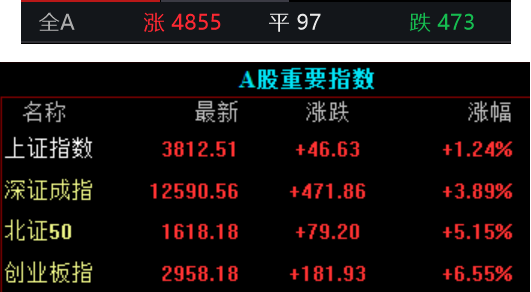
Market Overview - The three major stock indices collectively rose, with the Shanghai Composite Index closing at 3812.51 points, up 1.24% [1][2] - The Shenzhen Component Index closed at 12590.56 points, up 3.89% [1][2] - The ChiNext Index closed at 2958.18 points, up 6.55% [1][2] - The total trading volume in the Shanghai and Shenzhen markets reached 2.3 trillion [1] Sector Performance - Solid-state batteries, photovoltaic, wind power, silicon energy, and CPO sectors saw significant gains [5] - The solid-state battery sector surged, with Tianhong Lithium Battery hitting a 30% limit up, and several other stocks like Jinhai Galaxy and Tianshu New Energy also reaching 20% limit up [6] - The photovoltaic sector also performed well, with Jina Technology and Jing Sheng Machinery both seeing substantial increases [7] Individual Stock Movements - Zhongji Xuchuang rose by 10.26%, with a trading volume exceeding 30 billion [8] - Ningde Times increased by nearly 7%, with a trading volume over 22 billion [8] - Hanwujing saw a rise of over 6%, with a trading volume exceeding 24 billion [8] Fund Flow - Main funds saw a net inflow into sectors like power equipment, electronics, and machinery [9] - Notable net inflows were observed in stocks such as Xiandai Intelligent, Shenghong Technology, and Wolong Electric Drive [10] - Conversely, stocks like Pacific, Supply and Marketing Collective, and Sailis experienced significant net outflows [11] Institutional Insights - Dexun Securities noted that the Shanghai index is experiencing strong fluctuations around the 3800-point mark, with low-valuation sectors gaining strength [12] - Guojin Securities indicated that the recent pullback in strong sectors is more of a technical adjustment rather than a market peak [12] - Shenwan Hongyuan emphasized that the support level at 3731 points is strong, predicting no unilateral adjustment in the market [13]


超4800只个股上涨
第一财经· 2025-09-05 07:59
Core Viewpoint - The article highlights a significant rally in the Chinese stock market on September 5, with major indices experiencing substantial gains, indicating a positive market sentiment and potential investment opportunities in various sectors [2][3]. Market Performance - The Shanghai Composite Index closed at 3812.51 points, up 1.24% - The Shenzhen Component Index closed at 12590.56 points, up 3.89% - The ChiNext Index closed at 2958.18 points, up 6.55% - The North Star 50 Index rose by 5.15% - Total trading volume in the Shanghai and Shenzhen markets reached 2.3 trillion yuan, with over 4800 stocks rising [2][3]. Sector Performance - Solid-state batteries, photovoltaic, wind power, silicon energy, and CPO sectors showed the highest gains - The solid-state battery sector surged, with Tianhong Lithium Battery hitting a 30% limit up, and several other stocks like Jinhai Galaxy and Tianshu New Energy also reaching 20% limit up [5][6]. - The photovoltaic sector also performed well, with Jina Technology and Jing Sheng Machinery both seeing significant increases [7]. - Banking stocks experienced adjustments, with major banks like Postal Savings Bank and Agricultural Bank dropping nearly 3% [8]. Individual Stock Highlights - Zhongji Xuchuang rose by 10.26%, with a trading volume exceeding 30 billion yuan - Ningde Times increased by nearly 7%, with a trading volume over 22 billion yuan - Hanwujun saw a rise of over 6%, with a trading volume exceeding 24 billion yuan [9]. Capital Flow - Main capital inflows were observed in power equipment, electronics, and machinery sectors - Notable net inflows included 1.929 billion yuan into Xiandai Intelligent, 1.338 billion yuan into Shenghong Technology, and 1.223 billion yuan into Wolong Electric Drive [11][12]. - Significant net outflows were recorded from Pacific, Gongxiao Daji, and Sailisi, with outflows of 1.019 billion yuan, 571 million yuan, and 553 million yuan respectively [13]. Institutional Perspectives - Dexun Securities noted strong fluctuations around the 3800-point mark for the Shanghai Index, suggesting that low-valuation sectors will attract continued capital inflow, supporting a positive mid-term outlook for the index [15]. - Guojin Securities indicated that the recent pullback in strong sectors is a technical correction rather than a sign of market peak, with no substantial negative news affecting the market [15]. - Shenwan Hongyuan emphasized strong support at 3731 points, predicting that the market will not experience a unilateral adjustment [16].





收盘|创业板指大涨6.55%,固态电池、光伏板块爆发
Di Yi Cai Jing· 2025-09-05 07:28
Market Overview - The three major stock indices in China collectively rose, with the Shanghai Composite Index closing at 3812.51 points, up 1.24% [1][2] - The Shenzhen Component Index closed at 12590.56 points, up 3.89%, and the ChiNext Index closed at 2958.18 points, up 6.55% [1][2] - The total trading volume in the Shanghai and Shenzhen markets reached 2.3 trillion yuan, with over 4800 stocks rising across the three markets [1] Sector Performance - Solid-state batteries, photovoltaic, wind power, silicon energy, and CPO sectors showed significant gains, while gold concepts and consumer electronics also strengthened [5] - The solid-state battery sector experienced a surge, with Tianhong Lithium's stock hitting a 30% limit up, and several other stocks like Jinhai Galaxy and Tianshuan New Energy reaching 20% limit up [6] - The photovoltaic sector also performed well, with Jina Technology hitting a 20% limit up and several other stocks rising over 10% [6] Individual Stock Movements - Zhongji Xuchuang rose by 10.26% with a trading volume exceeding 30 billion yuan, while Ningde Times increased by nearly 7% with over 22 billion yuan in trading volume [7] - Hanwujing's stock rose over 6%, with a trading volume exceeding 24 billion yuan [7] Capital Flow - Main capital flows showed a net inflow into sectors such as power equipment, electronics, and machinery, while there was a net outflow from non-bank financials and computing sectors [8] - Specific stocks like Xiandao Intelligent, Shenghong Technology, and Wolong Electric Drive saw net inflows of 1.929 billion yuan, 1.338 billion yuan, and 1.223 billion yuan respectively [9] - Conversely, stocks like Pacific, Gongxiao Daji, and Sailis faced net outflows of 1.019 billion yuan, 571 million yuan, and 553 million yuan respectively [10] Institutional Insights - Dexun Securities noted that the Shanghai index is experiencing strong fluctuations around the 3800-point mark, with a rebound expected near the 20-day moving average, indicating that low-valuation sectors will attract continued capital inflow [11] - Guojin Securities stated that the recent pullback in previously strong sectors does not indicate a market peak, as there are no substantial negative factors, and the market is expected to maintain an upward trend [11] - Shenwan Hongyuan emphasized that the support level at 3731 points is strong, predicting that the market will not experience a unilateral adjustment pattern [12]


银行股午后震荡走弱
Di Yi Cai Jing· 2025-09-05 06:13
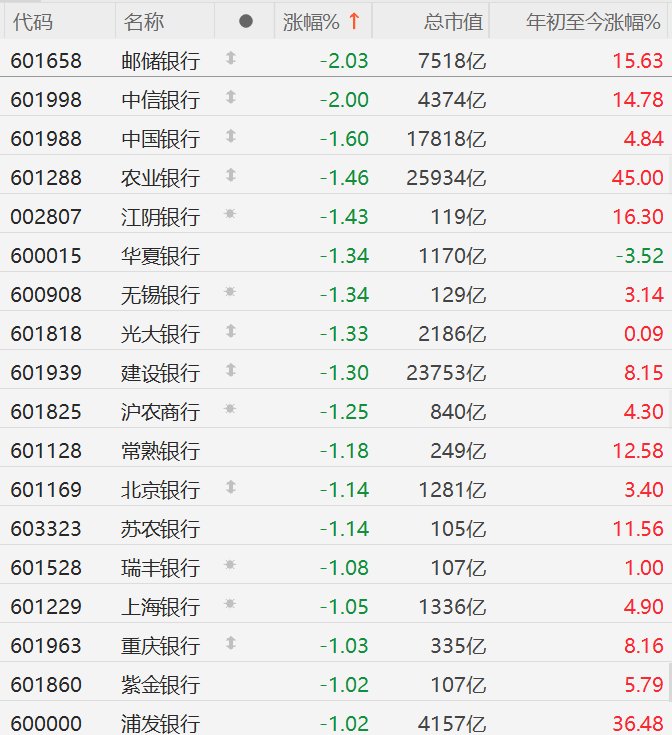
Group 1 - Agricultural Bank of China fell over 3% [1] - Postal Savings Bank, Jiangyin Bank, Citic Bank, and Huaxia Bank all dropped over 2% [1] - Bank of China, China Construction Bank, and Chongqing Bank also experienced declines [1]

A股银行股普跌,邮储银行、中信银行跌超2%
Ge Long Hui A P P· 2025-09-05 02:52
Core Viewpoint - The A-share market experienced a widespread decline in bank stocks, with several major banks seeing significant drops in their share prices [1][2]. Group 1: Stock Performance - Postal Savings Bank of China saw a decrease of 2.03%, with a total market capitalization of 751.8 billion [2]. - CITIC Bank's shares fell by 2.00%, with a market value of 437.4 billion [2]. - Bank of China experienced a decline of 1.60%, with a market capitalization of 1.7818 trillion [2]. - Agricultural Bank of China dropped by 1.46%, holding a market value of 2.5934 trillion [2]. - Other banks such as Everbright Bank, Construction Bank, and Shanghai Pudong Development Bank also reported declines of over 1% [1]. Group 2: Year-to-Date Performance - Agricultural Bank of China has the highest year-to-date increase at 45.00% [2]. - Postal Savings Bank of China and CITIC Bank have year-to-date increases of 15.63% and 14.78%, respectively [2]. - Shanghai Pudong Development Bank has a notable year-to-date increase of 36.48% despite the recent decline [2].


透视A股上市农商行中期“成绩单”:营收持续分化,非利息收入扛起增长“大旗”
Mei Ri Jing Ji Xin Wen· 2025-09-04 14:40
Core Viewpoint - The financial performance of listed rural commercial banks in China is showing a trend of increasing differentiation, with significant revenue growth observed in specific banks like Changshu Bank and Jiangyin Bank, while others lag behind [1][2][3]. Group 1: Revenue Performance - In the first half of 2025, the top two performing banks were Chongqing Rural Commercial Bank and Shanghai Rural Commercial Bank, with revenues of 14.741 billion and 13.444 billion respectively, both nearing 15 billion [2]. - Changshu Bank and Qingnong Bank followed with revenues exceeding 6 billion, while the remaining banks had revenues below 3 billion [2]. - Changshu Bank and Jiangyin Bank reported significant year-on-year revenue growth, both exceeding 10%, which is notably higher than other banks [3]. Group 2: Non-Interest Income - In a declining net interest margin environment, listed rural commercial banks are increasingly relying on non-interest income to stabilize revenue [5]. - Investment income has become a crucial component of non-interest income, with most banks reporting significant increases compared to the previous year, particularly Zijin Bank and Jiangyin Bank, which saw increases of 95.41% and 81.44% respectively [5]. - Chongqing Rural Commercial Bank was the only bank to report a decrease in investment income year-on-year, while its interest income ratio increased, helping maintain stable overall revenue [5][6]. Group 3: Mid-Year Dividends - Several listed rural commercial banks announced their first-ever mid-year dividend plans, including Changshu Bank, which proposed a cash dividend of 0.15 yuan per share, totaling 497 million yuan [7]. - Jiangyin Bank and Su Nong Bank also introduced mid-year dividends, aiming to enhance investor returns and boost long-term holding confidence [7][8]. - The overall trend indicates a shift towards more frequent dividend distributions, moving from annual to semi-annual payouts, which is expected to improve dividend yields in the coming years [8].

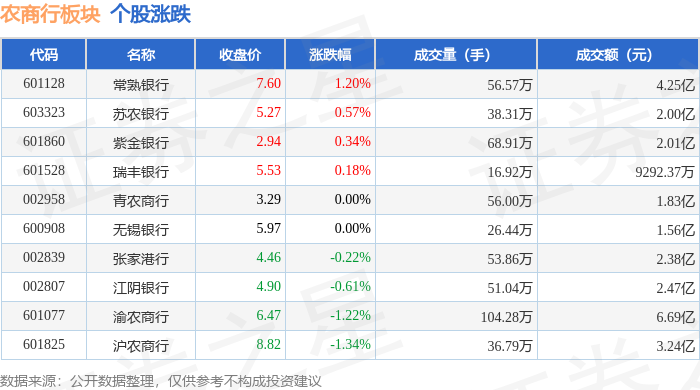
农商行板块9月4日跌0.61%,沪农商行领跌,主力资金净流入38.47万元
Zheng Xing Xing Ye Ri Bao· 2025-09-04 08:48
Market Overview - On September 4, the rural commercial bank sector declined by 0.61% compared to the previous trading day, with Hu Nong Bank leading the decline [1] - The Shanghai Composite Index closed at 3765.88, down 1.25%, while the Shenzhen Component Index closed at 12118.7, down 2.83% [1] Individual Stock Performance - Among the rural commercial banks, Changshu Bank saw a closing price of 7.60 with a gain of 1.20%, while Hu Nong Bank closed at 8.82, down 1.34% [1] - The trading volume and turnover for various banks were reported, with Changshu Bank having a trading volume of 565,700 shares and a turnover of 4.25 billion yuan [1] Capital Flow Analysis - The rural commercial bank sector experienced a net inflow of 384,700 yuan from institutional investors, while retail investors saw a net inflow of 11.7 million yuan [1] - The table of capital flow indicates that the majority of the funds were flowing into certain banks, with Yu Nong Bank receiving a net inflow of 73.51 million yuan from institutional investors [2] Detailed Capital Flow by Bank - Yu Nong Bank had a net inflow of 73.51 million yuan from institutional investors, while it faced a net outflow of 41.89 million yuan from speculative funds [2] - Changshu Bank experienced a net inflow of 19.16 million yuan from institutional investors, but a significant outflow of 51.75 million yuan from speculative funds [2] - Other banks like Zijin Bank and Su Nong Bank also reported net outflows from institutional and speculative funds, indicating varied investor sentiment across the sector [2]


矛盾的江阴银行,大涨同时伴随着“窘迫”
Xin Lang Cai Jing· 2025-09-04 07:53
Core Insights - Jiangyin Bank has achieved a "double growth" in revenue and net profit for the first half of 2025, with operating income reaching 2.401 billion yuan, a year-on-year increase of 10.45%, and net profit attributable to shareholders amounting to 846 million yuan, up 16.69% year-on-year [1][2] Group 1: Performance Analysis - The significant increase in performance is primarily driven by a substantial rise in investment income, which has seen non-interest income grow for three consecutive years, reaching 999.2 million yuan in the first half of 2025, a year-on-year increase of 30.26% [2][3] - Investment income alone surged to 882 million yuan in the first half of 2025, marking an impressive increase of 81.44% compared to the previous year, contributing 36.72% to total operating income [2][3] - The bank's trading financial assets grew from 19.703 billion yuan at the end of the previous year to 25.335 billion yuan by June 2025, reflecting a 28.58% increase [3] Group 2: Challenges Faced - Despite the impressive growth in non-interest income, net interest income has slightly declined by 0.23% to 1.409 billion yuan in the first half of 2025, with losses in funding operations widening by 30.71% [4][5] - The bank's fee and commission income also faced pressure, dropping by 35.18% to 50.085 million yuan in the first half of 2025 [5] - Personal loan balances have decreased for two consecutive years, falling to 20.507 billion yuan in the first half of 2025, leading to a significant decline in personal loan interest income by 18.37% [6] Group 3: Business Focus - The bank's corporate business has also encountered challenges, with corporate revenue declining by 0.76% to 1.051 billion yuan, despite an increase in total corporate assets to 110.586 billion yuan [8] - Jiangyin Bank's corporate loans are heavily focused on the manufacturing sector, which constitutes 31.47% of its loan portfolio, indicating a strong reliance on this industry [8] Group 4: Market Position - Jiangyin Bank's global ranking improved to 506th place, an increase of 26 positions compared to the previous year, marking the third consecutive year of ranking improvement [9] - However, compared to leading regional banks, Jiangyin Bank's retail transformation is lagging, and adjustments are needed in corporate business to enhance support for green technology and innovative enterprises [9][10]
A股银行股普跌,渝农商行、沪农商行跌超2%
Ge Long Hui A P P· 2025-09-04 06:57
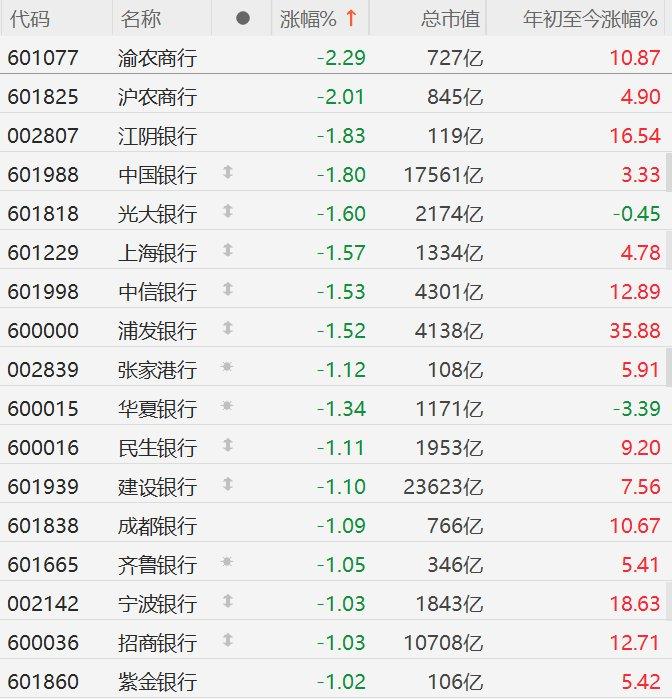
Core Viewpoint - The A-share market experienced a widespread decline in bank stocks, with several banks falling over 2% and others declining by more than 1% [1] Group 1: Stock Performance - Yunnan Rural Commercial Bank (渝农商行) saw a decline of 2.29%, with a total market capitalization of 72.7 billion [2] - Shanghai Rural Commercial Bank (沪农商行) decreased by 2.01%, with a market cap of 84.5 billion [2] - Jiangyin Bank (江阴银行) fell by 1.83%, with a market value of 11.9 billion [2] - Bank of China (中国银行) dropped by 1.80%, with a market capitalization of 1,756.1 billion [2] - China Everbright Bank (光大银行) decreased by 1.60%, with a market cap of 217.4 billion [2] - Shanghai Bank (上海银行) declined by 1.57%, with a market value of 133.4 billion [2] - CITIC Bank (中信银行) fell by 1.53%, with a market capitalization of 430.1 billion [2] - Pudong Development Bank (浦发银行) decreased by 1.52%, with a market cap of 413.8 billion [2] - Zhangjiagang Bank (张家港行) saw a decline of 1.12%, with a market value of 10.8 billion [2] - Huaxia Bank (华夏银行) fell by 1.34%, with a market capitalization of 117.1 billion [2] - Minsheng Bank (民生银行) decreased by 1.11%, with a market cap of 195.3 billion [2] - China Construction Bank (建设银行) dropped by 1.10%, with a market capitalization of 23,623 billion [2] - Chengdu Bank (成都银行) saw a decline of 1.09%, with a market value of 76.6 billion [2] - Qilu Bank (齐鲁银行) decreased by 1.05%, with a market cap of 34.6 billion [2] - Ningbo Bank (宁波银行) fell by 1.03%, with a market capitalization of 184.3 billion [2] - China Merchants Bank (招商银行) decreased by 1.03%, with a market cap of 1,070.8 billion [2] - Zijin Bank (紫金银行) saw a decline of 1.02%, with a market value of 10.6 billion [2]

银行研究框架及25H1业绩综述:营收及利润增速双双转正
GOLDEN SUN SECURITIES· 2025-09-04 06:14
Investment Rating - The report indicates a positive outlook for the banking industry, with overall revenue and net profit growth rates turning positive in the first half of 2025, at 1.0% and 0.8% respectively, showing improvements from the previous quarter [4]. Core Insights - The banking sector's net interest margin for the first half of 2025 is reported at 1.42%, a decrease of 10 basis points compared to the previous year, but the decline is narrowing due to improved cost management on the liability side [5]. - Non-interest income, particularly from fees and commissions, has increased by 3.1% year-on-year, driven by a recovery in wealth management and a more active market environment [5]. - The asset quality remains stable, with a non-performing loan ratio of 1.23% and a provision coverage ratio of 239%, indicating a solid credit environment [5]. Summary by Sections Financial Performance Overview - The overall revenue and net profit growth for listed banks in the first half of 2025 were 1.0% and 0.8%, respectively, with both metrics showing improvement from the first quarter [4][22]. - The total assets of listed banks reached 321.3 trillion yuan, growing by 6.35% year-to-date, with loans and advances totaling 179.4 trillion yuan, accounting for 55.84% of total assets [21][24]. Income Sources - Net interest income decreased by 1.3% year-on-year, but the decline rate has slowed, reflecting better management of funding costs [5]. - Fee and commission income grew by 3.1% year-on-year, benefiting from a recovering market and the gradual impact of regulatory changes [5]. - Other non-interest income saw a significant increase of 10.7%, primarily due to favorable market conditions in the bond market [5]. Asset Quality and Management - The non-performing loan ratio remained stable at 1.23%, with a provision coverage ratio of 239%, indicating a robust asset quality [5]. - The credit cost for the first half of 2025 was 0.81%, a decrease of 5 basis points year-on-year, suggesting manageable credit risks [5]. Loan Growth and Composition - Loan growth was primarily driven by corporate lending, with significant contributions from infrastructure and manufacturing sectors [20]. - Personal loan growth was weaker, with a year-on-year increase of only 3.6%, reflecting a cautious approach to consumer lending amid rising risks [20]. Investment and Market Conditions - The investment asset proportion decreased to 34% as banks adjusted their strategies in response to market volatility [20]. - The overall yield on bonds fluctuated significantly, prompting banks to engage in tactical trading to enhance returns [20].


