苏州银行

Search documents
上市银行中期分红热潮持续:国有大行领衔中小银行加速跟进
Sou Hu Cai Jing· 2025-11-16 06:26
与此同时,常熟银行、宁波银行、长沙银行、苏农银行、张家港行、兴业银行、无锡银行等7家银行首 次启动中期分红。常熟银行每10股派1.5元(含税),派现4.97亿元,占其2025年半年度归母净利润的 25.27%;长沙银行每10股派2.00元(含税),合计派现8.04亿元;苏农银行和张家港行首次派现金额分 别为1.82亿元和2.44亿元。 更多银行正积极酝酿或推进中期分红方案。例如,江阴银行已发布预案,拟每10股派1.0元(含税), 待股东大会审议通过后实施。浙商银行副行长骆峰在业绩说明会上表示,该行近三年累计分红超132亿 元,将结合政策与同业经验,研究未来分红安排。 东方财富Choice数据显示,截至本周四,已有8家A股上市银行完成2025年中期分红,其中常熟银行、 长沙银行、苏农银行、张家港行首次实施中期分红。民生银行以59.54亿元的分红金额暂居首位。下 周,苏州银行、杭州银行、中信银行将分别于11月17日、18日、21日实施中期分红,金额分别为9.39亿 元、27.55亿元和104.61亿元。后续,工商银行、农业银行、中国银行、建设银行四大国有银行的百亿元 级分红方案也将陆续落地。 杭州银行本周发布的公 ...
上市银行中期分红热潮持续:国有大行领衔 中小银行加速跟进
Huan Qiu Wang· 2025-11-16 01:37
Core Insights - A total of 8 A-share listed banks have completed their mid-term dividend distributions for 2025, with notable first-time distributions from banks like Changshu Bank, Changsha Bank, and Su Nong Bank [1][3] - Minsheng Bank leads in dividend payout with a total of 5.954 billion yuan, while other banks like Suzhou Bank, Hangzhou Bank, and CITIC Bank are set to distribute dividends next week [1][3] - The trend of mid-term dividends is shifting from an optional practice to a positive factor for smaller banks, as evidenced by Hangzhou Bank's 24.10% year-on-year increase in its dividend payout [3] Summary by Category Dividend Distribution - As of this week, 23 A-share listed banks have disclosed their mid-term dividend plans, accounting for 56.10% of the total, with a cumulative payout of 257.586 billion yuan [3] - The six major state-owned banks collectively account for nearly 80% of the total mid-term dividend payouts, with Industrial and Commercial Bank of China leading at 50.396 billion yuan [3] First-time Dividend Payouts - Seven banks, including Changshu Bank, Ningbo Bank, and Zhangjiagang Bank, have initiated mid-term dividends for the first time, with Changshu Bank distributing 0.15 yuan per share, totaling 0.497 billion yuan [3][4] - Changsha Bank's payout is 0.20 yuan per share, amounting to 0.804 billion yuan, while Su Nong Bank and Zhangjiagang Bank's first-time payouts are 0.182 billion yuan and 0.244 billion yuan, respectively [3] Future Dividend Plans - Jiangyin Bank has announced a proposed dividend of 0.10 yuan per share, pending shareholder approval [4] - Zheshang Bank's vice president indicated that the bank has distributed over 13.2 billion yuan in dividends over the past three years and is considering future dividend arrangements based on policies and industry practices [4]





超2500亿元!银行“红包雨”来了
Shang Hai Zheng Quan Bao· 2025-11-15 09:45
国有大行持续引领 更多中小银行及农商行加入分红大军 11月11日晚间,杭州银行发布2025年半年度权益分派实施公告,向全体普通股股东每股派送现金股利 0.38元(含税),以该行当前普通股总股本72.49亿股测算,此次中期分红将派发普通股现金股利达 27.55亿元(含税),分红总额同比增长24.10%。 以杭州银行为代表,2025年上半年,上市银行中期分红已从"可选项"升级为"加分项",在国有大行持续 分红的引领下,更多中小银行及农商行加入中期分红阵营。 作为中期分红的主力军,23家A股上市银行的2575.86亿元中期分红"红包"正在路上。 东方财富Choice数据显示,截至11月13日,已有8家A股上市银行中期分红实施完成,其中常熟银行、 长沙银行、苏农银行、张家港行是首次进行中期分红,民生银行以59.54亿元的分红金额暂居首位。 下周,苏州银行、杭州银行、中信银行将分别于11月17日、18日、21日实施中期分红,金额分别为9.39 亿元、27.55亿元和104.61亿元。后续,工农中建四大行的百亿元分红也在路上。 根据半年报披露,招商银行2025年度中期利润分配现金分红金额占上半年度归属于普通股股东净利润的 ...
银行业数据点评:政策效果仍待显现
Xiangcai Securities· 2025-11-14 09:52
Investment Rating - The industry investment rating is maintained at "Overweight" [3][10] Core Views - Credit recovery is pending the effectiveness of policies, with social financing growth declining by 0.2 percentage points to 8.5% in October, indicating a continued downward trend [6][12] - The demand for loans from residents and medium to long-term corporate loans remains weak, and the impact of policy tools on credit has yet to be fully realized [6][12] - The total amount and structure of credit data in October are weak, but monetary easing support is still expected, enhancing the relative advantage of high-dividend banks [9][32] Summary by Sections Recent Industry Performance - Relative return over the past 12 months shows a 5.4% increase in 1 month, a decrease of 13.7% in 3 months, and a 4.2% increase in 12 months [5] - Absolute return indicates a 7.7% increase in 1 month, a decrease of 1.1% in 3 months, and an 18.5% increase in 12 months [5] Credit Market Analysis - In October, social financing increased by 815 billion yuan, a year-on-year decrease of 597 billion yuan, primarily due to a significant drop in government bond financing [6][12] - The new loans from financial institutions amounted to 220 billion yuan, with a year-on-year decrease of 280 billion yuan, reflecting weak demand in the real estate market [7][15] - Policy financial tools have been implemented but their effect on credit demand remains insufficient, with expectations for continued monetary policy support if credit demand weakens further [16][32] Deposit Trends - In October, M1 grew by 6.2% and M2 by 8.2%, with both growth rates declining compared to previous values [8][24] - New RMB deposits increased by 610 billion yuan, with fiscal deposits showing a significant increase, indicating a slowdown in fiscal spending [27][24] - Non-bank institutions saw a significant increase in deposits, suggesting a shift of funds towards wealth management products [27][32] Investment Recommendations - The report suggests focusing on state-owned banks for stable high-dividend investment opportunities and potential valuation recovery for joint-stock and regional banks as economic conditions improve [9][32] - Recommended banks include Industrial and Commercial Bank of China, Bank of China, CITIC Bank, Jiangsu Bank, Shanghai Rural Commercial Bank, Chongqing Rural Commercial Bank, and Suzhou Bank [9][32]
银行研思录25:银行股息率排名与中期分红进度梳理-20251114
CMS· 2025-11-14 03:02
Investment Rating - The report does not explicitly state an investment rating for the banking sector, but it provides detailed insights into dividend yields and distribution processes, which can inform investment decisions. Core Insights - The report outlines the latest dividend yields and mid-term dividend processes for A and H shares of listed banks, emphasizing the importance of accurately calculating dynamic dividend yields to avoid discrepancies across periods [1][2]. - It details the two processes for mid-term dividends following the 2023 revision of the regulatory guidelines, highlighting the conventional and simplified processes for implementing mid-term dividends [2]. - The report provides a comprehensive overview of key dates related to dividend distribution for both A and H shares, including the importance of purchasing shares before the ex-dividend date to qualify for dividends [3][4]. Summary by Sections Dynamic Dividend Yield Calculation - A simplified yet accurate method for calculating dynamic dividend yield is introduced, defined as "rolling 12-month EPS * cash dividend rate / share price," which helps avoid issues related to overlapping or missing annual and mid-term dividends [1]. - The report calculates the cash dividend rate using a standardized approach across different banks, resulting in a clear comparison of dividend yields as of November 13, 2025 [1]. Mid-Term Dividend Processes - The report explains the two processes for mid-term dividends: the conventional process requiring shareholder approval and a simplified process allowing for quicker implementation [2]. - The simplified process is designed to enhance flexibility for companies in distributing mid-term dividends, thereby improving shareholder returns [2]. Dividend Distribution Key Dates - For A shares, investors must purchase shares before the ex-dividend date to receive dividends on the same day, while H shares typically see a delay of about one month for dividend payments [3][4]. - The report outlines the differences in the dividend distribution timeline between A and H shares, emphasizing the need for investors to be aware of these timelines to maximize their returns [3][4]. Mid-Term Dividend Progress - As of November 13, 2025, 31 A-share banks have confirmed mid-term dividends, while 11 H-share banks have also confirmed their dividend distributions [9][11]. - The report categorizes banks based on their dividend status, detailing those that have implemented dividends, those that are pending, and those that have opted not to distribute dividends [9][10][11]. - It highlights that the end of 2025 and early 2026 is expected to be a peak period for mid-term dividend distributions, suggesting potential investment opportunities for dividend-seeking investors [11].





红利资产重现吸引力!市场风格切换?
券商中国· 2025-11-13 23:24
Core Viewpoint - The article discusses the recent performance of dividend stocks, particularly bank stocks, which have regained investor interest after a period of adjustment, highlighting a potential shift in market style towards dividend assets while maintaining a balance with technology stocks [1][2][4]. Group 1: Market Performance - Since October, the dividend low volatility index has increased by 8.69%, while the Sci-Tech 50 index has decreased by 7.75%, indicating a possible market style switch towards dividend stocks [1]. - In the past month, despite net redemptions in broad-based indices like CSI 300 and CSI A500, dividend and growth sectors have seen net inflows, with the dividend low volatility index attracting a net inflow of 3.898 billion yuan [1][2]. - The banking sector, a key component of dividend assets, experienced a significant pullback of 15% in Q3, but has since rebounded, with bank stock prices reaching new highs [2][3]. Group 2: Dividend Attractiveness - The appeal of dividend assets lies in their consistent cash flow and ability to provide stable returns through cash dividends, with many bank stocks now offering dividend yields around 5% after recent adjustments [2][4]. - As of November 13, the banking index has rebounded over 10% in Q4, with cumulative gains of 9%, while the Sci-Tech 50 index has declined [2]. - The insurance sector has also shown significant interest in bank stocks, with increased holdings and stock price appreciation [3]. Group 3: Fundamental Support - The fundamental support for bank stocks includes a stabilization in net interest margins and strong performance from the insurance sector, which has seen stable premium income and improved investment returns [5]. - Public funds have reduced their holdings in bank stocks, creating room for potential increases in Q4, as the market seeks to rebalance styles [5]. Group 4: Future Outlook - The article suggests that while dividend assets are currently favored, the technology sector remains relevant, and investors should be cautious of potential short-term corrections [9]. - The overall market sentiment indicates a preference for low-valuation sectors, including consumer, chemical, and pharmaceutical industries, which may also attract investor interest [9].

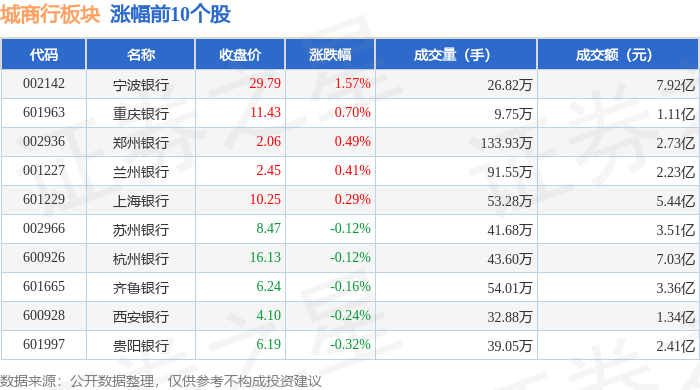
城商行板块11月13日跌0.02%,长沙银行领跌,主力资金净流出6796.93万元
Zheng Xing Xing Ye Ri Bao· 2025-11-13 08:45
Core Points - The city commercial bank sector experienced a slight decline of 0.02% on November 13, with Changsha Bank leading the drop [1] - The Shanghai Composite Index closed at 4029.5, up 0.73%, while the Shenzhen Component Index closed at 13476.52, up 1.78% [1] Summary by Category Stock Performance - Ningbo Bank (002142) closed at 29.79, with an increase of 1.57% and a trading volume of 268,200 shares, totaling a transaction value of 792 million yuan [1] - Chongqing Bank (601963) closed at 11.43, up 0.70%, with a trading volume of 97,500 shares, totaling 111 million yuan [1] - Zhengzhou Bank (002936) closed at 2.06, up 0.49%, with a trading volume of 1,339,300 shares, totaling 273 million yuan [1] - Other banks such as Lanzhou Bank, Shanghai Bank, and Suzhou Bank showed minor fluctuations in their stock prices, with varying trading volumes and values [1] Capital Flow - The city commercial bank sector saw a net outflow of 67.9693 million yuan from main funds, while retail funds experienced a net outflow of 99.3293 million yuan [3] - Conversely, speculative funds recorded a net inflow of 166.7 million yuan [3]



银行直售房,没那么吓人
Ge Long Hui· 2025-11-12 10:55
Core Insights - The recent surge in banks selling properties has raised concerns about the accumulation of non-performing assets within the banking sector [1][2][4] - Data indicates that the number of properties listed for sale by various rural credit systems is substantial, with Guangdong, Sichuan, and other provinces showing significant figures [1][2][6] - Despite the high number of properties being sold, they represent a small fraction of the overall housing inventory in major cities like Guangzhou, Shenzhen, and Chengdu [6][11][9] Summary by Sections Property Sales Data - Since August 2024, the Guangdong rural credit system has listed 12,386 properties for sale, while the Sichuan rural credit system has listed 24,821 properties since November 2024 [1] - Other provinces such as Liaoning, Guizhou, Jilin, and Fujian have also contributed to the total number of properties being sold [1] Market Reaction - The market has reacted with surprise, speculating that banks may be facing a significant amount of non-performing assets [2][4] - The perception is that the properties being sold are just the tip of the iceberg, indicating a larger issue with banks needing to liquidate assets [2] Non-Performing Loans and Asset Management - The sale of properties is often linked to borrowers' inability to repay loans, leading banks to reclaim and sell these assets [3] - The current data suggests that the number of properties being sold is relatively small compared to the total inventory of second-hand homes available in the market [6][11] Trends in Non-Performing Loan Rates - The overall non-performing loan rates for listed banks have been declining since 2020, indicating that banks have been effectively managing and disposing of non-performing assets [12][13] - As of November 2025, the non-performing loan rates for various banks show a downward trend compared to previous years, with many banks reporting lower rates than in 2020 [12][13] Industry Restructuring - The banking sector has undergone significant reforms and consolidations, with over 300 rural banks being merged or restructured in 2025 alone [15] - Major banks have also participated in these consolidations, indicating a strategic move to strengthen their positions and manage non-performing assets more effectively [15] Asset Disposal Efforts - Banks have been actively disposing of non-performing assets, with significant amounts being processed each year [18][20] - In 2025, banks disposed of 1.5 trillion yuan in non-performing assets, reflecting a proactive approach to managing risk [20] - The rural commercial banks have seen the highest non-performing loan rates but have also experienced the most significant reductions in these rates over the years [21][22]

城商行板块11月12日涨0.05%,长沙银行领涨,主力资金净流入2.2亿元
Zheng Xing Xing Ye Ri Bao· 2025-11-12 08:49
Core Insights - The city commercial bank sector experienced a slight increase of 0.05% on November 12, with Changsha Bank leading the gains [1] - The Shanghai Composite Index closed at 4000.14, down 0.07%, while the Shenzhen Component Index closed at 13240.62, down 0.36% [1] Stock Performance - Changsha Bank (601577) closed at 10.08, up 0.90% with a trading volume of 199,800 shares and a transaction value of 201 million yuan [1] - Shanghai Bank (601229) closed at 10.22, up 0.89% with a trading volume of 597,100 shares and a transaction value of 611 million yuan [1] - Other notable performances include: - Lanzhou Bank (001227) at 2.44, up 0.41% - Jiangsu Bank (616009) at 11.13, up 0.27% - Beijing Bank (601169) at 5.73, up 0.17% [1] Capital Flow - The city commercial bank sector saw a net inflow of 220 million yuan from main funds, while retail investors experienced a net outflow of 200 million yuan [2] - Key capital flows include: - Jiangsu Bank (600919) with a net inflow of 10.4 million yuan from main funds [2] - Beijing Bank (601169) with a net inflow of 62.5 million yuan from main funds [2] - Shanghai Bank (601229) with a net inflow of 58.5 million yuan from main funds [2]


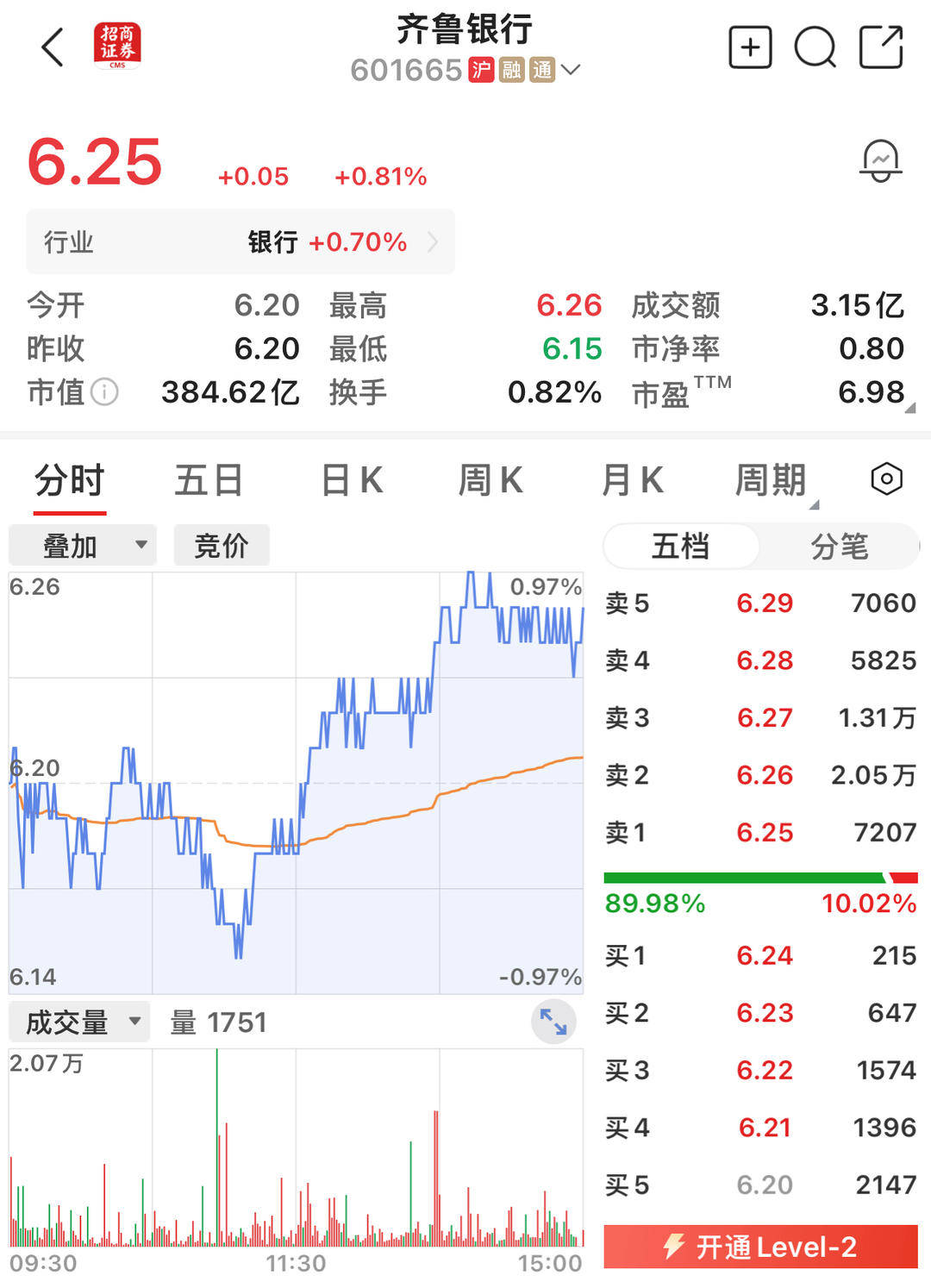
这些上市银行获增持
Sou Hu Cai Jing· 2025-11-12 08:18
Core Insights - Multiple A-share listed banks have seen significant share purchases by executives and major shareholders since 2025, indicating confidence in the banking sector's long-term value [1][5] - Recent quarterly reports show that most city commercial banks have stabilized and improved their net interest margins compared to the end of the first half of the year [1] Group 1: Shareholder Activity - Over 10 banks have received share purchases from shareholders or executives, including Xiamen Bank, Suzhou Bank, Chengdu Bank, Chongqing Bank, Shanghai Bank, Everbright Bank, Lanzhou Bank, Postal Savings Bank, and Wuxi Bank, with city commercial banks being the majority [1] - On November 7, Qilu Bank reported that its directors, supervisors, and senior executives had collectively increased their holdings by approximately 3.15 million yuan, accounting for 90% of the planned increase [3] - Qingdao Bank's major shareholder, Guoxin Chanin Holdings, increased its stake through the Hong Kong Stock Connect, raising its total shareholding to 15.42%, making it the largest shareholder [5] Group 2: Financial Performance - Among the 42 listed banks, 35 reported a year-on-year increase in net profit for the first three quarters, with seven banks achieving double-digit growth, including Qingdao Bank, Qilu Bank, Hangzhou Bank, Jiangyin Bank, Changshu Bank, Shanghai Pudong Development Bank, and Chongqing Bank [5] - The recent quarterly reports reflect a positive performance for banks this year, contributing to market confidence [5]