
永辉超市

Search documents
永辉超市(601933) - 永辉超市股份有限公司关于召开2026年第一次临时股东会的通知
2026-01-20 11:00
证券代码:601933 证券简称:永辉超市 公告编号:2026-006 永辉超市股份有限公司 关于召开2026年第一次临时股东会的通知 本公司董事会及全体董事保证本公告内容不存在任何虚假记载、误导性陈述 或者重大遗漏,并对其内容的真实性、准确性和完整性承担法律责任。 重要内容提示: 一、 召开会议的基本情况 (一) 股东会类型和届次 2026年第一次临时股东会 召开的日期时间:2026 年 2 月 6 日 13 点 30 分 召开地点:福建省福州市鼓楼区湖头街 120 号(永辉集团)6 楼会议室 涉及融资融券、转融通业务、约定购回业务相关账户以及沪股通投资者 的投票,应按照《上海证券交易所上市公司自律监管指引第 1 号 — 规范运 作》等有关规定执行。 (七) 涉及公开征集股东投票权 (五) 网络投票的系统、起止日期和投票时间。 网络投票系统:上海证券交易所股东会网络投票系统 股东会召开日期:2026年2月6日 本次股东会采用的网络投票系统:上海证券交易所股东会网络投票系统 (二) 股东会召集人:董事会 (三) 投票方式:本次股东会所采用的表决方式是现场投票和网络投票相结合 的方式 (四) 现场会议召开的日期 ...

永辉超市(601933) - 永辉超市股份有限公司第六届董事会第十次会议决议公告
2026-01-20 11:00
永辉超市股份有限公司 第六届董事会第十次会议决议公告 本公司及董事会全体成员保证本公告内容不存在任何虚假记载、误导性陈述 或者重大遗漏,并对其内容的真实性、准确性和完整性承担法律责任。 永辉超市股份有限公司(下称"公司"或"永辉超市")第六届董事会第十 次会议于 2026 年 1 月 19 日在公司左海总部六楼会议室以现场结合通讯方式召 开。会议应出席董事 9 人,实际出席会议董事 9 人。公司高级管理人员列席本 次会议。会议的通知、召开符合《中华人民共和国公司法》及其他相关规定。经 全体董事审议和表决,会议通过如下决议: 一、关于公司2025年度关联交易执行情况及2026年关联交易计划的议案 证券代码:601933 证券简称:永辉超市 公告编号: 2026-004 具体内容详见公司同日披露于上海证券交易所网站(www.sse.com.cn)的 《永辉超市股份有限公司关于公司 2025 年度关联交易执行情况及 2026 年关联 交易计划的公告》(公告编号:2026-005) 根据《永辉超市股份有限公司关联交易管理办法》规定,关联董事张轩松先 生、张轩宁先生需回避此项议案,因涉及向关联公司福建轩辉房地产开发有限 ...
永辉超市:2025年预亏21.4亿元
Ge Long Hui· 2026-01-20 10:52
Core Viewpoint - The company, Yonghui Supermarket, anticipates a significant net loss for 2025, with a projected net profit attributable to shareholders of -2.14 billion yuan and a net profit of -2.94 billion yuan after excluding non-recurring gains and losses. This reflects a strategic shift from "scale expansion" to "quality growth" [1] Group 1: Strategic Adjustments - In 2025, the company undertook major operational strategic adjustments, repositioning itself with the strategy of "New Yonghui, New Quality" [1] - The company deeply adjusted 315 stores and closed 381 stores that did not align with its future strategic positioning, leading to substantial losses [1] - The adjustments resulted in asset write-off losses and one-time setup costs totaling approximately 910 million yuan, along with an estimated gross profit loss of about 300 million yuan due to store renovations [1] Group 2: Supply Chain Reform - The company initiated a supply chain reform based on the principles of "transparency, quality-driven, and efficiency improvement," focusing on five key areas: "sunshine supply chain, bare-price direct procurement, core focus, cold chain upgrade, and store collaboration" [1] - Short-term challenges include stock shortages and declining gross margins, which have impacted revenue; however, these effects are gradually being mitigated as the supply chain reform progresses [1] Group 3: Investment and Asset Impairment - The company recognized a fair value change loss of 236 million yuan on its overseas equity investment in Advantage Solutions due to a continuous decline in stock price [2] - The company plans to recognize an impairment provision of approximately 162 million yuan for long-term assets, primarily related to continuously loss-making store assets, pending final audit results [2]
永辉超市(601933.SH):2025年预亏21.4亿元
Ge Long Hui A P P· 2026-01-20 10:44
Core Viewpoint - The company, Yonghui Supermarket, anticipates a significant net loss for 2025, with a projected net profit attributable to shareholders of -2.14 billion yuan and a net profit of -2.94 billion yuan after excluding non-recurring gains and losses. This shift is part of a strategic transition from "scale expansion" to "quality growth" [1] Group 1: Strategic Adjustments - In 2025, the company undertook major operational strategic adjustments, repositioning itself with the strategy of "New Yonghui, New Quality" [1] - The company deeply adjusted 315 stores and closed 381 stores that did not align with its future strategic positioning, leading to significant losses [1] - The adjustments resulted in asset write-off losses and one-time setup costs totaling approximately 910 million yuan, along with an estimated gross profit loss of about 300 million yuan due to store renovations [1] Group 2: Supply Chain Reform - The company initiated a supply chain reform based on the principles of "transparency, quality-driven, and efficiency improvement," focusing on five key areas: "sunshine supply chain, bare-price direct procurement, core focus, cold chain upgrade, and store collaboration" [1] - Short-term challenges include stock shortages and declining gross margins, which have impacted revenue; however, these effects are gradually being mitigated as the supply chain reform progresses [1] Group 3: Investment and Asset Impairment - The company recognized a fair value loss of 236 million yuan on its overseas equity investment in Advantage Solutions due to a continuous decline in stock price [2] - Additionally, the company plans to recognize an impairment provision of approximately 162 million yuan for long-term assets, primarily related to underperforming store assets, pending final audit results [2]
永辉超市:预计2025年净利润亏损21.4亿元
Xin Lang Cai Jing· 2026-01-20 10:44
Core Viewpoint - The company expects a net profit loss of 2.14 billion yuan for 2025, compared to a loss of 1.47 billion yuan in the previous year [1] - The company anticipates a net profit loss of 2.94 billion yuan after deducting non-recurring gains and losses for 2025 [1] - The company is shifting its strategic focus from "scale expansion" to "quality growth," rebranding as "New Yonghui, New Quality" [1] Financial Performance - The projected net profit loss for 2025 is 2.14 billion yuan, an increase in loss compared to the previous year's 1.47 billion yuan [1] - The anticipated loss after excluding non-recurring items is 2.94 billion yuan for 2025 [1] Strategic Adjustments - The company has made significant operational adjustments, including a deep restructuring of 315 stores during the reporting period [1] - A total of 381 stores that do not align with the company's future strategic positioning have been closed [1]
永辉超市:预计2025年净亏损21.4亿元
Mei Ri Jing Ji Xin Wen· 2026-01-20 10:44
Core Viewpoint - The company, Yonghui Supermarket, announced a significant net profit loss forecast for 2025, projecting a net profit attributable to shareholders of -2.14 billion yuan, compared to -1.47 billion yuan in the previous year [1] Group 1: Strategic Adjustments - In 2025, the company shifted its operational strategy from "scale expansion" to "quality growth," rebranding itself under the strategy of "New Yonghui, New Quality" [1] - During the reporting period, the company made substantial adjustments to its store layout, deeply modifying 315 stores and closing 381 stores that did not align with its future strategic positioning [1] Group 2: Financial Impact of Store Adjustments - The adjustments to the stores resulted in significant financial impacts, including asset write-off losses, loss of operating income due to store renovations, and one-time startup costs, totaling approximately 910 million yuan [1] - The estimated gross profit loss due to store closures for renovations is around 300 million yuan [1] - The closure of 381 stores also incurred substantial losses, including asset write-off losses, employee severance compensation, and lease-related penalties [1] Group 3: Investment and Asset Impairment - The company recognized a fair value change loss of 236 million yuan on its overseas equity investment in Advantage Solutions due to a continuous decline in stock price [1] - A preliminary assessment indicates that the company will recognize an impairment provision of 162 million yuan for long-term assets, primarily related to continuously loss-making store assets, with the final amount subject to audit results [1]
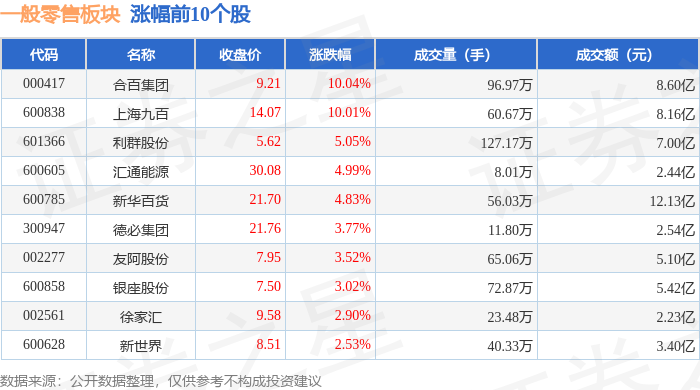
一般零售板块1月20日涨0.19%,合百集团领涨,主力资金净流入1.05亿元
Zheng Xing Xing Ye Ri Bao· 2026-01-20 08:56
Core Viewpoint - The general retail sector experienced a slight increase of 0.19% on January 20, with HeBai Group leading the gains, while the Shanghai Composite Index fell by 0.01% and the Shenzhen Component Index decreased by 0.97% [1]. Group 1: Stock Performance - HeBai Group (000417) closed at 9.21, up 10.04%, with a trading volume of 969,700 shares and a transaction value of 860 million yuan [1]. - Shanghai Jiubai (600838) closed at 14.07, up 10.01%, with a trading volume of 606,700 shares and a transaction value of 816 million yuan [1]. - LiQun Co. (601366) closed at 5.62, up 5.05%, with a trading volume of 1,271,700 shares and a transaction value of 700 million yuan [1]. - Other notable performers include Huitong Energy (600605) with a 4.99% increase and XinHua Department Store (600785) with a 4.83% increase [1]. Group 2: Market Trends - The general retail sector saw a net inflow of 105 million yuan from institutional investors, while retail investors experienced a net outflow of 66.77 million yuan [2]. - The overall trading activity indicates a mixed sentiment among retail investors, with significant outflows despite the sector's slight gain [2]. Group 3: Capital Flow Analysis - Shanghai Jiubai (600838) had a net inflow of 183 million yuan from institutional investors, but a net outflow of 82.23 million yuan from retail investors [3]. - HeBai Group (000417) also saw a net inflow of 141 million yuan from institutional investors, with retail investors withdrawing 73.61 million yuan [3]. - Other companies like Yonghui Supermarket (601933) and Wangfujing (600859) showed varying levels of net inflow and outflow, indicating diverse investor behavior across the sector [3].





商场B1B2层,“最强开店王”大洗牌!
3 6 Ke· 2026-01-20 02:17
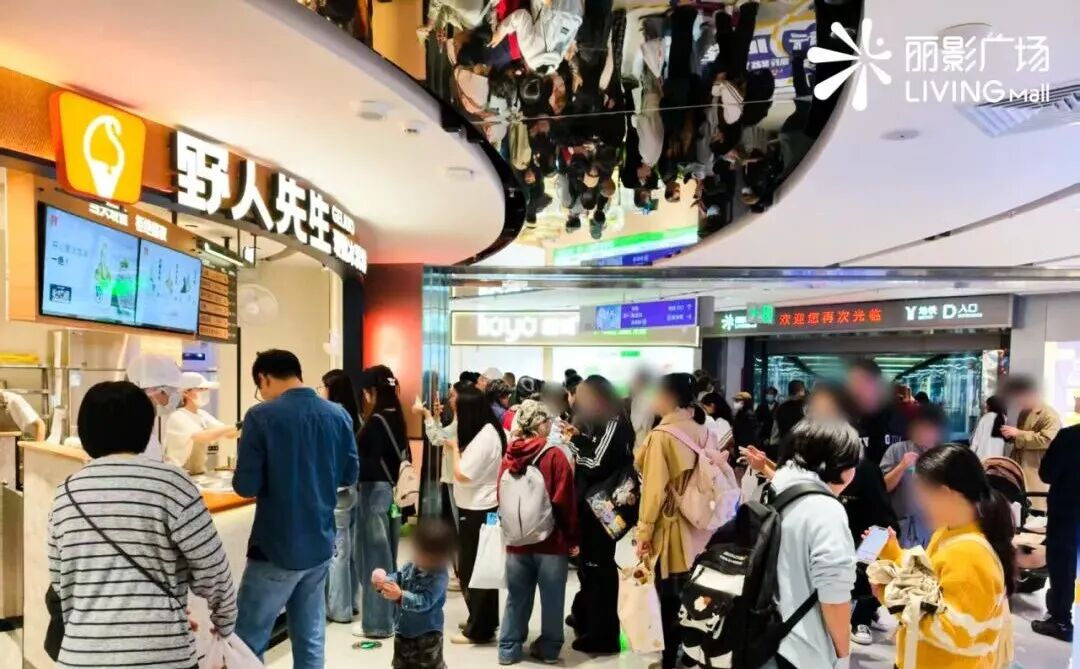
Core Insights - The B1B2 levels of shopping malls have transformed into vibrant spaces that attract young consumers, reflecting a shift in the Chinese consumer market towards experiences that provide emotional value rather than mere ownership [1][2] - The B1B2 levels are characterized by a mix of instant dining and emotional retail, with dining accounting for approximately 45% and retail around 35% of the space [2][3] Group 1: B1B2 Level Dynamics - The B1B2 levels are experiencing a value reassessment, with a stable distribution of five major sectors: retail, dining, children's activities, cultural and entertainment, and lifestyle services [2] - Instant dining, particularly snack and beverage options, is a key driver of foot traffic, appealing to young consumers with low prices and high convenience [3][4] - The popularity of baked goods is on the rise, projected to exceed 7.15% by 2025, with new brands emerging to meet social and self-indulgent needs [4][5] Group 2: Emotional Retail and Consumer Trends - Emotional retail focuses on sales experiences and social currency, providing a sense of joy without spending money, thus injecting freshness and engagement into the B1B2 levels [5][7] - Young consumers prioritize emotional returns on investment, seeking experiences that enhance their feelings rather than just acquiring products [7][20] - The presence of lifestyle services, such as pet shops and lottery stations, contributes to maintaining foot traffic and a relaxed atmosphere in the B1B2 levels [14] Group 3: Market Adjustments and Brand Opportunities - Certain categories, such as automotive showrooms and luxury goods, are shrinking in the B1B2 levels due to their low-frequency nature, while traditional categories like beauty and women's apparel are also declining [8][12] - The B1B2 levels are seeing a significant turnover, with over 22% of total store adjustments occurring in this area, indicating a dynamic market environment [15][16] - Brands that align with the instant dining and emotional retail trends, such as Wildman and Tamkoko, are rapidly expanding, indicating a shift towards brands that offer immediate satisfaction and emotional engagement [19][20]
如何看2025年12月消费数据
2026-01-20 01:50
Summary of Key Points from Conference Call Records Industry Overview - **Consumer Sector Performance**: In December 2025, the overall retail sales growth was 0.9% year-on-year, with a full-year growth of 3.7%. Online retail grew by 5.2% for the year, while offline retail showed slower growth [2][3]. Key Insights and Arguments - **Retail Categories**: - Supermarket retail sales increased by 4.3% year-on-year, while department stores only saw a 0.1% increase [3]. - Essential goods performed well, with grain and oil food growth at 3.9%. In the discretionary category, cosmetics grew by 8.8%, and gold and jewelry increased by 5.9% due to a rise in gold prices [3][4]. - Communication equipment maintained a growth rate of over 20%, while home appliances declined by 19% due to tightening subsidies [3][4]. - **Automotive Sector**: - The total retail sales for automobiles reached 548.2 billion, down 5% year-on-year. Passenger car sales fell by 8.8%, but new energy vehicle wholesale sales grew by 3.3% [11]. - **Textile and Apparel**: - The textile and apparel sector saw a 0.6% year-on-year retail growth in December, but a decline in month-on-month performance due to weather and the delayed Spring Festival [13][14]. - **Alcohol Industry**: - The retail sales of the liquor industry decreased by 2.9% year-on-year in December, with a price index decline of 0.19%. The industry is currently in a phase of active inventory reduction [16][17]. - **Consumer Expectations**: - Due to the late Spring Festival and expectations of rising gold prices, consumer demand is anticipated to recover in January and February 2026 [5]. Additional Important Insights - **Investment Recommendations**: - In the beauty and personal care sector, companies like Shiseido and domestic brands such as Maogeping are recommended. For the gold and jewelry sector, brands with strong store expansion logic are highlighted [6][10]. - In the automotive sector, companies like JAC Motors and Geely are recommended, focusing on high-end and luxury markets [12]. - For the textile and apparel sector, brands like Li Ning and Fuanna are suggested, with a focus on companies that can support their market value through dividends [15]. - **Household Appliances**: - The household appliance sector is experiencing a downturn, with significant declines in sales across various categories. However, leading companies like Midea and Haier are expected to maintain slight growth due to low inventory levels [21][22][24]. - **Light Industry**: - The light industry saw a decline in furniture sales by 2.2% year-on-year, with exports down by 9.8%. However, some companies are expected to see revenue and profit recovery in 2026 [26][27]. Conclusion The consumer sector is facing mixed performance across various categories, with essential goods showing resilience while discretionary spending is under pressure. Investment opportunities exist in specific brands and sectors that are positioned to benefit from changing consumer behaviors and market dynamics.
双融日报-20260120
Huaxin Securities· 2026-01-20 01:28
Market Sentiment - The current market sentiment score is 62, indicating a "relatively hot" market condition, which suggests increased investor confidence and activity [6][9][22]. Hot Themes Tracking - **Robotics Theme**: The upcoming Spring Festival Gala will feature robotics, highlighting advancements in technology and creativity. Related stocks include Sanhua Intelligent Control (002050) and Wolong Electric Drive (600580) [6]. - **Banking Theme**: Bank stocks offer high dividend yields, with the China Securities Bank Index yielding 6.02%, significantly above the 10-year government bond yield. This makes bank stocks attractive for long-term investors during economic slowdowns. Related stocks include Agricultural Bank of China (601288) and Ningbo Bank (002142) [6]. - **Retail Theme**: The National Business Work Conference has set the tone for boosting consumption in 2026, emphasizing actions like trade-in programs and retail innovation. Related stocks include Yonghui Superstores (601933) and Wangfujing (600859) [6]. Capital Flow Analysis - The top ten stocks with the highest net inflow include China Xidian (601179) with 107.61 million and Xinyi Technology (300502) with 83.55 million, indicating strong investor interest in these companies [10]. - The top ten stocks with the highest net outflow include Ningde Times (300750) with -144.05 million and Xiangshan Chip (300475) with -135.38 million, reflecting a shift in investor sentiment away from these stocks [14]. Industry Insights - The banking sector is highlighted for its stability and high dividend yield, making it a key focus for long-term institutional investors [6]. - The retail sector is poised for growth due to government initiatives aimed at enhancing consumer spending and market development [6].