
江阴银行

Search documents
“红包群”扩大!超20家上市银行预告中期分红,7位新成员加入
券商中国· 2025-08-31 07:39
Core Viewpoint - The article highlights the significant increase in mid-term dividends announced by various A-share listed banks, reflecting their commitment to returning value to investors amid a strong performance in the banking sector in the first half of the year [1][2]. Summary by Sections Mid-term Dividends Announcement - As of August 30, at least 21 A-share listed banks have announced plans for mid-term dividends for 2025, with 17 banks disclosing specific dividend proposals [2]. - Notably, seven banks, including China Merchants Bank and Changshu Bank, are implementing mid-term dividends for the first time since their listings [2][4]. Dividend Details - The total cash dividend amount from the major state-owned banks (ICBC, ABC, CCB, BOC, CMB, and PSBC) is 204.657 billion yuan [2]. - ICBC leads with a dividend of 1.414 yuan per 10 shares, totaling 50.396 billion yuan [2]. - China Merchants Bank, known as the "King of Retail," has a dividend payout ratio of 35%, amounting to 26.226 billion yuan [2][5]. - Other banks like CITIC Bank and Ping An Bank have also confirmed their mid-term dividends, with CITIC Bank's total reaching 10.46 billion yuan and a payout ratio of 30.7% [2]. Implications of Mid-term Dividends - The implementation of mid-term dividends is seen as a response to the new "National Nine Articles" and related requirements from the China Securities Regulatory Commission, aimed at enhancing investor confidence and stabilizing stock prices [5]. - Experts emphasize that while increasing the frequency of dividends is beneficial, the focus should be on maintaining a balance between short-term payouts and long-term growth [5]. Market Outlook - Analysts from CITIC Securities note that the banking sector is experiencing a gradual improvement in performance, with expectations for continued positive trends in subsequent quarters [6]. - The sector is undergoing a net asset revaluation process, and while there is potential for recovery, the market may experience volatility without sustained inflows of investment funds [6].






上市银行探路转型新增长极:扩资产规模 增非息收入
Zhong Guo Jing Ying Bao· 2025-08-29 19:36
Core Viewpoint - The 2025 A-share banking mid-year report reveals significant profit differentiation among banks, with some city commercial banks achieving double-digit profit growth while others face negative growth due to narrowing interest margins and market volatility [1] Group 1: Profit Growth of City Commercial Banks - City commercial banks have emerged as the main contributors to profit growth among listed banks in the first half of 2025, with Hangzhou Bank reporting a net profit of 11.662 billion yuan, a year-on-year increase of 16.66% [2] - Factors contributing to the rapid profit growth of city commercial banks include stable asset scale growth, continuous optimization of asset-liability structure, and a recovery in fee and commission income driven by low base and wealth management growth [2][3] - Other city commercial banks such as Jiangyin Bank, Qilu Bank, and Qingdao Bank reported net profit growth rates of 16.63%, 16.48%, and 16.05% respectively [2] Group 2: Challenges Faced by Some Banks - In contrast, some banks like Guiyang Bank experienced negative profit growth, with a net profit of 2.474 billion yuan, a decrease of 7.20% year-on-year, attributed to declining interest income and weaker bond market performance [4] - The differentiation in profit performance among banks is largely due to variations in customer base, financing capabilities, risk preferences, and asset quality [4] Group 3: Interest Income and Margin Trends - The net interest margin for commercial banks narrowed to 1.42% in the first half of 2025, reflecting ongoing pressure on interest margins [7] - Strategies to manage interest margins include increasing the proportion of low-cost deposits and optimizing asset-liability management to improve net interest income [8][9] Group 4: Non-Interest Income and Business Diversification - Expanding non-interest income is seen as a crucial strategy for banks to mitigate the impact of declining interest margins, with a focus on enhancing middle business services such as custody, agency sales, and settlement [9] - Currently, non-interest income accounts for less than 30% of major listed banks in China, which is significantly lower than that of large international banks [9]




信用卡“缩量”背后:加速出清不良谋转型
Zhong Guo Jing Ying Bao· 2025-08-29 19:16
Core Insights - The credit card business of banks is undergoing a significant contraction, with a shift from expansion to value reconstruction, indicating a transformation in the industry [1][5][7] Group 1: Industry Trends - The overall credit card loan scale is declining across multiple banks, despite some growth in personal loan business [1][2] - Many banks are closing credit card centers, signaling a move towards a more refined and high-value development phase [1][4] - The total number of credit cards and combined credit and loan cards has decreased, with a notable drop of 6 million cards in Q2 compared to the previous quarter [4][9] Group 2: Bank Performance - CITIC Bank reported a credit card issuance of 126 million cards, with a loan balance of 458.45 billion yuan, but a 12.54% decline in transaction volume and a 14.61% drop in business revenue [2] - Ping An Bank's credit card receivables decreased by 9.2% to 394.87 billion yuan, with a significant drop in the number of active credit card users [3] - Smaller banks like Jiangsu Bank and Chongqing Bank also reported declines in credit card loan scales, with reductions of 7.51% and 10.23% respectively [3][4] Group 3: Strategic Shifts - Banks are focusing on improving asset quality and risk management, with CITIC Bank emphasizing a shift from scale to quality in its credit card business [5][6] - The trend of integrating credit card and consumer loan products is emerging, with banks like Chongqing Bank adapting their strategies to maintain competitiveness [6][9] - Experts suggest that the future of credit card business will focus on high-end customer needs and basic customer demands, moving away from merely acquiring new customers [7][8]





农商行板块8月29日跌0.23%,渝农商行领跌,主力资金净流出1346.05万元
Zheng Xing Xing Ye Ri Bao· 2025-08-29 08:48
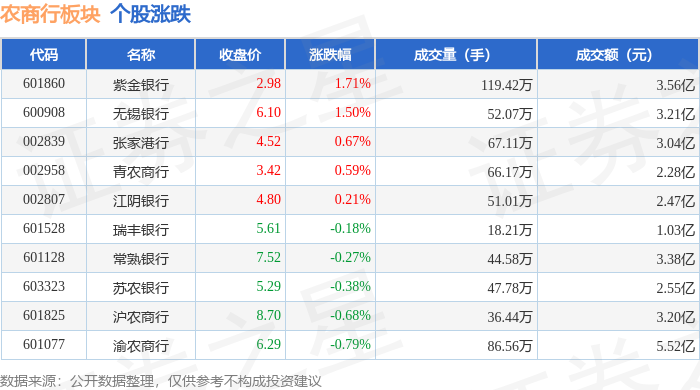
Market Overview - On August 29, the rural commercial bank sector declined by 0.23%, with Yunnan Rural Commercial Bank leading the drop [1] - The Shanghai Composite Index closed at 3857.93, up 0.37%, while the Shenzhen Component Index closed at 12696.15, up 0.99% [1] Individual Stock Performance - Key stock performances in the rural commercial bank sector included: - Zijin Bank: Closed at 2.98, up 1.71% with a trading volume of 1.1942 million shares and a turnover of 3.56 billion [1] - Wuxi Bank: Closed at 6.10, up 1.50% with a trading volume of 520,700 shares and a turnover of 321 million [1] - Zhangjiagang Bank: Closed at 4.52, up 0.67% with a trading volume of 671,100 shares and a turnover of 304 million [1] - Qingnong Bank: Closed at 3.42, up 0.59% with a trading volume of 661,700 shares and a turnover of 228 million [1] - Jiangyin Bank: Closed at 4.80, up 0.21% with a trading volume of 510,100 shares and a turnover of 247 million [1] - Ruifeng Bank: Closed at 5.61, down 0.18% with a trading volume of 182,100 shares and a turnover of 103 million [1] - Changshu Bank: Closed at 7.52, down 0.27% with a trading volume of 445,800 shares and a turnover of 338 million [1] - Sunong Bank: Closed at 5.29, down 0.38% with a trading volume of 477,800 shares and a turnover of 255 million [1] - Hunan Rural Commercial Bank: Closed at 18.70, down 0.68% with a trading volume of 364,400 shares and a turnover of 320 million [1] - Yunnan Rural Commercial Bank: Closed at 6.29, down 0.79% with a trading volume of 865,600 shares and a turnover of 552 million [1] Capital Flow Analysis - The rural commercial bank sector experienced a net outflow of 13.4605 million from main funds, while speculative funds saw a net inflow of 38.5712 million, and retail investors had a net outflow of 25.1107 million [1] - Detailed capital flow for individual stocks included: - Sunong Bank: Main funds net inflow of 22.3068 million, speculative funds net inflow of 30.55 million, retail net outflow of 22.6123 million [2] - Jiangyin Bank: Main funds net inflow of 7.4654 million, speculative funds net inflow of 73.39 million, retail net outflow of 8.1993 million [2] - Zijin Bank: Main funds net inflow of 7.3454 million, speculative funds net inflow of 819.73 million, retail net outflow of 15.5427 million [2] - Qingnong Bank: Main funds net inflow of 6.0408 million, speculative funds net inflow of 374.38 million, retail net outflow of 9.7846 million [2] - Wuxi Bank: Main funds net inflow of 3.1286 million, speculative funds net inflow of 96.36 million, retail net outflow of 4.0922 million [2] - Ruifeng Bank: Main funds net outflow of 1.3678 million, speculative funds net inflow of 794.01 million, retail net outflow of 6.5722 million [2] - Zhangjiagang Bank: Main funds net outflow of 2.5651 million, speculative funds net inflow of 438.50 million, retail net outflow of 1.8199 million [2] - Hunan Rural Commercial Bank: Main funds net outflow of 7.2508 million, speculative funds net inflow of 596.70 million, retail net inflow of 128.37 million [2] - Changshu Bank: Main funds net outflow of 8.2141 million, speculative funds net inflow of 620.80 million, retail net inflow of 200.61 million [2] - Yunnan Rural Commercial Bank: Main funds net outflow of 40.3497 million, speculative funds net inflow of 12.71 million, retail net inflow of 40.2227 million [2]



江阴银行(002807) - 2025年8月29日投资者关系活动记录表
2025-08-29 08:32
Group 1: Business Strategy and Focus Areas - The bank positions its pension finance business as a core growth driver, aiming to develop it alongside wealth management over the next 2-3 years [2][3] - The bank identifies a multi-trillion market opportunity driven by the shift in pension needs from simple savings to comprehensive life-cycle planning [3] - Key strategies include forming specialized teams, leveraging technology for personalized services, and creating a financial product-service ecosystem [3] Group 2: Financial Performance and Growth Metrics - As of June, the bank's technology finance loan balance reached CNY 15.9 billion, while green finance loans totaled CNY 4.459 billion, reflecting a 30.57% increase since the beginning of the year [4] - The bank's total loans grew by 5.87% year-to-date, with deposits increasing by 6.35% [8] - The bank plans to maintain moderate asset growth and align credit issuance with regional industrial transformation needs in 2025 [8] Group 3: Market Positioning and Competitive Strategy - The bank emphasizes a "steady progress" approach in market value management, focusing on enhancing profitability and market influence [5][6] - It aims to innovate in the technology finance sector by establishing a dedicated financial center and specialized teams to support startups and early-stage companies [6][7] - The bank's product development strategy includes a comprehensive service matrix for different stages of technology enterprises [7] Group 4: Compliance and Governance - The independent board members monitor compliance with laws and regulations, focusing on key risk areas such as related party transactions and anti-money laundering [8] - The bank ensures that management provides detailed compliance reports for critical areas to maintain regulatory adherence [8] - The board exercises veto power on any proposals with compliance concerns to protect shareholder interests [8]
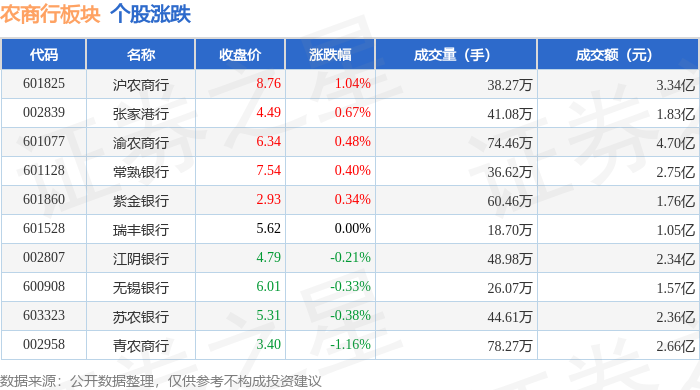
农商行板块8月28日涨0.41%,沪农商行领涨,主力资金净流入979.2万元
Zheng Xing Xing Ye Ri Bao· 2025-08-28 08:43
Market Performance - The agricultural commercial bank sector increased by 0.41% on August 28, with Shanghai Agricultural Commercial Bank leading the gains [1] - The Shanghai Composite Index closed at 3843.6, up 1.14%, while the Shenzhen Component Index closed at 12571.37, up 2.25% [1] Individual Stock Performance - Shanghai Agricultural Commercial Bank (601825) closed at 8.76, up 1.04% with a trading volume of 382,700 shares and a transaction value of 334 million [1] - Zhangjiagang Bank (002839) closed at 4.49, up 0.67% with a trading volume of 410,800 shares and a transaction value of 183 million [1] - Chongqing Agricultural Commercial Bank (601077) closed at 6.34, up 0.48% with a trading volume of 744,600 shares and a transaction value of 470 million [1] - Jiangyin Bank (002807) closed at 4.79, down 0.21% with a trading volume of 489,800 shares and a transaction value of 234 million [1] Capital Flow Analysis - The agricultural commercial bank sector saw a net inflow of 9.792 million from institutional investors and a net inflow of 43.4504 million from retail investors, while individual investors experienced a net outflow of 53.2424 million [1] - Chongqing Agricultural Commercial Bank had a net inflow of 32.1428 million from institutional investors, while retail investors had a net outflow of 786.10 thousand [2] - Jiangyin Bank experienced a net inflow of 1.0032 million from institutional investors, with a net outflow of 2.76418 million from retail investors [2]


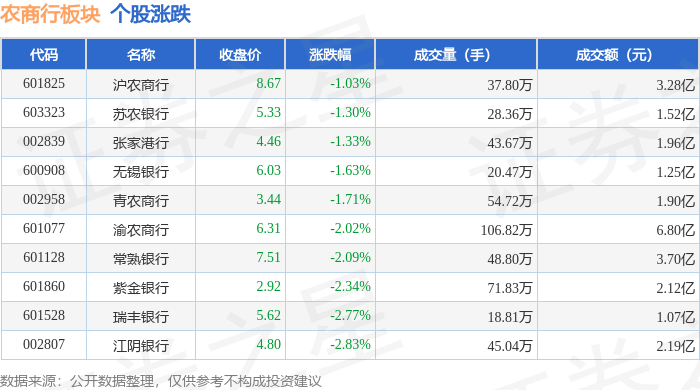
农商行板块8月27日跌1.68%,江阴银行领跌,主力资金净流出8013.69万元
Zheng Xing Xing Ye Ri Bao· 2025-08-27 08:46
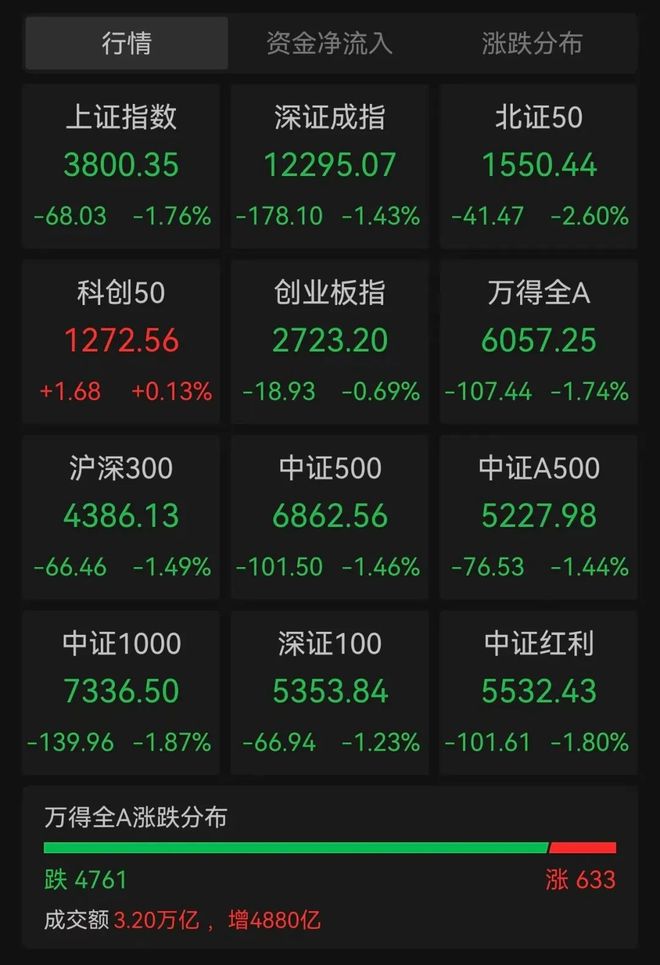
Market Performance - The agricultural commercial bank sector declined by 1.68% on August 27, with Jiangyin Bank leading the drop [1] - The Shanghai Composite Index closed at 3800.35, down 1.76%, while the Shenzhen Component Index closed at 12295.07, down 1.43% [1] Individual Stock Performance - Notable declines in individual stocks include: - Jiangyin Bank: -2.83% closing at 4.80 [1] - Chongqing Rural Commercial Bank: -2.02% closing at 6.31 [1] - Common declines across other banks such as Zijin Bank (-2.34%) and Ruifeng Bank (-2.77%) [1] Trading Volume and Capital Flow - The total net outflow of main funds from the agricultural commercial bank sector was 80.14 million yuan, while retail funds saw a net inflow of 427,100 yuan [1] - The trading volume for major stocks included: - Jiangyin Bank: 450,400 shares traded with a transaction value of 219 million yuan [1] - Chongqing Rural Commercial Bank: 1,068,200 shares traded with a transaction value of 680 million yuan [1] Detailed Capital Flow Analysis - Key capital flow data for selected banks: - Su Nong Bank: Main funds net inflow of 12.16 million yuan, retail net outflow of 10.25 million yuan [2] - Qing Nong Bank: Main funds net inflow of 9.05 million yuan, retail net outflow of 5.90 million yuan [2] - Jiangyin Bank: Main funds net inflow of 7.65 million yuan, retail net outflow of 17.77 million yuan [2] - Significant outflows were observed in: - Zijin Bank: Main funds net outflow of 21.16 million yuan [2] - Common Agricultural Bank: Main funds net outflow of 26.58 million yuan [2]
沪指跌超1.7%,超4700股下跌
2 1 Shi Ji Jing Ji Bao Dao· 2025-08-27 07:27
Market Overview - The A-share market experienced a significant decline, with the Shanghai Composite Index dropping over 1.7% and the Shenzhen Component Index falling by 1.43% [1][2] - A total of 4,761 stocks declined, while the trading volume exceeded 3 trillion yuan, an increase of 488 billion yuan compared to the previous day [1][2] Sector Performance - The financial sector led the declines, with notable drops in bank stocks such as Postal Savings Bank down over 4% and Everbright Bank down 2.78% [2][3] - Other sectors like liquor, coal, and real estate also saw significant declines, with major liquor brands like Luzhou Laojiao and Gujing Gongjiu experiencing drops of 4.97% and 4.43% respectively [4][3] Investment Trends - There has been a notable increase in the number of new A-share accounts, with 1.9636 million new accounts opened in July 2025, marking a year-on-year increase of 70.54% [7] - The active user base for securities apps reached 167 million, reflecting a 3.36% month-on-month increase and a 20.89% year-on-year increase [7] - Investors are shifting from traditional savings to equity markets, with a significant reduction in household deposits by 1.1 trillion yuan in July [8] Economic Insights - The preference for bond assets is expected to decline as the yield center decreases, leading to an increased allocation towards equity assets among domestic investors [9] - The focus on corporate earnings is rising as the A-share market enters the peak reporting season, with sectors like TMT, consumer goods, and manufacturing showing strong Q2 performance [11] Future Outlook - The liquor industry is anticipated to reach a bottom by Q3 2025, with expectations of a gradual recovery in the second half of the year [13] - The consumer sector, particularly leading companies, may benefit from foreign capital inflows, providing support to the market [13]




A股银行股走弱,邮储银行跌超3%
Ge Long Hui A P P· 2025-08-27 05:54
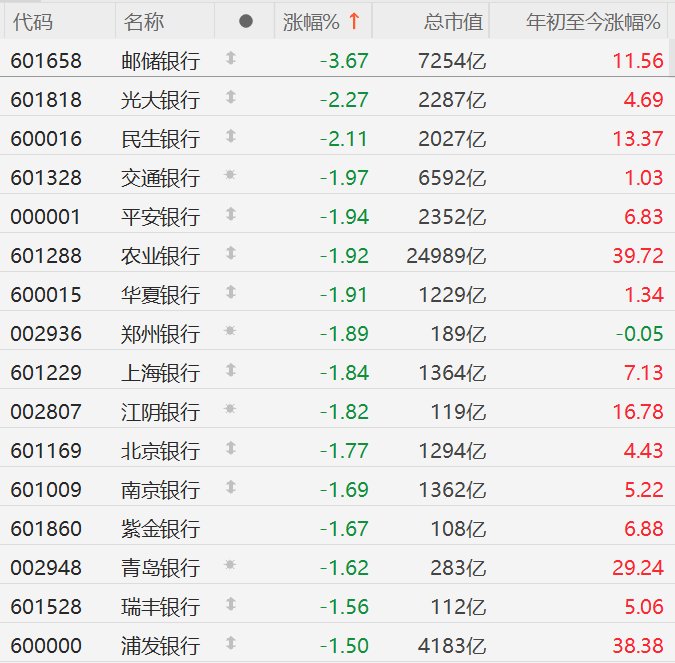
Core Viewpoint - The A-share banking sector is experiencing a continuous decline, with notable drops in several major banks' stock prices, indicating a bearish trend in the market [1]. Group 1: Stock Performance - Postal Savings Bank of China (邮储银行) saw a decline of 3.67%, with a total market capitalization of 725.4 billion [2]. - China Everbright Bank (光大银行) decreased by 2.27%, with a market cap of 228.7 billion [2]. - Minsheng Bank (民生银行) fell by 2.11%, having a market value of 202.7 billion [2]. - Agricultural Bank of China (农业银行) dropped by 1.92%, with a significant market cap of 2,498.9 billion [2]. - Other banks such as Huaxia Bank (华夏银行) and Bank of Communications (交通银行) also experienced declines, with respective drops of 1.91% and 1.97% [2]. Group 2: Year-to-Date Performance - Despite the recent declines, Postal Savings Bank has a year-to-date increase of 11.56% [2]. - Minsheng Bank shows a year-to-date increase of 13.37% [2]. - Agricultural Bank of China has a substantial year-to-date increase of 39.72%, indicating strong performance earlier in the year [2].

江阴银行(002807) - 2025年8月25日投资者关系活动记录表
2025-08-26 09:26
Group 1: Loan Quality and Risk Management - As of June 30, 2025, the bank's non-performing loan (NPL) ratio is 0.86%, maintaining stability since the beginning of the year [2] - The bank has not disclosed specific NPL rates for real estate loans, personal consumption loans, and personal business loans [2] - The bank focuses on credit quality control, optimizing credit structure, and enhancing post-loan management to mitigate risks [2] Group 2: Profitability and Provisioning - In the first half of 2025, the bank's net profit attributable to shareholders increased by 16.63% year-on-year [3] - The provision coverage ratio stands at 381.22%, an increase of 1 percentage point from the beginning of the year [3] - Future write-offs and provisions will be adjusted based on asset quality, credit scale, and macroeconomic conditions [3]