证券类APP

Search documents
金融行业双周报(2026、2、13-2026、2、26)-20260227
Dongguan Securities· 2026-02-27 09:04
Investment Ratings - Banking: Overweight (Maintain) [1] - Securities: Market Weight (Maintain) [1] - Insurance: Overweight (Maintain) [1] Core Insights - The report indicates a stabilization and recovery in social financing growth, with significant improvement in short-term loans for residents [1] - As of January, the total social financing stock was 449.11 trillion yuan, with a month-on-month growth rate increase of 1.1 percentage points to 1.6% [44] - The report highlights a notable increase in personal short-term loans, reflecting stronger consumer sentiment ahead of the holiday season [44] - The insurance sector showed a robust performance in 2025, with total premium income reaching 61,194 billion yuan, a year-on-year growth of 7.43% [47] Summary by Sections Market Review - As of February 26, 2026, the banking, securities, and insurance indices experienced declines of -1.61%, -1.61%, and -4.91% respectively, while the CSI 300 index rose by 0.15% [9] - Among the sub-sectors, Huaxia Bank (+1.06%), First Venture (+5.83%), and New China Life (-4.16%) were the best performers [9] Valuation Situation - As of February 26, 2026, the banking sector's price-to-book (PB) ratio was 0.68, with state-owned banks, joint-stock banks, city commercial banks, and rural commercial banks having PB ratios of 0.72, 0.56, 0.72, and 0.61 respectively [19] - The securities sector's PB ratio was 1.43, indicating potential for valuation recovery [23] Recent Market Indicators - The average daily trading volume in the A-share market was 24,023.87 billion yuan, reflecting a 14.70% increase week-on-week [33] - The average margin balance remained stable between 26,142 billion and 26,585 billion yuan, indicating a slight recovery in investor sentiment [46] Industry News - In January 2026, the incremental social financing was 7.22 trillion yuan, exceeding the previous year's figure by 1,662 billion yuan [40] - Insurance funds are expected to continue entering the market in 2026, with a significant increase in stock allocations anticipated [41] Company Announcements - Ningbo Bank announced a valuation enhancement plan approved by its board [43] - Ping An Bank plans to redeem all of its preferred shares on March 9, 2026, totaling 20 billion yuan [43] Weekly Perspectives - The banking sector is advised to focus on regional banks with strong performance certainty, such as Ningbo Bank and Chengdu Bank [45] - The securities sector should consider stocks with restructuring expectations, including Zheshang Securities and Guolian Minsheng [46] - The insurance sector is recommended to focus on companies with leading premium growth, such as China Pacific Insurance and China Life [49]
非银周报:非银板块仍处于低配状态,短期资金面扰动不改基本面向上趋势-20260125
SINOLINK SECURITIES· 2026-01-25 12:39
Investment Rating - The report suggests a positive outlook for the securities sector, indicating a potential for significant gains in the coming months, particularly for quality brokers with valuation mismatches [2][43]. Core Insights - The securities sector remains underweight, with a public fund holding value of 11.8 billion yuan, reflecting a 14% quarter-on-quarter increase. The industry allocation ratio is at 0.73%, which is still 2.67 percentage points below the benchmark, although this gap has narrowed by 0.29 percentage points [1]. - The monthly active users of securities apps reached 175 million in December 2025, marking a 1.75% increase from the previous month and a 2.26% increase year-on-year, setting a new monthly record for 2025 [1][39]. - The report anticipates strong profit growth for brokers in Q1 2026, highlighting opportunities for sector rebound [1]. Summary by Sections Securities Sector - The report notes that the securities sector is currently underweight, with a public fund holding value of 11.8 billion yuan, which is a 14% increase quarter-on-quarter. The industry allocation ratio stands at 0.73%, still 2.67 percentage points below the benchmark, but this gap has narrowed by 0.29 percentage points [1]. - Monthly active users of securities apps reached 175 million in December 2025, reflecting a 1.75% month-on-month growth and a 2.26% year-on-year increase, achieving a new monthly high for 2025 [1][39]. - The report projects a bright profit growth outlook for brokers in Q1 2026, suggesting a focus on rebound opportunities within the sector [1]. Investment Recommendations - The report recommends focusing on three main lines: 1. Strongly recommend high-quality brokers with significant valuation and performance mismatches, particularly highlighting Guotai Junan [2]. 2. Attention to Sichuan Shuangma, which is positioned well in the technology sector and is expected to benefit from investments in gene therapy [2]. 3. Highlighting multi-financial firms with impressive performance growth, suggesting a focus on Yixin Group, Far East Horizon, and Jiufang Zhitu Holdings [2]. Insurance Sector - The latest research indicates that the preset interest rate for life insurance is at 1.89%, with expectations that it will not decrease further in 2026 [3]. - China Pacific Insurance announced a profit increase forecast of 215%-225% for 2025, primarily due to favorable investment conditions and tax adjustments [4]. - The report maintains a positive recommendation for the insurance sector, emphasizing the upward trend in both short-term and long-term fundamentals [5]. Market Dynamics - The report highlights that the A-share market has shown mixed performance, with the non-bank financial sector underperforming the broader market [11]. - The report also notes significant growth in the issuance of equity funds and bond underwriting, indicating a robust capital market environment [17]. Regulatory Updates - The China Securities Regulatory Commission has released new guidelines for the performance benchmarks of publicly offered securities investment funds, aiming to enhance transparency and accountability in the sector [38].

1.19犀牛财经晚报:IMF上调中国经济增长预期
Xi Niu Cai Jing· 2026-01-19 10:26
Group 1 - IMF raised China's economic growth forecast for 2025 by 0.2 percentage points to 5% and also increased the 2026 growth expectations [1] - The People's Bank of China lowered the re-lending and rediscount rates by 0.25 percentage points, which is expected to enhance credit supply to key sectors [1] - In December 2025, the monthly active users of securities apps reached 175 million, marking a 1.75% month-on-month increase and a 2.26% year-on-year increase, setting a new monthly record for that year [1] Group 2 - The number of private equity firms with over 10 billion yuan in assets has reached 114, with the addition of one firm and two exits from this category [2] - Michael Burry warned about the AI bubble, predicting a prolonged downturn in the tech industry due to overspending on data centers and microchips [2] Group 3 - The gold price in Shenzhen's Shui Bei market reached 1200 yuan per gram, up from approximately 1126 yuan at the beginning of January [3] - Global DRAM supply is expected to be revised upward by 2027 due to Micron's acquisition plans, which will enhance advanced DRAM production capacity [3] Group 4 - Porsche's global sales in 2025 were 279,400 units, a 10% decline year-on-year, with a significant drop of 26.28% in the Chinese market [4] - Three squirrels confirmed a price adjustment for some products due to rising logistics and labor costs as the Spring Festival approaches [4] Group 5 - West Securities Research Director Mu Qiguo is set to resign from his position [5] - Greenland Holdings has had 3.71 billion yuan worth of shares frozen for three years by a court [5] Group 6 - Vanke has been listed as an execution target for over 1.08 billion yuan by a court [6] - The China Securities Regulatory Commission imposed a three-year market ban on Jin Yongrong for manipulating the securities market [7] Group 7 - Shenzhen Pengcheng New Energy Technology Co., Ltd. has initiated IPO counseling for A-shares [8] - Jiangxi Copper signed a cooperation framework agreement with China Ordnance Material Group for the purchase and sale of copper and nickel products [9] Group 8 - Huazhong Cable terminated its acquisition of Hunan Xingxin Aerospace New Materials Co., Ltd. due to disagreements on specific terms [10] - Zhonghe Technology won a 141 million yuan project for the Chongqing Rail Transit signal system [11] Group 9 - New Fengming plans to acquire a 35% stake in a port development company for 259 million yuan [12] - Chongqing Construction won a construction project worth approximately 1.023 billion yuan [13] Group 10 - Nanjing Commercial Travel expects a net profit decline of 75.90% to 83.57% for 2025 [14] - Ruimai Te anticipates a net profit increase of 22.28% to 51.24% for 2025 [15] Group 11 - Fulai Ente expects a net profit growth of 81.67% to 127.08% for 2025 [16] - Libang Instruments forecasts a net profit increase of 75% to 105% for 2025 [17] Group 12 - Ding Tong Technology expects a net profit increase of approximately 120% for 2025 [19] - E-Dian Tianxia's stock will resume trading on January 20 after a suspension for price volatility [20] Group 13 - The three major indices showed mixed results, with the Shanghai Composite Index rising by 0.29% and the ChiNext Index falling by 0.7% [21]
证券ETF鹏华(159993)盘中净申购3200万份,12月证券类APP月活达1.75亿
Xin Lang Cai Jing· 2026-01-19 06:59
Group 1 - The number of monthly active users for securities apps reached 175 million in December 2025, marking a month-on-month increase of 1.75% and a year-on-year increase of 2.26%, setting a new monthly record for 2025 [1] - CITIC Securities highlighted that the latest draft for public consultation focuses on serving the real economy, enhancing the inclusiveness of the capital market, and preventing systemic risks, establishing a clear and sustainable regulatory framework for the derivatives market [1] - Securities companies with strong compliance capabilities and superior product and service offerings are expected to gain more stable development opportunities in an increasingly regulated market environment [1] Group 2 - As of January 19, 2026, the constituents of the Guozheng Securities Leading Index (399437) showed mixed performance, with Guolian Minsheng leading with a 2.49% increase, followed by Caitong Securities at 0.58%, and Changjiang Securities at 0.35% [1] - The Securities ETF Penghua (159993) closely tracks the Guozheng Securities Leading Index, reflecting the market performance of quality listed companies in the securities theme of the Shanghai and Shenzhen markets, and providing investors with richer index investment tools [1] - As of December 31, 2025, the top ten weighted stocks in the Guozheng Securities Leading Index accounted for 79.13% of the total index weight, including companies like Dongfang Caifu, CITIC Securities, and Huatai Securities [2]

四连涨终结,炒股软件流量下降,两融新开账户数同步下滑
2 1 Shi Ji Jing Ji Bao Dao· 2025-11-19 15:11
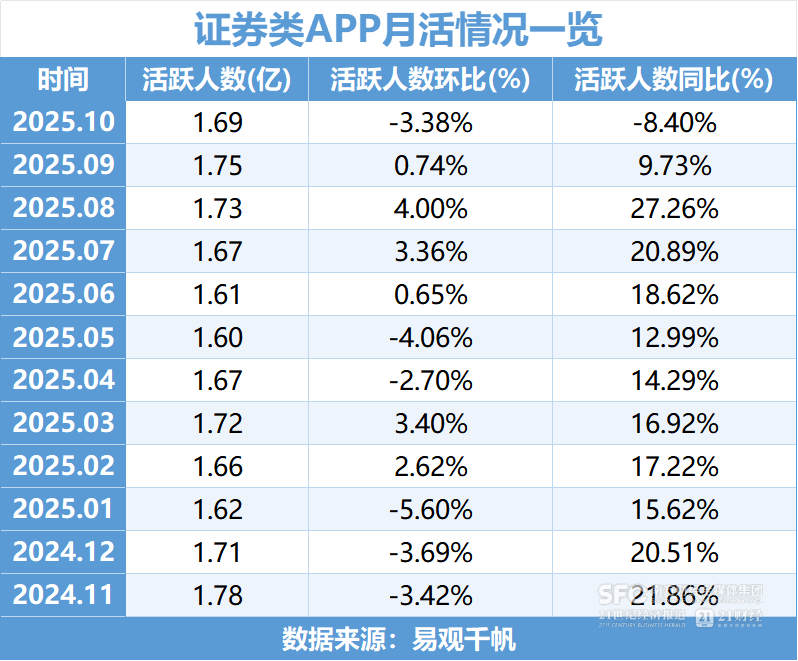
Core Insights - The active user count for securities apps has declined after four consecutive months of growth, with October seeing a total of 169 million active users, representing a year-on-year decrease of 8.40% and a month-on-month decrease of 3.38% [1][2][5] - The decline in active users is attributed to market fluctuations and changes in investor behavior, particularly after the Shanghai Composite Index surpassed 4000 points, leading to profit-taking pressures and increased investor caution during the National Day holiday [1][5][12] - Despite the overall decline, some smaller securities apps and specialized tools have shown positive growth, indicating a divergence in user engagement across different platforms [12][14] User Activity Trends - In October, the top 50 securities apps all experienced a decline in active users, with only Huatai Securities' "Zhang Le Wealth" app surpassing 10 million active users [10][11] - The top three third-party apps, Tonghuashun, Dongfang Wealth, and Dazhihui, continue to dominate the market with significant user bases, while the gap between third-party apps and broker-owned apps is gradually narrowing [8][12] - The overall user activity in October was the fourth highest of the year, following a peak in September, which saw 175 million active users [11][12] Market Dynamics - The market's high base effect from October 2024 has put pressure on year-on-year comparisons, contributing to the observed declines in user activity [1][5][11] - The number of new A-share accounts opened in October 2025 was 2.31 million, reflecting a month-on-month decline, which aligns with the decrease in app activity [8][12] - The competitive landscape among the top 50 apps remained stable, with no changes in rankings despite the overall decline in user activity [11][12] Technological Advancements - Securities firms are increasingly investing in financial technology, transitioning their apps from basic trading tools to comprehensive wealth management platforms that integrate research, education, and lifestyle services [3][14][15] - The integration of AI technologies is becoming a focal point for firms, with new AI-driven applications being launched to enhance user experience and engagement [14][15] - The emphasis on user-centric services and intelligent solutions is seen as essential for navigating market fluctuations and ensuring long-term growth [15][16]





四连涨终结,炒股软件流量下降,两融新开账户数同步下滑
21世纪经济报道· 2025-11-19 15:05
Core Viewpoint - The active user count of securities apps has declined in October after four consecutive months of growth, influenced by high market volatility and changes in investor behavior [1][3]. User Activity Summary - In October 2025, the monthly active users of securities apps reached 169 million, marking an 8.40% year-on-year decline and a 3.38% month-on-month decrease, ending a four-month growth streak [2][5]. - The peak user activity was recorded in September 2025, with 175 million users, the highest monthly figure for the year [1][10]. - The decline in October is attributed to profit-taking pressures after the Shanghai Composite Index surpassed 4000 points and increased investor caution due to the National Day holiday [3][5]. Top Securities Apps Performance - Among third-party securities apps, Tonghuashun led with over 30 million active users, followed by Dongfang Caifu and Dazhihui, both exceeding 10 million [1][6]. - In the brokerage self-operated apps, Huatai's Zhangle Wealth app surpassed 10 million users, while Guotai Haitong's Junhong app fell below that threshold [1][6]. Market Dynamics - The top 50 securities apps all experienced a decline in active users in October, with the average decrease being 3.59% compared to September [10]. - Despite the overall decline, some smaller securities apps and specialized tools showed positive growth, indicating a divergence in user engagement across different platforms [11][12]. AI Integration in Securities Apps - The industry is witnessing a shift towards integrating AI technologies into securities apps, enhancing user experience and service offerings [14][15]. - Major firms like Huatai Securities and Guotai Haitong are launching independent AI applications to improve trading, analysis, and user engagement [14][15].


沪指跌超1.7%,超4700股下跌
2 1 Shi Ji Jing Ji Bao Dao· 2025-08-27 07:27
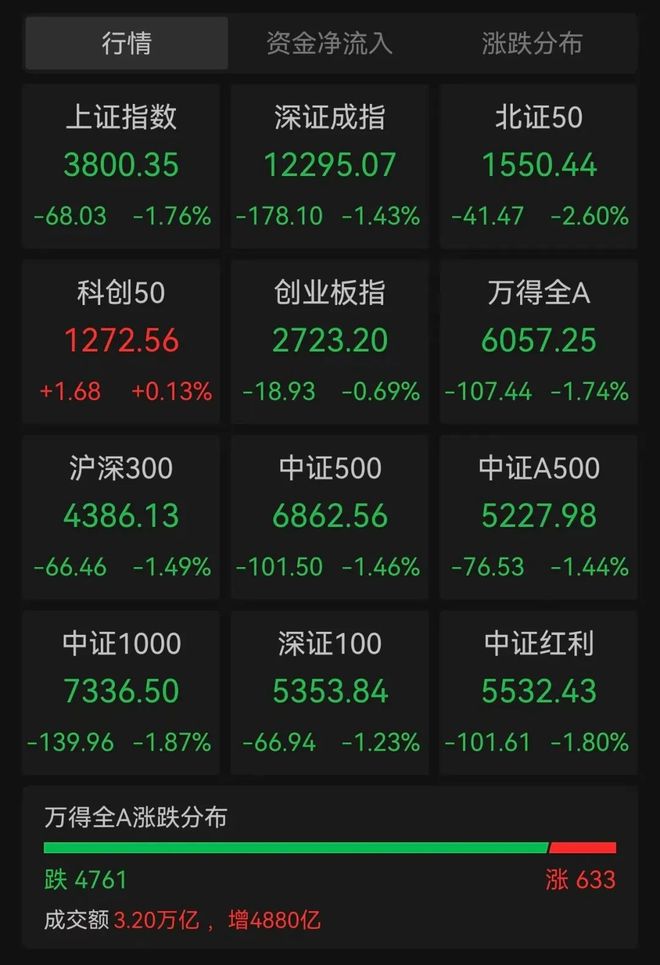
Market Overview - The A-share market experienced a significant decline, with the Shanghai Composite Index dropping over 1.7% and the Shenzhen Component Index falling by 1.43% [1][2] - A total of 4,761 stocks declined, while the trading volume exceeded 3 trillion yuan, an increase of 488 billion yuan compared to the previous day [1][2] Sector Performance - The financial sector led the declines, with notable drops in bank stocks such as Postal Savings Bank down over 4% and Everbright Bank down 2.78% [2][3] - Other sectors like liquor, coal, and real estate also saw significant declines, with major liquor brands like Luzhou Laojiao and Gujing Gongjiu experiencing drops of 4.97% and 4.43% respectively [4][3] Investment Trends - There has been a notable increase in the number of new A-share accounts, with 1.9636 million new accounts opened in July 2025, marking a year-on-year increase of 70.54% [7] - The active user base for securities apps reached 167 million, reflecting a 3.36% month-on-month increase and a 20.89% year-on-year increase [7] - Investors are shifting from traditional savings to equity markets, with a significant reduction in household deposits by 1.1 trillion yuan in July [8] Economic Insights - The preference for bond assets is expected to decline as the yield center decreases, leading to an increased allocation towards equity assets among domestic investors [9] - The focus on corporate earnings is rising as the A-share market enters the peak reporting season, with sectors like TMT, consumer goods, and manufacturing showing strong Q2 performance [11] Future Outlook - The liquor industry is anticipated to reach a bottom by Q3 2025, with expectations of a gradual recovery in the second half of the year [13] - The consumer sector, particularly leading companies, may benefit from foreign capital inflows, providing support to the market [13]