Slack

Search documents
From Digg to deals: Kevin Rose on reinvention and investing at TechCrunch Disrupt 2025
Yahoo Finance· 2025-09-24 15:00
Core Insights - Kevin Rose, the founding CEO of Digg, will return to TechCrunch Disrupt 2025 to discuss the relaunch of Digg and share insights on product development, community building, and navigating challenges [1][5] - Over the past decade, Rose has become a prominent early-stage investor in Silicon Valley, supporting startups in consumer tech and crypto as a partner at True Ventures [2][6] - The event will feature a session where Rose will discuss evaluating founders, identifying opportunities, and applying lessons from his entrepreneurial experiences to current investing practices [8] Company Insights - Digg is undergoing a reboot, with Rose serving as board chair and advisor, leveraging his extensive entrepreneurial background [5] - Rose's investment portfolio includes notable companies such as Twitter, Facebook, Solana, OpenAI, and Magic Spoon, highlighting his influence in the tech and media sectors [6] Industry Insights - TechCrunch Disrupt 2025 is expected to attract over 10,000 founders, investors, and operators, emphasizing the event's significance in the tech industry [9] - The session with Rose will focus on critical strategies for startups, including the importance of pivoting and maintaining conviction in a competitive market [8]
European Commission OKs Microsoft's Proposals to Resolve Teams Antitrust Probe
PYMNTS.com· 2025-09-12 14:40
Core Points - The European Commission has accepted Microsoft's proposals to address competition concerns regarding its Teams platform [1][2] - The decision resolves an antitrust investigation initiated in July 2023, focusing on whether Microsoft violated EU competition rules by tying Teams to its Office 365 and Microsoft 365 suites [2][5] Commitments and Changes - Microsoft's commitments include increasing the price difference between Microsoft 365 and Office 365 suites with and without Teams, ensuring that websites offering a suite with Teams also provide one without Teams, and publishing information on interoperability and data portability [3][4] - The commitments related to interoperability and portability will last for 10 years, while other commitments will be in effect for 7 years [4] Impact on Competition - The European Commission's decision aims to end Microsoft's tying practices that may hinder competition against Teams, thereby promoting a more competitive market for communication and collaboration products [5][6] - The investigation was prompted by a complaint from Slack in 2020, alleging that Microsoft violated competition law by tying Teams to its Office productivity suite [6][7]



Microsoft slips unscathed through EU competition probe after promising to unbundle Teams
TechCrunch· 2025-09-12 13:09
Core Viewpoint - Microsoft has successfully navigated a significant antitrust investigation by the European Commission by agreeing to unbundle its Teams app from its Office productivity suites, avoiding potential massive fines [1][2][8]. Group 1: Investigation and Findings - The European Commission approved Microsoft's concessions to address competition concerns regarding the bundling of Teams with its Office suite, concluding a multi-year investigation initiated by complaints from Slack in 2020 [2][4]. - The Commission accused Microsoft of breaching competition rules by bundling Teams, which granted the app an undue advantage due to its integration with other Microsoft 365 applications [4][8]. Group 2: Microsoft's Commitments - Microsoft has committed to offering Microsoft 365 and Office 365 without Teams at a 50% lower price for the next seven years, allowing customers to choose whether to pay more for the collaboration app [3][7]. - The company will also open its APIs to enable interoperability with third-party messaging and collaboration tools and allow data export from Teams for the next five years [3][9]. Group 3: Implications and Outcomes - The approval is seen as a win for both the EU and Microsoft, as it avoids a legal battle and allows the Commission to claim a significant compromise from a major tech player [7][10]. - The Commission noted that Slack and Alfaview have withdrawn their complaints following a market test, indicating a potential resolution of competitive concerns [8].

Microsoft Teams dispute resolved, five years after Slack complaint
GeekWire· 2025-09-12 11:51
Core Viewpoint - Microsoft has committed to providing simplified versions of its productivity suites that exclude the Teams communication service, which has been accepted by the European Commission, thereby resolving a significant antitrust issue [1] Group 1 - The European Commission's acceptance of Microsoft's commitment marks a resolution to a high-profile antitrust case [1] - The stripped-down versions of productivity suites aim to enhance competition in the market by offering alternatives without the Teams service [1]

Anthropic's $10B Round, Klarna's IPO, Inside a16z's 72 Deal Seed Investment Machine ft. Marc Benioff
20VC with Harry Stebbings· 2025-08-28 14:03
Investments and Acquisitions - Scale led investments in category leaders such as Billcom, Box, DocuSign, and WalkMe [1] - Salesforce expanded through major acquisitions including Slack, Tableau, and MuleSoft [1] - Anthropic's funding round reached $10 billion [1] - a16z made 72 seed investments compared to Sequoia's 27 [1] Market Trends and Dynamics - Discussion on whether SaaS apps will disappear in an AI world [1] - Analysis of the evolution of Sales Development Representatives (SDRs) due to AI [1] - Debate on who will win in the AI race: OpenAI or Anthropic [1] - Klarna's valuation experienced a wild ride, from $45 billion to $6 billion, then aiming for a $15 billion IPO [1] Leadership and Strategy - Consideration of whether Marc Benioff feels the need to acquire AI talent like Mark Zuckerberg [1] - Examination of Salesforce's learnings from Palantir on forward-deployed engineers [1] - Discussion on whether consensus investing is dangerous or the only viable strategy [1]


爆火的Lovable:AI建站工具,8个月达到1亿美元ARR,速度之快超过了Cursor
硬AI· 2025-08-04 09:46
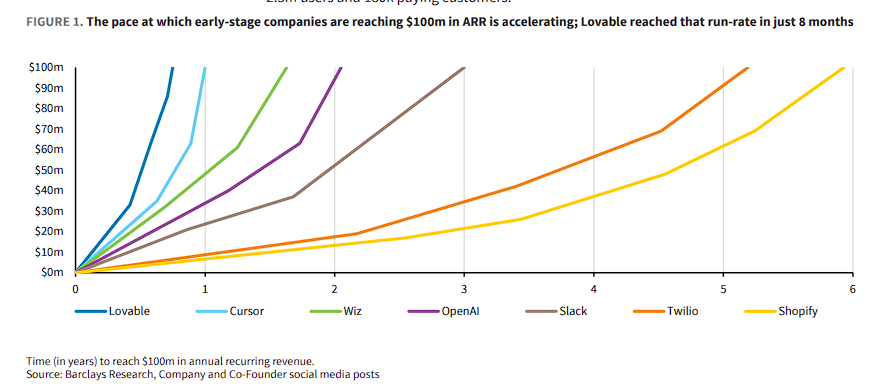
Core Insights - Lovable, an AI website building tool, is rapidly transforming the website development market, achieving significant milestones in a short time frame [3][5][15] - Barclays reports that Lovable reached $100 million in Annual Recurring Revenue (ARR) within 8 months, surpassing the growth rates of established AI tools like Cursor and OpenAI [3][5][13] - The rise of Lovable poses a substantial threat to traditional website builders such as Wix and GoDaddy, which are struggling to adapt to the fast-paced technological changes [3][15][16] Growth Metrics - Lovable created 2.5 million websites in June alone, with user numbers reaching 2.3 million by late July [2][3] - The company achieved $4 million in ARR within just 4 weeks of product launch, with 9,000 paying customers [7] - By February 2025, Lovable's ARR is projected to grow to $17 million, with over 300,000 users [8] - In March, the company added 1,500 new customers daily, marking a nearly 50% week-over-week growth, and increased paying customers to 45,000 [9] - After reaching $50 million ARR in June, Lovable doubled its revenue in just two months [10] - Current data shows Lovable has 2.3 million users and 180,000 paying customers [11] Market Impact - The rapid growth of Lovable indicates a strong market demand for AI-native website building tools, with a significant portion of this demand coming from non-programmers who can now create websites easily [13] - The emergence of Lovable has reignited discussions about the potential disruption of traditional web tool companies, particularly Wix and GoDaddy [15] - Despite the challenges posed by new entrants, GoDaddy and similar companies may still benefit from their established services in domain registration and email productivity applications [15][16]

爆火的Lovable:AI建站工具,8个月达到1亿美元ARR,速度之快超过了Cursor
Hua Er Jie Jian Wen· 2025-08-02 13:33
Core Insights - Lovable, an AI website building tool, has achieved unprecedented growth, reaching $100 million in annual recurring revenue (ARR) within just 8 months, surpassing the growth rates of established AI tools like Cursor [1][2] - The company completed a $200 million Series A funding round at an $18 billion valuation, indicating strong investor confidence in its business model and market potential [1][2] Growth Metrics - Lovable created 2.5 million websites in June alone, with user numbers reaching 2.3 million by late July, showcasing a rapid adoption rate [1][8] - The company reached $4 million ARR within 4 weeks of its product launch and had 9,000 paying customers [8] - By February 2025, ARR increased to $17 million with over 300,000 users, and by March, the company was adding 1,500 new customers daily, marking a nearly 50% week-over-week growth [8] Market Impact - The rise of Lovable poses a significant threat to traditional website builders like Wix and GoDaddy, as the demand for AI-driven solutions grows [1][9] - Barclays analysts note that while traditional companies are integrating AI features, they may struggle to adapt quickly during major technological shifts [9] - Despite the potential disruption, companies like GoDaddy may still benefit from their core services, such as domain registration and email productivity applications, which remain in demand [9]
用生物进化论解构科技企业兴衰史
Sou Hu Cai Jing· 2025-07-31 13:38
Core Insights - The lifecycle of technology companies mirrors biological evolution, where only a small fraction survive through continuous adaptation and innovation [1][8] - Successful companies like Amazon and Netflix exemplify beneficial mutations, while failures like Kodak highlight the consequences of resistance to change [1][6] - The tech ecosystem is shaped by collaborative evolution, where partnerships can lead to mutual benefits but also pose risks of dependency [4][6] Group 1: Evolution and Adaptation - The principle of natural selection in the tech industry is represented by user choice, where products that best meet user needs thrive [2][4] - Companies must continuously optimize their offerings to survive in a competitive landscape, creating a feedback loop between user preferences and corporate evolution [2][4] - Extinction events, such as financial crises and pandemics, can reshape the tech landscape by eliminating weaker players and allowing survivors to expand [6][8] Group 2: Innovation and Competition - The Red Queen effect illustrates the relentless competition in the tech sector, where companies must innovate continuously to maintain their market position [6][8] - Random innovations, akin to genetic drift, can lead to unexpected successes, but companies must also establish systematic innovation processes to sustain growth [7][8] - The history of tech companies reveals that adaptability is more crucial than current advantages, emphasizing the importance of learning and transformation [8] Group 3: Collaborative Ecosystems - Symbiotic relationships between companies and their partners can enhance ecosystem health, but over-reliance on a single platform can lead to collective failure [4][6] - Geographic isolation fosters differentiated competition, allowing local companies to innovate without direct competition from global giants [4][6] - The decline of certain technologies, like Flash, demonstrates the risks associated with dependency on specific platforms within the tech ecosystem [4][6]

帮30家独角兽定价,这位最懂AI产品定价的人却说:95%AI初创公司的定价都错了
3 6 Ke· 2025-07-31 12:20
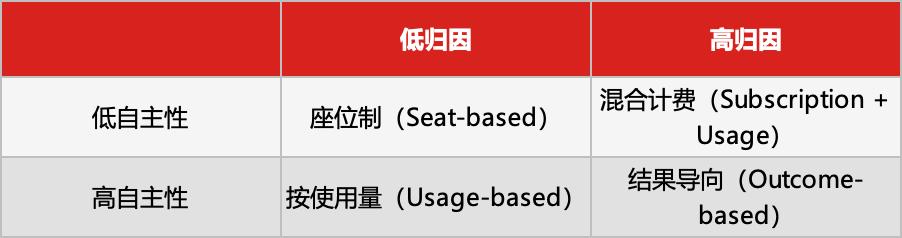
Core Insights - The article emphasizes the critical importance of pricing strategies for AI products, highlighting that traditional SaaS pricing models may not be suitable for AI applications due to their unique value propositions and capabilities [2][3][4]. Group 1: AI Pricing Challenges - AI products create significant value from day one, yet many founders still adopt low subscription pricing, failing to capture the true value [3][4]. - Early user pricing anchors can lead to long-term challenges, making it difficult to raise prices later even if the product delivers substantial value [4][12]. - The "AI Pricing Four Quadrants" model categorizes pricing strategies based on attribution ability and autonomy, suggesting different models for different types of AI products [4][10]. Group 2: Common Pricing Traps - Many AI startups fall into the trap of setting low prices, which can lock them into a low-value perception and hinder future growth [11][12]. - Using free trials for proof of concept (POC) without establishing a clear value proposition can waste resources and fail to convert leads into paying customers [16][23]. - Treating AI as a traditional SaaS product overlooks its potential to replace human roles, necessitating a shift in pricing strategies to reflect the value delivered [17][19]. Group 3: Effective Pricing Strategies - Establishing a commercial attribution model from day one is crucial for demonstrating ROI and justifying pricing [21][22]. - Charging for POCs can filter out non-serious inquiries and set the stage for meaningful commercial discussions [23][24]. - Implementing tiered pricing strategies allows customers to choose options that reflect their perceived value, enhancing the overall pricing framework [27][28]. Group 4: New Pricing Paradigms - The article introduces a dual-engine strategy for AI companies, focusing on both market share and wallet share to ensure sustainable growth [34][36]. - AI products must demonstrate clear attribution of value and possess automation capabilities to justify higher pricing [37][39]. - The ultimate goal is to integrate AI deeply into customer processes, allowing for expanded usage and higher willingness to pay [41][42].
Jinqiu Select | 价格即品牌:AI产品定价如何重塑企业增长逻辑
锦秋集· 2025-07-28 14:38
Core Insights - The article emphasizes that sustainable growth for companies is driven by two engines: market share and wallet share, which must be balanced to avoid stagnation or financial difficulties [1][10] - The rise of AI technology has shifted pricing strategies from user count to actual usage and the value created, making pricing a strategic decision throughout product design and operations [2][3] Pricing Strategies - A growing number of AI companies are adopting hybrid pricing models that combine subscription fees with usage-based billing, though designing these models can be complex [4][5] - Clay's pricing strategy exemplifies hybrid pricing, offering a subscription package with usage credits, which encourages customer retention and avoids revenue erosion from large discounts [5] - The popularity of hybrid pricing is attributed to its ability to smoothly transition from traditional models, provide natural upsell paths, safeguard profits, and maintain predictable costs for customers [6][7] Common Pricing Models - Various pricing models are discussed, including pay-as-you-go, capped usage fees, and platform fees combined with usage fees, each with its own advantages and challenges [8][9] - Companies should adapt their pricing strategies based on their product's value delivery and customer preferences, potentially combining different models as they grow [9] Market Share and Wallet Share Strategy - Companies must focus on both acquiring new customers (market share) and maximizing revenue from existing customers (wallet share) to achieve sustainable growth [10][11] - Early-stage companies should prioritize product development and user growth, while later stages should enhance monetization capabilities, ensuring both engines are operational [11] Pricing Misconceptions - Entrepreneurs often fall into pricing traps by focusing too heavily on one growth engine, leading to missed opportunities or customer loss [13][14] - Common pitfalls include overemphasizing market share at the expense of retention, complicating pricing structures, and misjudging the relationship between price and perceived value [14] Value Attribution and Pricing Models - A 2x2 pricing model framework is proposed, categorizing pricing strategies based on value attribution and autonomy, guiding entrepreneurs in selecting appropriate pricing paths [15][17] - The ultimate goal is to reach a results-based pricing model, where companies charge based on measurable outcomes, significantly increasing their pricing power [18] Core Principles of Pricing Strategy - Key principles include focusing on the most valuable product features, overcoming price anxiety, and attracting the right customers to reduce churn [19] - Companies should ensure that core value is not given away for free and should be willing to adjust pricing based on the value provided [19] Organizational Changes and Challenges - Transitioning to usage-based pricing necessitates significant internal operational changes, requiring a redefinition of roles and processes across departments [20][21] - Establishing clear pricing responsibilities and collaborative processes is crucial to avoid decision-making paralysis as companies scale [21] Strategic Leadership in Pricing - CEOs must lead pricing strategy changes, setting clear timelines and accountability to ensure successful implementation across the organization [22][23] - Pricing should be integrated into product experience and brand strategy, reflecting the company's value proposition and differentiating it from competitors [23][24] AI Market Dynamics - The shift towards usage-based pricing is driven by structural factors, making it essential for companies to adapt their organizational frameworks to support this model [24][25] - Companies that effectively implement usage-based pricing can gain a competitive edge, as customer loyalty becomes harder to disrupt once established [25]