
Tokyo Electron

Search documents
日股全年上涨26%,涨幅比欧美突出
日经中文网· 2025-12-31 03:02
Core Viewpoint - The Nikkei average index closed above 50,000 points for the first time, driven by global expectations for generative AI and stable inflation in Japan, with a 26% increase in 2025, outperforming the US Dow Jones for three consecutive years [2][4]. Group 1: Market Performance - The Nikkei average index closed at 50,339 points on December 30, down 0.4% from the previous day, but still marked the highest year-end point for two consecutive years [4]. - Global stock market capitalization reached $146 trillion, increasing by $25 trillion (20%) over the year, with almost all major countries experiencing stock index gains [4]. Group 2: Economic Factors - Major countries' monetary easing has led to abundant investment funds, with the US Federal Reserve expected to cut rates three times and the European Central Bank four times by 2025 [6]. - The rise of AI-related stocks in the US has mirrored global trends, with significant investments in data center equipment by major tech companies like Microsoft [6]. Group 3: Japanese Market Dynamics - Japanese AI-related stocks, such as Advantest, SoftBank Group, and Tokyo Electron, are expected to benefit from increased demand, significantly boosting the Nikkei index [7]. - The Japanese stock market's performance has been notably strong, with a 14% increase in 2025, marking the first time since the 1989 bubble that it has outperformed the US Dow Jones for three consecutive years [7][8]. Group 4: Inflation and Corporate Earnings - Japan's inflation has stabilized, with consumer price increases exceeding the government's 2% target since April 2022, leading to expectations of wage increases of over 5% in 2026 [7][8]. - The expected earnings per share (EPS) for TOPIX constituents have reached 2.2 times the levels seen at the end of 2020, slightly surpassing the S&P 500's growth [8]. Group 5: Foreign Investment and Policy Implications - Foreign investors purchased over 5 trillion yen in Japanese stocks this year, the largest since the first year of Abenomics in 2013 [8]. - The new government's aggressive economic policies may pose risks to stock price increases, as fiscal expansion under inflation could lead to concerns about economic growth and fiscal health [8].

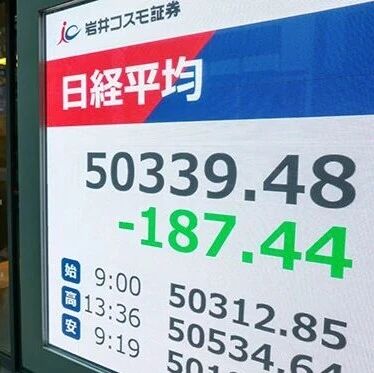
Japan's Nikkei slips as tech stocks track Wall Street lower
The Economic Times· 2025-12-29 03:25
Market Overview - The Nikkei index decreased by 0.5% to 50,517.41, while the broader Topix index saw a slight increase of 0.04% to 3,424.42 [1][7] - All three major U.S. stock indexes closed nominally lower, ending a five-session rally [2][7] Sector Performance - Technology stocks in Japan, particularly chip-related companies, experienced declines, with Advantest and Tokyo Electron falling by 2.17% and 0.9%, respectively [7] - Electronic components maker TDK also saw a decrease of 1.3% [2][7] - Japan Tobacco and Bridgestone reported declines of 1.72% and 0.83%, respectively, as they went ex-dividend [4][5][7] - The rubber maker index within the Topix fell by 0.89%, marking it as one of the worst-performing sectors [6][7] Investment Trends - The Topix's value share index increased by 0.35%, while the growth share index decreased by 0.28% [6][7] - Value shares, which typically offer higher dividends, are expected to rise in January as retail investors purchase them for the Nippon Individual Savings Account (NISA) program [6][7] - The NISA program is expanding, providing tax exemptions on capital gains for retail investors [6][7] Banking Sector - Banks showed positive performance, with Mitsubishi UFJ Financial Group gaining 0.6%, and Sumitomo Mitsui Financial Group and Mizuho Financial Group rising by 0.63% and 0.76%, respectively [6][7] - The Bank of Japan's discussions indicated a potential need for continued interest rate hikes, influencing bank stock performance [6][7]

日股能否突破“预期值天花板”?
日经中文网· 2025-12-25 02:56
Group 1 - The core viewpoint of the article highlights that Japan's stock market has struggled to break through a PER ceiling of 16 times, with the PER not being a driving factor for market growth historically [2][6][8] - The Nikkei average index reached a historic high of around 50,000 points by the end of 2025, with the focus on whether market expectations can be further improved [2] - Analysts suggest that many individual stocks still have low PERs, and the challenge for 2026 is for companies to improve performance and capital efficiency to stimulate further stock price increases [2] Group 2 - The trading volume of the Tokyo Stock Exchange's Prime section fell below 4 trillion yen, marking a five-month low, while SCREEN Holdings saw a significant stock price increase of 13%, reaching 15,320 yen, with a 57% rise in 2025, outperforming the Nikkei average [4] - Morgan Stanley MUFG Securities raised SCREEN's target stock price from 16,200 yen to 24,400 yen, citing a genuine recovery phase in the front-end equipment market starting from mid-November 2025 [4] - SCREEN has consistently achieved revenue and profit growth since the fiscal year ending March 2022, with ROE increasing from 7.9% in the fiscal year ending March 2021 to 25.1% in the fiscal year ending March 2025 [5] Group 3 - The PER of Japan's stock market has remained between 12 to 16 times since the Lehman crisis, with the current market conditions pushing PER close to the upper limit of this range [6][8] - Despite improvements in ROE, the trend of declining PER continues, indicating that the long-term growth of Japanese companies is not being properly priced in the stock market [8] - To achieve ROE growth and enhance market expectations, companies need to focus on sustainable profitability through sales growth, especially in an inflationary economic environment [9] Group 4 - Japan's PER is approaching levels seen in technology-driven markets like the US, India, and Taiwan, suggesting that it is unlikely for Japan's PER to continue rising in isolation [11] - While inflation may push PER higher, rising interest rates pose a risk, as the yield on newly issued 10-year Japanese government bonds has entered the 2% range, surpassing the Nikkei average dividend yield of 1.8% [11] - The underestimation of growth potential in the Japanese stock market is a long-standing barrier, with investors looking for catalysts such as companies that boldly adjust their business portfolios and focus on growth markets [11]
半导体生产设备技术月报(2025 年 12 月)-Investor Presentation-Semiconductor Production Equipment Tech Monthly Dec 2025
2025-12-24 02:32
Summary of Semiconductor Production Equipment Industry Insights Industry Overview - The semiconductor production equipment industry in Japan is currently viewed as attractive, with a confirmed entry into a recovery phase for front-end equipment [8][10][21]. Key Companies and Upgrades - **Tokyo Electron (TEL)** and **Kokusai Electric** have been upgraded to an Overweight (OW) rating due to increasing inquiries for equipment from foundries and DRAM makers [8][10]. - Other companies highlighted include **Advantest**, **Disco**, **Ebara**, **SCREEN Holdings**, and **Ulvac**, which are also positioned favorably in the market [10][21]. Market Trends - There has been a significant increase in equipment inquiries from foundries and DRAM manufacturers since mid-November 2025, driven by additional investments in AI semiconductors and supply shortages in DRAM [8][10]. - Demand for back-end equipment remains strong, while front-end equipment, which had been weak, is showing signs of recovery [10][21]. Specific Developments - **Micron Technology** plans to invest approximately ¥1,500 billion to construct a new fab in Hiroshima for next-gen HBM chips, which is expected to benefit front-end equipment makers like Tokyo Electron, Ebara, SCREEN HD, and Kokusai Electric [22]. - The transition to 12-inch SiC wafers is anticipated to drive revenue growth for Disco's KABRA systems and Ulvac's deposition equipment, particularly as demand from Chinese EV makers recovers [12][21]. Technological Innovations - Advancements in 3D-DRAM technology, as confirmed by Kioxia Holdings, could lead to significant changes in the DRAM semiconductor production equipment market, benefiting companies like Tokyo Electron, Ebara, and Kokusai Electric [14]. - The collaboration between Advantest and Tokyo Seimitsu on die-level probers aims to improve yield rates in IC packages, indicating a shift towards more complex testing methods [30]. Government Support and External Factors - The Japanese government is providing substantial support to Rapidus, aiming to mass-produce advanced semiconductors, with investments expected to reach ¥1 trillion by the end of F3/27-28 [26]. - Potential US government approval for H200 exports to China could increase demand for Japanese semiconductor production equipment, particularly benefiting back-end equipment makers like Advantest and Disco [24]. Conclusion - The semiconductor production equipment industry in Japan is poised for growth, driven by increased demand for advanced technologies and government support. Key players are strategically positioned to capitalize on these trends, with significant investments and technological advancements expected to shape the market landscape in the coming years [8][10][21][22].
半导体设备_2025 年日本半导体展:设备厂商 2026 年前景向好_ Semiconductor Capital Equipment_ Semicon Japan 2025_ A promising year ahead for equipment manufacturers in 2026
2025-12-23 02:56
Summary of Conference Call Notes Industry Overview - **Industry**: Semiconductor Capital Equipment - **Event**: Semicon Japan 2025, held from December 17-19 - **General Outlook**: Strong demand for equipment, particularly in memory and advanced logic applications, with expectations of promising business conditions for equipment manufacturers heading into 2026 [1] Key Companies and Insights Tokyo Electron (8035.T, Buy) - **New Products**: Introduced new coater/developer (LITHIUS Pro DICE) and batch deposition system (EVAROS) - **Productivity**: LITHIUS Pro DICE offers higher productivity and reduced customer cost of ownership compared to previous models - **Wafer Processing**: EVAROS increases wafer processing capacity by approximately 60%, processing up to 200 wafers at a time [15] Disco (6146.T, Buy) - **New Models**: Launched three new laser saw models, including two ablation-type and one stealth dicing model - **Productivity**: New models show improved productivity and capability to process unique shapes - **Equipment Update**: Introduced a fully automatic grinder for 300 mm wafers, the first update in 23 years [2] Ebara (6361.T, Buy) - **Productivity**: Latest CMP model, F-REX300XA, offers high productivity with competitive advantages in metrology technology - **Growth Areas**: Anticipates growth in plating equipment for advanced packaging applications, particularly CoWoS - **Adoption**: Memory manufacturers are beginning to use Ebara's bevel polishing equipment in pre-wafer bonding processes [3] Ulvac (6728.T, Buy) - **Market Uptake**: Increased demand for sputtering equipment in front-end-of-line processes, transitioning to Gate-All-Around generation - **Panel-Level Packaging**: Developing solutions for panel-level packaging sputtering equipment, leveraging technology from FPD applications - **Order Momentum**: Strong orders from Chinese customers for metal hard mask processes and increasing orders from global memory makers [9] Advantest (6857.T, Neutral) - **Product Focus**: Showcased test solutions for optoelectronic integrated devices and DRAM, including a new automation tool developed with EDA vendors - **Development**: Joint development of a die-level prober with Tokyo Seimitsu, with potential results emerging in 2H3/27 [10] Kokusai Electric (6525.T, Neutral) - **Product Adoption**: Emphasized the adoption of high value-added products but did not announce new products at the event - **Market Conditions**: Current semiconductor orders are tracking in line with guidance, with expectations for gradual earnings growth [4][12] SCREEN Holdings (7735.T, Sell) - **Growth Drivers**: Anticipates growth in cleaning equipment due to increased needs in wafer bonding processes and shifts in memory device systems - **New Technology**: Introduced the DW-3100 direct imaging system, achieving a line/space resolution of less than 1 micrometer [14] Lasertec (6920.T, Neutral) - **Product Evaluation**: New ACTIS A200HiT model is under evaluation by multiple customers, with expectations to book at least one order in FY6/26 [11] Tokyo Seimitsu (7729.T, Sell) - **Product Compatibility**: All main products are compatible with panel-level packaging, with expectations for orders to exceed previous quarters [12] Price Targets and Risks - **Disco**: Target price of ¥61,000, risks include slowdown in AI-related demand and semiconductor capex downcycle [16] - **Ebara**: Target price of ¥5,000, risks include increasing competition from Chinese manufacturers [16] - **Ulvac**: Target price of ¥7,700, risks include cooling of FPD capex and lower profit margins [16] - **Tokyo Electron**: Target price of ¥38,000, risks include further export restrictions and valuation pressures [16] Conclusion The semiconductor capital equipment industry is poised for growth, driven by strong demand in memory and advanced logic applications. Key players like Tokyo Electron, Disco, and Ebara are introducing innovative products that enhance productivity and meet evolving customer needs. However, potential risks such as market slowdowns and competitive pressures remain critical considerations for investors [1][16]
US markets today: Wall Street opens higher in holiday-shortened week; S&P 500 nears record
The Times Of India· 2025-12-22 15:16
Market Overview - The S&P 500 rose 0.4%, remaining just below its all-time high set earlier this month, while the Dow Jones Industrial Average increased by 170 points, or 0.4%, and the Nasdaq composite also gained 0.4% [4][6] - Market sentiment was bolstered by strength in commodities, with gold and silver reaching record highs and oil prices rising after US authorities pursued another sanctioned oil tanker in the Caribbean [4][6] Corporate Developments - Shares of Uber and Lyft rose approximately 1.4% each following their announcements to launch robotaxi services in London next year through partnerships with Chinese technology company Baidu, with testing set to begin in the first half of 2026 [4][6] Economic Indicators - The US Labor Department is expected to release weekly data on jobless benefit applications, a key indicator of layoffs, on Wednesday [5][6] - Economic sentiment has weakened over the year due to persistent inflation, a cooling job market, and weaker retail sales, with businesses and households facing uncertainty from a US-led trade war [5][6] Federal Reserve Actions - The Federal Reserve has cut its benchmark interest rate in its last three meetings, despite inflation remaining above the 2% target, and is expected to keep rates unchanged at the January meeting [5][6] International Markets - European markets were mostly lower, with Germany's DAX flat and France's CAC 40 and Britain's FTSE 100 both down 0.4% [5][6] - Asian markets closed higher, led by Japan's Nikkei 225, which jumped 1.8% to 50,402.39, driven by gains in semiconductor stocks [5][6] Commodity Prices - US benchmark crude rose by $1.17 to $57.69 per barrel, while Brent crude increased by $1.23 to $61.70 per barrel [5][6] - Gold prices gained 1.3% to $4,443.10 per ounce, and silver surged over 2% to $68.90 per ounce, setting a new record [5][6]

US futures edge higher after tech-led weekly gains
The Economic Times· 2025-12-22 09:11
Market Performance - Germany's DAX increased by 0.1% to 24,315.90, while the CAC 40 in Paris decreased by 0.2% to 8,135.23 and Britain's FTSE 100 fell by 0.3% to 9,864.71 [1] - In Asian markets, Tokyo's Nikkei 225 rose by 1.8% to 50,402.39, driven by significant gains in computer chip makers [2] - The S&P 500 futures were up by 0.4% and the Dow Jones Industrial Average futures gained 0.2% [1] Sector Performance - The technology sector, particularly companies like Nvidia and Broadcom, has been a major driver of market gains, with Nvidia rising by 3.9% and Broadcom by 3.2% [6][7] - Semiconductor maker Tokyo Electron saw a jump of 6.3%, while chip testing equipment maker Advantest gained 4.5% [2] - Oracle's stock rose by 6.6% following news of a joint venture with TikTok, indicating strong interest in technology partnerships [6] Economic Indicators - Homebuilders experienced a decline, with KB Home falling by 8.5% due to a report showing a slowdown in home sales for the first time since May [8] - Consumer sentiment improved slightly in December compared to November, but remains significantly lower than the previous year [8] - Inflation continues to exceed the Federal Reserve's 2% target, prompting concerns about the impact of interest rate cuts on economic growth [10] Currency and Commodities - The Japanese yen weakened against the dollar, trading at 157.45 yen, down from 157.60 [5] - U.S. benchmark crude oil prices increased by 57 cents to $57.09 per barrel, while Brent crude rose by 58 cents to $61.05 per barrel [11]


World shares are mixed and Japan's yen slips after AI stocks push higher on Wall Street
Yahoo Finance· 2025-12-22 05:37
World shares were mixed on Monday after a rebound in AI-related stocks like Nvidia spurred a late-in-the-week rally on Wall Street. Germany's DAX edged 0.1% higher to 24,315.90, while the CAC 40 in Paris slipped 0.2% to 8,135.23. Britain's FTSE 100 shed 0.3% to 9,864.71. The future for the S&P 500 was up 0.4% while that for the Dow Jones Industrial Average gained 0.2%. In Asian trading, Tokyo's Nikkei 225 gained 1.8% to 50,402.39, helped by hefty gains for computer chip makers and other companies benef ...
半导体行业-日本 SEMICON 展会要点-Semiconductors-Weekly SEMICON Japan Takes
2025-12-22 02:31
Summary of Semiconductor Industry Insights from SEMICON Japan Industry Overview - The semiconductor industry outlook has improved following SEMICON Japan, with a noted uptick in DRAM and leading logic segments [1][2] - Japanese OEMs are optimistic about year-over-year shipment increases into 2026, primarily driven by logic demand [2] Key Insights Demand Trends - There is a clear uptick in the Japan SPE supply chain, with subsystem players reporting accelerated builds and OEMs seeing increased orders from DRAM and leading logic customers [2] - The 2026 outlook is more favorable compared to previous earnings reports from October/November, indicating a strengthening order book [2] - Demand for leading-edge logic is particularly focused on TSMC's 3nm expansion, while DRAM strength is observed across various players [2] NAND Market - Orders from NAND manufacturers remain muted, with consensus on the timing of recovery being uncertain, indicating a longer wait for significant improvements [2] Advanced Packaging - Advanced packaging is emerging as a significant growth driver for the front-end, with companies exploring opportunities in panel-level packaging (PLP) and wafer bonding [3] - KLA reported approximately 70% year-over-year growth in advanced packaging revenue, while AMAT experienced more muted growth due to a decline in HBM tool purchases [3] AI and Technology Innovations - AI is creating new business opportunities, with companies like Tokyo Electron and Advantest showcasing innovations that leverage machine learning to enhance R&D and testing processes [3] Industry Collaboration - The conference highlighted a shift from competition to collaboration within the semiconductor equipment sector, exemplified by AMAT's EPIC Center aimed at fostering cross-industry partnerships [3] Company-Specific Insights Applied Materials (AMAT) - AMAT is well-positioned due to its diverse product portfolio and strategic partnerships, which are expected to support future technology advancements [3][8] - The company is shifting its focus back towards leading logic and DRAM, moving away from China/ICAPS [8] MKS Instruments (MKSI) - MKSI is anticipated to see significant estimate revisions due to favorable trends in semiconductor equipment and packaging tools [8] Financial Metrics - Semiconductor company inventory is currently at 109 days, down 5 days quarter-over-quarter, which is ahead of the seasonal decrease [26] - The Days of Inventory (DOI) for semiconductor customers decreased to 57 days, indicating a tightening supply chain [28] Risks and Considerations - Potential risks include market share loss for AMAT in China and the impact of NAND market dynamics on overall growth [35][38] - Upside risks involve stronger-than-expected WFE spending and market share gains in DRAM and NAND sectors [38] Conclusion - The semiconductor industry is showing signs of recovery and growth, particularly in advanced packaging and logic segments, with companies like AMAT and MKSI positioned to benefit from these trends [2][3][8]
日本科技_半导体资本设备_上调晶圆厂设备展望;预计投资持续强劲(尤其是 DRAM 领域);重申东京电子 “买入” 评级-Japan Technology_ Semiconductor Capital Equipment_ WFE outlook raised; expecting continued robust investment, especially in DRAM; reiterate Buy on TEL
2025-12-16 03:30
Summary of Conference Call Notes on Semiconductor Capital Equipment Industry Industry Overview - The semiconductor capital equipment industry is experiencing a robust investment outlook, particularly in the DRAM segment, driven by increasing demand for AI semiconductors and various DRAM types including HBM, LPDDR, and GDDR [1][2] - The forecast for wafer fabrication equipment (WFE) demand has been raised by 3-4% for CY25-27, with expected growth rates of +11% year-over-year (yoy) to $113 billion in CY25, $124 billion in CY26, and $132 billion in CY27 [1][8] Key Insights - **WFE Demand Growth**: The demand for WFE, excluding China, is projected to surpass the CY22 peak in CY26-27, indicating a favorable business environment for front-end companies [1][9] - **DRAM Investment**: Major DRAM manufacturers are expected to expand production capacity, with $6 billion of the $11 billion increase in the CY26 forecast attributed to DRAM investments [1][8] - **NAND and Foundry Investments**: While NAND demand continues to exceed supply, investment in NAND is not uniform across manufacturers, as major players prioritize DRAM investments. Logic/foundry investments are expected to grow, particularly in advanced processes [2][9] Company-Specific Insights - **Tokyo Electron (TEL)**: The company has been reiterated as a "Buy" with raised earnings estimates and target prices, expected to grow faster than the WFE market due to DRAM investment expansion and new product offerings. The new target price is set at ¥38,000, up from ¥36,000 [3][11] - **Kokusai Electric**: Rated as "Neutral," with expectations of weaker earnings momentum due to a decline in new customer ratios in China and low memory exposure [7][12] - **SCREEN Holdings**: Rated as "Sell," anticipated to have the weakest earnings momentum among covered companies due to low memory exposure and declining new customer ratios in China [7][12] - **Lasertec**: Rated as "Neutral," expected to see increased orders mainly for MATRICS, but limited upside in current valuation [7][12] Financial Projections - **WFE Market Forecasts**: - Total WFE for CY25 is projected at $113 billion, with a yoy growth of +11% - For CY26, the forecast is $124 billion, also +11% yoy - For CY27, the forecast is $132 billion, with a slower growth of +7% yoy [8][9] - **Memory Segment Growth**: - DRAM is expected to grow from $32 billion in CY25 to $38 billion in CY26, maintaining a +20% yoy growth rate [8][9] - NAND is projected to grow from $10 billion in CY25 to $13 billion in CY26, with a +30% yoy growth rate [8][9] Risks and Considerations - Investment appetite among key customers in NAND is mixed, which may affect overall demand and investment strategies [2][7] - Potential risks include changes in investment at key customers, export controls, and competitive landscape shifts [15][12] Conclusion The semiconductor capital equipment industry is poised for significant growth, particularly in the DRAM segment, with companies like Tokyo Electron expected to outperform the market. However, challenges remain in the NAND sector and overall investment dynamics, necessitating careful monitoring of market trends and company-specific developments.
