
Vita Coco

Search documents
晚入局的泰国 IF 椰子水,为何能成为中国市场第一?| 声动早咖啡
声动活泼· 2025-06-11 10:42
Core Viewpoint - IFBH, the parent company of "if" coconut water, has rapidly captured the Chinese market, achieving a revenue of over 1.1 billion RMB in 2024, with a year-on-year growth of approximately 80% [1]. Market Position and Strategy - As of now, "if" holds a 34% market share in China's coconut water market, significantly outperforming its closest competitor, Vita Coco, by more than seven times [1]. - The brand initially entered high-end supermarkets in first-tier cities to establish its image as an "imported health drink," but shifted to more accessible channels like convenience stores from 2019 onwards, offering smaller, more affordable packaging [2][4]. Competitive Landscape - The coconut water market in China has over 50 competing brands, including traditional beverage companies and new tea brands, leading to intensified price competition [8]. - Despite "if" achieving a peak market share of around 55% in Q1 2024, it has faced fluctuations, dropping to approximately 30% by Q4 2024, indicating increasing competitive pressure [8]. Supply Chain and Cost Structure - "if" benefits from a light asset operation model, outsourcing production and logistics, which allows the company to focus on brand building and marketing [4]. - The sourcing of all coconut raw materials from Thailand provides a cost advantage of about 18% compared to competitors, due to favorable growing conditions [4]. Marketing and Brand Development - The brand's marketing expenses surged from $1.8 million in 2022 to $7.35 million in 2023, with significant sales boosts from collaborations with influencers and celebrities [5]. - Collaborations with popular IPs like Pop Mart's Crybaby have enhanced the brand's appeal among younger consumers [5]. Financial and Operational Challenges - The company's reliance on coconut water for over 90% of its revenue poses risks related to changing consumer preferences and market saturation [9]. - The concentration of supply chain operations in Thailand raises concerns about vulnerability to agricultural disruptions, such as climate change or political instability [9]. Investment and Future Outlook - IFBH's recent investment from Aquaviva, which involved a $17.5 million stake for 11.11%, has made the company's IPO a critical objective to avoid financial strain and potential negative market perceptions [10].

推香椰水新品,椰子跳动转战C端市场
Bei Jing Shang Bao· 2025-05-19 13:36
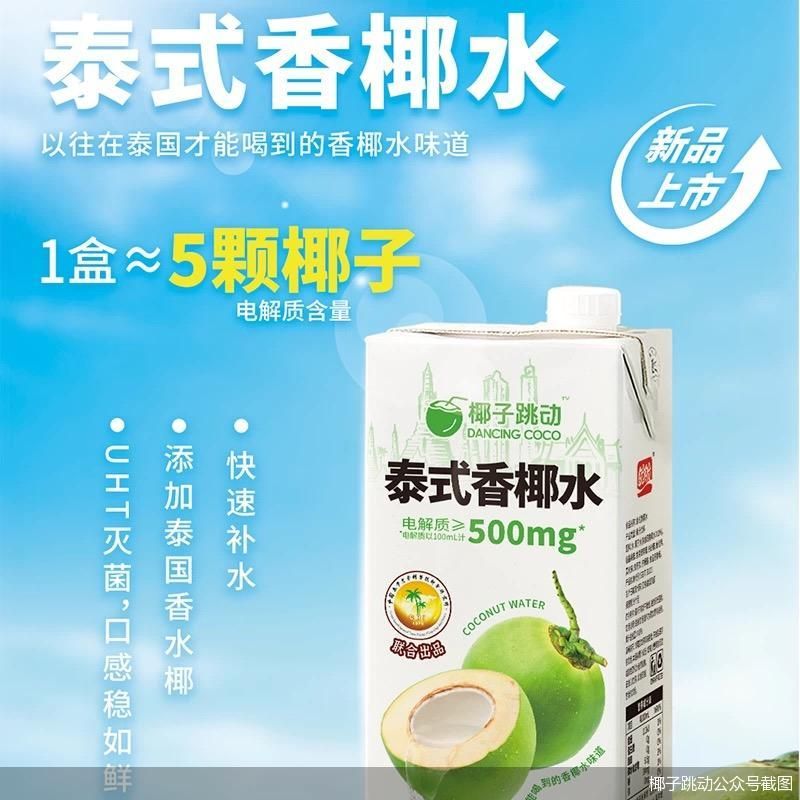
Core Viewpoint - Coconut Jumping has launched a new product, Thai Coconut Water, aiming to establish a presence in the competitive coconut water market, which is characterized by intense price competition and a lack of brand differentiation [1][4]. Company Overview - Coconut Jumping is a coconut-based beverage brand incubated by Panpan Food Group in 2023, focusing on the B2B market, particularly coffee and tea shops [1][5]. - The brand has already formed partnerships with various coffee and baking brands, indicating its growing presence in the B2B sector [5]. Product Details - The newly launched Thai Coconut Water is packaged in a 1L format and claims to provide essential electrolytes, with 500mg of electrolytes per 100ml, equivalent to the electrolytes found in five coconuts [3]. - The product emphasizes freshness, utilizing UHT sterilization and low-temperature filling to maintain its clarity and taste [3]. Market Positioning - The retail price of Coconut Jumping's Thai Coconut Water is approximately 17.67 yuan per liter, which is higher than the average market price of 1.45 yuan per 100ml for similar products [4]. - The coconut water market is experiencing rapid growth, with global retail sales projected to increase from $2.517 billion in 2019 to nearly $5 billion by 2024, reflecting a CAGR of 14.66% [6]. Industry Challenges - The coconut water industry is facing significant price competition, with many brands engaging in price wars, leading to a decline in average prices [6][7]. - There are concerns regarding product authenticity, with reports of many coconut water brands using additives and low-quality ingredients, which could undermine consumer trust [6][7]. Future Outlook - Analysts suggest that Panpan Food Group needs to enhance its brand effect, scale effect, and fan effect to succeed in the competitive coconut water market [7]. - The company has the potential to leverage its supply chain advantages and innovative capabilities to improve product offerings and market presence [5].
贴牌“泰国神饮”,被中国白领捧上神坛
商业洞察· 2025-05-17 09:25
Core Viewpoint - The article discusses the rapid rise of IFBH, a Thai company that has successfully captured a significant share of the coconut water market in China, leveraging strategic marketing and operational efficiencies to outperform established competitors like Vita Coco [3][60]. Group 1: Company Overview - IFBH, with only 46 employees, achieved a revenue of 1.16 billion yuan in 2024, with 92.4% coming from the Chinese market [9][60]. - The company holds a 34% market share in China's coconut water sector, making it the leading brand [11][60]. - Each employee at IFBH generated an impressive 25.21 million yuan in revenue, which is 5.3 times more efficient than Moutai [9][60]. Group 2: Market Dynamics - The coconut water market in China is projected to reach approximately 1.08 billion USD in 2024, with a compound annual growth rate of 82.9% over the past five years [60][81]. - The shift in consumer preferences towards healthier, low-calorie beverages has created a favorable environment for coconut water [21][60]. - IFBH capitalized on this trend by associating its product with fitness and health, leading to a threefold increase in online sales [23][60]. Group 3: Competitive Strategy - IFBH's low-cost advantage stems from sourcing high-quality coconut water from Thailand, which is 18% cheaper than local competitors [29][60]. - The company employs a "light asset" model, outsourcing production and focusing on marketing and sales, which allows for rapid market penetration [37][60]. - IFBH's marketing strategy includes collaborations with popular brands and influencers, significantly boosting its visibility and sales [55][57]. Group 4: Challenges and Future Outlook - Despite its success, IFBH faces challenges from domestic brands that are enhancing their supply chains and entering the coconut water market [60][70]. - The reliance on a single product poses risks, especially with potential supply chain disruptions due to climate impacts on coconut production in Thailand [74][75]. - Competitors like Luckin Coffee are expanding their supply chains into coconut-producing regions, which could erode IFBH's cost advantages [70][81].

椰子水“大战”,正在上演
3 6 Ke· 2025-04-29 23:19
Group 1 - The core viewpoint of the article highlights the rapid growth of coconut water in the Chinese beverage market, driven by health consumption trends, with IFBH Limited achieving significant revenue and market share [1][2][4] - IFBH Limited's coconut water revenue in China reached 1.16 billion yuan in 2024, with a per capita revenue of over 25 million yuan, showcasing its operational efficiency [1][4] - The company holds the largest market share in both mainland China (approximately 34%) and Hong Kong (approximately 60%), significantly surpassing its closest competitor [4][9] Group 2 - The rise of coconut water is attributed to the increasing health consciousness among consumers, with the beverage being marketed as a natural sports drink with low calories and high potassium content [2][4] - The consumption scenarios for coconut water have expanded beyond traditional ready-to-drink formats, with innovative products like coconut water hot pot base and iced desserts being introduced [4][9] - IFBH's marketing strategy has effectively targeted the younger generation, utilizing celebrity endorsements and social media to enhance brand visibility and consumer engagement [5][7] Group 3 - IFBH operates on a light asset model, relying on third-party manufacturers and distributors, which has allowed for high production flexibility and a gross profit margin increase from 34.7% in 2023 to 36.7% in 2024 [5][7] - The company faces increasing competition in the coconut water market, with over 50 brands now present, including international giants and local players, leading to a price war [9][10] - The average selling price of coconut water in China has dropped by 23.5% over two years, with many brands now offering products below 10 yuan per liter, challenging IFBH's pricing strategy [10][11] Group 4 - IFBH is exploring new product lines such as electrolyte water and Thai milk tea, but these currently account for less than 5% of total revenue [11] - The ultimate competition in the beverage industry is seen as a battle between product quality and supply chain efficiency, with IFBH's IPO representing both a success of its business model and challenges related to supply chain management [11]
一个员工创造2513万元收入!46人干出个“全球第二”!就靠“东方力量”!
IPO日报· 2025-04-16 07:04
星标 ★ IPO日报 精彩文章第一时间推送 靠着"东方力量",人少也能干出大事情,特别是当前特朗普对世界各国挥着关税大棒的时候,世界尤其需要中国市场,需要"东 方力量"。 椰子水品牌if的母公司IFBH Limited(下称"IFBH)")对此应该体会深刻——仅凭46名员工,它一年能创造11亿元收入,2024年,一个员 工平均赚到营收2513万元!它的赚钱密码就是——占据中国市场冠军宝座! IFBH的注册地在新加坡,趁着中国市场的东风,日前它向资本市场又迈出了一步——向港交所提交上市申请,拟香港主板上市,中 信证券担任独家保荐人。 据了解,if目前是椰子水品牌的全球老二,老大Vita Coco三年半之前登陆了美国纳斯达克,现在算是在资本市场上奋起急追。 更有意思的是,相比Vita Coco集齐美洲、欧洲、亚洲等全球市场后称霸,IFBH仅凭"东方力量"就杀入到全球第二。 制图:佘诗婕 凭借中国市场拿下全球第二 资料显示,IFBH是一家植根泰国的即饮饮料及即食食品公司,其前身由泰国知名饮料制造商General Beverage分拆的国际业务独立得 来,业务涵盖了椰子水饮料与植物基零食两大领域。 IFBH于2013 ...
if椰子水冲击港交所:46名员工如何卖出1.6亿美元?
Hua Er Jie Jian Wen· 2025-04-14 01:50
Core Viewpoint - IFBH Pte. Ltd., the company behind the popular Thai coconut water brand if, is preparing for an IPO on the Hong Kong Stock Exchange, with a significant focus on the Chinese market, which accounts for 92.4% of its revenue [2][3]. Company Overview - IFBH was spun off from General Beverage, a Thai beverage manufacturer, and operates primarily under the brands if and Innococo [2]. - The company has achieved a revenue of $157.6 million and a profit of $33.3 million in 2024, marking year-on-year growth of 80.3% and 98.9% respectively [3]. - IFBH employs a light asset model, having no factories or warehouses, and relies heavily on advertising and logistics for its operations [3][4]. Market Position - IFBH holds the leading market share in the Chinese coconut water market, with a 34% share in 2024, significantly outpacing its nearest competitor [2]. - The company has become the second-largest coconut water company globally due to its success in the Chinese market [2]. Operational Model - As of the end of 2024, IFBH had only 46 employees and maintained minimal inventory valued at $1.044 million, with an average inventory turnover of three days [4]. - The operational costs are primarily focused on advertising and logistics, totaling approximately $11 million, which is about 6.4% of total sales [4]. - The company has a high dependency on a few suppliers and customers, with transactions with the top five suppliers and customers accounting for 96.9% and 97.6% of total transactions respectively [5][9]. Supply Chain Dynamics - IFBH continues to purchase coconut water from its parent company, General Beverage, leading to significant related party transactions, which amounted to $12.4 million and $18.1 million in 2023 and 2024 respectively [9]. - The company aims to reduce its reliance on General Beverage for coconut water procurement to below 70% by the end of 2025 and plans to expand into markets in Australia, the Americas, and Southeast Asia [10]. Competitive Landscape - The coconut water market in China has seen increased competition, with over 50 mainstream brands expected by 2025, a 40% increase from two years prior [15]. - Price competition is intensifying, with the average selling price of coconut water dropping by 23.5% from two years ago [16]. - The industry faces challenges from rising raw material costs, particularly due to adverse weather conditions affecting coconut production in Southeast Asia [18][19]. Financial Performance - Despite the competitive pressures, IFBH's gross margin improved by 2 percentage points to 36.7% in 2024, while its net margin increased by 1.9 percentage points to 21.1% [20]. - The company is considering leveraging its IPO proceeds to accelerate growth outside of the Chinese market, which may provide a strategic advantage in the face of increasing competition [20].