
三博脑科

Search documents
山西证券研究早观点-20251117
Shanxi Securities· 2025-11-17 01:23
Market Overview - The domestic market indices showed a decline, with the Shanghai Composite Index closing at 3,990.49, down 0.97%, and the Shenzhen Component Index at 13,216.03, down 1.93% [2] Industry Commentary - The non-bank financial sector is experiencing a positive trend, with the capital market's dual opening deepening and broker fundamentals improving [4][7] - The China Securities Regulatory Commission (CSRC) emphasizes the importance of risk prevention and high-quality development while planning more substantial opening measures for the capital market [7] - Brokerages have seen significant improvements in performance in Q3 2025, with expectations for steady growth through both external and internal development strategies [7] Company Performance Yuanyuan Group - In Q3 2025, Yuanyuan Group reported revenues of $6.017 billion, a year-on-year decrease of 1.0%, and a net profit of $279 million, down 16.0% [6][9] - The company maintains its profit forecast for 2025-2027, expecting revenues of $8.135 billion, $8.588 billion, and $9.051 billion, with corresponding net profits of $353 million, $380 million, and $411 million [9] Huace Navigation - Huace Navigation reported a revenue of $2.618 billion in Q1-Q3 2025, reflecting a year-on-year increase of 15.47%, with a net profit of $493 million [11] - The manufacturing business saw a revenue of $4.232 billion, up 2.3%, with a production capacity utilization rate of 93% [11] Investment Recommendations - The report suggests focusing on investment opportunities in the brokerage sector due to improving fundamentals and potential for growth [7] - For Yuanyuan Group, the recommendation is to maintain a "Buy-A" rating based on its stable profit forecasts and market positioning [9] - The report highlights the importance of companies with technological barriers and clinical implementation capabilities in the brain-computer interface sector, suggesting a "Buy-A" rating for key players [15]
医疗服务板块11月14日跌0.47%,数字人领跌,主力资金净流出2.38亿元
Zheng Xing Xing Ye Ri Bao· 2025-11-14 08:58
Market Overview - The medical services sector declined by 0.47% on November 14, with the digital human sector leading the drop [1] - The Shanghai Composite Index closed at 3990.49, down 0.97%, while the Shenzhen Component Index closed at 13216.03, down 1.93% [1] Stock Performance - Notable declines in individual stocks include: - Digital Human: closed at 17.28, down 4.85% with a trading volume of 80,400 shares and a turnover of 1.411 million [1] - Haoyuan Pharmaceutical: closed at 77.20, down 3.54% with a trading volume of 30,800 shares and a turnover of 2.4212 million [1] - Yinos: closed at 48.69, down 2.62% with a trading volume of 14,300 shares and a turnover of 7132.217 [1] - Other notable declines include Taige Pharmaceutical, MediX, and WuXi AppTec, all showing declines between 1.28% and 2.08% [1] Capital Flow - The medical services sector experienced a net outflow of 238 million yuan from institutional investors, while retail investors saw a net inflow of 181 million yuan [3] - Notable capital flows for specific stocks include: - Ruizhi Pharmaceutical: net inflow of 38.93 million yuan from institutional investors, but net outflows from retail and speculative investors [3] - Chengda Pharmaceutical: net inflow of 37.96 million yuan from institutional investors, with significant outflows from speculative investors [3] - Other stocks like Sanbo Brain Science and Jinyu Medical also showed varying net inflows and outflows among different investor types [3]






脑机接口行业深度报告:脑科学产业与政策趋势共振
China Post Securities· 2025-11-14 08:35
Investment Rating - The report maintains an investment rating of "Outperform" for the brain-computer interface (BCI) industry [1] Core Insights - Continuous policy support is evident, with the Ministry of Industry and Information Technology and six other departments releasing implementation opinions to promote BCI innovation [2] - Significant technological and clinical breakthroughs have been achieved, including China's first invasive clinical trial for BCI technology [2] - The global BCI market is projected to exceed $10 billion, with a compound annual growth rate (CAGR) of over 13% from 2019 to 2023 [2] Summary by Sections What is Brain-Computer Interface? - BCI is defined as a communication system that establishes a direct connection between the brain and external devices, enabling interaction through brain wave recognition [7][10] - The technology is expected to revolutionize medical rehabilitation, assistive communication, and intelligent control [7] Why is BCI at a Critical Turning Point for Industrialization? - Policy support has intensified, with a clear roadmap for BCI standardization and development outlined by various government bodies [35][41] - The industry is expected to see significant advancements in technology and clinical applications, with a focus on creating a robust ecosystem by 2030 [35][46] Investment Recommendations - Companies to watch include Sanbo Brain Science, Zhongke Information, Entropy Technology, and Yanshan Technology, which are involved in clinical applications or product development [2]
国内首次,侵入式脑机产品进审批“绿色通道”
3 6 Ke· 2025-11-13 02:10
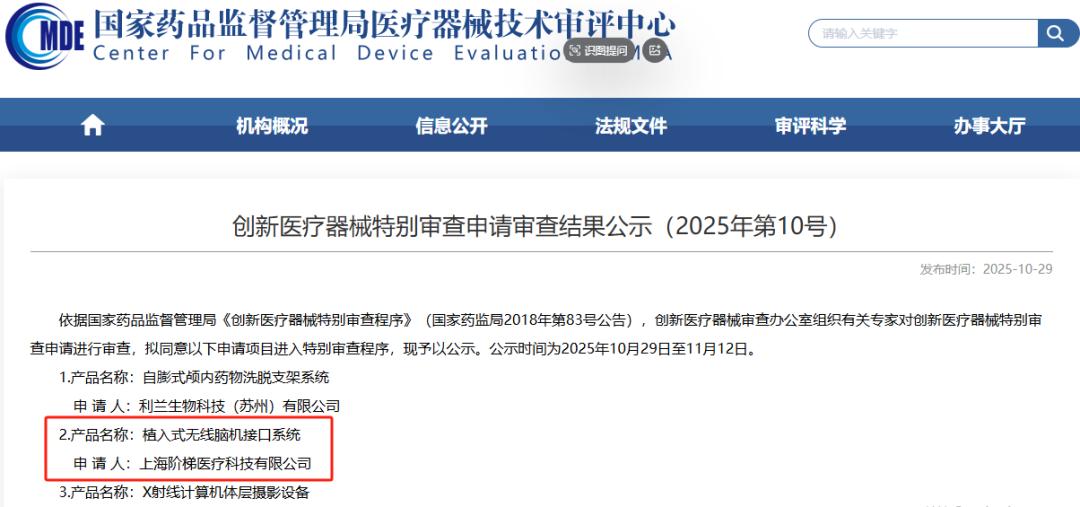
Core Insights - The article highlights the significant potential of new materials and flexible electrodes in China, particularly in the field of brain-computer interfaces (BCIs) [1][7] - The approval of the first invasive brain-computer interface product by Shanghai Ladder Medical Technology Co., Ltd. marks a milestone in the domestic medical device industry [1][4] Industry Overview - The innovative medical device special review procedure established by the National Medical Products Administration (NMPA) aims to encourage innovation in medical devices, providing expedited review for products with core technology patents and significant clinical value [2][3] - The invasive brain-computer interface technology requires surgical implantation, which presents higher technical barriers and risks but offers higher quality and precision in neural signal acquisition compared to non-invasive methods [3][4] Company Developments - Shanghai Ladder Medical, founded in 2021, focuses on the development of implantable brain-computer interface technology and has recently completed a 350 million yuan Series B financing round [3][4] - The company's ultra-flexible electrode technology allows for minimally invasive implantation, significantly reducing the risk of tissue damage and immune response [4][6] Clinical Progress - Ladder Medical has initiated clinical trials, with a recent case demonstrating a participant controlling a computer cursor using thought after undergoing the brain-computer interface implantation [6][8] - The company is now the second globally, after Neuralink, to enter the clinical phase of invasive brain-computer interfaces [6][8] Market Potential - The global brain-computer interface market is projected to grow from approximately $2.62 billion in 2024 to $12.4 billion by 2034, with a compound annual growth rate of 17.35% [8] - The Chinese brain-computer interface market is expected to expand from 3.2 billion yuan in 2024 to 6.14 billion yuan by 2028, indicating strong growth potential in the sector [8] Regulatory Environment - Recent policy developments, including the establishment of industry standards for brain-computer interface medical devices, are expected to facilitate faster market entry for approved products [7][8] - The NMPA's new standards for brain-computer interface terminology will take effect on January 1, 2026, marking a significant step in regulatory clarity for the industry [7][8]
人脑工程板块活跃





Di Yi Cai Jing· 2025-11-12 13:19
Core Insights - The brain engineering sector is leading the market with a rise of 1.05% [1] Company Performance - Aipeng Medical saw a significant increase of 7.51% [1] - Innovation Medical experienced a rise of 4.41% [1] - Century Huatong increased by 3.41% [1] - Chengyitong, Xiangyu Medical, and Sanbo Brain Science all rose by over 2% [1]
脑机接口产业化加速,全产业链核心标的梳理
Xin Lang Cai Jing· 2025-11-12 13:16
Industry Background - The brain-computer interface (BCI) industry is entering a commercialization phase in 2025, driven by policy support and technological breakthroughs. The Ministry of Industry and Information Technology (MIIT) and other departments have set a goal for key technological breakthroughs by 2027 and the establishment of an industrial system [1] - The National Medical Insurance Administration has added pricing items for BCI implantation and adaptation fees, accelerating clinical applications and charging [1] - Domestic companies are making significant progress, with Shanghai Ladder Medical's implantable wireless BCI system becoming the first to enter the NMPA's green channel for innovative medical devices [1] - Global competition includes Neuralink's plan to launch a Telepathy device by 2029, but domestic companies have achieved technological advantages in certain areas, such as Yanshan Technology's 60ms ultra-low latency control performance [1] Industry Chain Overview - The BCI industry chain consists of three main segments: upstream (electrodes/chips), midstream (EEG processing devices), and downstream (application scenarios), each with distinct technological barriers and commercialization rhythms [3] - Upstream components, particularly implantable and non-invasive electrodes/chips, are critical for signal precision and stability, representing the core competitiveness of the industry [3] Upstream Segment - Implantable electrodes/chips are essential for medical applications, with companies like Gaode Infrared developing flexible tactile sensors that reduce immune rejection and extend signal collection duration [4] - Weisi Medical focuses on optimizing biocompatibility for its microelectrode arrays, which have entered clinical validation for precise localization in epilepsy [4] - Non-invasive chips serve as entry points for consumer applications, with companies like Xiangyu Medical developing multi-modal EEG acquisition devices for rehabilitation [7] Midstream Segment - The midstream segment is responsible for EEG signal acquisition, analysis, and transmission, with a focus on low latency (under 60ms) and multi-modal integration [9] - Companies like iFlytek have achieved a 92% accuracy rate in emotion recognition from EEG signals, indicating significant algorithmic advantages [10] - Yanshan Technology has achieved ultra-low latency control performance, surpassing early versions of Neuralink [11] Downstream Segment - The downstream applications are driven by both medical and consumer sectors, with a focus on epilepsy, Parkinson's disease, and gaming [13] - Medical rehabilitation is a high-demand area supported by policies, with companies like Aipeng Medical developing EEG acquisition devices and achieving a net profit margin of approximately 15% [14] - Consumer applications include gaming and smart home technologies, with companies like Tom Cat integrating BCI into AI games to develop mind-control products [16]

国产侵入式脑机接口进入审评“绿色通道” 资本竞逐前沿医疗蓝海
Zheng Quan Ri Bao Wang· 2025-11-12 12:47
Core Insights - Shanghai Ladder Medical Technology Co., Ltd.'s "Implantable Wireless Brain-Computer Interface System" has entered the special review process of the National Medical Products Administration (NMPA), marking a significant step in the commercialization of invasive brain-computer interface products in China [1] Group 1: Industry Breakthroughs - The invasive brain-computer interface (BCI) technology is seen as a revolutionary method for human-computer interaction, with invasive products offering more precise signal transmission due to direct implantation into the brain cortex [2] - The implementation of the "green channel" significantly shortens the product review cycle from 3-5 years to an expected 1-2 years, which is crucial for rapidly evolving technologies [2] Group 2: Industry Chain Development - China's BCI industry chain has been continuously improving, with a complete chain covering upstream materials, chips, electrodes, midstream signal collection and processing, and downstream medical health and consumer markets [3] - Progress in upstream areas, such as biocompatible materials and low-power chips, supports performance improvements in midstream and downstream products, with clear commercialization paths in the medical field [3] Group 3: Market Growth and Investment - The global BCI market in medical applications is projected to reach $40 billion by 2030 and exceed $145 billion by 2040 [3] - In China, the BCI market is expected to reach 3.203 billion yuan in 2024, with a year-on-year growth of 18.81%, and is forecasted to reach 3.830 billion yuan in 2025 [3] Group 4: Capital Market Dynamics - The BCI industry has seen an annualized financing growth rate of over 30% from 2018 to 2024, with 20 new financing events in just the third quarter of 2025 [4] - Continuous capital influx is expected to accelerate technology transformation and industry consolidation, with the industry still in its early stages and exploring technical routes and business models [4] Group 5: Clinical Applications and Challenges - Clinical trials, such as those conducted by Fujian Sanbo Neurosurgery Hospital, have successfully demonstrated the feasibility of domestic technology in clinical settings [4] - There is a need for a mature standard system for long-term biocompatibility and signal stability assessments, which is a core issue that needs to be addressed in the BCI field [5]
三博脑科(301293) - 三博脑科医院管理集团股份有限公司2025年第二次临时股东会的法律意见
2025-11-12 09:50
北京市中伦律师事务所 关于三博脑科医院管理集团股份有限公司 2025 年第二次临时股东会的 法律意见 二〇二五年十一月 北京 • 上海 • 深圳 • 广州 • 武汉 • 成都 • 重庆 • 青岛 • 杭州 • 南京 • 海口 • 东京 • 香港 • 伦敦 • 纽约 • 洛杉矶 • 旧金山 • 阿拉木图 Beijing • Shanghai • Shenzhen • Guangzhou • Wuhan • Chengdu • Chongqing • Qingdao • Hangzhou • Nanjing • Haikou • Tokyo • Hong Kong • London • New York • Los Angeles • San Francisco • Almaty 北京市中伦律师事务所 关于三博脑科医院管理集团股份有限公司 2025 年第二次临时股东会的 法律意见 致:三博脑科医院管理集团股份有限公司 北京市中伦律师事务所(以下简称"本所")接受三博脑科医院管理集团股份 有限公司(以下简称"公司")委托,指派本所律师列席公司 2025 年第二次临时 股东会(以下简称"本次股东会"),并出具本法律意 ...
三博脑科(301293) - 2025年第二次临时股东会决议公告
2025-11-12 09:50
证券代码:301293 证券简称:三博脑科 公告编号:2025-046 三博脑科医院管理集团股份有限公司 2025 年第二次临时股东会决议公告 本公司及董事会全体成员保证信息披露的内容真实、准确、完整,没有虚假 记载、误导性陈述或重大遗漏。 特别提示: 1、本次股东会未出现否决议案的情形; 2、本次股东会未涉及变更以往股东会已通过的决议。 一、会议召开和出席情况 (一)会议召开情况 1、股东会召集人:公司董事会。 2、会议召开的合法、合规性:本次股东会的召开符合有关法律、行政法规、 部门规章、规范性文件及《公司章程》的规定。 3、会议召开时间: 1 权股份总数的 37.3230%。其中:通过现场投票的股东 3 人,代表股份 21,948,003 股,占公司有表决权股份总数的 10.8124%。通过网络投票的股东 288 人,代表 股份 53,813,928 股,占公司有表决权股份总数的 26.5107%。 (1)现场会议时间:2025 年 11 月 12 日下午 15:30 (2)网络投票时间:通过深圳证券交易所交易系统进行网络投票的具体时 间为:2025 年 11 月 12 日上午 9:15-9:25、9: ...
利好频频,脑机接口概念股集体大涨!
Sou Hu Cai Jing· 2025-11-12 06:39
Core Viewpoint - The brain-computer interface (BCI) sector is experiencing significant activity and is on the verge of a potential explosion in growth, driven by recent regulatory advancements and clinical developments [6][10]. Group 1: Market Activity - On November 12, companies in the brain-computer interface sector, such as Aipeng Medical and Innovation Medical, saw notable stock price increases, indicating strong market interest [2]. - In the Hong Kong market, companies like MicroPort NeuroTech and Nanjing Panda Electronics also recorded gains, reflecting a broader trend in the BCI industry [3]. Group 2: Regulatory Developments - The invasive brain-computer interface product developed by Shanghai Ladder Medical Technology has entered the "green channel" for approval by the National Medical Products Administration, marking a significant regulatory milestone [4]. - This is the first invasive BCI product to receive such treatment in China, indicating a growing confidence in the safety and efficacy of these technologies by regulatory bodies [5]. Group 3: Clinical Advancements - The first global trial of an invasive BCI for restoring motor function in patients has been successfully completed in China, showcasing the potential of these technologies in clinical applications [7]. - Clinical trials for BCI systems are set to take place in 10 centers across China, with plans to enroll 30 to 50 patients by the end of the year, further pushing the technology towards commercialization [8]. Group 4: Market Projections - The global BCI market is projected to reach approximately $2.62 billion in 2024, with expectations to grow to $2.94 billion in 2025 and potentially $12.4 billion by 2034, reflecting a compound annual growth rate of 17.35% over the next decade [8]. - In China, the BCI market is expected to grow from 3.2 billion yuan in 2024 to 6.14 billion yuan by 2028, indicating strong domestic growth potential [8]. Group 5: Policy Support - The Chinese government has recognized BCI technology as a strategic priority, with policies aimed at fostering innovation and establishing it as a new economic growth point [9]. - Recent joint initiatives by multiple government departments have outlined clear industry goals and begun to implement pricing and insurance coverage for BCI medical services, facilitating the industry's development [9].
