
Huawei

Search documents
U.S. firms remain 'meaningfully ahead' of Chinese competitors on AI chips, says 'Chip War' author
CNBC Television· 2025-07-16 12:47
US-China Trade & Technology - The Trump administration initially banned the sale of Nvidia's H20 chip to China, a downgraded chip designed to meet US requirements for sale in the Chinese market, but later reversed this stance [2] - Chinese customers reportedly desire the H20 chip in very large quantities, potentially leading to billions of dollars in sales for Nvidia [2][3] - The decision to allow H20 sales may stem from US-China talks where China allowed rare earth magnet shipments to the US in exchange for the US lifting certain controls [5] - The initial ban on H20 chips was based on concerns that large-scale purchases by Chinese firms would enable them to compete with US AI players and develop AI for strategic purposes [6] Competitive Landscape in AI Chips - Nvidia remains a leading player in the AI chip market, even with downgraded chips, as Huawei's domestic production of needed AI chips is limited [7] - Nvidia's ability to sell scaled-down versions of its chips in large volumes to China indicates its lead over Huawei, which struggles with production [9] - Huawei faces challenges in ramping up production and resorts to smuggling chips and components from abroad [9] - US firms, along with Taiwanese manufacturing partners like TSMC, maintain a significant lead over Chinese competitors in high-end AI chips [8][9] Semiconductor Manufacturing & Geopolitics - Taiwan produces 90% or more of the most advanced chips used in AI, smartphone processors, and PC processors [10] - TSMC is developing a large campus in Arizona, representing early-stage efforts to diversify the semiconductor supply chain, but significant concentration remains in Taiwan [11]


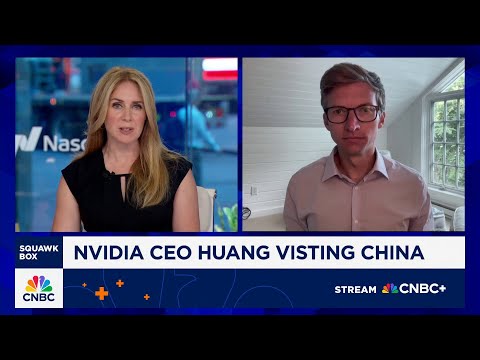
As Nvidia gets a lifeline in China, Jensen Huang goes on the charm offensive in Beijing
CNBC· 2025-07-16 12:08
Core Insights - Nvidia CEO Jensen Huang expressed optimism about resuming sales of H20 AI chips to China after a three-month pause, highlighting the company's significant market cap of $4 trillion [2][7] - The resumption of chip sales is linked to a broader exchange between the U.S. and China regarding rare earths, indicating geopolitical influences on technology trade [3][7] - Nvidia's market share in China has been nearly halved due to U.S. export controls, resulting in a loss of $2.5 billion in sales during the April quarter and an expected $8 billion hit in the July quarter [9][10] Company Meetings and Discussions - Huang had a productive meeting with Chinese Vice Premier He Lifeng, focusing on topics excluding battery technology and rare earths [4] - Discussions with Xiaomi's CEO Lei Jun revolved around AI applications in large language models, autonomous driving, and robotics, with Xiaomi utilizing Nvidia's automotive chips [5] Export Controls and Market Impact - Nvidia anticipates resuming H20 chip shipments to China following U.S. government assurances, after a halt due to new export requirements [7] - The U.S. government is still processing licenses for Nvidia to sell chips to China, with a potential nine-month timeline to restart the supply chain [11] Competition and Industry Landscape - Huang acknowledged Huawei's capabilities in chip design and AI systems, emphasizing that underestimating Huawei's manufacturing prowess is misguided [12] - Huawei has developed its own AI chips and cloud systems, which do not rely on Nvidia's technology, indicating a competitive landscape for AI development in China [12] Chinese AI Models - Huang praised the quality of Chinese AI models, such as DeepSeek and Qwen, noting their open-source nature and widespread adoption for various applications [14][15] - The emergence of Chinese AI models poses a challenge to established players like OpenAI, particularly in terms of cost efficiency and accessibility [14][15]
X @Bloomberg
Bloomberg· 2025-07-16 05:00
Market Position - Huawei secured the leading position in China's smartphone market for the first time in over four years [1] - Huawei's resurgence is attributed to innovative designs and software that resonated with consumers [1] Market Dynamics - The market is characterized as slowing down [1]
Nvidia plans to sell its H20 AI chip in China again: What investors need to know
Yahoo Finance· 2025-07-15 22:04
Market Trends & Regulatory Landscape - Nvidia and AMD are working with the administration to overcome regulatory barriers and ship products back into China [1] - The details of how scaled down the chips need to be have been worked out, providing a clearer path for Nvidia and AMD in China [3] - American export controls have been motivating Chinese companies to develop local silicon and manufacturing capabilities [7][8] China Market Opportunity - China represents a multi-billion dollar opportunity for Nvidia [3] - Jensen estimates the China market to be a $50 billion market [4] - The total refresh of infrastructure in the age of AI represents trillions of dollars globally, with China being a significant part of this opportunity [4][5] - China's increasing AI services and cloud players require new infrastructure, making it a significant and growing market [6] Competitive Dynamics - While Huawei is manufacturing competitive products, companies like Baidu and Tencent still prefer Nvidia's offerings [6] - Despite local competition, the market opening up presents significant opportunities for Nvidia and AMD [7] Company Strategy & Investments - Apple is investing $500 million in MP Materials to secure rare earth elements for manufacturing and control pricing [14][15][16] - Apple's AI strategy focuses on creating an intelligent agent with domain expertise in its ecosystem, partnering with others for broader capabilities [23][28] - Apple may consider smaller acquisitions of companies with technologies and teams that fit its culture and AI vision [27] Consumer Adoption of AI - Consumers are excited about AI features that add value to their lives, such as improved search, summarization, and agentic capabilities [31][32] - AI is viewed as a software feature that enhances functionality and productivity, rather than a standalone technology [30][32]

Nvidia, AMD Set to Resume Some AI Chip Sales to China | Bloomberg Tech 7/15/2025
Bloomberg Technology· 2025-07-15 21:17
AI Chip Sales & Geopolitics - Nvidia and AMD are resuming some AI chip sales to China after securing licenses and approvals from the US government [1][5] - Jensen Huang believes US export controls on AI chips have been a failure and put US competitiveness at risk [1] - If Nvidia can't sell modified AI chips to China, the US risks ceding the market to Huawei, potentially allowing Huawei to export AI technology [1][6] - The US government views AI chip export curbs as a negotiating chip in trade talks with China, potentially linked to rare earth exports [1][5] - The Biden administration's policy is to not sell state-of-the-art semiconductors to China, with H20 chips being a heavily depreciated exception within trade negotiations [6] - The US aims to encourage business relationships with Gulf States, creating a pathway for them to purchase American technology and chips for data centers [6] Crypto & Regulation - Two investigations into Poly Market by the DOJ and CFTC have been dismissed [1] - There's a "tectonic shift" towards getting back to fundamentals and clarity in crypto regulation, with bipartisan support in Congress [2] - Stablecoin regulation is expected to move forward, with potential for House and Senate versions to be reconciled [2] Energy & AI - Surging demand for energy to power AI is a key focus, particularly in Pennsylvania [2][5] - The US Energy Secretary emphasizes enabling private businesses to build and invest in energy infrastructure to meet rising demand [2] - Mark Zuckerberg is pledging billions in energy centers, raising concerns about energy sources [2] - Pennsylvania is a massive energy producer and could grow production further to power AI, potentially keeping the US ahead of China in the AI race [3] - A 50% tariff on copper could speed up copper mining in the US, as copper is essential for data centers [3] Mergers & Acquisitions - Cognition is acquiring the remainder of Windsurf, citing a clean fit in products, enterprise focus, and customers [1][8][9] - The Windsurf acquisition aims to combine Windsurf's IDE with Cognition's software agent, Devon, to accelerate code production [9][19][20] - The acquisition terms include immediate consideration for all Windsurf employees, integrating them into Cognition [15] Next Door App Redesign - Next Door has launched a redesigned app focused on safety alerts, local news, and recommendations [4] - Next Door aims to become a daily habit for users, with the ambition of reaching over 1 billion users [4] - Next Door is inviting local publishers to use the platform as a distribution mechanism for local news [4]


Trump AI czar defends reversal of China chip curbs #shorts #crypto #ai #chips #nvidia #amd
Bloomberg Technology· 2025-07-15 21:17
Competitive Landscape - Huawei is becoming increasingly competitive, potentially benefiting significantly from exclusive access to the Chinese market, which would subsidize their R&D efforts [1] - Granting Huawei the entire Chinese market would enable them to refine their cloud matrix system and scale up operations [1] - Nvidia believes it can compete for a significant portion of the Chinese market, even with a less advanced chip [2] - Restricting Huawei's market share in China is seen as a strategic move to limit their global competitive advantage [2] Policy Implications - The current policy regarding chip sales to China is considered nuanced and strategically sound [2] - The policy aims to prevent Huawei from dominating the Chinese market and using it as a springboard for global expansion [2]

Trump AI czar defends reversal of China chip curbs #shorts #crypto #ai #chips #nvidia #amd
Bloomberg Television· 2025-07-15 20:11
Huawei is becoming much more competitive. And if you give the whole Chinese market to Huawei, it's a huge subsidy for their R&D, right. And it basically forces Chinese companies that might be willing to use the H20 to use the the Huawei chip and to basically figure out uh basically to figure out the bugs, work out the kinks of the cloud matrix system and help Huawei scale that up.So, I think there is a compelling argument here that you just don't want to hand Huawei, the entire Chinese market when Nvidia is ...

Commerce Secretary Lutnick says China is only getting Nvidia's ‘4th best' AI chip
CNBC· 2025-07-15 17:32
Group 1 - The Trump administration has reversed its decision, allowing Nvidia to sell its H20 AI chips to China, but only the "4th best" chip, which is slower than the top models used in the U.S. [2][3] - The renewed sales of H20 chips to China are linked to a rare-earths magnet deal, emphasizing the U.S. interest in maintaining a technological relationship with China [3] - Nvidia's CEO Jensen Huang supports the sale of chips to China to prevent Chinese companies from developing their own infrastructure, arguing that the Chinese military would not utilize Nvidia chips [3][4] Group 2 - The reversal of the sales ban is a significant victory for Nvidia, which previously estimated a potential loss of $8 billion in sales due to the restrictions [4] - The U.S. aims to keep Chinese companies reliant on American technology, ensuring they continue to purchase U.S. chips rather than developing their own [3][4]

Nvidia set to resume China chip sales
CNBC Television· 2025-07-15 17:16
Market Dynamics & Strategic Shift - Nvidia expects to resume sales in China, focusing on maintaining its software ecosystem, specifically CUDA [1] - The US administration is shifting from hard bans to controlled diffusion, aiming to keep American technology entrenched globally, even in rival markets [7] - This strategy aims to prevent adversaries like Huawei from building independent alternatives by ensuring continued reliance on American standards [7] Competitive Landscape - Nvidia's H20 chip is slower than alternatives like Huawei's Ascend, but Nvidia maintains an advantage through its CUDA software [2] - Huawei is reportedly redesigning its next AI chip to ease the transition away from CUDA, targeting Chinese companies still reliant on Nvidia's software [4] - A full ban on Nvidia could have created a captive market for Huawei, accelerating the development of its own chips and ecosystem [5] Nvidia's Position - Nvidia aims to sell enough chips in China to remain relevant and keep CUDA as the default platform for AI development [6] - Maintaining CUDA lock-in is crucial, as it serves as the operating system for AI development for companies like Alibaba and DeepSeek [3]
