Synopsys

Search documents
Countdown to Synopsys (SNPS) Q2 Earnings: A Look at Estimates Beyond Revenue and EPS
ZACKS· 2025-05-23 14:22
Core Insights - Wall Street analysts forecast Synopsys (SNPS) to report quarterly earnings of $3.39 per share, reflecting a year-over-year increase of 13% [1] - Anticipated revenues for Synopsys are projected to be $1.6 billion, indicating a 10.1% increase compared to the same quarter last year [1] - The consensus EPS estimate has remained unchanged over the past 30 days, suggesting a reassessment of projections by covering analysts [1] Revenue Estimates - Revenue from Maintenance and Service is expected to reach $279.24 million, showing a year-over-year change of +1% [3] - Total Products Revenue is estimated at $1.32 billion, indicating a +12.3% change from the prior-year quarter [4] - Revenue by segment for Design IP is projected to be $443.37 million, reflecting a +10.9% change from the year-ago quarter [4] - Revenue by segment for Design Automation is anticipated to reach $1.16 billion, indicating a +9.9% change from the prior-year quarter [4] - Upfront Products revenue is forecasted at $415.15 million, suggesting a +4.7% year-over-year change [5] - Time-based Products revenue is expected to come in at $904.12 million, reflecting a +15.7% change from the year-ago quarter [5] Stock Performance - Synopsys shares have increased by +14.7% in the past month, outperforming the Zacks S&P 500 composite, which has moved up by +10.7% [6] - The company holds a Zacks Rank 3 (Hold), indicating it is expected to closely follow overall market performance in the near term [6]


Synopsys: It Wouldn't Surprise Me If The FY2025 Guidance Was Lowered
Seeking Alpha· 2025-05-16 15:55
Group 1 - Synopsys, Inc. is currently in a notable situation due to an upcoming merger with Ansys [1] - The focus is on identifying high-quality companies with a market capitalization of less than $10 billion, which present significant growth opportunities [1] - The ideal companies should demonstrate a long-term capability of capital compounding with a high compound annual growth rate, potentially delivering tenfold returns or more [1] Group 2 - A conservative investment strategy is primarily adopted, with occasional pursuits of favorable risk-reward opportunities [1] - The approach emphasizes maintaining a long-term perspective to generate higher returns compared to market indices in a rapidly evolving investment landscape [1]

Chiplet互连之争:UCIe何以胜出?
半导体芯闻· 2025-05-16 10:08
Core Viewpoint - The UCIe 2.0 standard for die-to-die interconnects in advanced packaging has raised concerns about its complexity, but many of its new features are optional, allowing for customization based on specific needs [1][2][3] Group 1: UCIe 2.0 Features and Flexibility - UCIe 2.0 introduces optional features that are not necessary for internal designs, which dominate the current chiplet market [2][6] - The standard provides flexibility similar to PCIe and CXL, allowing companies to implement only the features they require [2][5] - Most of the new features in UCIe 2.0 are management-related, aimed at ensuring startup and composability, but they are not mandatory [7][9] Group 2: Market Dynamics and Competition - The current advanced packaging products are primarily developed by well-funded companies that control all components, limiting the need for interoperability with externally sourced chiplets [3][17] - There is ongoing competition between UCIe and Bunch of Wires (BoW), with both standards having their proponents and potential applications [15][17] - The UCIe Consortium is working towards establishing a universal market for chiplets, similar to the existing soft design IP market [4][5] Group 3: Implementation and Adoption Challenges - The implementation of UCIe features may face challenges due to the need for consensus among various stakeholders, which can slow down the adoption of new functionalities [17][18] - Companies may choose to use proprietary interfaces for chiplets that are not intended for sale, while others will look to adopt industry standards for commercial products [18][19] - The complexity of UCIe features may deter some companies from fully utilizing the standard, as many prefer simpler, more lightweight solutions [15][16]

Advantest Unveils SiConic Test Engineering: Unified, Scalable Bench Environment for Debug and Validation
Globenewswire· 2025-05-08 07:05
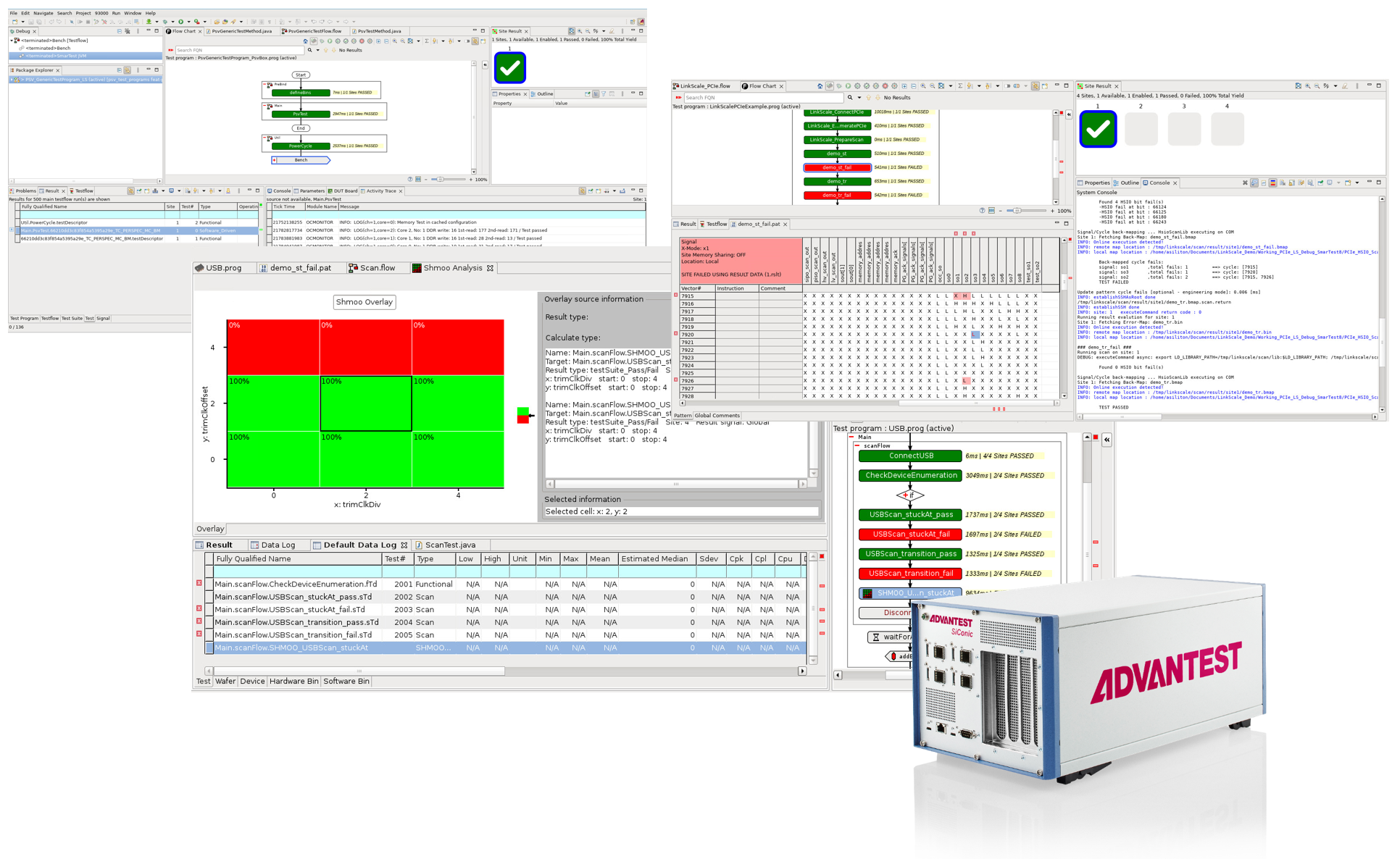
Core Viewpoint - Advantest Corporation has introduced SiConic Test Engineering (TE), enhancing the SiConic ecosystem to empower test engineers throughout the development lifecycle, facilitating earlier validation and debugging without utilizing ATE systems [1][6]. Group 1: Product Features - SiConic TE allows test engineers to validate and debug design verification (DV) and design for test (DFT) content in a unified environment, connecting flexibly to standard evaluation boards via interfaces like USB and PCIe [2][3]. - The integration of SiConic TE with SiConic Link hardware and SmarTest 8 software enhances throughput and trace capabilities during test execution, promoting collaboration among silicon validation (SV), DV, and TE teams [4][5]. - SiConic TE optimizes engineering resources by offloading bring-up and debug tasks from ATE to the bench, improving correlation between bench, ATE, and SLT systems [5]. Group 2: Industry Collaboration - Advantest developed SiConic TE in collaboration with leading customers and EDA partners to ensure seamless integration into existing design and validation workflows [7]. - The partnership with Siemens EDA focuses on improving time-to-market and productivity through joint development of DFT technologies [8]. - Collaboration with Synopsys aims to enhance verification approaches, enabling users to validate high-speed interfaces and perform functional testing through the combined capabilities of Advantest's SiConic platform and Synopsys' solutions [8]. Group 3: Market Impact - SiConic TE is expected to improve productivity at the R&D level, allowing concurrent sign-off and test engineering processes, which can accelerate SoC design ramp-up and reduce time-to-market [6]. - Advantest's commitment to addressing emerging testing challenges positions the company as a leader in the semiconductor test equipment market, catering to applications such as 5G, IoT, and AI [10].
Synopsys and Intel Foundry Propel Angstrom-Scale Chip Designs on Intel 18A and Intel 18A-P Technologies
Prnewswire· 2025-04-29 16:00
Core Insights - Synopsys and Intel Foundry have announced collaborations to enhance EDA and IP solutions for advanced semiconductor processes, specifically targeting the Intel 18A and 18A-P process nodes [2][5][6] EDA and IP Solutions - Synopsys has introduced certified AI-driven digital and analog design flows for the Intel 18A process node and production-ready EDA flows for the Intel 18A-P process node, which includes advanced technologies like RibbonFET and PowerVia [2][6] - The collaboration aims to accelerate the development of AI and high-performance computing (HPC) chip designs, providing comprehensive technologies for mutual customers [5][6] Multi-Die Design Innovation - Synopsys and Intel Foundry are working together to enable the new Embedded Multi-die Interconnect Bridge-T (EMIB-T) technology, which combines benefits from both 2.5D and 3D packaging technologies [3][9] - The EMIB-T reference flow is powered by Synopsys' unified exploration-to-signoff platform, facilitating efficient designs and high-quality results [9] Power, Performance, and Area (PPA) Optimization - Synopsys' EDA flows are optimized for power and area, leveraging Intel's PowerVia technology for enhanced thermal-aware implementations [6][10] - The collaboration has resulted in significant advancements in power, performance, and area (PPA) for designs on Intel 18A and Intel 18A-P process nodes [6][10] Ecosystem Expansion - Synopsys has joined the Intel Foundry Accelerator Design Services Alliance and the Intel Foundry Accelerator Chiplet Alliance to further support the semiconductor ecosystem [11] - This membership aims to enhance interoperability and manufacturability for multi-die chip designs on Intel 18A [11]


Cadence Design Systems: Gaining Ground To Synopsys
Seeking Alpha· 2025-04-27 11:59
Khaveen Investments is a global Investment Advisory Firm dedicated to serving the investment needs of clients worldwide including high-net-worth individuals, corporations, associations, and institutions. We provide comprehensive services ranging from market and security research to business valuation and wealth management. Our flagship Macroquantamental Hedge Fund maintains a diversified portfolio with exposure to hundreds of investments across various asset classes, geographies, sectors, and industries. We ...


华大九天(301269)深度报告:国产半导体EDA领航者,加速赶超全球三巨头
ZHESHANG SECURITIES· 2025-04-02 12:46
Investment Rating - The report assigns a "Buy" rating for the company, Huada Jiutian (301269.SZ) [6] Core Insights - Huada Jiutian is positioned as a leader in the domestic EDA (Electronic Design Automation) market, aiming to accelerate its growth and market share to compete with global giants like Synopsys, Cadence, and Siemens EDA [2][4] - The company is expected to achieve a compound annual growth rate (CAGR) of over 40% in revenue over the next three years, driven by product expansion, market share growth, and advancements in AI technology [3][4] - The company is projected to become the first domestic EDA company to achieve full-process coverage in EDA tools, transitioning from import substitution to global supply [4][11] Summary by Sections Investment Highlights - The company currently holds a 7% market share in the Chinese EDA market, which is dominated by three major players with a combined market share of 75% [2] - Huada Jiutian's revenue is expected to grow from 1.29 billion yuan in 2024 to 3.92 billion yuan in 2026, with a CAGR of 74% for net profit during the same period [4][11] Financial Forecasts - Revenue projections for 2024-2026 are 1.288 billion yuan, 1.808 billion yuan, and 2.617 billion yuan, respectively, with year-on-year growth rates of 27.51%, 40.31%, and 44.75% [4][11] - The company maintains a high gross margin, with a consistent rate above 90% over the past five years, while R&D expenses have been increasing significantly [40][38] Market Context - The EDA industry is expected to grow significantly, with the Chinese EDA market projected to expand from 14 billion yuan in 2024 to 35.4 billion yuan by 2027, reflecting a CAGR of 36.1% [43][47] - The report highlights the importance of EDA tools as a strategic foundation for the integrated circuit industry, emphasizing their role in enhancing design efficiency and driving technological advancements [41][42] Competitive Positioning - Huada Jiutian is recognized for its strong R&D capabilities, with over 300 authorized patents and a commitment to innovation, supported by significant investment from state-owned enterprises [32][35] - The company is well-positioned to leverage national policies that support the semiconductor industry, creating a favorable environment for growth and development [51]

Chiplet,刚刚开始!
半导体行业观察· 2025-03-29 01:44
Core Viewpoint - The management of chip resources is becoming a significant and multifaceted challenge as chips move beyond proprietary designs of large manufacturers and interact with other elements in packaging or systems [1] Group 1: Chiplet Market Dynamics - The chiplet market is currently dominated by monopolistic suppliers, with approximately 95% to 99% of the market controlled by one or a few suppliers adhering to specific specifications [3] - There are three main markets for small chips: exclusive markets, local ecosystems, and open markets, with local ecosystems consisting of five to seven companies collaborating on interoperability [3][6] - Major system and processor suppliers have effectively utilized chiplet approaches to enhance performance and reduce costs through increased computational density [1][3] Group 2: Design and Interoperability Challenges - Many companies are struggling with interoperability and generality, often starting their work from within the chip rather than from a system perspective [2] - The complexity of integrating third-party chips into systems is a significant challenge, requiring time and effort to resolve [1][2] - The need for a common system bus across all chipsets is emphasized, as it adds complexity for IP suppliers who must adapt to changing customer needs [2][3] Group 3: Resource Management and Optimization - Effective resource management is crucial as poor management can lead to performance bottlenecks, increased development costs, and challenges in power consumption [1] - The industry is transitioning from exclusive ecosystems to local ecosystems, with companies seeking the best methods for chip construction [6] - Simplifying chip design through partitioning based on technology can help manage complexity and improve performance [6][7] Group 4: Future Directions and Innovations - The chip industry is beginning to explore open chip economies, allowing for plug-and-play capabilities from multiple suppliers within a single package [11][12] - There is a growing recognition of the need for robust verification IP to ensure interoperability among chiplets, which is currently lacking in the industry [9][10] - The challenge of managing thousands of chips in a single package requires a comprehensive approach to resource management and system integration [12]
概伦电子宣布:筹划收购锐成芯微
半导体行业观察· 2025-03-28 01:00
Core Viewpoint - The company, Shanghai Gai Lun Electronics Co., Ltd., is planning to acquire a controlling stake in Chengdu Ruicheng Chip Micro Technology Co., Ltd. through a combination of share issuance and cash payment, while also raising supporting funds for this transaction [1]. Group 1: Transaction Details - The transaction is expected to constitute a major asset restructuring as defined by the "Measures for the Administration of Major Asset Restructuring of Listed Companies" and is anticipated to involve related party transactions [1]. - The company’s stock will be suspended from trading starting March 28, 2025, for a period not exceeding five trading days to ensure fair information disclosure and protect investor interests [1]. Group 2: Company Background - Founded in 2010, the company has evolved its guiding principles from "Yield-Driven Design" (DFY) to "Design-Technology Co-Optimization" (DTCO) over the years, focusing on enhancing the competitiveness of integrated circuit design and manufacturing [3][4]. - As the first EDA listed company in China, the company emphasizes EDA software licensing as a primary business direction, leveraging international leading technologies and continuous external cooperation to drive application-oriented EDA solutions [4]. Group 3: Strategic Development - The company’s overall strategy involves optimizing technology and product layouts around process and design collaboration, targeting advanced process nodes in the integrated circuit industry [4][5]. - The company aims to establish comprehensive EDA solutions for manufacturing processes and enhance its offerings in analog circuit design, digital circuit design, and data-driven EDA solutions [5]. Group 4: Acquisition Target Overview - Chengdu Ruicheng Chip Micro Technology Co., Ltd., established in 2011, specializes in integrated circuit IP product design and customization services, holding over 150 domestic and international patents [5]. - The target company has established partnerships with over 30 global wafer foundries and has promoted more than 1,000 IPs, serving hundreds of integrated circuit design companies across various applications including automotive electronics and artificial intelligence [5].


Cadence Stock Plunges 10% YTD: How Should You Play the Stock?
ZACKS· 2025-03-26 12:40
Core Viewpoint - Cadence Design Systems (CDNS) has experienced a challenging start to 2025, with a 10.4% decline in share price year to date, underperforming compared to the Computer Software industry, broader technology sector, and S&P 500 composite [1] Price Performance - The stock is currently trading at $269.11, which is 18.2% lower than its 52-week high of $328.99, and is below its 50-day moving average, indicating bearish sentiment among investors [3] Growth Concerns - CDNS provided soft guidance for 2025, projecting revenue growth of 11-12% and non-GAAP EPS growth of 12%, following a 13.5% revenue and 15.9% EPS growth in 2024 [4] - Global macroeconomic conditions and significant exposure to the semiconductor sector raise concerns, as any reduction in R&D spending in this sector could negatively impact CDNS's topline performance [5] Competitive Landscape - Increased operating costs and competition in the EDA/AI space from companies like Keysight Technologies, Synopsys, and ANSYS are additional challenges, with Synopsys's pending acquisition of ANSYS likely intensifying competition [6] Analyst Sentiment - Analysts have shown bearish sentiment, with a 5.1% downward revision in earnings estimates for the current quarter to $1.49 over the past 60 days [8] Valuation Metrics - CDNS's stock is trading at a forward 12-month Price/Earnings ratio of 38.87X, compared to the industry average of 28.5X, reflecting high expectations for future growth despite uncertain near-term prospects [9] Business Fundamentals - The company benefits from broad-based demand for its solutions amid robust design activity, particularly in advanced technologies like AI, 5G, and autonomous vehicles [10] - CDNS is collaborating with major tech companies such as Qualcomm and NVIDIA on next-generation AI designs and is exploring new markets like Life Sciences through its OpenEye drug discovery software [11] Product Development - The verification business is gaining traction due to increasing complexity in system verification, with the launch of advanced systems like Palladium Z3 Emulation and Protium X3 FPGA Prototyping aimed at addressing these challenges [12] Customer Engagement - In 2024, CDNS added over 30 new customers and nearly 200 repeat customers, particularly among AI and hyperscale clients [14] Future Outlook - While CDNS is positioned to benefit from high-growth areas like AI and machine learning, potential risks include macroeconomic uncertainties, competitive pressures, and significant exposure to the semiconductor sector [15] - Concerns about margin compression due to high investments in AI and R&D are present, with estimated non-GAAP operating margins for Q1 2025 between 40% and 41%, down from 46% in Q4 2024 [16]