
EDA

Search documents
【研选行业】智能算力年复合增速超30%,政府工作报告首提“算电协同”!绿电板块迎万亿蓝海,从电力跨界数据中心黑马名单曝光
第一财经· 2026-03-12 10:55
Group 1 - The core viewpoint of the article emphasizes the importance of timely and relevant research reports in identifying investment opportunities, particularly in rapidly evolving sectors like smart computing and manufacturing upgrades [1] - The smart computing sector is projected to have a compound annual growth rate (CAGR) exceeding 30%, with the government report highlighting "coordinated electricity and computing" for the first time, indicating a significant market potential in the green electricity sector [1] - The manufacturing industry is experiencing a transformation driven by "selling tools," where costs account for only 1%-4% but are crucial for processing capabilities, suggesting a focus on three core targets as the industry anticipates a "volume-price-profit" boost [1] Group 2 - The introduction of the first domestic AI EDA (Electronic Design Automation) tool is seen as a pivotal development, with institutions optimistic about the opportunities arising from a threefold resonance within the industry chain [1] - The geopolitical situation in the Middle East is triggering a surge in the chemical sector, with expectations of a major profit increase in the upcoming market wave [1]


华大九天- 数字 EDA 与晶圆厂 EDA 扩张;基于合理相对估值下调至中性
2026-03-10 10:17
Summary of Empyrean (301269.SZ) Conference Call Company Overview - **Company**: Empyrean (301269.SZ) - **Industry**: Electronic Design Automation (EDA) - **Market Cap**: Rmb41.6 billion / $6.0 billion - **Enterprise Value**: Rmb40.3 billion / $5.9 billion - **Current Price**: Rmb95.66 - **Target Price**: Rmb125.00 - **Upside Potential**: 30.7% [1][2] Key Points and Arguments Market Position and Growth - Empyrean is positioned as a leader in the local EDA market, benefiting from the trend of localization of EDA tools in China [1] - The company has developed total solutions for analog and memory EDA, but full-flow digital EDA and foundry EDA tools are still in the scaling phase [1] - Revenue contributions from digital and foundry EDA tools are expected to increase from 27% and 34% in 2024/25E to 39% and 43% in 2027/28E [1] Financial Performance and Projections - Revenue estimates for 2025-2028 have been revised down by 17%-20% due to lower expected revenues from digital and foundry EDA and increased R&D spending [1][20] - Expected revenue growth rates are 42% in 2026E and 40% in 2027E [1] - The company is projected to achieve revenues of Rmb1,979.1 million in 2026E and Rmb2,764.6 million in 2027E [6] Earnings and Valuation - The stock is currently trading at a P/E of 42x for 2028E and 29x for 2029E, which aligns with peers [2] - The target price has been revised down from Rmb155 to Rmb125, reflecting a 31% upside potential [2] - The downgrade from Buy to Neutral is based on slower-than-expected new product rollouts and longer timelines for EDA localization [2] Product Development and Client Adoption - Empyrean is developing point tools such as DFT (Design for Testability) and place and route tools for digital clients, which are crucial for increasing user adoption [3] - The company is focusing on the full coverage of digital EDA tools to meet rising demand for AI chips [3][19] Operational Challenges - The company faces challenges in the development of full-flow tools and the adoption timeline by ASIC/GPU or foundry clients [1][20] - High R&D spending is expected to continue, impacting operational efficiency in the short term [20] Financial Metrics - Projected EBITDA for 2026E is Rmb245.0 million, with a net income of Rmb346.5 million [6][17] - The company’s gross margin is expected to decline slightly from 93.3% in 2024 to 90.5% in 2028 [23] - Free cash flow is projected to be negative in 2025E but positive in subsequent years, reaching Rmb841.1 million in 2027E [29] Additional Important Insights - The company’s account receivable days are expected to improve from 147 days in 2024 to 139 days in 2028E, indicating better cash flow management [24] - The cash conversion cycle is projected to decrease from 262 days in 2024 to 146 days in 2028, reflecting improved operational efficiency [27] - The company’s valuation is based on a target multiple of 45x for 2029E EPS, which is derived from the correlation between P/E and forward earnings growth among peers [31][32] This summary encapsulates the key insights from the conference call regarding Empyrean's market position, financial performance, product development, and operational challenges, providing a comprehensive overview for potential investors.

未知机构:美股半导体与科技板块的周度投资备忘录核心是对近期市场情绪板块轮动个股表现以-20260224
未知机构· 2026-02-24 03:00
Summary of Conference Call Notes Industry Overview - **Industry Focus**: Semiconductor and Technology Sector in the US [1] - **Market Sentiment**: Investors are experiencing a prolonged period of uncertainty, likened to a "long winter," with a focus on risk reduction and seeking new opportunities outside optical and storage stocks [1] Key Insights - **Market Expectations**: There is potential for upward movement in hardware and semiconductor stocks once uncertainties dissipate, although institutional buying has already increased by 4% in semiconductor stocks [1] - **Semiconductor Equipment**: Strong earnings from Applied Materials (AMAT) have bolstered the sector, but some individual stocks are facing valuation pressures [2] - **Optical Stocks**: Significant increases in stocks like LITE, COHR, CIEN, and FN driven by optimistic expectations from AXTI's performance and NVIDIA's co-packaged optics (CPO) ahead of the OFC conference [2] - **Hard Drive Stocks**: Profit-taking observed, with investors questioning why Seagate Technology (STX) continues to underperform compared to Western Digital (WDC) [2] - **Analog Chips**: Analog Devices (ADI) is viewed positively for the second half of the year, though its valuation is considered high; ON Semiconductor (ON) is seen as an industry bellwether [2] - **EDA**: Cadence Design Systems (CDNS) and KLA Corporation (KLAC) show strong fundamentals, but market sentiment remains cautious [2] Institutional Positioning and Fund Flows - **De-leveraging**: The de-leveraging phase ended last week, with a slight recovery in net flows after hedge funds sold off in early February [2][3] - **Hedge Fund Leverage**: A slight increase in hedge fund leverage was noted, with performance rebounding to a monthly flat position [3] - **Sector Rotation**: There is a high degree of differentiation in semiconductor and software sector positioning, with rotation slowing or slightly reversing [4] - **Mag7 Stocks**: A minor buying trend (+0.9%) observed, with neutral fund flows in US semiconductors and moderate buying in AI concept stocks [5] NVIDIA (NVDA) Insights - **Market Sentiment**: The position remains crowded but optimistic, with no change in holdings over the past month [5] - **Earnings Expectations**: Buy-side institutions expect NVIDIA's Q2 earnings to exceed market expectations by $2 billion, with Q3 guidance also anticipated to surpass expectations by the same amount, excluding revenue from China [5] - **Valuation Discussions**: Increased discussions on the re-evaluation of valuations for non-foundry AI leaders like AVGO and NVDA, alongside skepticism regarding OpenAI's reduced 2030 compute targets and META's opaque announcements [5] - **Memory Prices**: High memory prices are viewed as a long-term risk [5] - **Institutional Positioning**: A score of 8/10 indicates a high allocation to NVIDIA, reflecting a bullish stance [5] - **Implied Volatility**: Implied volatility stands at 4.4%, indicating market expectations for short-term price fluctuations [5] Future Focus Areas - **Upcoming Events**: Key upcoming events include NVIDIA's GTC conference, earnings guidance, Broadcom's (AVGO) AI chip developments, and the OFC conference focusing on CPO and other technological advancements [6]

台积电EDA名单更新:Ansys退出,国产仅1席
是说芯语· 2026-02-10 08:18
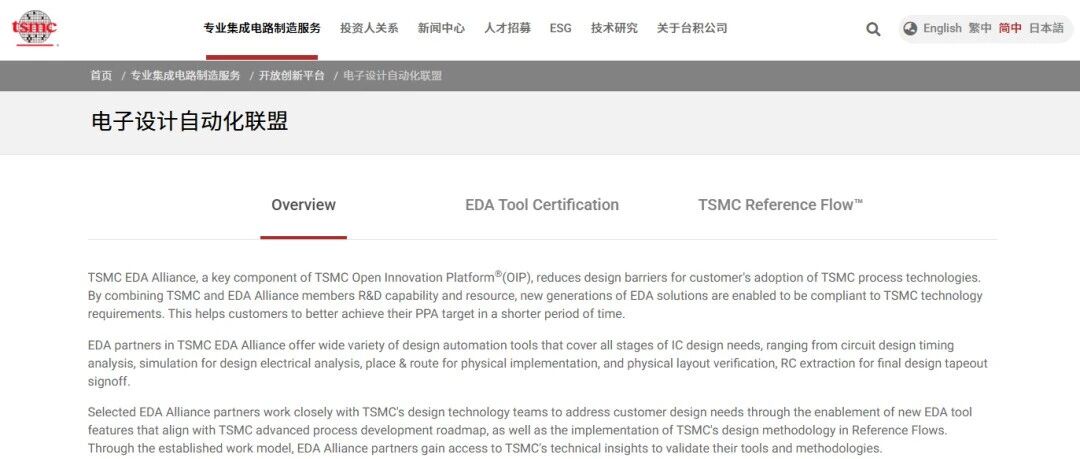
Core Viewpoint - TSMC's latest EDA alliance list, announced on February 6, includes 12 member companies, reflecting the industry's structural adjustments and the importance of EDA in semiconductor development [1][3]. Group 1: EDA Alliance Composition - The EDA alliance remains stable, with major players like Synopsys, Cadence, and Siemens EDA maintaining their dominant positions, while Primarius is the only domestic EDA company included [1][3]. - Ansys has exited the alliance due to its acquisition by Synopsys, which enhances Synopsys's influence within TSMC's EDA ecosystem [3]. - The remaining 11 members of the alliance have not changed, indicating a stable ecosystem [3]. Group 2: Domestic EDA Industry - Primarius's continued presence as the sole Chinese EDA firm highlights its technical recognition and the current state of the domestic EDA industry [4]. - Primarius focuses on core EDA areas such as modeling, simulation, and circuit verification, serving mid-to-high-end analog and mixed-signal circuit design, demonstrating strong technical capabilities [4]. - The exit of Empyrean from the alliance, following significant changes, underscores the challenges faced by domestic EDA firms in maintaining their positions in global ecosystems [7][8]. Group 3: Industry Dynamics - The TSMC EDA alliance is part of its Open Innovation Platform (OIP), aimed at collaborating with global EDA vendors for tool adaptation and methodology optimization [7]. - The stability and minor adjustments in the alliance reflect the ongoing dominance of international EDA giants in the advanced EDA field, while domestic firms still face significant technological gaps [10]. - Domestic EDA companies like Primarius are gradually overcoming technical barriers and integrating into the global semiconductor manufacturing ecosystem through focused R&D and collaboration with foundries [10].


20cm速递|科创人工智能ETF国泰(589110)回调超3%,EDA行业加速发展,回调或可布局
Mei Ri Jing Ji Xin Wen· 2026-02-04 07:04
Group 1 - The core viewpoint of the article highlights that the EDA (Electronic Design Automation) industry is entering an accelerated development phase, with recent IPOs and mergers becoming more active, leading to increased transaction amounts and a focus on core digital IC design segments [1] - The industry is expected to consolidate into 2 to 3 leading firms that will cover the entire market in the medium to long term [1] - There is a significant opportunity arising from the divergence in domestic manufacturing processes, as domestic wafer fabs are developing new technological paths unsupported by overseas EDA tools, creating a completely independent market space for domestic EDA companies [1] Group 2 - The Guotai Science and Technology Artificial Intelligence ETF (589110) tracks the Science and Technology AI Index (950180), which has a daily price fluctuation limit of 20% and selects 30 large-cap listed companies from the Sci-Tech Innovation Board related to AI resources, technology, and applications [1] - The index's industry allocation is concentrated in cutting-edge technology fields such as electronics and computers, emphasizing high R&D investment and technological innovation capabilities [1]
未知机构:申万计算机EDA月度思考202602国资再入股概伦-20260204
未知机构· 2026-02-04 02:10
Summary of Key Points from the Conference Call Company and Industry Involved - The conference call focuses on the EDA (Electronic Design Automation) industry, specifically discussing the company "概伦电子" (Gao Lun Electronics) and its recent developments [1][2]. Core Insights and Arguments 1. **State-Owned Capital Increase** On January 12, Gao Lun Electronics announced that KLProTech and eight employee shareholding platforms plan to transfer 21.76 million shares (5% of total shares) to Shanghai Kechuang Group at a price of 31.8 CNY per share, totaling 6.92 billion CNY [1]. 2. **Significance of State-Owned Capital** The increase in state-owned capital highlights the strategic position of Gao Lun in the EDA platform. The involvement of Shanghai Kechuang Group, a wholly-owned subsidiary of State Investment, indicates a deepening strategic cooperation [1]. 3. **Potential of EDA Integration Platforms** The EDA industry is expected to undergo significant consolidation, with projections indicating the emergence of 2-3 comprehensive giants within the next five years [1]. 4. **Performance Forecast for 2025** On January 26, Gao Lun Electronics projected a revenue of 487 million CNY for 2025, representing a year-on-year increase of 16.21%. The company anticipates a net profit of 36 million CNY, a turnaround from a loss of 95.97 million CNY in the previous year [2]. 5. **Importance of Domestic Advanced Processes** The performance growth of Gao Lun is expected to be driven by domestic advanced manufacturing processes. EDA tools are closely linked to manufacturing processes, and the inability of overseas EDA tools to adapt to domestic advanced processes creates a unique opportunity for domestic EDA tools [2]. 6. **Competition in Advanced IC Design** The fields of analog and digital ICs at 7nm and above will face direct competition from established overseas tools, while the divergence of domestic manufacturing processes presents a unique supply-demand scenario for domestic EDA companies [2]. 7. **IPO and M&A Activity** The EDA industry is witnessing an increase in IPO activities, which may lead to more capital influx to support industry development. The tools of companies entering the IPO process have low overlap with existing listed companies, minimizing potential conflicts [3]. 8. **Overall Industry Trends** The EDA industry is expected to continue its trend of mergers and acquisitions, optimizing the overall market structure. The introduction of more capital from various sources, including state funds, will further support industry growth [4]. Other Important but Potentially Overlooked Content - The integration of state-owned capital is crucial for the EDA industry's consolidation efforts, and local EDA integration entities are highlighted as having significant development potential [2]. - The anticipated performance growth of Gao Lun Electronics is closely tied to the evolving landscape of domestic manufacturing processes and the strategic positioning of state-owned enterprises in the EDA sector [2].
EDA 行业月报 202602 期:国资再入股概伦电子-20260203
Shenwan Hongyuan Securities· 2026-02-03 11:53
Investment Rating - The report rates the EDA industry as "Overweight," indicating that the industry is expected to outperform the overall market [12]. Core Insights - The EDA industry is entering an accelerated development phase, driven by active IPOs and mergers and acquisitions [5]. - The report highlights two significant events in January 2026: the performance forecast of Gaolun Electronics and the increase in shareholding by state-owned investment [5]. - The long-term outlook for the EDA industry suggests the emergence of 2-3 major players through mergers and acquisitions, with state capital playing a crucial role in this growth [5]. Summary by Sections Key Events - Gaolun Electronics forecasts a revenue of 487 million yuan for 2025, a year-on-year increase of 16.21%, and a net profit of 36 million yuan, marking a turnaround from a loss of 95.97 million yuan in the previous year [5]. - State-owned investment increased its stake in Gaolun Electronics by 5%, highlighting the company's strategic importance in the EDA sector [5]. Industry Trends - The report emphasizes the importance of domestic technology paths in semiconductor manufacturing, which creates independent market opportunities for local EDA companies due to the lack of support from foreign EDA tools [5]. - The report notes that the EDA industry is experiencing a surge in IPO activities, with three new companies entering the IPO process, reflecting the overall growth trend in the sector [5]. - The report stresses the need for EDA companies to possess comprehensive platform capabilities to enhance competitiveness, underscoring the role of EDA firms as integration platforms for local industries [5]. Related Companies - Key companies mentioned include Huada Jiutian, Gaolun Electronics, and Guangli Micro, each with distinct advantages in the EDA market [5].
EDA行业月报202602期:国资再入股概伦电子-20260203
Shenwan Hongyuan Securities· 2026-02-03 09:21
Investment Rating - The industry investment rating is "Overweight" indicating that the EDA industry is expected to outperform the overall market [13]. Core Insights - The EDA industry is entering an accelerated development phase, driven by active IPOs and mergers and acquisitions [5][3]. - The report highlights two key events in January 2026: the performance forecast of Gaon Electronics and the increase in shareholding by state-owned investment [5]. - Gaon Electronics is projected to achieve a revenue of 487 million yuan in 2025, a year-on-year increase of 16.21%, and is expected to turn a profit with a net profit of 36 million yuan [5]. - The report emphasizes the potential of EDA integration platforms, predicting the emergence of 2-3 comprehensive giants in the next five years, supported by state capital and large funds [5]. - The report identifies three main viewpoints: the opportunities arising from the divergence of domestic process paths, the active IPO and M&A activities, and the importance of industry chain collaboration and policy/capital support [5]. Summary by Sections Key Events - In January 2026, two significant events occurred in the domestic EDA industry: Gaon Electronics' performance forecast and the increase in shareholding by state-owned investment [5]. - Gaon Electronics expects to achieve a revenue of 487 million yuan in 2025, a 16.21% increase year-on-year, and a net profit of 36 million yuan, marking a turnaround from a loss of approximately 95.97 million yuan in the previous year [5]. Industry Trends - The EDA industry is experiencing an acceleration in development, with three new companies entering the IPO process, each positioned in different segments of the industry [5]. - The report notes that recent M&A activities in the EDA sector have seen increasing transaction values, focusing on core areas of digital IC design, indicating a shift towards advanced fields [5]. Investment Opportunities - The report highlights the importance of domestic process divergence, which creates opportunities for local EDA companies due to the lack of support from overseas EDA tools for new domestic technologies [5]. - It emphasizes the necessity for EDA companies to possess comprehensive platform capabilities to enhance competitiveness and the role of EDA listed companies as important integration platforms for local EDA industries [5]. Related Companies - Key companies mentioned include Huada Jiutian, Gaon Electronics, and Guangliwei, each with distinct advantages and growth potential in the EDA sector [5].
概伦电子股价跌5.2%,南方基金旗下1只基金位居十大流通股东,持有574.41万股浮亏损失1160.31万元
Xin Lang Cai Jing· 2026-02-02 03:11
Group 1 - The core point of the news is that Gaolun Electronics experienced a 5.2% drop in stock price, closing at 36.86 yuan per share, with a trading volume of 127 million yuan and a turnover rate of 0.78%, resulting in a total market capitalization of 16.041 billion yuan [1] - Gaolun Electronics, established on March 18, 2010, and listed on December 28, 2021, is located in the Shanghai Free Trade Zone and specializes in providing EDA products and solutions widely validated by leading global integrated circuit design and manufacturing companies [1] - The revenue composition of Gaolun Electronics includes 67.95% from EDA tool licensing, 21.23% from technical development solutions, 10.63% from semiconductor device characteristic testing systems, and 0.18% from other sources [1] Group 2 - Southern Fund's Southern Information Innovation Mixed A (007490) entered the top ten circulating shareholders of Gaolun Electronics in the third quarter, holding 5.7441 million shares, which accounts for 1.32% of the circulating shares, with an estimated floating loss of approximately 11.6031 million yuan [2] - The Southern Information Innovation Mixed A fund, established on June 19, 2019, has a latest scale of 2.835 billion yuan, with a year-to-date return of 29.28%, ranking 42 out of 9000 in its category, and a one-year return of 105.7%, ranking 149 out of 8193 [2] - The fund manager of Southern Information Innovation Mixed A is Zheng Xiaoxi, who has a cumulative tenure of 6 years and 231 days, with a total asset scale of 6.898 billion yuan and a best fund return of 244.45% during the tenure [3] Group 3 - Southern Fund's Southern Sci-Tech Innovation 3-Year Open Mixed (506000) holds 2.8683 million shares of Gaolun Electronics, representing 4.33% of the fund's net value, making it the ninth largest holding, with an estimated floating loss of about 579.41 thousand yuan [4] - The Southern Sci-Tech Innovation 3-Year Open Mixed fund was established on July 28, 2020, with a latest scale of 2.307 billion yuan, achieving a year-to-date return of 17.23%, ranking 369 out of 9000, and a one-year return of 60.74%, ranking 1266 out of 8193 [4] - The fund manager of Southern Sci-Tech Innovation 3-Year Open Mixed is also Zheng Xiaoxi, with the same cumulative tenure and asset scale as mentioned previously [5]
学大教育:投资EDA公司,有望享受国产替代红利及产业协同-20260127
Xinda Securities· 2026-01-27 10:30
Investment Rating - The investment rating for the company is upgraded to "Buy" from "Hold" [3] Core Insights - The company plans to invest up to 35 million yuan in Jiangyin Qixin Linghang through a newly established partnership, acquiring a 6.48% stake [3] - Jiangyin Qixin Linghang is in its cultivation and development stage, with projected revenues of 51.71 million yuan in 2024 and 29.10 million yuan in the first three quarters of 2025, alongside net losses of 36.03 million yuan and 12.91 million yuan respectively [3] - The investment is expected to benefit from the domestic substitution boom in the EDA industry, where U.S. companies dominate with a combined market share of 74% globally and over 80% in the domestic market [3] - The founding team of Qixin Linghang has over 20 years of experience in EDA, which positions the company well for industrialization in this sector [3] - The partnership is anticipated to create synergies in vocational education within the EDA field, leveraging the company's extensive network and resources in vocational training [3] Financial Summary - Total revenue is projected to grow from 2,213 million yuan in 2023 to 4,931 million yuan in 2027, with a compound annual growth rate (CAGR) of 19.2% [4] - Net profit attributable to the parent company is expected to increase significantly from 154 million yuan in 2023 to 345 million yuan in 2027, reflecting a growth rate of 1035.2% in 2024 [4] - The company's EPS is forecasted to rise from 1.26 yuan in 2023 to 2.83 yuan in 2027, with corresponding P/E ratios decreasing from 31.28 to 13.95 [4]
