南京银行

Search documents
银行积存金业务热度不减 部分银行上调准入门槛
Zhong Guo Zheng Quan Bao· 2026-01-08 22:12
受到年轻投资者青睐 "最低1克即可入场,无需一次性投入大量资金,资金量有限的投资者进场无压力。投资者可以从1克 起,一点一点攒金条。"光大银行一位客户经理表示,积存金支持"T+0"交易,投资者在工作日的白天 和晚上都可以在手机银行实时交易,利用碎片时间就能进行操作管理。交易费定价清晰透明,没有隐性 成本支出,持有一定期限还能获得利息。 南京银行北京分行人士表示,该行有活期积存、定期积存、黄金定投等多种投资方式。活期积存可以看 成是存在银行可灵活买卖的黄金,1克起购买卖灵活,还可兑换实物黄金。定期积存是存在银行可以"生 金"的黄金,2克起购,多期限选择,可以随时转活期。此外,客户还可以进行黄金定投,以"懒人"模式 轻松积攒黄金份额,定投周期可以灵活选择。 近日,工商银行发布公告称,自1月12日起,将个人积存金业务风险准入等级上调至C3(平衡型)及以 上。此前,考虑到市场波动情况、投资者保护和产品风险属性等因素,多家银行已上调评级准入门槛, 达不到门槛的低风险投资者无法办理相关业务,根据客户风险偏好严把入口关。业内人士预计,随着金 价波动持续,未来会有更多银行跟进上调积存金投资准入门槛,有关积存金业务的风控举措也 ...
银行积存金业务热度不减部分银行上调准入门槛
Zhong Guo Zheng Quan Bao· 2026-01-08 20:50
● 本报记者 薛瑾 近日,工商银行发布公告称,自1月12日起,将个人积存金业务风险准入等级上调至C3(平衡型)及以 上。此前,考虑到市场波动情况、投资者保护和产品风险属性等因素,多家银行已上调评级准入门槛, 达不到门槛的低风险投资者无法办理相关业务,根据客户风险偏好严把入口关。业内人士预计,随着金 价波动持续,未来会有更多银行跟进上调积存金投资准入门槛,有关积存金业务的风控举措也将持续升 级。 受到年轻投资者青睐 "最低1克即可入场,无需一次性投入大量资金,资金量有限的投资者进场无压力。投资者可以从1克 起,一点一点攒金条。"光大银行一位客户经理表示,积存金支持"T+0"交易,投资者在工作日的白天 和晚上都可以在手机银行实时交易,利用碎片时间就能进行操作管理。交易费定价清晰透明,没有隐性 成本支出,持有一定期限还能获得利息。 工商银行提高准入门槛 南京银行北京分行人士表示,该行有活期积存、定期积存、黄金定投等多种投资方式。活期积存可以看 成是存在银行可灵活买卖的黄金,1克起购买卖灵活,还可兑换实物黄金。定期积存是存在银行可以"生 金"的黄金,2克起购,多期限选择,可以随时转活期。此外,客户还可以进行黄金定投, ...

积存金走俏!投资门槛有变化
Zhong Guo Zheng Quan Bao· 2026-01-08 10:36
"趁着前两天金价稍微回调,我以每克大约980元的价格入了几克积存金。今天打开银行App一看,已经 有浮盈了。"来自北京的投资者小林告诉记者。近期,黄金投资热度不减,银行积存金备受关注。 从银行端看,一场有关业务风控的升级正在加速进行。1月12日起,工商银行(601398)将个人积存金 业务风险准入等级上调至C3(平衡型)及以上,此前,考虑到市场波动情况、投资者保护和产品风险 属性等因素,多家银行已调整评级准入门槛,达不到门槛的低风险投资者无法办理相关业务。 业内人士预计,随着金价波动持续,未来会有更多银行上调积存金投资准入门槛。 "一点一点攒金条" "最低1克即可入场,无需一次性投入大量资金,资金量有限的投资者进场无压力,投资者可以一点一点 攒金条。"光大银行(601818)一位客户经理表示,"积存金支持T+0交易,投资者在工作日的白天和晚 上都可以在手机银行实时进行交易,利用碎片时间就能进行操作管理。交易费定价清晰透明,也没有隐 性成本支出,长期持有一定期限还能获得利息。" 上述特性让积存金成为投资者投资黄金的一大选择。记者从多位银行业内人士处了解到,自2024年黄金 开启新一轮升浪以来,积存金业务变得更加 ...
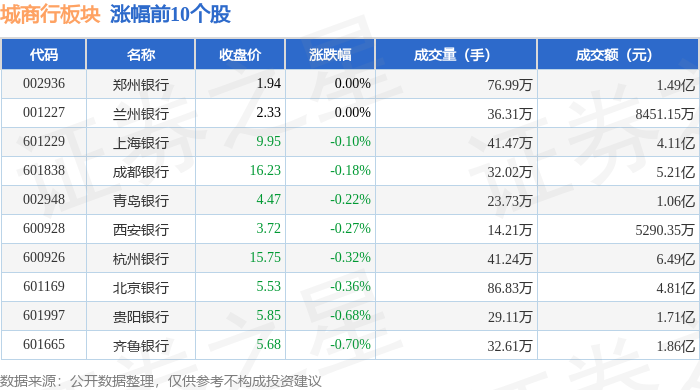
城商行板块1月8日跌0.89%,重庆银行领跌,主力资金净流入673.97万元
Zheng Xing Xing Ye Ri Bao· 2026-01-08 08:56
Market Overview - The city commercial bank sector experienced a decline of 0.89% on January 8, with Chongqing Bank leading the drop [1] - The Shanghai Composite Index closed at 4082.98, down 0.07%, while the Shenzhen Component Index closed at 13959.48, down 0.51% [1] Individual Stock Performance - Zhengzhou Bank closed at 1.94 with no change, while Lanzhou Bank also remained unchanged at 2.33 [1] - Shanghai Bank closed at 9.95, down 0.10%, and Chengdu Bank closed at 16.23, down 0.18% [1] - Chongqing Bank saw a significant decline of 2.70%, closing at 10.45, with a trading volume of 99,000 shares [2] Trading Volume and Turnover - The trading volume for Zhengzhou Bank was 769,900 shares with a turnover of 149 million yuan, while Lanzhou Bank had a trading volume of 363,100 shares and a turnover of 84.51 million yuan [1] - The highest turnover was recorded for Nanjing Bank at 1.342 billion yuan with a trading volume of 1,217,000 shares [2] Capital Flow Analysis - The city commercial bank sector saw a net inflow of 6.7397 million yuan from institutional investors, while retail investors experienced a net outflow of 70.5351 million yuan [2] - Chengdu Bank had a net inflow of 87.0825 million yuan from institutional investors, but a net outflow of 46.0321 million yuan from retail investors [3] Summary of Capital Flows - Institutional investors showed a positive net flow for several banks, including Hangzhou Bank with 77.8301 million yuan and Qingdao Bank with 8.4480 million yuan [3] - Conversely, Chongqing Bank had a negative net flow of 535,600 yuan from institutional investors, indicating a lack of confidence [3]


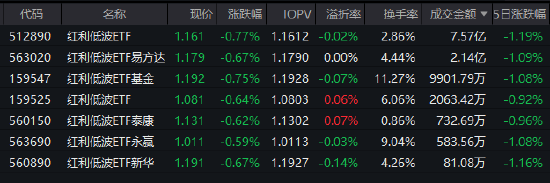
沪指录得K线15连阳 红利低波ETF(512890)近20个交易日逆势2吸金18.08亿元
Xin Lang Cai Jing· 2026-01-08 08:08
Core Viewpoint - The market is experiencing fluctuations, with the ChiNext Index dropping over 1% and the Shanghai Composite Index down 0.07%, while the Hongli Low Volatility ETF (512890) has seen a decline of 0.77% [1][11]. Fund Performance - The Hongli Low Volatility ETF (512890) is currently priced at 1.161 CNY, with a trading volume of 7.57 billion CNY and a turnover rate of 2.86% [1][11]. - Over the past five trading days, the fund has seen a net inflow of 297 million CNY, with a total net inflow of 1.808 billion CNY over the last 20 days and 5.172 billion CNY over the last 60 days [4][10]. - The fund's total return as of January 7, 2026, is 133.70%, outperforming its benchmark, ranking 98th among 502 funds [6][13]. Market Context - Morgan Stanley predicts that the CSI 300 Index will reach a target of 5200 points in 2026, indicating a potential increase of approximately 13.5% [6][13]. - The current market phase is transitioning from liquidity-driven growth to profit improvement-driven growth, suggesting a favorable environment for cyclical stocks [6][13]. - New regulations are expected to benefit sectors such as banking, public utilities, and coal, which are part of the dividend sector [6][13]. Top Holdings - The top ten holdings of the Hongli Low Volatility ETF include companies like COFCO Sugar, Nanjing Bank, and Agricultural Bank of China, with varying performance among these stocks [3][8].
陕国投拟8亿“入局”长安银行增资 区域银行资本补充潮起
Jing Ji Guan Cha Wang· 2026-01-08 03:18
Group 1: Core Insights - Shaanxi International Trust Co., Ltd. (Shaanxi Guotou) plans to invest up to 800 million yuan in Chang'an Bank's capital increase, acquiring no more than 209 million shares at a price of 3.83 yuan per share, which will be used to supplement core Tier 1 capital [1] - The capital increase is part of a broader trend where regional banks are receiving shareholder support to strengthen their capital bases amid intensified regulatory constraints and competitive pressures [1][7] - The investment by Shaanxi Guotou reflects a strategic shift from being a provider of financial products to becoming a long-term shareholder in core financial institutions, aiming to stabilize income and enhance influence within the regional financial system [2][3] Group 2: Financial Performance and Challenges - Chang'an Bank faces significant capital pressure, with its core Tier 1 capital adequacy ratio declining from 9.15% at the end of 2024 to 8.23% by September 2025, indicating a growing tension between asset expansion and capital replenishment [4] - The bank's revenue and net profit have shown a downward trend, with revenue decreasing from 9.779 billion yuan in 2023 to 9.461 billion yuan in 2024, and net profit dropping from 2.445 billion yuan in 2023 to 2.315 billion yuan in 2024 [4] - The bank's provision coverage ratio has decreased from 191.15% at the end of 2023 to 151.77% by September 2025, although it remains above regulatory requirements, indicating a buffer against potential asset quality fluctuations [5] Group 3: Strategic Implications - The pricing strategy for the capital increase reflects a discount to the book value, indicating a cautious market valuation of regional bank equities in the current economic environment [6] - The collective action of the Shaanxi state-owned enterprises in this capital increase is not merely a financial investment but a strategic move by the local government to maintain regional financial stability and enhance collaboration between finance and industry [6] - The ongoing capital increase trend among regional banks signifies a shift from "blood transfusion" to "blood production," highlighting the need for banks to convert capital advantages into sustainable competitive strengths amid structural changes in the banking environment [8]

长安银行增资扩股 陕国投拟入场增持股份至6.23%
Zheng Quan Shi Bao· 2026-01-07 18:03
目前,陕国投共持有长安银行4.26亿股,其中3.54亿股通过以物抵债方式获得,相关手续正在办理中。 本次增资后,陕国投将持有长安银行6.35亿股,占长安银行增资后的股份比例为6.23%。 2025年11月26日,陕国投收到长安银行发来的《长安银行增资扩股关于法人股东认购股份的意向函》及 相关附件,邀请该公司参与长安银行本次增资。 近日,陕国投发布公告称,拟以自有资金参与长安银行增资扩股,增资金额不超过8亿元,对应认购股 份不超过2.09亿股。 截至目前,长安银行与多名潜在认购对象积极沟通,签订附条件生效的《股份认购协议》,并将在确定 全部投资者后根据投资者最终股权比例履行投资者资格报备或审批程序。潜在认购对象包括:陕西延长 石油(集团)有限责任公司、陕西煤业(601225)化工集团有限责任公司、陕西有色金属控股集团有限责 任公司、陕西金融控股集团有限公司、榆林市财金投资管理有限公司、宝鸡市投资(集团)有限公司、宝 鸡高新投资控股集团有限公司、咸阳市财金担保管理有限公司等。 截至2025年末,长安银行总股本为75.77亿股,前十大股东合计持股比例为81.84%,单一股东持股比例 不超过20%,无控股股东,实际控 ...
银行开年信贷“加速跑”
Shang Hai Zheng Quan Bao· 2026-01-07 17:52
Group 1 - Agricultural Bank of China plans to focus on serving national strategic needs by prioritizing high-quality credit allocation, targeting a total of over 60 billion yuan in new loans for 2026, with an emphasis on the "Five Major Articles" related to financial supply [1] - Zhejiang-based banks are increasing their loan offerings in green finance, technology innovation, manufacturing, agriculture, and private enterprises to support structural indicators related to the "Five Major Articles" [1] - The People's Bank of China aims to enhance the financial policy framework of the "Five Major Articles" and improve the evaluation system for financial services, emphasizing specialized and refined financial service levels [1] Group 2 - Banks are innovating mechanisms to accelerate fund disbursement, with Ningbo Bank implementing a green approval channel for technology innovation, achieving loan disbursement in just three working days at a reduced interest rate of 2.3% [2] - A shift in banking strategy is observed, moving away from traditional interest rate competition to a focus on comprehensive services and long-term client relationships, as exemplified by a small agricultural machinery manufacturer choosing a bank based on service rather than the lowest interest rate [3] - The trend of integrating various financial services, such as credit, investment banking, and cash management, is becoming prevalent among banks, aiming to provide a holistic "financing + intelligence" service to support enterprises in accessing capital markets [3]
早部署、快投放、重质量 银行开年信贷“加速跑”
Shang Hai Zheng Quan Bao· 2026-01-07 17:51
Core Insights - The banking sector has entered a "full bow" state at the beginning of the year, with a noticeable acceleration in credit issuance, emphasizing "early deployment, rapid disbursement, and quality" [1] - There is a shift from a "scale-first" approach to a focus on the rhythm, structure, and strategy of credit issuance, aiming to optimize credit structure and upgrade service models for long-term development [1] Group 1: Credit Issuance Trends - Banks are prioritizing early loan disbursement to support enterprises' operational needs, with a focus on completing project funding before the Spring Festival [2] - A significant portion of annual credit issuance typically occurs in the first quarter, with frontline credit personnel recognizing the importance of "early disbursement, early returns" [2][3] - A head of a major joint-stock bank noted that achieving 50% to 60% of the annual loan target in the first quarter is crucial to meeting overall goals [3] Group 2: Structural Adjustments in Credit Supply - In response to narrowing net interest margins, banks are recalibrating their credit issuance direction, emphasizing quality and structural optimization over sheer volume [4] - Agricultural Bank of China plans to focus on high-quality credit issuance, targeting key areas aligned with national strategies, with a goal of adding over 60 billion yuan in loans in 2026 [4] - Zhejiang Commercial Bank aims to increase lending in green, technology, manufacturing, agricultural, and private enterprise sectors [4] Group 3: Innovative Approaches to Credit - The People's Bank of China is enhancing the financial policy framework to improve service evaluation and professionalization in financial services [5] - Banks are adjusting their credit structures to address interest margin pressures, with a focus on supporting technology startups despite their limited short-term profitability [5] - Mechanisms such as "pre-approval" processes are being implemented to expedite loan disbursement, exemplified by Ningbo Bank's rapid funding for technology enterprises [5] Group 4: Shift in Business Strategy - Banks are moving away from traditional interest rate competition, focusing instead on comprehensive service and long-term partnerships with clients [6] - A case study of a small agricultural machinery manufacturer illustrates this shift, where service quality and problem-solving capabilities outweighed the importance of interest rates in client decisions [6] - The transition from "single-point service" to "comprehensive empowerment" is becoming a prevalent strategy among banks, integrating various financial tools to support enterprises [6]


按揭、信用卡、消费贷与经营贷深度:深度银行四大零售资产的风险分析框架
ZHONGTAI SECURITIES· 2026-01-07 11:17
Investment Rating - The report maintains an "Overweight" rating for the banking sector [2] Core Insights - The four categories of retail loans (mortgages, credit cards, consumer loans, and business loans) collectively constitute household liabilities, each with distinct collateral types, duration structures, and policy influences. The report aims to establish a risk framework for these retail assets and assess their impact on banking operations in the future [2][4] - Under stress testing, the non-performing loan (NPL) ratios for mortgages, credit cards, and consumer loans are projected to increase by 11, 12, and 20 basis points respectively in 2026, while the growth in non-performing amounts remains manageable. The overall quality of corporate assets is expected to continue improving, indicating a stable banking sector [2][4] - Retail asset risks are deemed controllable, with policies expected to maintain stability in the near term [2] Summary by Sections Retail Asset Analysis Framework: Collateral Types + Duration Structure + Policy Impact - The overall NPL ratio for retail loans of listed banks is estimated at 1.27% in the first half of 2025, slightly above the corporate NPL ratio of 1.26%, but the increase in NPL ratios is stabilizing. The composition of existing NPLs is 63% corporate and 37% retail, with business loans and mortgages showing higher proportions of both existing and newly added NPLs [2][12] - The report establishes a risk analysis framework for retail assets, highlighting the differences in collateral types, duration structures, and policy impacts among the four categories of retail loans [2][4] Consumer Loans: "High-Risk" Assets - The relationship between consumer loans and consumption trends is closely aligned, with notable deviations occurring during strict property purchase restrictions and regulatory cycles for online loans. The market structure for consumer credit (excluding credit cards and mortgages) shows that listed banks hold over 51.5% of the market, while non-listed banks account for 17% and other players for 31% [2][4] - The risk logic for consumer credit indicates that risk pricing is primarily determined by interest rates, which can be categorized into four tiers based on risk levels. The report estimates that 4.4% of consumer loans fall into the "high-risk" category, with commercial banks' high-risk consumer loans representing only 0.6% of their total consumer loans [2][4] Mortgage Loans: Risk Sources and International Comparisons - The primary sources of mortgage risk include negative cash flow and high loan-to-value (LTV) ratios, with 1.2% of respondents reporting monthly incomes below their mortgage payments. The report anticipates that the current high LTV portion, which constitutes 2.9% of total mortgage balances, will not necessarily lead to increased NPLs [2][4] - International comparisons indicate that mortgage NPL ratios in most countries remain below 2%, suggesting that the risks in the domestic market are manageable [2][4] Business Loans: High-Risk Assets - The report estimates that approximately 2 trillion yuan of high-risk business loans were outstanding at the end of 2021, with nearly one-third of these high-risk assets already exposed. The peak of risk exposure is expected in 2024 and the first half of 2025, with NPL ratios projected to rise by 18 basis points to 1.96% under stress testing conditions [2][4] Credit Cards: Early NPL Exposure - Credit cards have historically shown early exposure to NPLs, with the NPL ratio at 2.44% in the first half of 2025. The report notes that the net increase in credit card NPLs has significantly decreased, indicating that credit cards are not currently a major pressure point for banks [2][4] Investment Recommendations - The report suggests two main investment lines for bank stocks: focusing on regional banks with strong certainty and advantages, particularly in areas like Jiangsu, Shanghai, Chengdu, Shandong, and Fujian, and recommending large banks with high dividend yields such as Agricultural Bank, Construction Bank, and Industrial and Commercial Bank [2][4]