红利板块

Search documents
二季度A股或为震荡,关注红利与新能源板块
AVIC Securities· 2026-03-30 03:34
Market Outlook - The A-share market is expected to experience fluctuations in Q2, with a focus on dividend and new energy sectors[4] - High oil prices will likely remain a key trading theme in the coming months, influenced by ongoing Middle East conflicts[8] - The current market sentiment is cautious, with a conservative risk appetite anticipated in Q2[9] Economic Indicators - As of March 25, the probability of the Federal Reserve cutting interest rates in Q2 dropped from 45.7% to 0%, while the probability of maintaining rates increased from 54.3% to 88.2%[11] - The correlation between stock prices and earnings is at its highest in April, indicating a focus on sectors with strong fundamental performance[6] Sector Analysis - The new energy sector is poised to benefit significantly from the global energy transition, with China leading in renewable energy systems[16] - Industries such as fiberglass, batteries, computer equipment, software development, agricultural processing, cement, and energy metals are expected to show improved earnings in Q3 2025 and continued positive forecasts for 2026[6] Investment Recommendations - Investors are advised to focus on sectors with solid earnings support, particularly in the dividend and new energy sectors[4] - The commercial aerospace sector is gaining attention due to SpaceX's potential IPO, which could reshape valuation standards in the industry[24]
湘财证券晨会纪要-20260309
Xiangcai Securities· 2026-03-09 00:48
Macro Strategy - The A-share market experienced fluctuations and a downward trend due to the escalation of conflicts in the Middle East, with the Shanghai Composite Index falling by 0.93% and the ChiNext Index down by 2.45% from March 2 to March 6, 2026 [3] - The rise in international oil prices and increased global inflation expectations were significant factors influencing the market [3] Industry Performance - Among the 31 first-level industries, the oil and petrochemical sector saw the highest gains, with an increase of 8.06%, while the media and non-ferrous metals sectors faced declines of 6.97% and 5.47%, respectively [4] - In the secondary industry, oil service engineering and electric grid equipment led the weekly gains at 12.73% and 6.66%, respectively, while energy metals and digital media faced declines of 9.22% and 8.24% [5] - The oil and gas refining engineering sector showed a cumulative increase of 75.77% since the beginning of 2026, indicating strong performance in this area [5] Investment Recommendations - The year 2026 is expected to support a "slow bull" market due to the implementation of proactive fiscal policies and moderately loose monetary policies, which are anticipated to stabilize economic growth [6] - Focus areas include sectors benefiting from the "14th Five-Year Plan" related to new productive forces, structural opportunities in traditional sectors, defensive dividend sectors, and those impacted by Middle Eastern conflicts [6] Traditional Chinese Medicine Industry - The year 2026 is seen as a pivotal year for the traditional Chinese medicine (TCM) industry, with a focus on policy and inventory cycles as key variables [8] - The industry faced challenges in 2025, with performance and valuation at historical lows due to demand pressures and policy disruptions [8] - The release of the "Implementation Plan for High-Quality Development of the Traditional Chinese Medicine Industry (2026-2030)" marks a shift towards quality improvement and efficiency, enhancing overall competitiveness [10] Policy Variables - Key policy impacts for the TCM industry in 2026 include a focus on high-quality development, market competition restructuring, and the normalization of centralized procurement [9] - The adjustment of the essential drug list is expected to create new opportunities in hospital markets, particularly for unique products [14] Inventory Cycle - The TCM industry is expected to see gradual inventory clearance in 2026, with improvements in accounts receivable and inventory turnover rates [15] - Companies with high inventory turnover and strong brand power are likely to recover first from the downturn [15] Investment Strategy - The TCM industry is anticipated to continue showing structural differentiation based on core competitiveness, with a recommendation to focus on companies with strong evidence-based medicine, R&D capabilities, and quality control advantages [16] - Key companies to watch include Yiling Pharmaceutical and Zhaohui Pharmaceutical, with attention to consumer demand recovery in the TCM sector [16]
必看,保险大佬们的最新十大观点
表舅是养基大户· 2026-03-04 13:33
Core Viewpoint - The article emphasizes the importance of a long-term perspective in investment strategies, particularly in the context of the insurance asset management industry and its outlook for 2026 [1]. Group 1: Interest Rate Projections - The forecast for 10-year government bonds is between 1.8% and 1.9%, while 30-year bonds are expected to yield between 2.2% and 2.4% [6][9]. - Approximately 70-80% of institutions predict that 10-year bonds will remain below 2%, with a significant portion expecting 30-year bonds to stay within the 2.2%-2.4% range [9]. - The yield on AAA-rated credit bonds is projected to be between 2% and 2.5%, influencing the actual risk-free rate for residents [12]. Group 2: Asset Allocation Trends - A significant trend is the shift from non-standard to standardized assets, with a notable increase in allocations towards bonds and equities, while deposits and other non-standard investments are being reduced [13][15]. - The majority of institutions (over 70%) plan to increase their allocations to stocks, indicating a strong preference for equity investments [15]. Group 3: Insurance Liability and Product Trends - The reform in insurance liabilities is leading to a rise in the popularity of participating insurance products, which in turn reduces the demand for long-duration bonds [19][21]. - The shift towards participating insurance products is resulting in a higher allocation to equities compared to traditional insurance products [21]. Group 4: Factors Influencing A-Share Market - Three main factors are identified as influencing the A-share market in 2026: corporate profit recovery, liquidity environment, and industrial policy along with technological growth [22][26]. - 90% of institutions believe that corporate profit recovery is the most critical factor affecting market performance [26]. Group 5: Preferred Investment Indices - The most favored indices among insurance asset management institutions are the Sci-Tech 50, CSI 300, and A500, with 80%, 60%, and nearly 50% of institutions respectively selecting them [29][33]. - The preference for these indices is partly due to regulatory changes that have adjusted risk factors for insurance companies investing in stocks [33]. Group 6: Industry Focus Areas - The consensus among institutions highlights several key industry sectors: non-ferrous metals, electronics, computers, power equipment, telecommunications, chemicals, pharmaceuticals, and military industry [34][39]. - The intersection of preferences from both insurance asset management and insurance companies reveals a strong interest in semiconductor, AI computing, and defense sectors [39]. Group 7: Investment Vehicles - Secondary bond funds are becoming a primary vehicle for insurance capital entering the market, with a notable increase in their allocation among insurance companies [41]. - The demand for overseas investments, particularly in Hong Kong stocks, remains high, while the interest in US dollar bonds has significantly decreased [45][49].


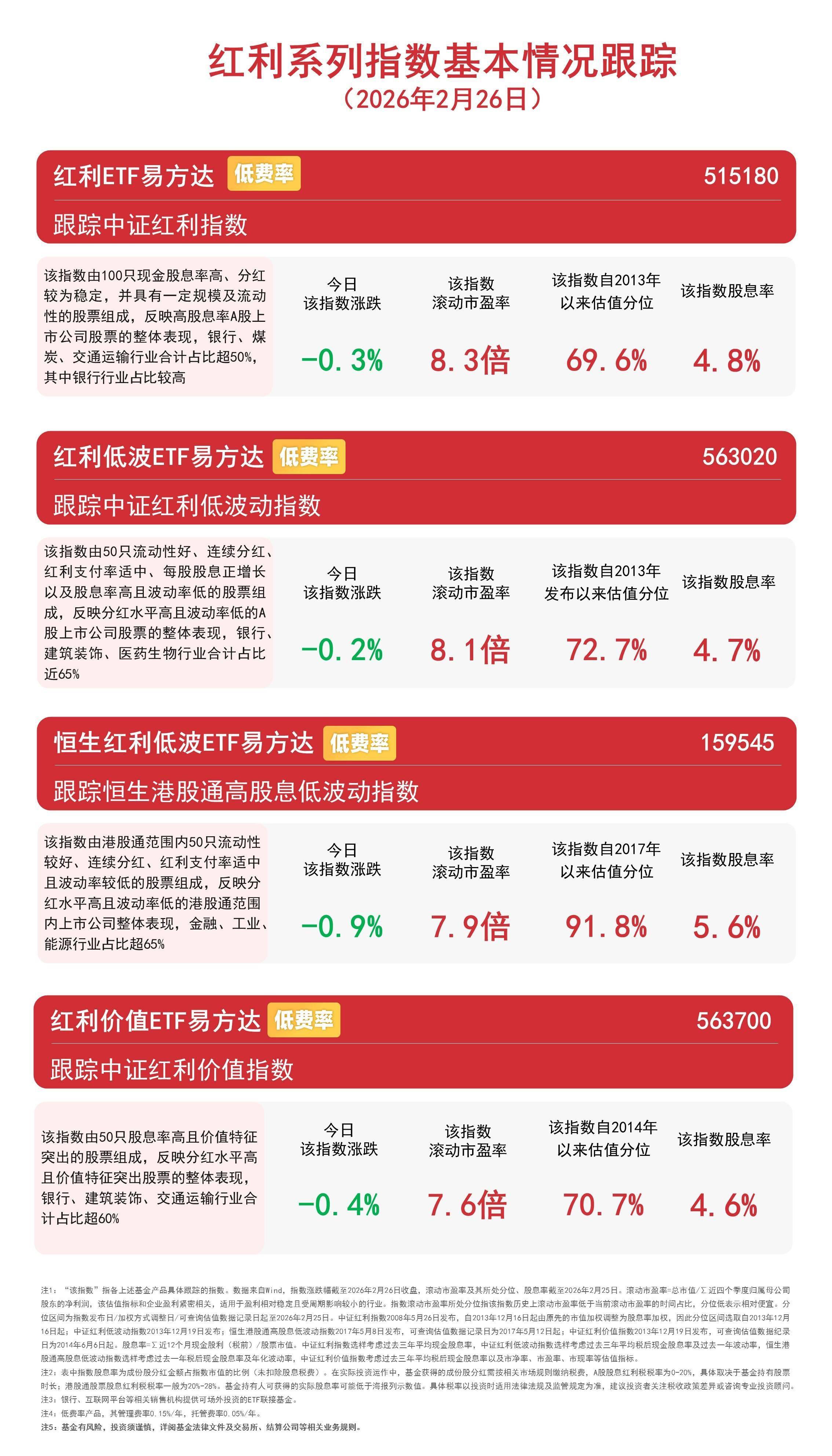
红利板块震荡调整,红利低波ETF易方达(563020)、恒生红利低波ETF易方达(159545)等产品受关注
Sou Hu Cai Jing· 2026-02-26 11:07
Group 1 - The core indices related to dividend stocks, including the CSI Dividend Low Volatility Index, CSI Dividend Index, and CSI Dividend Value Index, experienced declines of 0.2%, 0.3%, and 0.4% respectively, while the Hang Seng High Dividend Low Volatility Index fell by 0.9% [1][5][7] - The E Fund's dividend low volatility ETFs, including the E Fund Hang Seng Dividend Low Volatility ETF (159545) and the E Fund Dividend Low Volatility ETF (563020), saw net inflows of 55 million yuan and 110 million yuan respectively over the first two trading days after the holiday [1] - E Fund is currently the only fund company that implements low fee rates for all its dividend ETFs, with a management fee rate of 0.15% per year for its products, which helps investors to allocate high dividend assets at a low cost [1] Group 2 - The CSI Dividend Low Volatility Index is composed of 50 stocks that have good liquidity, continuous dividends, moderate dividend payout ratios, positive growth in earnings per share, and low volatility, reflecting the overall performance of A-share listed companies with high dividend levels and low volatility [3] - The Hang Seng Dividend Low Volatility ETF tracks an index made up of 50 stocks within the Hong Kong Stock Connect that also exhibit good liquidity, continuous dividends, moderate dividend payout ratios, and low volatility, with financial, industrial, and energy sectors accounting for over 65% of the index [5]
红利板块震荡调整,红利低波ETF易方达(563020)、恒生红利低波ETF易方达(159545)等产品受关注
Sou Hu Cai Jing· 2026-02-26 10:33
Group 1 - The core indices, including the China Securities Dividend Low Volatility Index and the Hang Seng High Dividend Low Volatility Index, experienced declines of 0.2%, 0.3%, 0.4%, and 0.9% respectively [1][5] - The E Fund's dividend low volatility ETFs, including the E Fund Dividend Low Volatility ETF (563020) and the E Fund Hang Seng Dividend Low Volatility ETF (159545), saw net inflows of 55 million yuan and 110 million yuan respectively over the first two trading days after the holiday [1] - E Fund is currently the only fund company that implements low fee rates for all its dividend ETFs, with a management fee rate of 0.15% per year for its various products [1] Group 2 - The China Securities Dividend Low Volatility Index consists of 50 stocks that are liquid, have a history of continuous dividends, moderate dividend payout ratios, positive growth in earnings per share, and low volatility, reflecting the overall performance of A-share listed companies with high dividend levels and low volatility [3] - The Hang Seng Dividend Low Volatility Index is composed of 50 stocks within the Hong Kong Stock Connect that are liquid, have continuous dividends, moderate dividend payout ratios, and low volatility, representing the overall performance of companies in this range [5]
2026年03月A股策略:3月市场热点或散乱,红利有望再受关注
Xiangcai Securities· 2026-02-25 12:23
Group 1 - The report predicts that both the macro short cycle and macro medium cycle in 2026 are likely to be in a bottom-up rising phase, forming an upward resonance pattern [2][14] - The GDP growth target for 2026 is expected to remain around 5%, with fiscal deficits and local special bonds likely to maintain levels similar to those in 2025 [18][20] - The upcoming National People's Congress and Chinese People's Political Consultative Conference in March 2026 will clarify fiscal and monetary policies for the year [18][22] Group 2 - The A-share market is expected to experience scattered hotspots in March 2026, with historical data from 2017 to 2025 indicating a generally downward trend in March [4][25] - The sectors that have shown significant performance in previous March months include professional services, fisheries, computer equipment, and IT services, which have low overlap with the technology and "anti-involution" sectors that performed well in early 2026 [4][30] - The report anticipates that the Hong Kong stock market will follow the A-share market and remain in a state of fluctuation due to various factors, including the expected stability of the RMB and the impact of the upcoming political meetings [5][36] Group 3 - The bond market is projected to show a "bear steepening" trend in March, supported by a continued moderately loose monetary policy and increased confidence from the political meetings [6][39] - In the commodity market, short-term volatility in crude oil prices is expected to increase due to geopolitical risks, while precious metals and strategic metals are still viewed positively [6][43] - The report highlights that the "anti-involution" and national security strategies are driving demand for strategic metals, which are becoming key production factors [43] Group 4 - Long-term investment strategies should focus on sectors benefiting from the "14th Five-Year Plan," particularly in new productive forces such as technology and environmental protection [7][44] - Short-term opportunities may arise in traditional sectors related to "anti-involution," while defensive long-term capital is expected to enter dividend-related sectors [7][45]

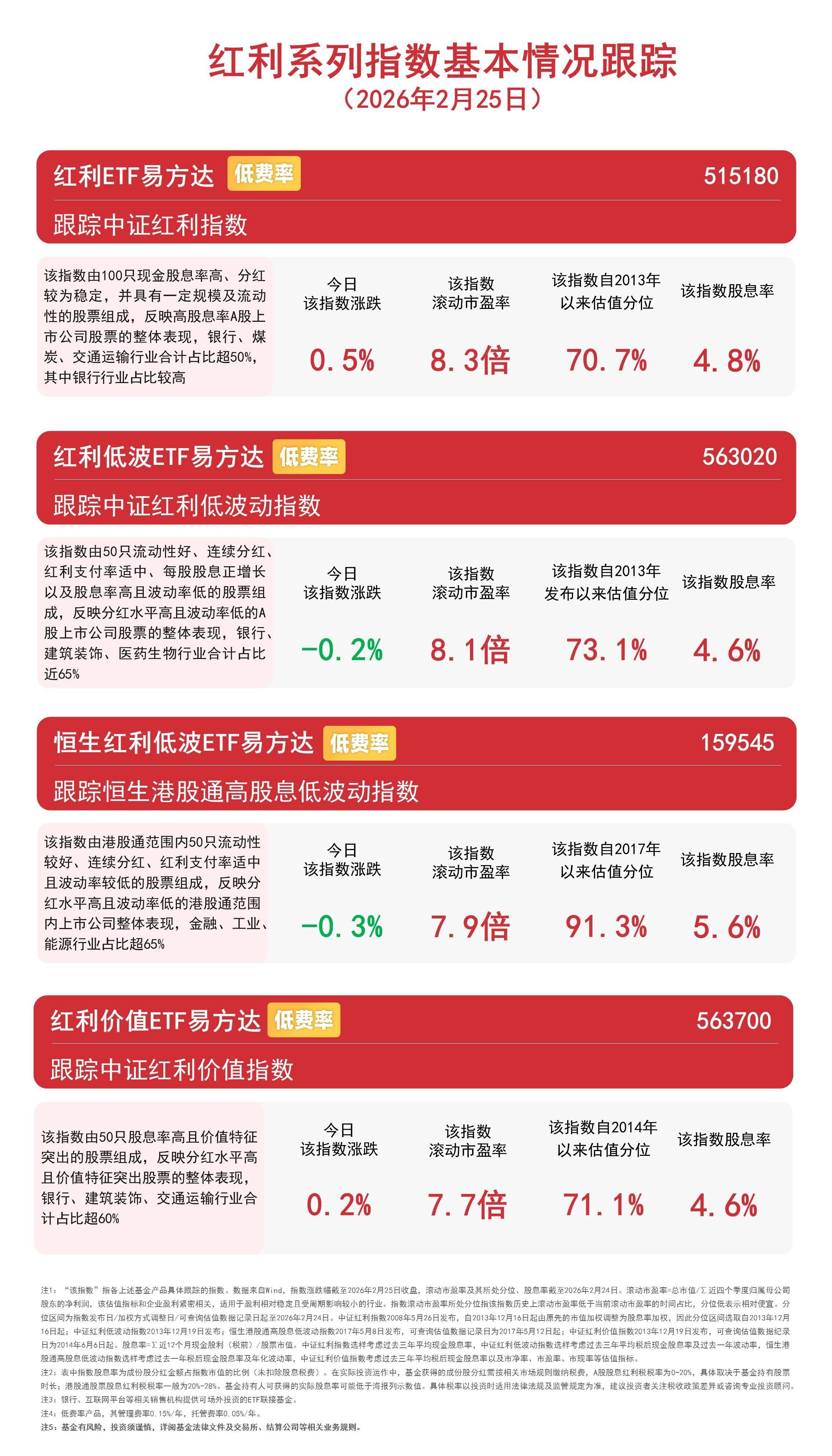
红利板块震荡分化,关注红利低波ETF易方达(563020)、恒生红利低波ETF易方达(159545)等产品布局机会
Sou Hu Cai Jing· 2026-02-25 11:53
Group 1 - The core index performance shows that the CSI Dividend Index increased by 0.5%, while the CSI Dividend Value Index rose by 0.2%. Conversely, the CSI Dividend Low Volatility Index decreased by 0.2%, and the Hang Seng Hong Kong Stock Connect High Dividend Low Volatility Index fell by 0.3% [1][4][8] - The E Fund's dividend low volatility ETFs, including the E Fund Dividend Low Volatility ETF (563020) and the E Fund Hang Seng Dividend Low Volatility ETF (159545), have seen a net inflow of funds totaling 120 million yuan and 190 million yuan respectively over the past two trading days [1] - E Fund is currently the only fund company that implements low fee rates for all its dividend ETFs, with a management fee rate of 0.15% per year for products such as the E Fund Hang Seng Dividend Low Volatility ETF (159545), E Fund Dividend ETF (515180), and others [1] Group 2 - The CSI Dividend Low Volatility Index is composed of 50 stocks that have good liquidity, continuous dividends, moderate dividend payout ratios, positive growth in earnings per share, and low volatility, reflecting the overall performance of A-share listed companies with high dividend levels and low volatility. The banking, construction decoration, and pharmaceutical industries account for a total of 65% [3] - The Hang Seng Dividend Low Volatility Index consists of 50 stocks within the Hong Kong Stock Connect that have good liquidity, continuous dividends, moderate dividend payout ratios, and low volatility, reflecting the overall performance of listed companies in the Hong Kong Stock Connect with high dividend levels and low volatility. The financial, industrial, and energy sectors account for over 65% [7]
红利国企ETF国泰(510720)涨超1.7%,低利率环境下红利板块配置价值凸显
Mei Ri Jing Ji Xin Wen· 2026-02-24 06:12
Core Viewpoint - The dividend-focused ETF, Guotai (510720), has risen over 1.7% as the value of dividend stocks becomes more prominent in a low-interest-rate environment [1] Group 1: Market Environment - The low-interest-rate environment and policies encouraging long-term capital inflow into the market highlight the attractiveness of dividend assets as a long-term investment direction [1] - The utility sector is identified as a high-quality dividend asset worth investing in over the long term, particularly low-priced utility assets [1] Group 2: Electricity Market Reform - To accommodate a high proportion of new energy consumption, China needs to further promote electricity market pricing reforms to support the increasingly complex new power system construction [1] - The future electricity market will gradually allow for comprehensive pricing of various attributes of electricity commodities, including energy value, adjustment value, capacity value, and environmental value [1] Group 3: ETF Overview - The Guotai dividend ETF tracks the Shangguo Dividend Index (000151), which selects high-dividend-capable and stable dividend-paying companies across sectors such as banking, coal, and transportation, focusing on traditional high-dividend areas [1] - The index employs strict assessments of constituent stocks' dividend yields and sustainability, using a cross-industry diversification strategy to effectively control investment risks and reflect the overall market performance of high-dividend companies [1] - According to the fund announcement, the Guotai dividend ETF has evaluated dividends monthly since its listing and has achieved continuous dividends for 22 months [1]
红利板块本周震荡分化,恒生红利低波ETF易方达(159545)标的指数周线“六连阳”
Mei Ri Jing Ji Xin Wen· 2026-02-13 09:47
Core Viewpoint - The Hang Seng High Dividend Low Volatility Index increased by 0.6% this week, marking a six-week consecutive rise, while the CSI Dividend Index, CSI Dividend Value Index, and CSI Dividend Low Volatility Index experienced declines of 0.1%, 0.5%, and 1.0% respectively [1]. Group 1: Index Performance - The CSI Dividend Index has a dividend yield of 4.8% and a rolling P/E ratio of 8.3 times, with a historical P/E ratio percentile of 72.3% [3]. - The CSI Dividend Low Volatility Index has a dividend yield of 4.6% and a rolling P/E ratio of 8.1 times, with a historical P/E ratio percentile of 73.3% [3]. - The Hang Seng High Dividend Low Volatility Index has a dividend yield of 5.6% and a rolling P/E ratio of 7.9 times, with a historical P/E ratio percentile of 91.2% [3]. - The CSI Dividend Value Index has a dividend yield of 4.6% and a rolling P/E ratio of 7.7 times, with a historical P/E ratio percentile of 71.7% [3]. Group 2: Future Investment Trends - According to Huatai Securities, it is estimated that insurance capital's secondary equity investment could reach 1 trillion yuan in 2025, with a secondary equity position of around 16%, becoming a significant source of funds for the stock market [1]. - In 2026, the overall new investable funds for insurance capital are expected to reach 3.1 trillion yuan, with secondary equity investment potentially reaching 900 billion yuan [1]. - Dividend stocks are increasingly important for insurance capital allocation, as the importance of cash dividend income rises and the need to reduce the volatility of equity assets becomes necessary [1]. Group 3: ETF Management Fees - E Fund is currently the only fund company that implements low fees for all dividend ETFs, with management fees for its products set at 0.15% per year [1].

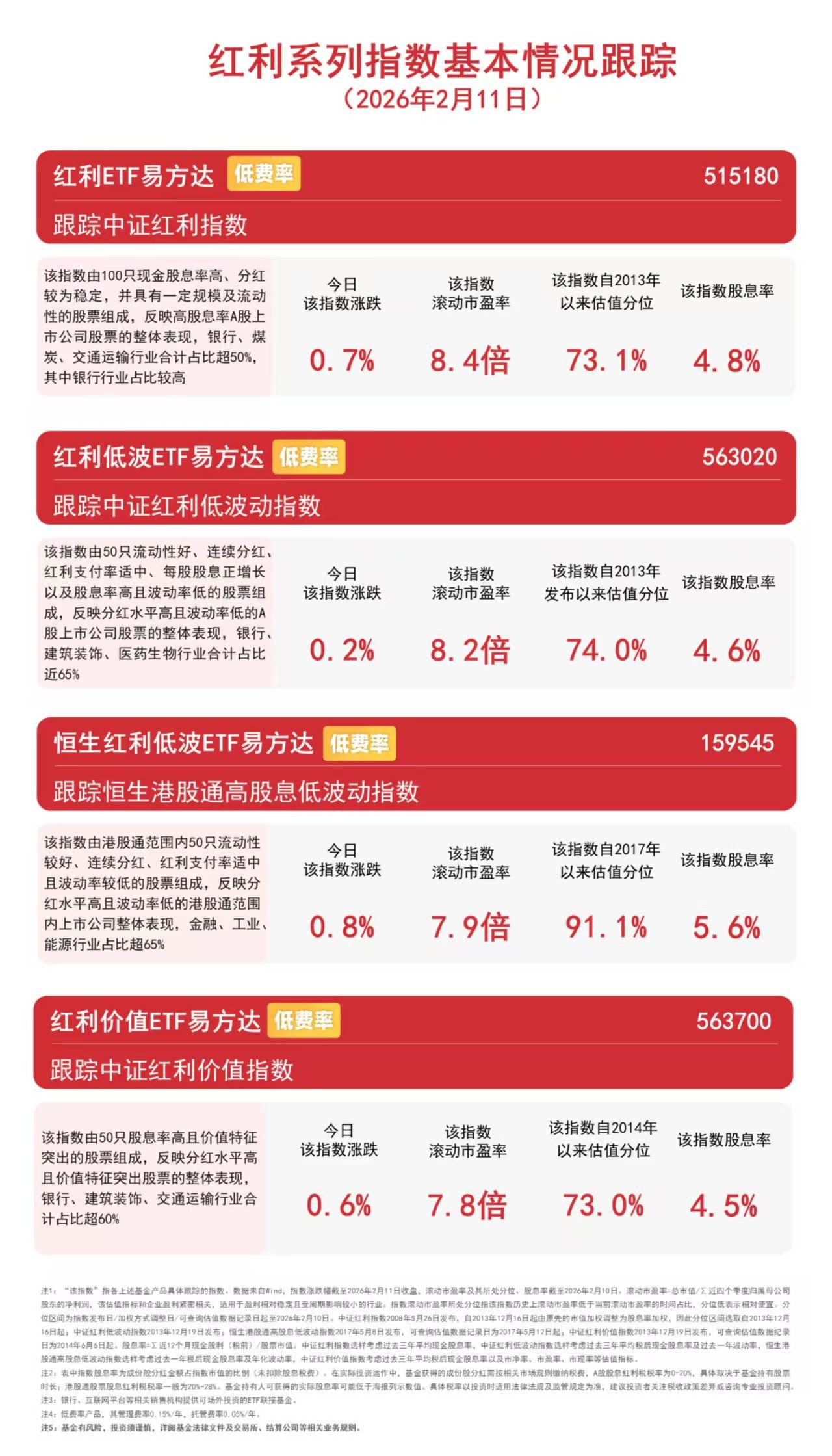
红利板块低开高走,恒生红利低波ETF易方达(159545)、红利ETF易方达(515180)等产品受资金关注
Sou Hu Cai Jing· 2026-02-11 10:43
Core Viewpoint - The article highlights the performance of various dividend-focused ETFs managed by E Fund, emphasizing their low fee structure and recent capital inflows, indicating strong investor interest in high dividend yield assets. Group 1: ETF Performance - The Hang Seng High Dividend Low Volatility Index increased by 0.8%, the CSI Dividend Index rose by 0.7%, the CSI Dividend Value Index went up by 0.6%, and the CSI Dividend Low Volatility Index saw a 0.2% increase [1] - E Fund's Hang Seng Dividend Low Volatility ETF (159545) and Dividend ETF (515180) experienced net inflows of 210 million yuan and 420 million yuan respectively over the past week [1] Group 2: E Fund's Low Fee Structure - E Fund is currently the only fund company offering all dividend ETFs at a low management fee rate of 0.15% per year, which helps investors to cost-effectively allocate to high dividend assets [1] - The management fee for E Fund's various dividend ETFs, including the Hang Seng Dividend Low Volatility ETF, Dividend ETF, and others, is consistently set at 0.15% per year [1][5] Group 3: Index Composition - The CSI Dividend Index consists of 100 stocks with high cash dividend yields and stable performance, with banking, coal, and transportation sectors accounting for over 50% of the index [3] - The CSI Dividend Low Volatility Index is composed of 50 stocks that exhibit good liquidity, continuous dividends, moderate dividend payout ratios, and low volatility, with banking, construction, and pharmaceutical sectors making up 65% of the index [3] - The Hang Seng High Dividend Low Volatility Index includes 50 stocks from the Hong Kong Stock Connect that have good liquidity, continuous dividends, moderate dividend payout ratios, and low volatility, reflecting the overall performance of high dividend and low volatility stocks in the Hong Kong market [3]