春秋航空

Search documents
机票“锁座”近四成,江苏消保委约谈10家航司直指变相付费
Bei Jing Shang Bao· 2025-11-26 13:02
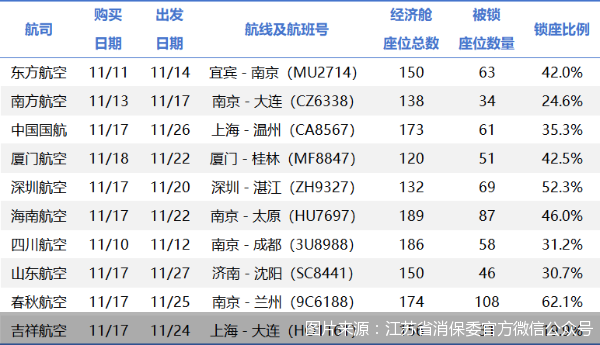
Core Viewpoint - The Jiangsu Consumer Rights Protection Committee has released a report highlighting issues related to seat locking practices by airlines, including widespread seat locking, excessive locking of premium seats, disguised fees for unlocking, and infringement on consumer rights [1][4]. Group 1: Survey Findings - The average seat locking rate among the 10 surveyed airlines is 38.7%, with rates ranging from 19.9% to 62.1% across different routes [2][4]. - Spring Airlines has the highest locking rate at over 60% for the Nanjing-Lanzhou route, while Juneyao Airlines has the lowest at under 20% [2][4]. - The survey included major airlines such as China Southern Airlines, China Eastern Airlines, and Hainan Airlines, focusing on their booking apps to assess seat locking practices [2][4]. Group 2: Identified Issues - The report identifies four main issues: the prevalence of seat locking, excessive locking of desirable seats, disguised fees for unlocking, and lack of transparency in information provided to consumers [4][5]. - Premium seats are predominantly locked, limiting consumer choice to less desirable options, which infringes on consumer rights [4][5]. - Airlines are increasingly charging for seat selection, which can significantly increase travel costs, especially for families seeking adjacent seating [6][8]. Group 3: Recommendations and Actions - The Jiangsu Consumer Rights Protection Committee has urged airlines to conduct self-inspections and rectify unfair terms in their agreements regarding seat locking [6][7]. - Airlines are recommended to ensure a reasonable distribution of free seat options and to eliminate disguised fees associated with seat selection [6][7]. - Continuous monitoring of airlines' compliance with these recommendations will be conducted by the Jiangsu Consumer Rights Protection Committee [8].




平均38.7%座位被锁定 江苏消保委约谈10家航司要求限期整改
Yang Shi Xin Wen· 2025-11-26 11:02
Core Viewpoint - The recent practice of airlines locking seats and charging for seat selection has raised consumer concerns, as it is seen as a way for airlines to increase revenue at the expense of consumer rights [1][2]. Group 1: Investigation Findings - A special investigation by Jiangsu Consumer Council targeted 10 domestic airlines, revealing that seat locking is prevalent, with the proportion of locked seats in economy class ranging from 19.9% to 62.1%, averaging 38.7% [1][2]. - The locked seats are primarily desirable ones, such as those in the front row, window, and aisle, limiting consumer choice to less favorable options [1][2]. Group 2: Consumer Rights Violations - The unlocking mechanism for preferred seats often requires payment through membership points or miles, disadvantaging non-members or occasional travelers who lack accumulation channels [2]. - Airlines have introduced additional paid options for unlocking seats, effectively splitting the basic seat selection rights into paid services, increasing travel costs for consumers [2]. - Information regarding seat locking rules and fees is often unclear, violating consumers' right to know, with customer service responses being inadequate and contradictory [2]. Group 3: Recommendations for Airlines - Airlines are urged to ensure transparency by clearly informing consumers about seat distribution and pricing policies [3]. - Fairness in rules must be maintained, ensuring equal seat selection opportunities for all passengers at the same fare [3]. - Airlines should respect consumer autonomy by safeguarding their right to choose and preventing disguised compulsory consumption [3]. Group 4: Required Actions - Airlines must conduct self-assessments to address excessive seat locking and eliminate disguised paid seat selection models, ensuring a reasonable and balanced distribution of free seat options [3][4]. - Unfair clauses in agreements related to seat locking should be reviewed and amended to avoid limiting consumer rights or increasing consumer responsibilities unfairly [4].
航空机场板块11月26日涨0.78%,中国东航领涨,主力资金净流出2.91亿元
Zheng Xing Xing Ye Ri Bao· 2025-11-26 09:05
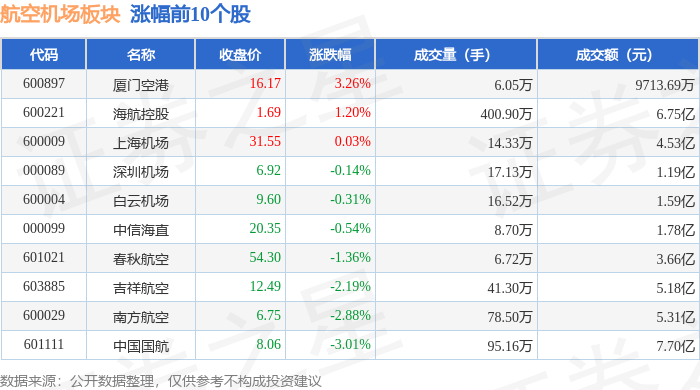
Core Insights - The aviation and airport sector saw a rise of 0.78% on November 26, with China Eastern Airlines leading the gains [1] - The Shanghai Composite Index closed at 3864.18, down 0.15%, while the Shenzhen Component Index closed at 12907.83, up 1.02% [1] Stock Performance - China Eastern Airlines (600115) closed at 5.06, up 2.43% with a trading volume of 1.2588 million shares and a turnover of 634 million yuan [1] - Xiamen Airport (600897) experienced a decline of 1.73%, closing at 15.89 with a trading volume of 43,400 shares [2] - The overall performance of the aviation sector stocks varied, with some stocks like China Eastern Airlines and Spring Airlines showing positive growth, while others like Xiamen Airport and China Southern Airlines had minor declines [1][2] Capital Flow - The aviation and airport sector experienced a net outflow of 291 million yuan from institutional investors, while retail investors saw a net inflow of 132 million yuan [2] - The capital flow data indicates that retail investors were more active in the sector, with significant net inflows compared to the outflows from institutional investors [2][3] Individual Stock Capital Flow - Shanghai Airport (600009) had a net inflow of 23.84 million yuan from institutional investors, while it faced a net outflow of 40.87 million yuan from retail investors [3] - China Eastern Airlines (600115) saw a net outflow of 31.86 million yuan from institutional investors, indicating a shift in investor sentiment [3] - The data highlights the varying levels of investor interest across different stocks within the aviation sector, with some stocks attracting more retail investment while facing institutional selling pressure [3]
江苏省消保委就飞机“锁座”问题约谈10家航司 要求限期整改
Di Yi Cai Jing· 2025-11-26 05:44
据江苏省消保委消息,近期,飞机"锁座"及有偿选座服务引发热议。为厘清行业经营边界,推动消费者 合法权益得到切实保障,江苏省消保委于11月21日线上约谈东方航空、南方航空、中国国航、海南航 空、厦门航空、深圳航空、山东航空、四川航空、春秋航空、吉祥航空等十家航空公司。会上,江苏省 消保委结合调查结果,通报了机票锁座服务市场存在的四个问题:一是锁座行为普遍存在,优质座位过 度锁定;二是解锁机制变相付费,挤压普通消费者权益;三是信息不透明且解释不合理,侵犯知情权; 四是协议文本存在不公平格式条款,权利义务设置不对等。江苏省消保委就飞机票锁座问题的整改工 作,向各航司提出两点明确要求,并于15个工作日内将整改情况以书面形式进行提交。 (文章来源:第一财经) ...
江苏省消保委约谈10家航司,就飞机票锁座问题要求限期整改
Xin Lang Cai Jing· 2025-11-26 05:37
Core Viewpoint - The Jiangsu Provincial Consumer Protection Committee has held an online meeting with ten major airlines to address consumer rights and clarify industry operational boundaries, particularly regarding seat selection fees [1] Group 1: Consumer Rights - The airlines involved include Eastern Airlines, Southern Airlines, Air China, Hainan Airlines, Xiamen Airlines, Shenzhen Airlines, Shandong Airlines, Sichuan Airlines, Spring Airlines, and Juneyao Airlines [1] - The committee emphasizes that air transport has public service attributes, and consumers have basic service rights, including the right to choose suitable seats after purchasing tickets [1] Group 2: Industry Practices - Some airlines are charging fees for seat selection, which the committee argues may infringe on consumers' rights to fair trade and autonomous choice [1] - The committee has issued two clear requirements for the airlines regarding the rectification of the seat locking issue and expects a written report on the corrective actions within 15 working days [1]
航空机场板块11月25日跌1.84%,华夏航空领跌,主力资金净流入1.05亿元
Zheng Xing Xing Ye Ri Bao· 2025-11-25 09:09
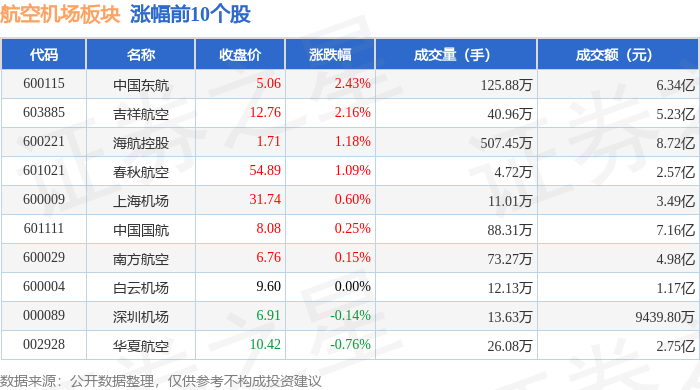
Core Viewpoint - The aviation and airport sector experienced a decline of 1.84% on November 25, with Huaxia Airlines leading the drop. In contrast, the Shanghai Composite Index rose by 0.87% and the Shenzhen Component Index increased by 1.53% [1]. Group 1: Market Performance - The aviation and airport sector saw a net inflow of 105 million yuan from institutional investors, while retail investors contributed a net inflow of 141 million yuan. However, speculative funds experienced a net outflow of 246 million yuan [2][3]. - Key stocks in the aviation sector showed varied performance, with Xiamen Airport rising by 3.26% to close at 16.17 yuan, while Huaxia Airlines fell by 3.93% to 10.50 yuan [1][2]. Group 2: Individual Stock Analysis - Major stocks such as China Eastern Airlines and China National Aviation Corporation saw declines of 3.89% and 3.01%, respectively, indicating a broader trend of negative performance within the sector [2][3]. - The trading volume for China Eastern Airlines reached 2.06 million shares, with a transaction value of 1.028 billion yuan, highlighting significant trading activity despite the stock's decline [2].



日本机场,挤满了回家的中国人
Mei Ri Jing Ji Xin Wen· 2025-11-25 05:21
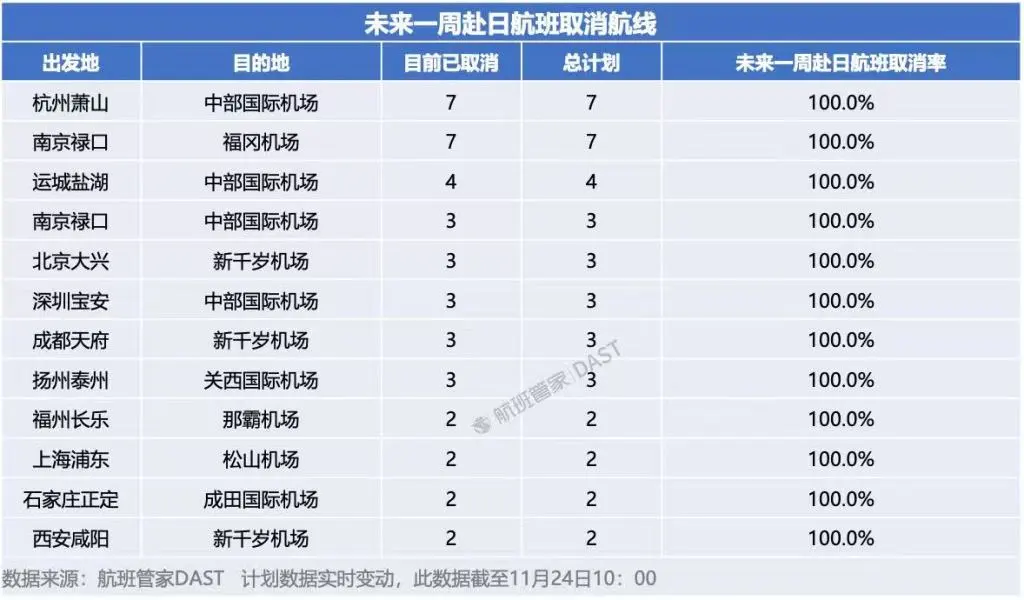
每经编辑|何小桃 据极目新闻报道,近日,多名中国网友发布视频称,在日本多个机场,挤满了返回国内的中国人,有的原计划就是近期回国,但也有人选择提前结束在日 行程安排,提前回国,大家拎着大包小包排队登机。 据多家媒体报道,截至11月24日10点,已有12条中日航线取消所有航班,涉及名古屋、福冈、札幌、大阪等地。 | | | 535 | 周赴目航班取消航线 | | | --- | --- | --- | --- | --- | | 出发地 | 目的地 | 目前已取消 | 总计划 | 未来一周赴日航班取消率 | | 杭州萧山 | 中部国际机场 | 7 | 7 | 100.0% | | 南京禄口 | 福冈机场 | 7 | 7 | 100.0% | | 运城盐湖 | 中部国际机场 | 4 | 4 | 100.0% | | 南京禄口 | 中部国际机场 | 3 | 3 | 100.0% | | 北京大兴 | 新干岁机场 | 3 | 3 | 100.0% | | 深圳宝安 | 中部国际机场 | 3 | 3 | 100.0% | | 成都天府 | 新干岁机场 | 3 | 3 | 100.0% | | 扬州泰州 | 关西国际机场 ...
航空股跌幅居前 赴日航班取消量激增56% 机构称航司将通过调配航线缓和影响
Zhi Tong Cai Jing· 2025-11-25 02:28
Core Viewpoint - The recent increase in flight cancellations from China to Japan has negatively impacted major Chinese airlines, leading to a decline in their stock prices. Group 1: Stock Performance - Eastern Airlines (00670) fell by 5.02%, trading at HKD 4.35 [1] - Southern Airlines (600029) (01055) decreased by 3.88%, trading at HKD 4.96 [1] - Air China (601111) (00753) dropped by 3.44%, trading at HKD 6.18 [1] Group 2: Flight Cancellation Data - From November 24 to December 31, the number of planned flights from China to Japan increased by approximately 56% compared to the same period last month [1] - Following the announcement of special ticketing plans by the three major airlines, there has been a decline in ticket bookings [1] - The future 60-day ticket booking volume for flights from China to Japan has decreased by about 29% compared to the same period on November 15 [1] Group 3: Analyst Insights - Dongxing Securities indicated that airlines with a significant share of international flights to Japan may face some impact due to the high passenger volume on these routes [1] - Huatai Securities noted that while there may be short-term fluctuations in the China-Japan routes, the overall impact is manageable [1] - According to CAPA data, as of October 2025, the China-Japan route accounted for 2.8% of the overall ASK (Available Seat Kilometers) for Chinese airlines, suggesting that airlines could adjust their routes to mitigate the impact [1]
多家上市公司回购增持刷新进度
Mei Ri Shang Bao· 2025-11-25 01:38
Group 1 - Recent stock buybacks and shareholder increases from over 60 companies in the Shanghai market signal positive market expectations [2][3] - On November 21, approximately 40 companies in the Shanghai market announced buybacks and operational improvements, with over 30 buyback announcements [3] - Companies like Huida Technology and Yuyuan Group initiated new buyback plans, with Yuyuan Group planning to buy back between 80 million to 120 million yuan [3][4] Group 2 - Spring Airlines accelerated its buyback efforts, planning to repurchase shares worth 300 million to 500 million yuan for employee stock ownership plans [4] - Huida Technology announced a buyback plan of 200 million to 400 million yuan, representing 0.35% to 0.69% of its total share capital [4] - Heng Rui Pharmaceutical reported a total buyback of 889,870 shares for approximately 59.79 million yuan [5] Group 3 - State-owned enterprises like Sinopec and Fenghuo Communication disclosed their buyback and increase progress, with Sinopec completing a buyback of 48.82 million shares for 270 million yuan [6][7] - China Glass has repurchased 34.18 million shares, accounting for 0.85% of its total share capital, with over 534 million yuan spent [6] Group 4 - The hard technology sector saw at least 14 companies report buyback progress and contract orders, indicating strong market confidence [8] - JinkoSolar announced the mass production of its TigerNeo3.0 product, achieving a production efficiency of over 24.8% and a power output of up to 670W [8]






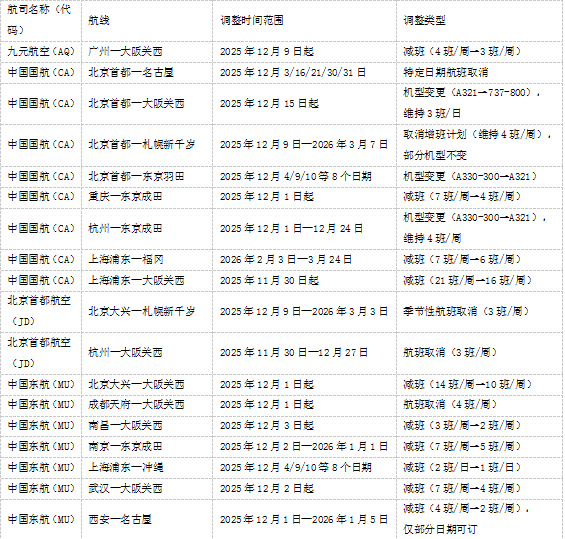
中国航司大面积调整日本航线,每周减少156航班
2 1 Shi Ji Jing Ji Bao Dao· 2025-11-24 13:40
Core Insights - The impact of recent statements from the Japanese Prime Minister has led to significant reductions and cancellations of flights between China and Japan, affecting travel plans during peak seasons such as New Year and Spring Festival [1][2] Flight Reductions and Cancellations - Starting December 1, 16 Chinese airlines will reduce weekly flights to Japan by 156, with the most significant cuts from Juneyao Airlines, which will decrease its flights from 114 to 79 per week, a reduction of 31% [1] - China Southern Airlines, Shenzhen Airlines, and Eastern Airlines will also see reductions of 23, 22, and 18 flights per week, respectively [1] - The cancellation rate for planned flights to Japan is projected to reach 21.6% by November 27, with 12 routes canceling all flights [1][2] Specific Route Adjustments - High cancellation rates are noted on routes such as Tianjin Binhai to Kansai International (65.0%) and Nanjing Lukou to Kansai International (59.4%) [2] - Smaller airlines like Beijing Capital Airlines are canceling entire routes, such as the Beijing Daxing to Sapporo New Chitose, while Changlong Airlines is canceling all flights in December [2][3] Aircraft Type Adjustments - Airlines are also adjusting aircraft types, with Air China switching from larger Airbus A330-300 to smaller A321 on several routes, reducing passenger capacity [3] - Some airlines, like Shandong Airlines and Xiamen Airlines, have not made any adjustments to their Japan flight schedules [3] Pricing Implications - The reduction in flights is expected to increase travel costs for consumers planning trips to Japan during the winter season, with Spring Airlines raising minimum ticket prices significantly [3] Summary of Flight Adjustments - A detailed table outlines various airlines and their specific flight adjustments, including reductions and cancellations across multiple routes, effective from late November through March 2026 [4][5]