
差异化服务

Search documents
博科测试:公司从未与联测科技有过同台竞标的情况
Zheng Quan Ri Bao Wang· 2026-01-22 12:13
Group 1 - The core viewpoint of the article is that 博科测试 (Boke Testing) clarifies its non-competitive relationship with 联测科技 (Lian Ce Technology) in the field of power system testing, emphasizing their distinct business operations [1] - 博科测试 has never participated in joint bidding activities with 联测科技, indicating a lack of competition between the two companies [1] - The company focuses on its core strengths in automotive testing and servo testing, aiming to provide differentiated and high-value-added technical services to its clients [1]

“教育”还是“陪伴”?基金投教不断进阶
Zheng Quan Shi Bao Wang· 2025-11-30 13:03
Core Insights - Investor education is crucial for enhancing public financial literacy and promoting high-quality development in financial markets, evolving through innovative paths and leveraging AI technology to meet diverse investor needs [1][3][7] Group 1: Educational Philosophy and Approach - The traditional model of investor education has been criticized for its one-way knowledge transmission, leading to investor resistance; a shift towards a "companion" approach is necessary to enhance investor experience [2][3] - Recent regulatory guidelines emphasize the importance of integrating investor education into corporate strategy, focusing on long-term investment principles and enhancing investor satisfaction [3][4] Group 2: Diverse Educational Formats - The industry is moving from traditional formats like articles and lectures to more engaging methods such as short videos, live broadcasts, and immersive experiences, breaking the limitations of previous educational approaches [4][5] - Companies like Bosera Fund and China Europe Fund are innovating by integrating education with art and community activities, creating unique educational experiences that resonate with investors [5][6] Group 3: AI Integration in Education - AI technology is significantly enhancing the efficiency and quality of investor education by streamlining content creation and enabling personalized service delivery [7][8] - AI's role includes emotional analysis to provide timely support and tailored educational content, marking a shift towards a service-oriented and value-driven educational model [8] Group 4: Differentiated Services for Diverse Needs - The increasing stratification of investor demographics necessitates personalized educational services that cater to varying levels of knowledge and specific needs [9][10] - Companies are adopting differentiated service models to create tailored educational content, ensuring that it meets the unique demands of different investor groups [10][12]
“教育”还是“陪伴”?基金投教不断进阶
券商中国· 2025-11-30 12:47
Core Viewpoint - Investor education is crucial for enhancing public financial literacy and promoting high-quality development of financial markets, requiring a long-term and systematic approach [2] Group 1: Educational Philosophy - The traditional view of investor education as a one-way knowledge transfer is being redefined to focus on "accompaniment" rather than mere education, addressing investor resistance to being "taught" [3] - The shift emphasizes the need for investment education to be centered around the investor's experience and feelings, rather than a top-down approach [3] Group 2: Regulatory Support - Regulatory bodies are increasingly emphasizing the importance of investor education, as seen in the guidelines issued by the China Securities Investment Fund Industry Association, which call for integrating investor education into corporate strategy and culture [4] - The "Action Plan for Promoting High-Quality Development of Public Funds" encourages fund companies to adopt a long-term investment philosophy and enhance investor satisfaction [4] Group 3: Innovative Formats and Content - The approach to investor education is evolving from traditional formats like articles and lectures to more engaging methods such as short videos, live broadcasts, and interactive activities [5] - Leading fund institutions are creating unique educational service systems that move beyond conventional methods, making investor education a vital link between investors and the capital market [5] Group 4: AI Integration - AI technology is significantly enhancing the efficiency and quality of investor education by streamlining content production and enabling personalized service [8] - AI's role includes rapid content generation, precise user matching, and emotional support, transforming investor education into a more service-oriented and value-driven process [9] Group 5: Differentiated Services - The increasing stratification of investor demographics necessitates personalized educational services that cater to diverse needs, moving away from a one-size-fits-all approach [11] - Fund companies are developing tailored educational content that aligns with the specific needs of different investor groups, ensuring a more effective educational experience [13]


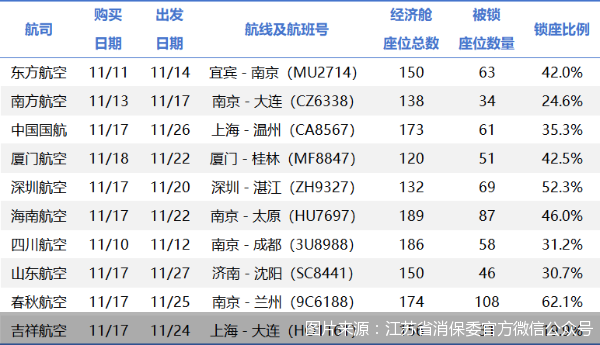
机票“锁座”近四成,江苏消保委约谈10家航司直指变相付费
Bei Jing Shang Bao· 2025-11-26 13:02
Core Viewpoint - The Jiangsu Consumer Rights Protection Committee has released a report highlighting issues related to seat locking practices by airlines, including widespread seat locking, excessive locking of premium seats, disguised fees for unlocking, and infringement on consumer rights [1][4]. Group 1: Survey Findings - The average seat locking rate among the 10 surveyed airlines is 38.7%, with rates ranging from 19.9% to 62.1% across different routes [2][4]. - Spring Airlines has the highest locking rate at over 60% for the Nanjing-Lanzhou route, while Juneyao Airlines has the lowest at under 20% [2][4]. - The survey included major airlines such as China Southern Airlines, China Eastern Airlines, and Hainan Airlines, focusing on their booking apps to assess seat locking practices [2][4]. Group 2: Identified Issues - The report identifies four main issues: the prevalence of seat locking, excessive locking of desirable seats, disguised fees for unlocking, and lack of transparency in information provided to consumers [4][5]. - Premium seats are predominantly locked, limiting consumer choice to less desirable options, which infringes on consumer rights [4][5]. - Airlines are increasingly charging for seat selection, which can significantly increase travel costs, especially for families seeking adjacent seating [6][8]. Group 3: Recommendations and Actions - The Jiangsu Consumer Rights Protection Committee has urged airlines to conduct self-inspections and rectify unfair terms in their agreements regarding seat locking [6][7]. - Airlines are recommended to ensure a reasonable distribution of free seat options and to eliminate disguised fees associated with seat selection [6][7]. - Continuous monitoring of airlines' compliance with these recommendations will be conducted by the Jiangsu Consumer Rights Protection Committee [8].



大行下沉,小行怎么办
Jing Ji Ri Bao· 2025-11-25 23:33
Core Insights - The recent data from the National Financial Supervision Administration indicates that large banks are increasing their inclusive agricultural loans, which are crucial for rural revitalization [1][2] - The competition between large banks and rural small and medium-sized banks is intensifying, prompting the latter to seek strategies for coexistence and better service to the agricultural sector [1][4] Summary by Sections Large Banks' Focus on Rural Financing - The central government's 2025 policy emphasizes innovation in rural financing mechanisms, leading to increased credit allocation in the agricultural sector [2] - As of the end of Q3 2025, the balance of inclusive agricultural loans reached 14.1 trillion yuan, an increase of 1.2 trillion yuan since the beginning of the year [2] - Large commercial banks hold approximately 5.4 trillion yuan in inclusive agricultural loans, while rural financial institutions have about 7.2 trillion yuan, indicating a narrowing gap in loan distribution [2][3] Impact on Small and Medium-sized Banks - The entry of large banks into the rural market is significantly altering the competitive landscape, compelling small banks to enhance their competitive awareness and fill service gaps [4] - Many rural small and medium-sized banks face challenges in digital transformation due to limited funding and technological capabilities, which hinders their ability to compete with larger banks [5][6] Digital Financial Transformation - Digital finance, leveraging technologies like big data and AI, is essential for breaking the time and space limitations of financial services [5] - Rural small and medium-sized banks are urged to focus on niche markets and develop specialized digital services to improve their competitiveness [7] Differentiation and Innovation Strategies - Small banks are encouraged to adopt differentiated services as a strategy to counter the competitive pressure from large banks [8] - Innovations in financial products, such as customized services for small agricultural enterprises, are being developed to address the financing challenges faced by these businesses [9] - The integration of local data and the development of tailored credit assessment models are being emphasized to enhance service efficiency and risk management [6][9]
中信建投:养老理财新规促进综合养老生态构建 向”主动管理,差异化服务”转型
智通财经网· 2025-11-04 03:24
Group 1 - The core viewpoint of the article is that the new pension financial regulations and trust management rules aim to transform the asset management industry by promoting long-term investments and reducing reliance on non-standard assets [1][2][4] - The pension financial regulations introduced by the National Financial Regulatory Administration focus on expanding nationwide trials, linking fundraising scale to net capital, and enhancing account services to activate pension funds in the market [1][2] - The trust management regulations aim to reduce the scale of traditional non-standard business and promote investment in standardized assets, requiring trust companies to rebuild their personal customer service networks and enhance their portfolio investment capabilities [3][4] Group 2 - The new regulations compel financial management companies to shift from product sales to constructing a comprehensive pension ecosystem, enhancing their service capabilities to remain competitive [2][4] - Both regulations encourage asset management institutions to transition from "channel business and homogeneous competition" to "active management and differentiated services," with a focus on long-term asset allocation and full-cycle advisory services [4] - Institutions that possess active management capabilities, effective risk management, and a comprehensive service ecosystem are expected to become market leaders [4]

华人健康:公司通过产品创新和差异化服务,构建独特的竞争优势
Zheng Quan Ri Bao Wang· 2025-09-01 11:11
Core Viewpoint - The announcement from Huaren Health highlights the significant impact of policy changes, such as extended medical insurance payment periods, on the pharmaceutical industry, creating opportunities for commercial health insurance and diversified payment channels [1] Industry Summary - The aging population and increasing health demands are driving growth in the pharmaceutical sector, particularly in retail pharmacy channels, with a notable rise in demand for chronic disease management and health services [1] - Retail pharmacies are positioned to enhance their service value and market status, benefiting from optimized payment structures to better meet public medication needs [1] Company Summary - Huaren Health focuses on pharmaceutical retail as its core business, aiming to build a unique competitive advantage through product innovation and differentiated services [1] - The company emphasizes deep integration of the industrial and commercial sectors to drive steady performance growth, leveraging a young and stable management team with innovative ideas [1] - The strategic direction includes internal growth and moderate acquisitions for business expansion, optimizing existing operations, and exploring emerging markets for sustainable growth [1]
券商两融价格战白热化 客户持截图“比价”要求降利率
Zheng Quan Shi Bao· 2025-08-26 22:10
Core Viewpoint - The recent price war in the margin financing and securities lending (two-in-one) market has led to a significant drop in financing rates, with some rates falling below 3%, which is lower than mortgage rates, raising concerns about profitability for brokerage firms [1][2][3] Group 1: Market Trends - As of August 25, the total margin financing and securities lending balance in the Shanghai and Shenzhen markets reached 21,883.27 billion yuan, marking a ten-year high [1] - The competition among brokerages has intensified, with some leading firms offering financing rates that continuously set new industry lows, pushing overall interest margins close to breakeven points [1][2] - The financing rates for high-net-worth clients (over 50 million yuan) have dropped to below 3%, while rates for ordinary clients can be as low as 3.8% [2][3] Group 2: Customer Sensitivity and Behavior - Customers are increasingly sensitive to financing rates, actively comparing rates across different brokerages to secure the lowest possible rate [3] - Some clients with net assets of 500,000 yuan are demanding rates as low as 3%, and if not met, they threaten to close their accounts [3][6] - New high-net-worth clients are being offered financing rates between 3.5% and 4.5%, while ordinary new clients generally face rates above 5% [3] Group 3: Historical Context and Rate Changes - The initial standard financing rate in China was 8.35% when the two-in-one trading business started in 2010, which has since decreased significantly [4] - By 2024, the average financing rate among leading brokerages is expected to be around 6%, with some rates dropping below 4% [4][5] - The rapid decline in financing rates is attributed to the overall downward trend in market interest rates and brokerages' strategies to attract clients [4][5] Group 4: Industry Challenges and Recommendations - The two-in-one business is experiencing a "volume increase, price decrease" phenomenon, particularly affecting leading brokerages [6] - Despite the narrowing interest margins, the total financing balance has surpassed 20 trillion yuan, and brokerage firms are expected to see some growth in interest income, albeit at a slower rate than in 2015 [6] - Industry experts suggest that brokerages should focus on providing differentiated services rather than solely competing on price, to ensure sustainable growth and maintain service quality [6][7]
券商两融价格战白热化客户持截图“比价”要求降利率
Zheng Quan Shi Bao· 2025-08-26 18:30
Core Viewpoint - The recent price war in the margin financing and securities lending (two-in-one) market has led to a significant drop in financing rates, with some rates falling below 3%, which is lower than mortgage rates, raising concerns about profitability for brokerage firms [1][2][3] Group 1: Market Trends - As of August 25, the total margin financing and securities lending balance in the Shanghai and Shenzhen markets reached a record high of 2.1883 trillion yuan, the highest in ten years [1] - The competition among brokerages has intensified, with some offering financing rates below 4%, although this is not yet a widespread phenomenon [2][3] - The financing rates have been on a downward trend, with the average rate for top brokerages expected to be around 6% in 2024, and some rates dropping below 4% for high-net-worth clients [4][5] Group 2: Competitive Strategies - Brokerages are increasingly focusing on attracting clients through lower financing rates, leading to a situation where many rates are approaching the cost of funds, resulting in a "loss leader" scenario [2][6] - There is a call within the industry for brokerages to shift their focus from price competition to providing differentiated services to enhance client retention and service quality [6][7] - The current price war has raised concerns about compliance risks, as not all investors may have the necessary risk tolerance or knowledge to engage in leveraged trading [7]
“差异化服务”:让金融活水流向最需要的地方
Jin Rong Shi Bao· 2025-08-07 02:34
Core Viewpoint - The People's Bank of China in Tongliao City focuses on providing financial support to private small and micro enterprises, leading to a continuous increase in loans for these businesses over the past 30 months, with a growth rate exceeding 15% [1][6]. Differentiated Service Concept - The bank adopts a "precise matching and targeted efforts" service concept, identifying four categories of private small and micro enterprises: agricultural, technological, manufacturing, and service-oriented, to tailor financing solutions [2]. Differentiated Policy System - A dual-featured policy system is established focusing on the "industry attributes and life cycle" of private small and micro enterprises, with specific policies for the livestock industry, technology innovation, green transformation, and consumer spending [3]. Differentiated Product Design - Innovative financial products are developed to address common challenges faced by private small and micro enterprises, such as lack of collateral and data, including non-traditional collateral options and tailored financing solutions [4]. Differentiated Service Model - The bank enhances financing efficiency through a restructured service model, implementing an online and offline parallel approval mechanism, and introducing quick loan renewal services to address cash flow issues [5]. Financing Growth Metrics - As of the end of June, the loan balance for private and inclusive small and micro enterprises in Tongliao City increased by 17.78% and 18.43% year-on-year, respectively [6]. Differentiated Promotion Model - A differentiated promotion model is created to ensure policies reach the right enterprises, including on-site policy interpretation and a platform for government and enterprise interaction, resulting in signed agreements worth 8.27 billion yuan [7]. Future Goals - The bank aims to expand its differentiated service system to include individual businesses and new agricultural operators, with plans to implement mobile and online lending models in remote areas [7].