
青岛银行

Search documents
从增量扩面到提质控险 银行业普惠金融迈向差异化精准服务
2 1 Shi Ji Jing Ji Bao Dao· 2025-11-10 04:21
Core Insights - The report highlights the significant growth and development of inclusive finance in China, particularly focusing on small and micro enterprises and rural areas, with a notable annual growth rate of over 20% in inclusive micro loans during the 14th Five-Year Plan period [1][2] - As of June 2025, the balance of inclusive micro loans reached 36 trillion yuan, which is 2.3 times that of the end of the 13th Five-Year Plan, with a decrease in interest rates by 2 percentage points [1][2] - The average interest rate for newly issued inclusive micro loans was 3.48% as of June 2025, reflecting a decrease of 66 basis points year-on-year [1][2] Group 1: Digital Empowerment - Digital technology has been a key driver for the development of inclusive finance, with banks utilizing big data and AI to enhance loan approval efficiency and reduce financing costs [2][7] - The market structure among banks is changing, with large commercial banks holding a 45.11% share of inclusive micro loans, while rural financial institutions have seen a decline in their market share [2][3] - The average growth rate of inclusive micro loans has been slowing down, with a decrease from 30.9% in 2020 to 12.3% by mid-2025 [2][3] Group 2: Performance of Listed Banks - Among listed banks, Agricultural Bank of China, Industrial and Commercial Bank of China, and Beijing Bank reported the highest growth rates in inclusive micro loans at 18.50%, 17.30%, and 17.27% respectively [3][4] - In contrast, some banks, including Shanghai Bank and Zhengzhou Bank, experienced negative growth rates of -3.97% and -2.06% [3][4] - The performance of different banks varies significantly, with state-owned banks generally showing stronger growth in inclusive micro loans compared to smaller banks [3][4] Group 3: Interest Rates and Risk Management - The interest rates for newly issued inclusive micro loans have decreased across various banks, with the highest rate at 4.20% and the lowest at 2.94% [7][8] - The gap in interest rates between large and small banks is narrowing, with some large banks' rates aligning closely with those of smaller banks [8][9] - The report emphasizes the importance of risk management in the inclusive finance sector, with several banks focusing on improving asset quality and managing non-performing loans [9][10]



0.94%。煤炭持续强势,化工化肥行业
Xin Yong An Guo Ji Zheng Quan· 2025-11-10 03:23
Market Performance - The Shanghai Composite Index fell by 0.25% to 3997.56 points, while the Shenzhen Component dropped by 0.36% and the ChiNext Index decreased by 0.51%[1] - The Hang Seng Index closed down 0.92% at 26241.83 points, with the Hang Seng Tech Index down 1.80% and the Hang Seng China Enterprises Index down 0.94%[1] - The total market turnover in Hong Kong decreased to 2096.443 million HKD[1] Economic Indicators - The U.S. Senate is planning a test vote on a new proposal to end the government shutdown, which has lasted for 40 days[8] - China's Consumer Price Index (CPI) unexpectedly rose by 0.2% year-on-year in October, contrasting with a decline of 0.3% in September[12] - The core CPI in China, excluding food and energy, increased by 1.2% in October[12] Consumer Confidence - The U.S. consumer confidence index fell to 50.3 in early November, the lowest level in over three years, down from 53.6 in October[12] - The government shutdown is estimated to cost the U.S. economy approximately 15 billion USD per week and reduce the annualized GDP growth rate by 1.5 percentage points before mid-November[12] Sector Performance - Lithium battery stocks showed strength, while the pharmaceutical and biotechnology sectors experienced declines[1] - The chemical and fertilizer industries saw significant gains, particularly in coal and chemical sectors[1]
智通港股通占比异动统计|11月10日
智通财经网· 2025-11-10 00:38
Core Insights - The article highlights the changes in the Hong Kong Stock Connect holdings, with notable increases in ownership for certain companies and significant decreases for others [1][2]. Summary by Category Increased Holdings - Haotian International Construction (01341) saw the largest increase in ownership percentage, rising by 3.28% to a total holding of 57.57% [2]. - Qingdao Bank (03866) and Hang Seng China Enterprises (02828) also experienced notable increases of 2.91% and 1.80%, respectively, with their latest holdings at 17.78% and 9.30% [2]. - Over the last five trading days, Qingdao Bank led with a 10.00% increase, followed by Hang Seng China Enterprises at 8.30% and Haotian International Construction at 5.79% [1][3]. Decreased Holdings - Xintian Green Energy (00956) faced the largest decrease, with a drop of 9.22% to a holding of 56.56% [2]. - Other companies with significant reductions include Dazhong Public Utilities (01635) and Changfei Optical Fiber Cable (06869), which decreased by 0.92% and 0.83%, respectively [2]. - In the past five trading days, Xintian Green Energy again led the decrease with a 9.14% drop, followed by Changfei Optical Fiber Cable at 5.19% and Delin Holdings (01709) at 3.75% [1][3]. Additional Insights - The data reflects a broader trend in the market, indicating shifts in investor sentiment towards specific sectors and companies, which could present both opportunities and challenges for investors [1][2].
智通港股通资金流向统计(T+2)|11月10日
智通财经网· 2025-11-09 23:32
Core Insights - Southbound funds saw significant inflows into Southern Hang Seng Technology, Alibaba-W, and Xiaomi Group-W, with net inflows of 1.286 billion, 0.885 billion, and 0.650 billion respectively [1][2] - Conversely, Huahong Semiconductor, SMIC, and Bilibili-W experienced the largest net outflows, with amounts of -0.642 billion, -0.505 billion, and -0.188 billion respectively [1][2] Net Inflow Summary - The top three stocks by net inflow were: - Southern Hang Seng Technology (03033) with a net inflow of 1.286 billion and a closing price of 5.670 (-0.61%) [2] - Alibaba-W (09988) with a net inflow of 0.885 billion and a closing price of 158.500 (-0.31%) [2] - Xiaomi Group-W (01810) with a net inflow of 0.650 billion and a closing price of 43.320 (-0.23%) [2] Net Outflow Summary - The top three stocks by net outflow were: - Huahong Semiconductor (01347) with a net outflow of -0.642 billion and a closing price of 73.450 (-3.10%) [2] - SMIC (00981) with a net outflow of -0.505 billion and a closing price of 71.700 (-0.21%) [2] - Bilibili-W (09626) with a net outflow of -0.188 billion and a closing price of 220.200 (-4.09%) [2] Net Inflow Ratio Summary - The top three stocks by net inflow ratio were: - Qingdao Bank (03866) with a net inflow ratio of 83.58% and a closing price of 4.240 (-1.17%) [1][2] - China Communication Construction (03969) with a net inflow ratio of 56.27% and a closing price of 3.490 (+1.16%) [2] - Datang New Energy (01798) with a net inflow ratio of 55.14% and a closing price of 2.470 (+0.82%) [2] Net Outflow Ratio Summary - The top three stocks by net outflow ratio were: - Yimaitong (02192) with a net outflow ratio of -51.15% and a closing price of 10.210 (+0.39%) [3] - China Oriental Education (00667) with a net outflow ratio of -48.49% and a closing price of 6.310 (-2.77%) [3] - Gushengtang (02273) with a net outflow ratio of -46.32% and a closing price of 28.180 (-1.33%) [3]




青岛银行大股东斥资近10亿元增持股份
Zhong Guo Jing Ying Bao· 2025-11-09 13:24
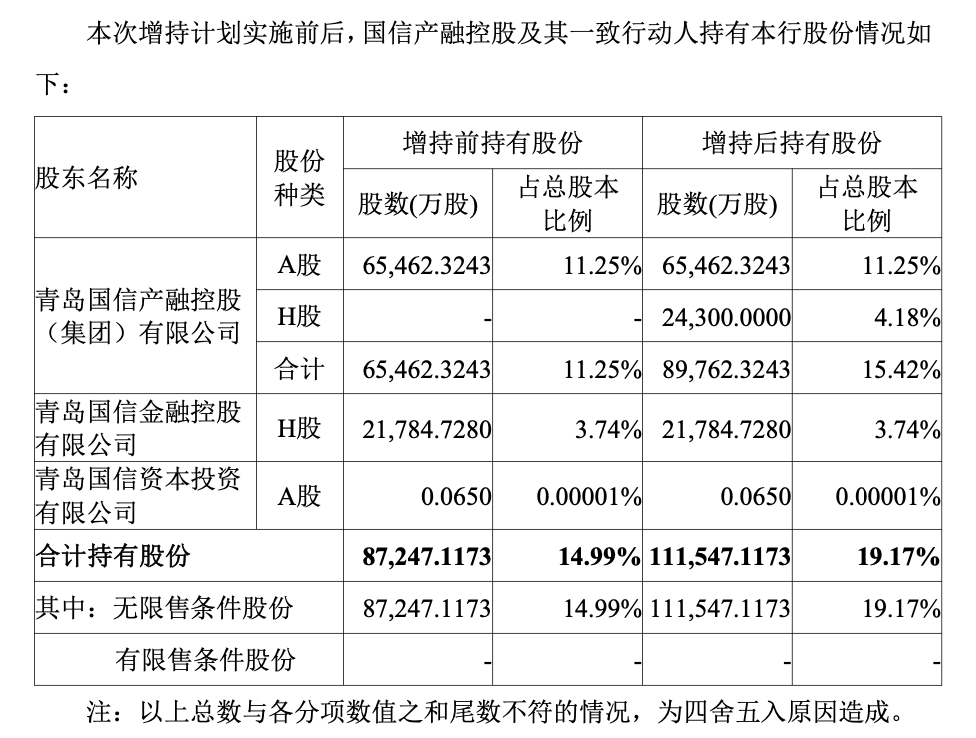
Core Points - Qingdao Bank announced that its major shareholder, Guoxin Chanquan Holdings, increased its stake in the bank by acquiring 243,000,000 H-shares through the Hong Kong Stock Connect from September 15 to November 5, 2025, representing 4.18% of the bank's total shares [1] - The total amount invested in this share acquisition was approximately RMB 956.79 million, sourced from the company's own funds [1] - Following this increase, Guoxin Chanquan Holdings and its concerted parties hold a total of 1.115 billion shares in Qingdao Bank, accounting for 19.17% of the bank's total shares [1]
普惠金融业务有望平稳增长
Xiangcai Securities· 2025-11-09 11:34
Core Insights - The report indicates that inclusive finance business is expected to maintain steady growth, with the People's Bank of China releasing the "China Inclusive Finance Index Analysis Report (2024-2025)" [8][34] - As of June 2025, the balance of inclusive micro and small loans reached 36.09 trillion yuan, reflecting a year-on-year growth of 12.2%, which, although lower than the previous year, remains significantly higher than the general loan growth rate [8][34] - The report highlights that the proportion of inclusive micro and small credit loans is increasing, while the interest rates on these loans are declining [8][34] Industry Performance - The report notes that personal consumption loans, excluding housing loans, reached a balance of 21.29 trillion yuan by September 2025, with a year-on-year growth of 4.2% [8][34] - The report emphasizes that the implementation of special actions to boost consumption since 2025, including fiscal subsidies for personal consumption loans in key areas, is expected to sustain low but steady growth in consumption loans [8][34] Investment Recommendations - The report suggests that the issuance of policy financial tools is likely to boost bank credit demand, with regional banks expected to maintain resilient asset expansion [11][37] - It recommends focusing on state-owned banks for stable high dividend investment value, specifically mentioning Industrial and Commercial Bank of China and Bank of China, as well as opportunities for valuation recovery in joint-stock and regional banks [11][37]
青岛银行股权结构重塑 国信系成第一大股东
Jing Ji Guan Cha Wang· 2025-11-09 06:38
Core Viewpoint - The recent shareholding increase by Qingdao Bank's major shareholder, Guoxin Chanin Holdings, marks a significant shift in the bank's equity structure and reflects a broader trend of capital reallocation within the banking sector in 2025 [1][6]. Group 1: Shareholding Increase Details - Guoxin Chanin Holdings and its concerted actions have raised their combined shareholding in Qingdao Bank to 19.17% within a few months, showcasing a well-structured and strategic approach to capital investment [1][4]. - The shareholding increase was executed through a series of transactions from September 15 to November 5, with the shareholding rising from 11.26% to 15.42% during this period [2][3]. - The increase was completed without triggering a mandatory tender offer and did not alter the bank's governance status, which maintains no controlling shareholder [1][2]. Group 2: Financial Performance and Shareholder Confidence - Qingdao Bank's third-quarter report for 2025 indicated a total asset growth of 10.96% year-on-year, with a net profit increase of 15.54% for the first three quarters [4]. - The bank's non-performing loan ratio decreased to 1.10%, and the provision coverage ratio improved to 269.97%, providing a solid foundation for the shareholder's confidence in the bank's long-term value [4][9]. - The commitment from Guoxin Chanin Holdings to hold the shares for at least five years reflects a long-term investment perspective rather than a short-term financial strategy [4]. Group 3: Broader Industry Trends - The shareholding increase at Qingdao Bank is part of a larger trend in the banking sector, where several banks have seen significant capital inflows from major shareholders throughout 2025 [6][8]. - Regional banks, particularly in economically vibrant areas, have experienced notable increases in shareholding, indicating strong local capital support for financial institutions [6][8]. - The current environment of improved bank profitability expectations and a stabilizing macroeconomic backdrop has led to a redefinition of bank stocks as core assets with safety margins and dividend appeal [8][9].
互联网、大消费集体转弱。银行有护盘迹象
Ge Long Hui· 2025-11-08 04:25
大消费低开低走延续弱势,截至目前下跌0.78%。其中统一企业大跌5.47%,泡泡玛特下跌4.23%,古茗 下跌2.29%,信达生物、创科实业、阿里健康等股跌幅均在1%上方。 银行股冲高回落,相对抗跌,截止午盘下跌0.28%。其中光大银行上涨1.51%,中信银行下跌0.55%,农 业银行下跌0.33%;青岛银行、邮储银行、大新金融等股跌幅均在1%上方。 内容只是个人观点,仅供参考,不作为投资依据!欢迎关注交流,互相学习、共同探讨! 开盘后直线跳水,随后超跌反弹,截至目前恒生指数下跌0.62%,互联网跌幅居前,大消费、恒生科 技、医疗等股紧随其后,银行相对抗跌。 恒生互联网低开低走大跳水,截至目前下跌1.41%,其中快手下跌4.14%,哔哩哔哩下跌2.76%,商汤下 跌2.23%,京东集团下跌2.13%,阿里巴巴下跌2.06%,美团、地平线机器人、腾讯控股等跌幅均在1% 上方。 ...
青岛银行:大股东增持H股至持股19.17%,完成增持计划
Hua Er Jie Jian Wen· 2025-11-07 13:11
Core Viewpoint - Qingdao Bank's major shareholder, Qingdao Guoxin Financial Holdings (Group) Co., Ltd., has successfully completed its shareholding increase plan, raising its stake to 19.17% from 14.99% [1] Group 1: Shareholder Increase Details - Increasing entity: Qingdao Guoxin Financial Holdings (Group) Co., Ltd. and its concerted parties [1] - Pre-increase shareholding: 87,247.11 million shares, accounting for 14.99% of total share capital [1] - Target shareholding: Aiming to reach a range of 19.00%-19.99% [1] Group 2: Implementation of Increase - Funding source: Self-owned funds [1] - Increase period: From September 15, 2025, to November 5, 2025 [1] - Number of shares increased: 24,300 million shares through Hong Kong Stock Connect, representing 4.18% of total share capital [1] - Amount of increase: RMB 95,679.37 million (excluding transaction taxes and fees) [1] Group 3: Post-Increase Shareholding Structure - Post-increase shareholding: Total shares held increased to 111,547.11 million, accounting for 19.17% of total share capital [1] - Completion of increase: The increase plan has been successfully achieved [1] - Share lock-up: Increased shares are not transferable for five years from the date of acquisition [1] - Regulatory approval: Approval obtained from the Qingdao Regulatory Bureau of the National Financial Supervision Administration [1] Group 4: Company Impact - Company status: The increase does not affect the company's listing status and governance structure [1]