
三博脑科

Search documents
三博脑科(301293) - 2025 Q3 - 季度财报
2025-10-27 08:30
三博脑科医院管理集团股份有限公司 2025 年第三季度报告 证券代码:301293 证券简称:三博脑科 公告编号:2025-042 三博脑科医院管理集团股份有限公司 1.董事会及董事、高级管理人员保证季度报告的真实、准确、完整,不存在虚假记载、误导性陈述或重大遗漏,并承担 个别和连带的法律责任。 2.公司负责人、主管会计工作负责人及会计机构负责人(会计主管人员)声明:保证季度报告中财务信息的真实、准确、完 整。 3.第三季度财务会计报告是否经过审计 □是 ☑否 1 三博脑科医院管理集团股份有限公司 2025 年第三季度报告 一、主要财务数据 2025 年第三季度报告 (一) 主要会计数据和财务指标 本公司及董事会全体成员保证信息披露的内容真实、准确、完整,没有虚假记载、误导性陈述或重大遗漏。 重要内容提示: □是 ☑否 | | 本报告期 | 本报告期比上年同期 | 年初至报告期末比上 年初至报告期末 | | | --- | --- | --- | --- | --- | | | | 增减 | 年同期增减 | | | 营业收入(元) | 445,991,649.75 | 25.65% | 1,273,244,0 ...

三博脑科(301293) - 第三届董事会第十五次会议决议公告
2025-10-27 08:30
证券代码:301293 证券简称:三博脑科 公告编号:2025-041 三博脑科医院管理集团股份有限公司 第三届董事会第十五次会议决议公告 本公司及董事会全体成员保证信息披露的内容真实、准确、完整,没有虚假 记载、误导性陈述或重大遗漏。 一、董事会会议召开情况 三博脑科医院管理集团股份有限公司(以下简称"公司")第三届董事会第十 五次会议于 2025 年 10 月 27 日在公司会议室以现场结合通讯的方式召开。会议 通知于 2025 年 10 月 21 日以电子邮件等方式发出。本次会议应出席董事 9 名, 实际出席的董事 9 人,会议由董事长张阳先生主持,公司高级管理人员列席了会 议。本次会议的召集、召开和表决程序符合《公司法》等法律法规和《公司章程》 的有关规定。 经与会董事认真审议,会议形成了如下决议: (一)审议通过《2025 年第三季度报告》 经审议,公司董事会认为:公司 2025 年第三季度报告的编制符合相关法律 法规及《公司章程》的有关规定,报告真实、准确、完整地反映了公司 2025 年 第三季度的财务状况和经营情况,不存在虚假记载、误导性陈述或重大遗漏。 表决结果:9 票同意,0 票反对,0 票 ...
三博脑科:第三季度净利润为1393.25万元,同比下降63.26%
Xin Lang Cai Jing· 2025-10-27 08:29
三博脑科公告,第三季度营收为4.46亿元,同比增长25.65%;净利润为1393.25万元,同比下降 63.26%。前三季度营收为12.73亿元,同比增长20.26%;净利润为8362.82万元,同比下降20.01%。 ...
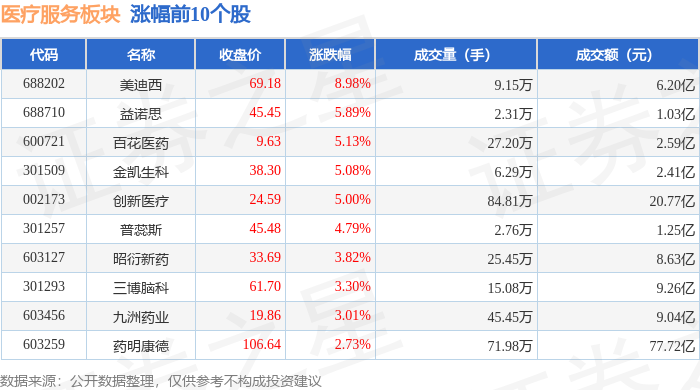
医疗服务板块10月27日涨1.63%,美迪西领涨,主力资金净流出410.09万元
Zheng Xing Xing Ye Ri Bao· 2025-10-27 08:25
证券之星消息,10月27日医疗服务板块较上一交易日上涨1.63%,美迪西领涨。当日上证指数报收于 3996.94,上涨1.18%。深证成指报收于13489.4,上涨1.51%。医疗服务板块个股涨跌见下表: | 代码 | 名称 | 收盘价 | 涨跌幅 | 成交量(手) | 成交额(元) | | | --- | --- | --- | --- | --- | --- | --- | | 688202 | 美迪西 | 69.18 | 8.98% | 9.15万 | | 6.20亿 | | 688710 | 益诺思 | 45.45 | 5.89% | 2.31万 | | 1.03亿 | | 600721 | 百花医药 | 9.63 | 5.13% | 27.20万 | | 2.59亿 | | 301509 | 美凯生科 | 38.30 | 5.08% | 6.29万 | | 2.41亿 | | 002173 | 创新医疗 | 24.59 | 5.00% | 84.81万 | | 20.77亿 | | 301257 | 曾感斯 | 45.48 | 4.79% | 2.76万 | | 1.25亿 | | 603127 | ...


“十五五”规划点名 十万亿级市场启幕 脑机接口升维“国家战略”
Hua Xia Shi Bao· 2025-10-27 00:32
Core Viewpoint - The article discusses the comprehensive deployment of China's 15th Five-Year Plan, emphasizing the development of a modern industrial system, a strong domestic market, and coordinated regional development, with a particular focus on emerging industries like brain-computer interfaces (BCIs) as a key driver for economic growth [1][3][6]. Industry Development - The 15th Five-Year Plan highlights the importance of brain-computer interfaces, which are expected to transition from cutting-edge technology to large-scale applications, becoming a crucial pillar for high-quality economic development in China [6][8]. - The BCI industry is projected to create a market scale in the hundreds of billions, generating numerous high-skilled job opportunities and establishing a new competitive advantage for China in global technology [6][7]. Policy Support - The implementation of the "Implementation Opinions" in 2025 marked a significant leap in policy support for the BCI industry, elevating it to a national strategic level with clear goals for technological breakthroughs and international competitiveness by 2030 [4][6]. - The policy framework includes five key tasks, three major projects, and 17 specific measures to create a closed-loop system of research, industry, and application, fostering the integration of BCIs with traditional industries [4][7]. Market Potential - Companies are actively exploring the commercial potential of BCIs, with various business models emerging, including partnerships for medical applications and consumer electronics [7]. - The BCI market is expected to expand significantly during the 15th Five-Year Plan, driven by decreasing costs and standardization, transitioning from niche applications to mainstream adoption [7][8]. Technological Advancements - The BCI system is categorized into non-invasive, partially invasive, and fully invasive devices, with advancements expected in precision, safety, and accessibility during the 15th Five-Year Plan [6][7]. - Collaboration between academia and industry is anticipated to accelerate breakthroughs in critical areas such as electrode materials and signal decoding efficiency, enhancing the overall performance of BCI technologies [6][7].
十五五”规划点名,十万亿级市场启幕,脑机接口升维“国家战略
Hua Xia Shi Bao· 2025-10-26 00:38
Group 1: Core Economic and Social Development Strategies - The "15th Five-Year Plan" emphasizes the construction of a modern industrial system, a strong domestic market, and coordinated regional development [1] - The plan aims to cultivate emerging and future industries, with a focus on sectors like quantum technology, bio-manufacturing, hydrogen energy, nuclear fusion, brain-machine interfaces, embodied intelligence, and 6G mobile communication [2][5] Group 2: Brain-Machine Interface (BMI) Industry Development - The BMI technology is recognized for its potential to transform economic structures and improve social welfare, with applications in medical rehabilitation and industrial manufacturing [2] - The "Implementation Opinions" issued in July 2025 will elevate the BMI industry to a national strategic level, aiming for breakthroughs in core technologies by 2027 and positioning the industry among the world's leaders by 2030 [3][5] - The BMI industry is projected to create a market scale in the hundreds of billions, generating numerous high-skilled jobs and enhancing China's competitive edge in global technology [5][6] Group 3: Policy and Market Support - The policy framework for BMI has evolved from local pilot projects to a comprehensive national strategy, fostering a collaborative environment among various government departments [3] - Local governments are responding rapidly, with initiatives like the establishment of specialized action plans and funding to support BMI innovation and development [3][4] - The integration of AI with BMI is expected to enhance the efficiency of brain signal decoding, leading to significant advancements in the industry [5][6] Group 4: Commercialization and Market Applications - Companies are exploring diverse business models in the BMI sector, including partnerships for clinical applications and consumer products, indicating a dual focus on B2B and B2C markets [6] - The BMI technology is anticipated to transition from niche applications to widespread use, aligning with China's goals for health and digital economy [6][7] - The current trajectory of BMI development in China highlights significant advancements in medical applications, particularly in areas like Parkinson's disease and mental health, supported by strong policy and market demand [6][7]
“十五五”规划点名,十万亿级市场启幕,脑机接口升维“国家战略”
Hua Xia Shi Bao· 2025-10-25 09:45
Core Viewpoint - The article discusses the comprehensive deployment of China's 15th Five-Year Plan, emphasizing the development of a modern industrial system, a strong domestic market, and coordinated regional development, with a particular focus on emerging industries like brain-machine interfaces [2][3][4]. Industry Development - The 15th Five-Year Plan aims to cultivate new pillar industries, with a focus on future industries such as quantum technology, bio-manufacturing, hydrogen energy, nuclear fusion, brain-machine interfaces, embodied intelligence, and 6G mobile communication [3][4]. - Brain-machine interface technology is highlighted for its potential to transform economic structures and improve societal welfare, enabling applications in medical rehabilitation, industrial manufacturing, and consumer electronics [3][4]. Policy Support - The brain-machine interface has been officially recognized as a future industry by the Ministry of Industry and Information Technology and other departments, marking its entry into national strategic planning [4][5]. - The "Implementation Opinions" released in July 2025 set clear goals for the brain-machine interface industry, aiming for breakthroughs in core technologies by 2027 and positioning the industry among the world's leaders by 2030 [4][5]. Market Potential - The brain-machine interface industry is projected to create a market scale in the hundreds of billions, generating numerous high-skilled job opportunities and establishing a new competitive advantage for China in global technology [6][7]. - The industry is expected to evolve towards more precise, safer, and more accessible technologies during the 15th Five-Year Plan, with significant advancements in hardware and software capabilities [6][7]. Commercial Applications - Companies are actively engaging in the brain-machine interface space, with various business models targeting both B2B and B2C markets, including medical rehabilitation and consumer electronics [7][8]. - Examples of commercial initiatives include partnerships for developing implantable systems, clinical transformation centers, and innovative products like brain-controlled games and smart mattresses [7][8]. Conclusion - The emphasis on brain-machine interfaces in the 15th Five-Year Plan signifies a shift from following to leading in this technology, aligning with China's development philosophy centered on improving human welfare [8].






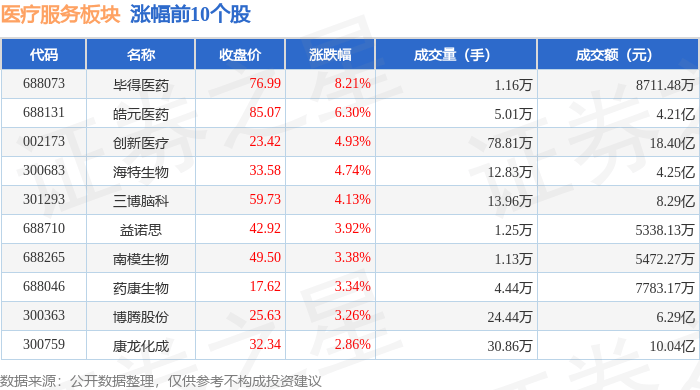
医疗服务板块10月24日涨1.37%,毕得医药领涨,主力资金净流入2.79亿元
Sou Hu Cai Jing· 2025-10-24 08:29
Core Viewpoint - The medical services sector experienced a rise of 1.37% on October 24, with Bid Medicine leading the gains, while the Shanghai Composite Index closed at 3950.31, up 0.71% [1]. Group 1: Market Performance - The medical services sector saw significant individual stock movements, with Bid Medicine (688073) closing at 76.99, up 8.21% with a trading volume of 11,600 and a transaction value of 87.11 million [1]. - Other notable performers included Haoyuan Medicine (688131) at 85.07, up 6.30%, and Innovation Medical (002173) at 23.42, up 4.93% [1]. - The overall trading volume and transaction values for the sector indicated strong investor interest, with a total of 2.79 billion net inflow from major funds [2]. Group 2: Fund Flow Analysis - Major funds showed a net inflow of 2.79 billion, while retail investors experienced a net outflow of 826.12 million [2]. - Specific stocks like Innovation Medical (002173) had a net inflow of 2.20 billion from major funds, despite a net outflow of 1.43 billion from retail investors [3]. - Other stocks such as Kanglong Chemical (300759) and Meian Health (002044) also showed mixed fund flows, with significant net inflows from major funds but outflows from retail investors [3].

华福证券:下游潜在应用场景广泛 脑机接口有望迎来新机遇
智通财经网· 2025-10-23 05:53
Core Insights - The brain-computer interface (BCI) industry is rapidly developing, allowing direct communication between the brain and external devices, driven by advancements in brain science, artificial intelligence, and related fields [2][3] - China has multiple advantages in developing the BCI industry, including technological leadership in non-invasive interfaces, a growing number of specialized enterprises, and significant market demand driven by aging populations and industrial upgrades [2][3] - The global BCI market is projected to grow from approximately $2.62 billion in 2024 to $2.94 billion in 2025, and is expected to reach $12.4 billion by 2034 [4] Industry Overview - The BCI industry has established a complete industrial chain, covering upstream (materials, chips, electrodes), midstream (signal acquisition and processing), and downstream (medical health, consumer life, industrial production) sectors [4] - The technology development process involves four core steps: neural signal acquisition, signal processing and feature extraction, decoding and machine learning, and feedback and control [3] - BCI technology can be categorized into three implementation paths: invasive (for precise neural signal acquisition), semi-invasive (balancing signal quality and safety), and non-invasive (easier public acceptance) [3] Market Potential - The BCI industry is witnessing a shift from laboratory research to clinical and commercial applications, with significant growth in market size anticipated due to advancements in artificial intelligence, neuroscience, and computer science [4] - The increasing demand for medical rehabilitation and industrial automation presents vast opportunities for BCI technology implementation in China [2] Investment Opportunities - Recommended companies to watch in the BCI sector include: - Yanshan Technology (002195.SZ) - Hanwei Technology (300007.SZ) - Sanbo Brain Science (301293.SZ) - Innovation Medical (002173.SZ) - Dongfang Zhongke (002819.SZ) - Xiangyu Medical (688626.SH) - Entropy Technology (301330.SZ) - Chengyitong (300430.SZ) - Weisi Medical (688580.SH) - Mailande (688273.SH) - Aipeng Medical (300753.SZ) - Beiyikang (920199.BJ) [5]
脑机接口行业深度系列报告:十五五重点赛道,脑机接口有望迎来新机遇
Huafu Securities· 2025-10-23 05:18
Investment Rating - The report maintains an "Outperform" rating for the brain-computer interface (BCI) industry [1] Core Insights - The brain-computer interface industry is rapidly developing, enabling direct communication between the brain and external devices, with significant advancements in technology and market potential [2][3] - China holds multiple advantages in developing the BCI industry, including technological leadership in non-invasive interfaces, a growing industrial base, and increasing market demand driven by an aging population and industrial upgrades [22][18] - The BCI technology involves four core steps: neural signal acquisition, signal processing and feature extraction, decoding and machine learning, and feedback and control [27][24] - The BCI industry has a complete supply chain covering upstream (materials, chips, electrodes), midstream (signal acquisition and processing), and downstream (medical health, consumer life, industrial production) applications [58][71] Summary by Sections Industry Investment Rating - The report maintains an "Outperform" rating for the BCI industry [1] Industry Overview - The BCI technology allows for a new communication channel between the brain and external devices, with applications expanding due to advancements in neuroscience and artificial intelligence [2][3] - The global BCI market is projected to grow from approximately $2.62 billion in 2024 to $2.94 billion in 2025, and is expected to reach $12.4 billion by 2034 [2] Technological Development - BCI technology is evolving through three main paths: invasive, semi-invasive, and non-invasive methods, each with distinct advantages and applications [28][30] - Invasive interfaces provide the most precise neural signal acquisition but come with higher risks, while non-invasive interfaces are safer and more user-friendly [41][45] Market Applications - The BCI industry is witnessing rapid growth in various application scenarios, including medical rehabilitation, consumer electronics, and industrial production [58][71] - The medical health sector is currently the largest application area for BCI technology, accounting for approximately 47.62% of the market, with significant potential in rehabilitation and neurodiagnostics [71]