饿了么

Search documents
美团、饿了么、京东,最新发声!
证券时报· 2025-08-01 10:11
Core Viewpoint - The article discusses the recent announcements from major food delivery platforms in China, including Meituan, Ele.me, and JD, to resist "involution" style competition and promote a healthier industry ecosystem following intense subsidy wars and regulatory scrutiny [1][2][5]. Group 1: Industry Response to Competition - On August 1, Meituan, Ele.me, and JD jointly announced their commitment to resist excessive competition and maintain a healthy industry ecosystem [2]. - The platforms emphasized the need to standardize subsidy behaviors, oppose involution, and enhance service quality, aligning with previous regulatory requirements [5]. - The State Administration for Market Regulation had previously urged these companies to comply with various laws and regulations, including the E-commerce Law and the Anti-Unfair Competition Law, to foster a win-win ecosystem for consumers, merchants, delivery riders, and platforms [5]. Group 2: Specific Stances on Subsidies - JD stated its position against "0 yuan purchase" and other harmful subsidies, aiming to create a transparent subsidy mechanism and ensure fair competition [8]. - Meituan outlined four specific guidelines for subsidy activities, including compliance with laws, transparency in subsidy information, respect for merchants' pricing autonomy, and non-discriminatory practices [9][10][11][12]. - Ele.me committed to avoiding large-scale irrational promotional activities like "0 yuan purchase," focusing instead on reasonable subsidy distribution and protecting merchants' rights [13][14]. Group 3: Enhancing Service Quality and Cooperation - JD aims to improve service quality by promoting responsible consumption and providing various incentives to merchants, while also enhancing rider welfare [17][20]. - Ele.me plans to enhance service quality through diversified consumer experiences and ongoing communication with merchants to optimize operations [18][19]. - Meituan emphasizes the importance of building a cooperative ecosystem that benefits consumers, merchants, and riders, while advocating for sustainable business practices [21].



美团、饿了么、京东,最新发声!
Zheng Quan Shi Bao· 2025-08-01 10:10
Core Viewpoint - The major food delivery platforms in China, including Meituan, Ele.me, and JD, have announced a joint effort to resist "involution" competition and promote a healthier industry ecosystem following intense subsidy wars and regulatory scrutiny [1][4]. Group 1: Industry Response to Competition - The three platforms have expressed a commitment to standardizing subsidy practices, opposing involution, and enhancing service quality, aligning with previous regulatory requirements [4]. - The State Administration for Market Regulation recently urged these platforms to comply with various laws, including the E-commerce Law and the Anti-Unfair Competition Law, to foster a win-win ecosystem for consumers, merchants, delivery riders, and platform companies [4]. Group 2: Specific Stances on Subsidies - JD has stated its position against "0 yuan purchase" and other harmful subsidies, emphasizing the need for a transparent subsidy mechanism and the importance of not inflating market status through order volume [6]. - Meituan has outlined four specific guidelines for subsidy activities, including compliance with laws, not selling below cost, ensuring fair participation for merchants, and maintaining transparency in subsidy information [7][8][9]. - Ele.me has committed to avoiding large-scale "0 yuan purchase" promotions and will focus on reasonable subsidy distribution while respecting merchants' rights [10]. Group 3: Enhancing Service Quality and Cooperation - JD aims to improve service quality by promoting food safety and encouraging responsible consumption, while also providing various incentives to merchants and enhancing rider welfare [12][13]. - Ele.me plans to enhance service quality through diversified consumer experiences and ongoing communication with merchants to optimize operations [14][15]. - Meituan emphasizes the importance of a balanced ecosystem among consumers, merchants, and riders, aiming to improve rider income stability and reduce operational costs for merchants [16][17].


多家外卖平台宣布规范促销补贴
Guang Zhou Ri Bao· 2025-08-01 08:48
Group 1 - Major platforms such as Meituan, Taobao, and Ele.me have committed to "regulating promotions" and introduced measures to limit subsidy behaviors, including rational planning of subsidies and avoiding irrational promotional activities [1][2] - The collective statement from these platforms is a response to previous regulatory discussions aimed at promoting healthy competition within the food delivery industry [1] - The State Administration for Market Regulation has urged food delivery platforms to further standardize promotional behaviors and participate in rational competition to foster sustainable development in the catering service industry [1] Group 2 - The upcoming "Autumn First Cup of Milk Tea" event, which has been a marketing staple since 2020, is expected to trigger a new round of competition among delivery platforms [2] - The simultaneous statements from the platforms serve as a preemptive reminder of anti-involution policies ahead of the significant marketing period [2] - The marketing activities and measures taken by each platform during the "Autumn First Cup of Milk Tea" will be critical for observing their actual strategies [2]
人民财评:回归理性,公平竞争做大“外卖”蛋糕
Ren Min Wang· 2025-08-01 08:08
Core Viewpoint - The three major food delivery platforms in China have called for a return to rational competition to address the issue of disorderly competition in the industry, which has been exacerbated by aggressive promotional activities and the entry of new players like JD.com [1][2]. Group 1: Industry Competition - The food delivery market has seen intensified competition with platforms launching aggressive promotions such as "0 yuan purchase" and "1 cent purchase" to capture market share [1]. - The entry of JD.com into the food delivery sector has significantly changed the competitive landscape, prompting existing players to respond with various promotional strategies [1]. - Regulatory bodies have intervened by urging platforms to comply with laws and regulations, aiming to establish a fair and orderly competitive environment [1][2]. Group 2: Impact of Disorderly Competition - Disorderly competition can distort market consumption structures and negatively impact the normal operations of merchants, despite consumers seemingly benefiting from lower prices [2]. - Increased order volumes due to aggressive competition may lead to safety risks for delivery personnel, highlighting the need for a balanced approach to competition [2]. - The platforms recognize that irrational competition leads to a lose-lose situation, while rational competition can enhance overall productivity and create greater value for consumers and businesses alike [2]. Group 3: Regulatory Measures - Regulatory authorities have previously addressed similar issues in other sectors, such as community group buying, by implementing guidelines to maintain fair competition [3]. - The newly revised Anti-Unfair Competition Law, effective from October 15, will prohibit platforms from forcing merchants to sell below cost, further promoting a fair competitive environment [3]. - The platforms are encouraged to adopt a long-term strategic vision by engaging in rational competition and fulfilling their corporate responsibilities [3].
集体交“作业”!美团、淘宝饿了么、京东同时发文公开承诺,抵制无序竞争
Sou Hu Cai Jing· 2025-08-01 08:05
Core Viewpoint - Major food delivery platforms in China, including Meituan, Ele.me (owned by Alibaba), and JD.com, have publicly committed to resisting irrational competition and promoting a healthy industry ecosystem through a series of pledges aimed at ensuring fair practices and sustainable development in the food delivery sector [1][6][9]. Group 1: Meituan's Commitments - Meituan has announced five commitments to promote a healthy ecosystem in the food delivery industry, emphasizing the need to regulate promotional activities and eliminate unfair competition [1]. - The company will strictly adhere to various laws, including the Anti-Monopoly Law and the Anti-Unfair Competition Law, ensuring that subsidies do not significantly undercut costs and distort market prices [2]. - Meituan will ensure transparency in subsidy activities by publicly disclosing subsidy information to merchants and consumers, avoiding exaggerated claims [3]. - The platform will not force or indirectly compel merchants to participate in subsidy activities, thereby protecting their pricing autonomy [4]. - Meituan aims to create a win-win ecosystem for consumers, merchants, delivery riders, and platform companies, focusing on quality and service rather than price competition [4]. Group 2: Ele.me and Alibaba's Commitments - Ele.me, in collaboration with Taobao, has made four commitments to enhance service quality and promote healthy competition, emphasizing the importance of consumer and merchant needs [6]. - The platform will implement a mechanism to ensure merchants' rights to know, choose, and set prices, while also establishing a compensation system for merchants [6]. - Ele.me will actively resist irrational competition and ensure that promotional activities do not harm merchants' profits, avoiding large-scale irrational promotions like "0 yuan purchase" [6][9]. - The company is committed to improving service quality and promoting green consumption, encouraging consumers to make rational choices [8]. Group 3: JD.com's Commitments - JD.com has also made four commitments to foster a healthy ecosystem in the food delivery industry, focusing on resisting irrational competition and ensuring transparency in subsidy mechanisms [9]. - The company will eliminate unfair competition practices and promote a focus on quality and service rather than subsidies, leveraging technology and supply chain innovations [9]. - JD.com is dedicated to maintaining food safety and integrity in operations, while also promoting anti-food waste initiatives through consumer education [9].
抵制恶性竞争!外卖平台集体发声:规范促销补贴行为
Bei Jing Ri Bao Ke Hu Duan· 2025-08-01 08:03
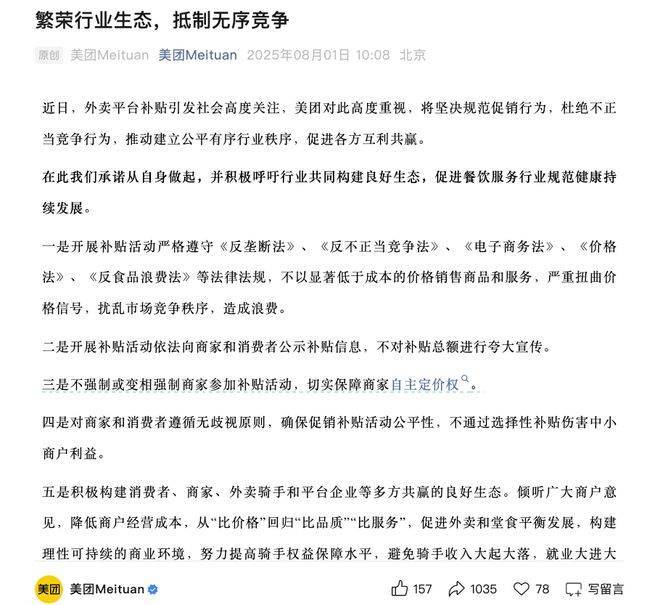
饿了么在官网上线一则题为《持续提升服务 推动良性竞争 激发消费烟火气》的声明。声明中承诺,将 从消费者和商家需求出发,合理规划发放补贴;坚决抵制恶性竞争,尊重市场运营规律;平台促销活动 为消费者提供简单明晰的优惠信息,展示价即到手价,保障消费者权利;推动良性竞争,合作促进生态 共赢。 本次多家平台同时发声,或源自上一轮约谈的政策延续。7月18日,市场监管总局官网发布消息称已约 谈外卖平台,要求进一步规范促销行为,理性参与竞争,促进餐饮服务行业规范健康持续发展。 约谈之后,各平台的营销均有不同程度的收缩。不过记者注意到,包括"零元购""1分购""免单券"等大 额补贴的变体仍在持续进行,且商家需要仍然需要承担70%左右的补贴成本。 业内分析认为,这一轮外卖价格大战是"存量博弈",并没有产生消费增量,同质化的低价竞争让平台企 业与相关外卖商家陷入利润困境。数据显示,今年上半年全国餐饮收入增速同比下降3.6个百分点。 8月1日,美团、饿了么、京东先后发布声明,承诺将"规范促销",同时提出多项限制补贴行为的举措, 包括规范促销行为、合理规划发放补贴、不做非理性促销活动、不以显著低于成本的价格销售商品和服 务等。 当日, ...
中国多家外卖平台同日发文抵制行业恶性竞争
Zhong Guo Xin Wen Wang· 2025-08-01 07:57
饿了么发文提出,将从消费者和商家需求出发,合理规划发放补贴;坚决尊重市场运营规律,保障商家 实收与盈利空间,不做大规模"0元购"等非理性促销活动;持续提升消费者服务体验,与商家、协会等 共同维护好线下经营秩序。 中国互联网络信息中心披露的数据显示,截至2024年底,中国网上外卖用户规模已达5.45亿人,占网民 整体的约五成。另据艾瑞咨询统计,中国餐饮外卖市场规模从2015年的1250亿元人民币升至2024年的 1.5万亿元人民币,年复合增长率高达28%,外卖对整体餐饮行业的渗透率从2015年的4%大幅提升至 2024年的26%。(完) (文章来源:中国新闻网) 中新社北京8月1日电 (记者刘亮)美团、饿了么、京东等平台1日陆续发文抵制行业内恶性竞争,并提出 进一步规范外卖平台补贴行为等有关举措。 今年以来,外卖平台"补贴大战"引发社会高度关注,中国官方两度就市场公平有序竞争问题约谈多家外 卖平台企业。 最近一次约谈是在7月18日,市场监管部门约谈饿了么、美团、京东三家平台企业,要求相关平台企业 进一步规范促销行为,理性参与竞争,促进餐饮服务行业规范健康持续发展。 美团1日发文称,坚决规范促销行为,杜绝不正当竞 ...
美团饿了么京东承诺抵制恶性竞争不以显著低价销售
Bei Ke Cai Jing· 2025-08-01 07:39
Core Viewpoint - Multiple food delivery platforms are calling for a resistance against vicious competition, emphasizing the need for a healthy industry ecosystem and the importance of not selling goods and services at significantly lower than cost prices, which distorts price signals and disrupts market order [1][2]. Group 1: Industry Commitments - Meituan published an article titled "Prosper the Industry Ecosystem, Resist Disorderly Competition," stating a commitment to not sell at significantly lower prices [1]. - Taobao Flash and Ele.me also released statements promoting service enhancement and healthy competition, urging against significant price undercutting [1]. - JD.com issued a statement on fulfilling corporate and social responsibilities, promising to regulate subsidy practices and improve service quality [1]. Group 2: Legal and Ethical Standards - The platforms are aligning with laws such as the "Anti-Food Waste Law," ensuring that subsidies are transparently communicated to merchants and consumers without exaggeration [2]. - There is a commitment to not force merchants into subsidy activities, thereby protecting their pricing autonomy [2]. - The platforms aim to ensure fairness in promotional activities, avoiding selective subsidies that could harm small and medium-sized businesses [2]. Group 3: Sustainable Development Goals - The industry recognizes that irrational competition leads to unsustainable benefits for consumers, merchants, and delivery riders [3]. - There is a collective willingness to resist "involution-style" competition, focusing resources on improving service experiences and safeguarding rider rights [3]. - The goal is to shift from price competition to quality and service competition, promoting a balanced development between food delivery and dine-in services [2][3].
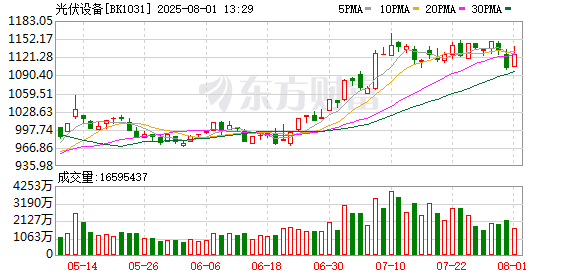
光伏设备板块大涨 三大利好突袭
Zhong Guo Zheng Quan Bao· 2025-08-01 05:28
Group 1: Pharmaceutical Sector - The pharmaceutical sector showed strong performance on the first trading day of August, with traditional Chinese medicine stocks experiencing significant gains, including companies like Weikang Pharmaceutical and Xintian Pharmaceutical reaching their daily price limits [2] - Various sub-sectors within pharmaceuticals, such as animal vaccines, pharmaceutical e-commerce, innovative drugs, chemical preparations, raw materials, and CRO, also saw increases [2] Group 2: Solar Energy Sector - Solar energy stocks rebounded, with significant gains in the solar equipment sector, including companies like Jiejia Weichuang and Haiyou New Materials [5] - Jiejia Weichuang announced a mid-year profit forecast, expecting a net profit of 1.7 billion to 1.96 billion yuan for the first half of 2025, representing a year-on-year growth of 38.65% to 59.85% [5] - The increase in silicon wafer prices continued, with average prices rising approximately 0.1 yuan per piece, driven by increased raw material costs and higher downstream orders [6] Group 3: Logistics Sector - The logistics sector experienced an uptick, with companies like Huapengfei, Shentong Express, and Yunda Holdings showing significant stock price increases [9] - Shentong Express has seen a cumulative increase of over 52% since its rebound on July 10 [9] - The logistics industry is undergoing consolidation, with Shentong Express announcing a cash acquisition of Zhejiang Dan Niao Logistics for 362 million yuan [9] - The introduction of unmanned logistics vehicles is entering a phase of large-scale commercial use, with major players like SF Express and Zhongtong expected to introduce thousands of unmanned vehicles this year [10]
抵制无序竞争!美团、京东、饿了么、淘宝闪购发声
Zhong Guo Zheng Quan Bao - Zhong Zheng Wang· 2025-08-01 04:48
Core Viewpoint - Major food delivery platforms including Meituan, JD.com, Ele.me, and Taobao Shanguo have jointly expressed their commitment to resisting disorderly competition and promoting a fair and orderly industry environment [1][3][5]. Group 1: Company Commitments - Meituan emphasizes the importance of regulating promotional activities and eliminating unfair competition, aiming to foster a mutually beneficial ecosystem within the food service industry [1]. - JD.com calls for an end to "0 yuan purchase" and similar promotional practices, advocating for a healthy industry ecosystem that supports win-win development [3]. - Ele.me and Taobao Shanguo plan to enhance the integration of physical and service consumption while promoting technological upgrades and business innovation [5]. Group 2: Specific Measures - Meituan commits to not selling goods and services at prices significantly below cost, which distorts price signals and disrupts market competition [7]. - The company will ensure transparency in subsidy activities, protecting merchants' pricing autonomy and adhering to non-discriminatory principles [7][8]. - JD.com aims to build core competitiveness through differentiated specialty dishes and improved service quality, leveraging technology and supply chain innovation [7]. Group 3: Regulatory Context - The State Administration for Market Regulation previously held discussions with Meituan, JD.com, and Ele.me, urging them to comply with laws and regulations while rationally participating in competition [9]. - In May, the regulatory body had already addressed prominent issues in the food delivery industry, indicating ongoing scrutiny of competitive practices [9].