Samsung

Search documents
X @Sei
Sei· 2025-12-10 18:21
RT Justin | SEI (@JustinBarlow)Sei is putting instant payments in the hands of millions of users.Xiaomi is the 3rd largest phone distributor behind Apple and Samsung.With over 160M new devices sold each year, the world is about to experience real-time, global-scale finance. On Sei. ...
Nvidia And The H200 Landscape; Broadcom's Strategic Positioning
Seeking Alpha· 2025-12-10 17:30
Group 1: Nvidia and H200 GPUs - The approval of Nvidia's H200 GPUs for China is a significant development, with the US taking a larger cut of 25% compared to the previous 15% for H20s, indicating a balancing act between national security and trade profits [8][10] - There is uncertainty regarding the actual demand for H200s in China, but it is believed that major players like Alibaba and Tencent will seek these products due to their superior performance compared to domestic alternatives [12][15] - The performance of the H200 significantly outstrips that of domestic Chinese chips, with estimates suggesting it has six times the power of the H20, making it an attractive option for Chinese companies [17][18] Group 2: Broadcom and Market Position - Broadcom is positioned as a strong investment opportunity, potentially more rewarding than Nvidia in the long term, due to its scale and exposure to both ASIC and AI GPU markets [28][30] - The company is expected to report positive earnings, with guidance above consensus, and is benefiting from a growing customer base among tier one hyperscalers [38][39] - The memory shortage is impacting the industry, with significant price increases in DRAM, which could benefit companies like Micron and Apple, as they navigate the challenges posed by competitors [46][51] Group 3: AI Market Dynamics - The AI market is evolving, with Nvidia currently holding a market share estimated between 70% to 90%, but it is anticipated that they will eventually lose some market share as ASIC technology matures [40][42] - The conversation around Nvidia's market share is seen as premature, as the ASIC segment is still developing, and Nvidia's re-entry into the Chinese market could provide significant tailwinds [43][44] - The memory shortage is described as an AI-led phenomenon, with companies like Micron focusing on high-bandwidth memory (HBM) to meet demand, which is expected to drive their performance in the coming years [48][49]



QCOM vs. ASTS: Which Wireless Innovator is the Smarter Bet for 2026?
ZACKS· 2025-12-10 15:46
Core Insights - Qualcomm and AST SpaceMobile are significant players in the wireless communications ecosystem, with Qualcomm focusing on high-performance chip designs and AST SpaceMobile developing a global cellular broadband network in space [1][2]. Qualcomm Overview - Qualcomm is well-positioned for long-term revenue growth, driven by strong 5G traction and a diversified revenue stream, with innovative product launches in mobile chipsets [4]. - The company is enhancing its Snapdragon mobile platforms, which support advanced features for augmented reality, virtual reality, and superior connectivity [4]. - Qualcomm is transitioning from a mobile communications firm to a connected processor company, gaining traction in EDGE networking and vehicle-to-everything (V2X) communication systems [5]. - Despite its advancements, Qualcomm faces competition from Intel in the AI PC market and from Samsung and MediaTek in the smartphone market, with potential impacts from U.S.-China trade tensions [6]. AST SpaceMobile Overview - AST SpaceMobile is preparing to launch BlueBird 6, a next-generation satellite that will significantly increase data capacity and size compared to previous models [7]. - The company plans to deploy 45-60 satellites by the end of 2026 to establish a space-based mobile network, enhancing cellular coverage in areas lacking terrestrial networks [8][9]. - AST SpaceMobile's service connects directly to standard smartphones, filling coverage gaps and partnering with major carriers like AT&T and Verizon [10]. - The company faces challenges from macroeconomic conditions and competition from established players like SpaceX's Starlink, which may impact its financial performance [11]. Financial Performance and Estimates - Qualcomm's fiscal 2026 sales are expected to grow by 3.2%, with EPS estimates trending upward by 2.1% over the past 60 days [12]. - AST SpaceMobile's 2025 sales are projected to grow by 1142%, but EPS estimates indicate a decline of 60.6%, with a downward trend of 8.2% over the past 60 days [12]. - Over the past year, Qualcomm's stock has increased by 10.2%, while AST SpaceMobile has surged by 209.2% [16]. Valuation Comparison - Qualcomm appears more attractive from a valuation perspective, trading at a price/sales ratio of 4.13, significantly lower than AST SpaceMobile's 107.22 [16]. - Both companies are rated with a Zacks Rank 3 (Hold), but Qualcomm is considered a better investment option for 2026 due to its steady revenue growth compared to AST SpaceMobile's volatility [19].



InterDigital (NasdaqGS:IDCC) FY Conference Transcript
2025-12-10 15:32
InterDigital FY Conference Summary Company Overview - **Company**: InterDigital (NasdaqGS:IDCC) - **Industry**: Technology, specifically in wireless communication and video technologies - **Core Business**: Primarily a research company focused on developing and licensing patents related to wireless standards, video compression, and AI technologies [5][31][34] Key Points and Arguments Company Evolution and Strategy - InterDigital has evolved from a focus on digital telephony to a broader range of technologies, including cellular, Wi-Fi, and video compression, especially after acquiring Technicolor's research team [5][6] - The current management team, led by Liren Chen and Rajesh Pankaj, has significantly contributed to the company's recent successes [6] Patent Portfolio and Licensing - The company holds a substantial number of standard essential patents (SEPs) that are critical for the deployment of technologies like 5G and Wi-Fi [9][11] - InterDigital is involved in licensing agreements with major smartphone manufacturers, achieving compensation for 85% of the 1.2 billion smartphones sold annually [9][52] Financial Goals and Progress - InterDigital aims to reach $1 billion in annual recurring revenue (ARR) by 2030, with a current ARR of approximately $588 million, up from $400 million in 2024 [12][13] - The revenue breakdown includes $500 million from smartphones, $200 million from consumer electronics and IoT, and over $300 million from streaming services [13][14] Market Dynamics and Geopolitical Considerations - The company operates on a global scale, successfully navigating geopolitical tensions while maintaining relationships with manufacturers across different regions [17] - InterDigital's strategy includes focusing on licensing agreements through negotiation, with litigation as a last resort [34][48] Emerging Markets and Technologies - The company is venturing into the gaming and streaming markets, targeting over $300 million in revenue from these sectors, although current revenue is zero [19][20] - AI technologies are being integrated into their research and operations, enhancing their capabilities in video and cellular technologies [29][30] Financial Performance and Margins - InterDigital enjoys strong operating margins, with adjusted EBITDA margins exceeding 60% [24] - The company anticipates that new licensing agreements will lead to non-linear revenue growth, characterized by "catch-up sales" from prior usage before formal licensing [41][42] Challenges and Risks - The company faces challenges related to patent expiration and obsolescence, but maintains that their investments in research and development mitigate these risks [44][45] - The competitive landscape requires continuous innovation and adaptation to maintain market position [55] Additional Important Insights - InterDigital emphasizes its identity as a research company rather than a patent litigation firm, with over 90% of licensing agreements resolved without litigation [34] - The company is focused on solving complex problems in wireless communication, which positions it for long-term growth and value creation [55][56] - Future growth opportunities are seen in expanding their technology applications beyond smartphones, including automotive and IoT markets [50][51] This summary encapsulates the key points discussed during the InterDigital FY Conference, highlighting the company's strategic direction, financial goals, and market positioning.

Google, Meta, and the Race for Your Face: Analyzing the Next Generation of AR Glasses
CNET· 2025-12-10 13:00
I just got an advanced peak of Google's 2026 smart glasses lineup and there's a lot to take in. It also tells you what the state of smart glasses is right now. This is all things mobile.During a demo with Google just a week ago, I got a chance to take a look at smart glasses that did some things that blew my mind. One was I used Google Maps to get turnbyturn directions and I looked down and I saw the map spread out in front of me. I also got live translation on the glasses that autorecognized the language a ...



Nvidia (NASDAQ: NVDA) Stock Price Prediction for 2025: Where Will It Be in 1 Year (Dec 10)
247Wallst· 2025-12-10 12:50
Core Viewpoint - Nvidia's stock has shown significant recovery and growth, driven by advancements in AI technology and strategic developments in U.S.-China trade relations [1][2][12]. Company Performance - Nvidia's shares increased by 3.0% in the past week and are up 29.7% over the last six months, outperforming major indices [1]. - The company reported a record revenue of $57.01 billion in the third quarter, with $51.2 billion coming from the data center division, marking a 66% year-over-year increase [9]. - Nvidia's capital expenditures surged over 200% this year to more than $3 billion to meet the demand from hyperscalers [9]. Market Dynamics - The AI market is projected to grow at a 37% CAGR through 2030, supporting Nvidia's revenue forecast of $170 billion for fiscal 2026, a 30% increase from $130.5 billion in 2025 [8]. - Nvidia's automotive segment also saw a 32% year-over-year increase to $592 million, driven by partnerships with companies like Toyota and Aurora Innovation [11]. Strategic Developments - Nvidia is developing location verification technology to prevent chip smuggling and has received approval to sell advanced H200 AI chips to China [1][7]. - The company plans to supply over 260,000 advanced GPUs to South Korean firms, indicating strong international demand [7]. Analyst Sentiment - Of 64 analysts covering Nvidia, 60 recommend buying shares, with a consensus one-year price target of $250.93, indicating a potential upside of about 36% from the current price [13]. - Citigroup, J.P. Morgan, and Morgan Stanley have maintained their Buy-equivalent ratings, citing strong demand and revenue growth [14]. Risks and Challenges - Ongoing U.S.-China trade restrictions and tariffs pose risks to Nvidia's supply chain and profitability, with analysts warning of potential margin pressure [4][5][10]. - The company faces competition from Huawei's Ascend chips and other emerging technologies, which could impact its market position [5][15].

The Case for Buying This Under-the-Radar AI Stock Before Its Next Big Catalyst
The Motley Fool· 2025-12-10 10:45
Core Insights - Micron Technology is a leading manufacturer of high-performance memory and storage devices, with significant potential for growth in the AI sector [1][2] - The stock has seen substantial gains, approximately 200% year-to-date, but may still be undervalued based on current analyst ratings [4][12] - Micron is strategically positioning itself to capitalize on the growing demand for AI memory solutions by exiting the consumer-grade market [11][12] Company Performance - Micron's stock price has fluctuated between $61.54 and $260.58 over the past 52 weeks, currently trading around $252.42 [7] - The company has achieved a five-year return of 236%, with most gains occurring this year [7] - Analysts have raised their average price target for Micron to $338, indicating a potential upside of 34% from current levels [14] Market Dynamics - There is a significant shortage of AI-grade memory solutions, leading to a 60% increase in memory chip prices announced by Samsung and an 80% to 100% increase in DRAM and 3D NAND contract prices for December 2025 [8] - Retail customers are facing price increases of up to 171% for memory products due to this shortage [8] - Micron is investing $9.6 billion in a new facility in Japan to expand production capacity, although this facility will not address the current shortage until it becomes operational in 2028 [10][12] Strategic Focus - Micron is focusing on maximizing revenue streams and managing margins while positioning itself as a primary supplier of AI and data center memory chips [11][12] - The company is transitioning away from consumer-grade memory to concentrate on high-powered AI memory solutions [11] - Current trading at approximately 31 times price-to-earnings (P/E) suggests Micron is undervalued compared to the broader sector, which trades at nearly 40 times P/E [13]


Omdia: OWS Crosses 10-Million-Unit Milestone as TWS Market Pivots to Value Creation
Businesswire· 2025-12-10 10:02
Core Insights - Global TWS shipments reached 92.6 million units in Q3 2025, reflecting a modest year-over-year growth of 0.33% [1] - Open Wireless Stereo (OWS) shipments surpassed 10 million units, marking a significant 69% increase year-over-year, which offset a 4% decline in conventional TWS shipments [1][2] Market Dynamics - The OWS category is reshaping consumer perceptions of hearable devices, with a notable shift towards democratized ANC technology priced under US$25 [2] - The market is diverging into two paths: premium differentiation focusing on advanced ANC and sound quality, and accessible innovation targeting emerging markets [2][4] - Apple remains the revenue leader in the TWS market, capturing around 50% of market value despite a 4% decline in shipments, while Xiaomi achieved triple-digit growth in Latin America and other emerging markets [2][3] Vendor Performance - In Q3 2025, Apple shipped 18.9 million units (20% market share), while Xiaomi shipped 8.6 million units (9% market share), reflecting a 24% growth [7] - Huawei and Shokz lead the advanced OWS segment, with Huawei focusing on AI-enabled experiences and Shokz targeting sports and safe listening [3][4] - OWS shipments are projected to reach 40 million units by 2026, representing 10% of the total TWS market, highlighting the strategic importance of open-ear audio [5] Regional and Technological Trends - Emerging markets are driving volume growth through aggressive pricing and feature democratization, while developed markets prioritize premium experiences and ecosystem integration [4] - The next phase of market differentiation will focus on AI-driven personalization and seamless device ecosystem integration [5]


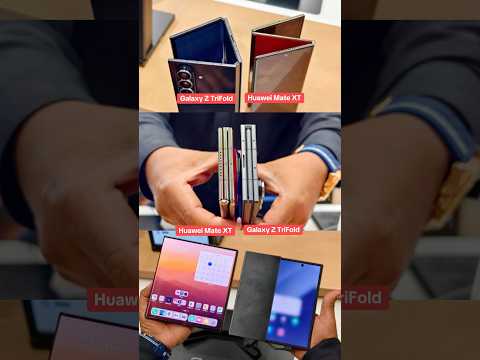
Battle of the TriFolds: Samsung Galaxy Z TriFold vs. Huawei Mate XT
CNET· 2025-12-10 04:17
No content yet! ...