
永辉超市

Search documents
平时被嫌弃的它,过年却备受青睐?
3 6 Ke· 2026-02-14 02:36
Core Insights - The pre-prepared meal market is experiencing significant growth, particularly during the 2026 Spring Festival, with a reported 180% year-on-year increase in sales of pre-prepared dishes for New Year's Eve dinners [2][3] - Young consumers, particularly those born in the 1990s and 2000s, are redefining family meal preparation, prioritizing efficiency over traditional cooking methods [12][13] - The shift in consumer behavior indicates a growing acceptance of pre-prepared meals, driven by the desire for convenience and time savings, especially among younger generations [21][24] Market Trends - The pre-prepared meal market in China surpassed 617.3 billion yuan in 2025 and is projected to reach 1.0698 trillion yuan by 2030, with over 60% of consumers willing to choose ready-made or semi-finished dishes for family gatherings [13][22] - The demand for pre-prepared meals is particularly strong among consumers aged 18-35, who make up more than half of the purchasing demographic for New Year's Eve meals [13][22] Consumer Behavior - The perception of pre-prepared meals has shifted from being seen as "lazy" to being embraced for their convenience and ability to provide a sense of accomplishment [24][31] - The younger generation values time and emotional well-being, opting for pre-prepared meals to free up time for family and personal activities, contrasting with older generations' focus on cost-effectiveness in ingredient sourcing [21][24] Industry Dynamics - The pre-prepared meal industry faced scrutiny in 2025 due to incidents like the "Xibei pre-prepared meal controversy," which highlighted issues of transparency and value perception [25][27] - In 2026, the market saw a rebound as consumers shifted their focus from restaurant-prepared meals to home-cooked pre-prepared options, driven by a desire for control over ingredients and preparation [27][31] Future Outlook - The success of pre-prepared meals during the Spring Festival raises questions about their sustainability in everyday consumption, as many consumers still prefer fresh cooking for daily meals [33][36] - The industry must find ways to position pre-prepared meals as a viable third option between fast food and home cooking, focusing on quality and convenience to capture a broader market [37][39]

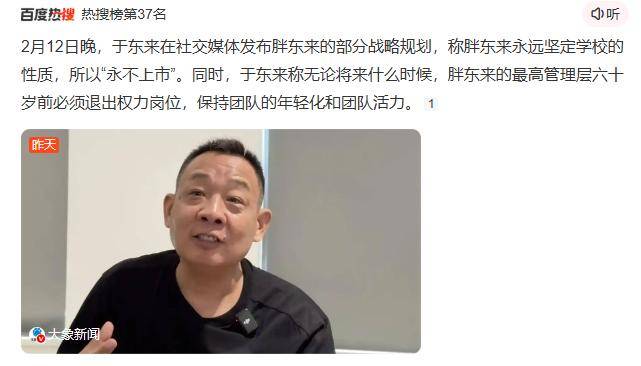
于东来:胖东来永不上市,上市公司永辉依然亏损
Sou Hu Cai Jing· 2026-02-13 16:18
Core Viewpoint - The founder of Pang Donglai, Yu Donglai, emphasizes that the company's decision to remain unlisted is rooted in prioritizing employee happiness over capital market pressures, presenting a significant contradiction in the retail industry where companies typically pursue public listings for expansion [3][4]. Group 1: Business Philosophy - Pang Donglai's "never going public" declaration reflects a deliberate separation from capital logic, with an average monthly salary of 9,886 yuan for employees, significantly higher than the 4,000 yuan level before Yonghui Supermarket's transformation [4][6]. - The company maintains a low employee turnover rate of only 1.05% among its 8,000 employees, showcasing the effectiveness of its high welfare system [4][6]. - Yu Donglai argues that going public would require accountability to investors focused on quarterly reports, which could undermine the company's commitment to employee welfare and supply chain optimization [4][6]. Group 2: Management Structure - A key aspect of Pang Donglai's strategy is the mandatory retirement of management by age 60, which aims to address the succession challenges faced by private enterprises [6][10]. - The governance structure combines family control with professional management, allowing the board to retain decision-making authority while delegating operational control [6][10]. - This approach contrasts with other companies, such as Lao Gan Ma, where the founder's return at an advanced age highlights the difficulties of leadership transition [6][10]. Group 3: Employee-Centric Model - Pang Donglai distributes 95% of its net profits to employees, with average annual bonuses of 100,000 yuan for regular employees and 700,000 yuan for management, fostering loyalty and commitment [6][8]. - The company offers extensive benefits, including 40 days of paid leave and 10 days of "unhappy leave," which materializes the concept of employee happiness into tangible policies [6][8]. - The high employee retention and customer repurchase rate of 82% demonstrate the effectiveness of this employee-centric model, creating a positive feedback loop of high investment leading to high loyalty and premium pricing [8][10]. Group 4: Strategic Positioning - Pang Donglai's strategy focuses on regional depth rather than national expansion, with 80% of its products sourced through self-purchasing, reducing procurement costs by 30%-50% [10][12]. - The company’s operational model, characterized by a 7-hour workday and 140 days of annual leave, poses challenges for replication outside its home region [10][12]. - The performance of Pang Donglai, achieving 235 billion yuan in revenue with only 14 stores by 2025, illustrates that a focused regional strategy can be as effective as nationwide expansion [10][12]. Group 5: Broader Implications - The case of Pang Donglai raises fundamental questions about the ownership and purpose of enterprises, contrasting with publicly listed companies like Yonghui and RT-Mart that struggle with profitability [8][12]. - The company's choice to prioritize employee welfare over capital market pressures represents an alternative model of business that challenges conventional notions of success in the retail sector [8][12]. - This experiment in business philosophy may offer insights into sustainable paths for private enterprises in China, questioning the necessity of public listings for success [12].
于东来即将退休, 胖东来的“分钱术”能否脱离老于继续存在?
3 6 Ke· 2026-02-13 13:00
Core Insights - The retirement of Yu Donglai, the founder of Pang Donglai, raises questions about the future identity and operational model of the company, as he has been a central figure in its culture and success for 30 years [1][2][4] Group 1: Leadership Transition - Yu Donglai announced his retirement on February 11, 2025, transitioning to a consultant role, emphasizing the need for younger leaders to take on responsibilities [1] - The decision-making will now be led by a committee, marking a shift from a founder-centric model to a collective decision-making approach [3][5] - This transition is seen as a significant challenge in the retail industry, where founder-led companies often struggle to maintain their identity post-retirement [2][3] Group 2: Company Culture and Employee Compensation - Pang Donglai has a unique compensation structure where 95% of profits are distributed to employees, with average salaries significantly higher than local competitors [6][8] - The company emphasizes employee rights and well-being, allowing staff to take breaks if faced with unreasonable customer behavior and mandating time off for rest [7][8] - The distribution model designed by Yu Donglai is considered a key factor in the company's success, raising concerns about whether it can be maintained without his direct influence [9] Group 3: Market Position and Expansion Challenges - Despite its success, Pang Donglai has remained largely regional, with only 15 stores concentrated in Henan, contrasting with competitors like Sam's Club and Costco, which have expanded rapidly [10] - Yu Donglai has historically prioritized quality over scale, expressing skepticism about the challenges of maintaining service standards while expanding [10] - The decision-making committee will face critical strategic choices regarding potential expansion beyond its current geographic limitations [10] Group 4: Brand Identity and Consumer Trust - Yu Donglai's personal brand has become integral to Pang Donglai's identity, with customers expressing loyalty based on his reputation [11][12] - The company will now confront the challenge of maintaining consumer trust and brand value without the founder's presence, marking a significant test of its operational model [11][12]
永辉超市:公司已于2025年10月31日披露第三季度报告,报告期末普通股股东总数309386户
Zheng Quan Ri Bao· 2026-02-13 12:44
Group 1 - The company disclosed that it has reported its third-quarter results for the year ending October 31, 2025 [2] - As of the end of the reporting period, the total number of common stock shareholders was 309,386 [2]

永辉超市:截至2025年12月31日,公司已完成315家门店的调改工作
Zheng Quan Ri Bao· 2026-02-13 10:12
Group 1 - The core point of the article is that Yonghui Supermarket has announced the completion of the renovation work for 315 stores by December 31, 2025 [2]
永辉超市:正在努力提供高质价比商品,夯实品质零售路线
Zheng Quan Ri Bao Wang· 2026-02-13 09:44
Group 1 - The company is focusing on providing high-quality and cost-effective products to strengthen its quality retail strategy [1]
永辉超市:2026年将聚焦调改店的提质增效
Zheng Quan Ri Bao Wang· 2026-02-13 09:43
Group 1 - The core focus of the company in 2026 will be on improving the quality and efficiency of its modified stores [1]
永辉超市:新店开业的情况请关注公司披露的定期报告
Zheng Quan Ri Bao· 2026-02-13 09:40
Group 1 - The company, Yonghui Supermarket, indicated that information regarding the opening of new stores will be disclosed in its regular reports [2]
中国最慷慨的老板,退休了
商业洞察· 2026-02-13 09:21
以下文章来源于邱处机 ,作者邱鑫浩 邱处机 . 专门研究商业牛人 作者: 邱鑫浩 来源: 邱处机 2026 年 2 月 11 日, 59 岁的于东来在社交平台发了一段话。 ----------------------------- 没有宏大的告别演说,没有煽情的纪念视频,甚至没等来春节的鞭炮声。这位把"自由·爱"写进企 业信仰手册的河南老板,只是平静地宣布:过年后正式退休,转为顾问,日常运营由决策委员会主 持。 在许昌,老百姓不叫他于董,更不叫于总。人们隔着老远喊一声"东来哥",他会抬起头,满脸笑意 地用许昌话回一句"过来了啊"。 2025 年,胖东来销售额超过 235 亿元,账上趴着 41 亿现金,没有任何贷款。在这个规模的民营 企业里,这组数字简直像财务造假——哪有不借钱的企业?哪有不拼命扩张的老板? 于东来偏偏是。 他 1966 年出生在许昌,早年倒过香烟、卖过水果,因为想快速赚钱还铤而走险过。后来他把自己 那段经历称作"贪婪、自私",言辞之狠,像在骂别人。 这一次,哥说他要放下了。 但熟悉他的人知道,这是于东来第无数次说"放手"。 早在 2023 年 6 月,他就说企业经营 80% 已经放了; 202 ...

于东来退休,永辉CEO检讨,2026永辉该怎么走?
Sou Hu Cai Jing· 2026-02-13 08:50
Core Viewpoint - The CEO of Yonghui Supermarket, Wang Shoucheng, issued an apology acknowledging the company's failure to align its expansion ambitions with its capabilities, resulting in a loss of trust from employees and customers [2]. Group 1: Company Performance and Strategy - Yonghui Supermarket plans to close nearly 400 low-quality stores and systematically renovate over 300 existing stores by 2025, covering a total area of more than 2 million square meters [2]. - Despite these efforts, the company is projected to incur a loss of 2.14 billion yuan in 2025, marking a 45.6% increase year-on-year, and this will be the fifth consecutive year of losses, totaling over 10 billion yuan [2]. - The losses are attributed to strategic adjustments, including asset write-offs and one-time costs exceeding 1.2 billion yuan due to store renovations and closures [2]. Group 2: Comparison with Competitors - In contrast, the competitor, Pang Donglai, is expected to achieve sales revenue of 23.53 billion yuan in 2025, reflecting a year-on-year growth of 38.7%, with significant contributions from its supermarket business and other sectors [2]. - Yonghui's previous business model of "fresh food driving traffic, general merchandise generating profit" has faltered since 2021 due to pressures from e-commerce and new business formats [3]. Group 3: Operational Challenges - The company has faced operational difficulties due to blind expansion without corresponding improvements in supply chain and management capabilities, leading to a decline in performance [3]. - Employee complaints have surfaced regarding increased training, overtime, and inspections, while salaries have not significantly changed, and vacation time has decreased [4]. - Experts have criticized Yonghui for superficially imitating the Pang Donglai model without grasping its core principles, resulting in rising costs outpacing revenue growth [4]. Group 4: Future Directions - Wang Shoucheng has identified 2026 as a year for "deep cultivation," aiming to transition from mere adjustments to systematic development, focusing on three areas: products, stores, and organization [5]. - The company faces significant challenges ahead, as acknowledging past mistakes is only the beginning of a more difficult adjustment process to find its own path forward [5].