ByteDance

Search documents
X @Bloomberg
Bloomberg· 2026-02-09 02:28
Chinese revenue from digital services sold abroad is soaring as tech champions from ByteDance to Tencent ramp up their overseas push in live streaming, e-commerce and AI https://t.co/7EFrmvQH6I ...
2 Stocks to Buy for AI's Next Stage
Investor Place· 2026-02-08 17:00
Core Insights - The article discusses the shift in investment focus from hardware suppliers to experience-driven companies in the tech sector, particularly in the context of the iPhone and artificial intelligence [1][3][22] Group 1: iPhone Supplier Dynamics - Companies like Skyworks Solutions, Cirrus Logic, and Universal Display saw stock price surges when named as iPhone suppliers, but Apple often imposed low prices and high quality demands, leading to profitability challenges for these suppliers [2] - The real beneficiaries of the iPhone boom were companies providing services and experiences, such as Uber and ByteDance, which have outperformed traditional hardware suppliers [3] Group 2: Current AI Market Trends - A recent selloff in AI infrastructure companies, including chipmakers and data center developers, occurred due to concerns over profitability in a rapidly evolving industry [4] - Analyst Louis Navellier warns of a potential market dislocation for AI companies, suggesting that expectations for "Stage 1" infrastructure firms are overly optimistic [5] Group 3: Investment Opportunities in AI - A select group of "Stage 2" companies in the AI sector is believed to offer significant upside potential, with estimates of around 500% growth [6] - Thomson Reuters, with its established legal research platform, is expected to recover from a 60% selloff, as it combines AI with human expertise to maintain accuracy in legal research [9][14] - ServiceNow, which serves over 85% of Fortune 500 companies, is experiencing rapid growth with a 21% revenue increase in 2025 and projected 20% growth for the current year, driven by its AI capabilities [15][16] Group 4: Comparisons with 5G Technology - The article draws parallels between the 5G technology rollout and the current AI landscape, noting that the biggest winners are not the infrastructure providers but the companies leveraging these technologies for consumer experiences [20][21] - OpenAI's GPT-5 is highlighted as a significant advancement in AI, similar to the leap made by 5G, with the potential for "Stage 2" companies to dominate the market [22][23]



Ripple Is Now Ranked the 9th Largest IPO Candidate at $50B: What Would That Mean for XRP?
Yahoo Finance· 2026-02-08 14:38
Core Insights - Ripple is currently ranked as the ninth-largest IPO candidate globally, with a valuation of $50 billion, which could enhance institutional confidence in XRP and its payments business [1][4] - Despite speculation, Ripple's leadership has consistently denied any plans for an IPO, emphasizing the company's ability to fund growth internally [2][9] Valuation and Market Position - Ripple's estimated enterprise value of $50 billion reflects significant market expectations for its business potential, marking a 25% increase from a previous valuation of $40 billion [5][8] - The valuation places Ripple above notable unicorns like Canva and just below Stripe and Revolut, indicating its substantial growth trajectory [4] Investment and Acquisitions - Since 2025, Ripple has made aggressive investments, spending nearly $4 billion on acquisitions, including Hidden Road and GTreasury, to enhance its capabilities in payments, custody, and trading [8][10] - The company has successfully attracted major investors, including Citadel and Fortress, without needing to go public, showcasing its strong financial position [10]
中国互联网行业展望 - 回应投资者关切:聚焦 AI 投资策略、监管与政策等核心领域-Navigating China Internet_ Addressing investor questions_focus areas around AI investment strategies, regulations and policies
2026-02-05 02:22
Summary of Key Points from the Conference Call Industry Overview - The focus is on the **China Internet** sector, particularly regarding **AI investments** and the competitive landscape among major players like **Tencent**, **Alibaba**, and **ByteDance** [1][3]. Core Insights and Arguments - **AI Investment Strategies**: 2026 is expected to be a pivotal year for AI investments, with increased capital expenditures (capex) and operational expenditures (opex) from major internet companies [1][3]. - **Competition**: There is an intensified competition for consumer AI super apps, with seamless transaction capabilities being crucial for user retention [1][3]. - **Regulatory Concerns**: Investors are worried about potential regulatory tightening similar to the 2020-21 cycle, which has contributed to a recent decline in sector share prices (HSTECH down by 10% in the past week) [1][9]. - **Tax Policies**: Recent changes in VAT and income tax rates are expected to impact profit growth and sector valuations. A sensitivity analysis indicates that a 1% increase in VAT could reduce pre-tax profits for major companies like Alibaba and Tencent by approximately 0.4% to 0.8% [31][34][41]. Upcoming Catalysts - Key events to watch include further AI model launches around the **Chinese New Year (CNY)**, developments in **anti-trust investigations** by SAMR, and the upcoming earnings season [2][3]. Stock Recommendations - **Valuation Metrics**: The median P/E ratio for China Internet companies is noted at 17X for 2026E, which is lower compared to US peers like META and GOOG [3][56]. - **Top Picks**: Alibaba and Tencent are highlighted as the best-positioned mega-cap stocks for long-term growth. Other recommended stocks include GDS, VNET, and Kuaishou, focusing on themes like EPS growth and shareholder returns [8][3]. Regulatory Landscape - Ongoing investigations by SAMR into the food delivery sector are aimed at promoting fair competition and may impact profit margins for companies like Meituan, Alibaba, and JD [45][46]. - The government is expected to support the healthy development of industries, particularly small to medium-sized enterprises (SMEs) [9]. Financial Performance and Projections - **Capex Forecasts**: Significant increases in capex are anticipated for Alibaba (Rmb454 billion) and ByteDance (Rmb300 billion) due to AI advancements [50][51]. - **Profitability Trends**: Tencent's cloud business has achieved profitability, and the company is optimistic about its Interactive and Entertainment Group's performance [27]. Conclusion - The China Internet sector is at a critical juncture with substantial investments in AI, regulatory challenges, and evolving competitive dynamics. Companies are advised to navigate these complexities while focusing on innovation and user engagement strategies to maintain market leadership [1][3][9].

Qualcomm(QCOM) - 2026 Q1 - Earnings Call Transcript
2026-02-04 22:47
Financial Data and Key Metrics Changes - The company reported record revenues of $12.3 billion and non-GAAP earnings per share (EPS) of $3.50 for fiscal Q1 2026, with non-GAAP EPS at the high end of guidance [6][16] - QCT revenues reached a record $10.6 billion, driven by strong performance in automotive and IoT segments [6][16] - Licensing business revenues were $1.6 billion, with an EBT margin of 77%, reflecting higher units and favorable mix [16] Business Line Data and Key Metrics Changes - QCT handset revenues reached a record $7.8 billion, benefiting from recently launched flagship smartphones [16] - QCT IoT revenues grew 9% year-over-year to $1.7 billion, driven by demand across consumer and networking products [16] - QCT Automotive revenues grew to $1.1 billion, up 15% year-over-year, driven by increased demand for Snapdragon Digital Chassis platforms [17] Market Data and Key Metrics Changes - Global consumer demand for handsets, particularly in the premium and high-tier segments, exceeded expectations, with healthy sell-through observed [6][7] - The handset industry is expected to face constraints due to memory availability and pricing, particularly DRAM, as suppliers redirect capacity to meet AI data center demand [7][18] - The company anticipates that the overall size of the handset market will be defined by memory availability throughout the fiscal year [39][69] Company Strategy and Development Direction - The company is focused on expanding its presence in the premium and high-tier smartphone segments, with a dual flagship product strategy that has been well received [8][42] - The company is investing in AI-native smartphones and intelligent wearables, positioning Snapdragon platforms as the choice for the industry [8][12] - The company aims to strengthen its leadership in automotive and robotics, with multiple design wins and collaborations with major automakers [10][22] Management's Comments on Operating Environment and Future Outlook - Management expressed confidence in the fundamentals of the handset business despite near-term challenges related to memory supply [18][39] - The company expects to return to prior growth trajectories for QCT handset revenues once memory supply conditions normalize [18] - Management remains optimistic about the long-term growth potential in automotive and IoT, with combined growth expected to outpace long-term revenue targets [21][22] Other Important Information - The company returned $3.6 billion to stockholders, including $2.6 billion in stock repurchases and $949 million in dividends [17] - The company completed the acquisition of Alphawave Semi, enhancing its data center solutions [14] Q&A Session Summary Question: What factors are driving the weakness in handset outlook beyond memory pricing? - Management indicated that the weakness is entirely related to memory availability, with strong microeconomic indicators and handset demand observed [26][27] Question: Is the automotive revenue growth driven by ADAS wins? - Management confirmed that the automotive pipeline continues to translate into revenue, with new car launches contributing to record revenues [30] Question: How is the company progressing with data center customers? - Management reported positive progress with customers, including shipping to Humane and engagement with major hyperscalers [34] Question: What is the company's strategy regarding memory shortages? - Management clarified that they do not purchase memory directly but work with customers who do, ensuring flexibility in memory sourcing [67][69] Question: How does the company plan to navigate the memory allocation challenges with larger OEMs? - Management acknowledged that larger OEMs may have better access to memory but emphasized that the issue is industry-wide and not limited to specific customers [73]

Qualcomm(QCOM) - 2026 Q1 - Earnings Call Transcript
2026-02-04 22:45
Financial Data and Key Metrics Changes - The company reported record revenues of $12.3 billion and non-GAAP earnings per share (EPS) of $3.50 for fiscal Q1 2026, with non-GAAP EPS at the high end of guidance [5][17] - QCT revenues reached a record $10.6 billion, with strong year-over-year growth across automotive and IoT segments [17] - Licensing business revenues were $1.6 billion, with an EBT margin of 77%, driven by higher units and favorable mix [17] Business Line Data and Key Metrics Changes - QCT handset revenues reached a record $7.8 billion, benefiting from recently launched flagship smartphones [17] - QCT IoT revenues grew 9% year-over-year to $1.7 billion, driven by demand across consumer and networking products [17] - QCT Automotive revenues grew to $1.1 billion, up 15% year-over-year, reflecting increased demand for Snapdragon Digital Chassis platforms [17] Market Data and Key Metrics Changes - Global consumer demand for handsets, particularly in the premium and high-tier segments, exceeded expectations, with healthy sell-through observed [5] - The handset industry is expected to face constraints due to memory availability and pricing, particularly DRAM, as suppliers redirect capacity to meet AI data center demand [5][6] Company Strategy and Development Direction - The company is focused on expanding its presence in the premium and high-tier smartphone segments, with a dual flagship product strategy that has seen broad OEM adoption [6][7] - The company is also investing in AI-native smartphones and intelligent wearables, positioning Snapdragon platforms as the choice for the industry [7][8] - In automotive, the company aims to reinforce its technology leadership with multiple design wins and collaborations with major automakers [10][11] Management's Comments on Operating Environment and Future Outlook - Management expressed confidence in the fundamentals of the handset business despite near-term challenges related to memory supply and pricing [19] - The company anticipates returning to prior growth trajectories for QCT handset revenues once memory supply normalizes [19] - Management remains optimistic about the long-term growth potential in automotive and IoT, with expectations for continued revenue acceleration [21] Other Important Information - The company completed the acquisition of Alphawave Semi, enhancing its high-speed wire connectivity technologies [15] - The company is actively engaging with leading hyperscalers and cloud service providers to develop data center solutions [14] Q&A Session Summary Question: What factors are driving the weakness in handset outlook beyond memory pricing? - Management indicated that the weakness is entirely related to memory availability, with strong microeconomic indicators and handset demand observed [26][27] Question: Is the automotive revenue growth driven by ADAS wins? - Management confirmed that the automotive pipeline continues to translate into revenue, with new car launches contributing to record revenues [29][30] Question: How is the company managing the memory supply situation? - Management clarified that they do not purchase memory directly but work closely with customers who do, ensuring flexibility with various memory providers [69][70] Question: What is the outlook for the data center business? - Management stated that progress is on track, with positive feedback from engagements with hyperscalers and cloud service providers [35][36] Question: How does the company view the impact of memory shortages on the overall handset market? - Management emphasized that the size of the handset market will be determined by memory availability, with expectations for premium and high-tier segments to remain resilient [40][76]
Exclusive: Nvidia's AI chip sale to ByteDance hinges on conditions set by Trump administration
Reuters· 2026-02-04 22:11
Core Insights - The Trump administration is open to allowing China's ByteDance to purchase Nvidia's H200 chips, indicating a potential shift in U.S.-China tech relations [1] - Nvidia, the AI chipmaker, has not yet agreed to the proposed conditions set by the administration for the use of these chips, suggesting ongoing negotiations and complexities in the deal [1] Company Summary - ByteDance is positioned to potentially acquire advanced AI technology through Nvidia's H200 chips, which could enhance its capabilities in the competitive tech landscape [1] - Nvidia's reluctance to accept the proposed conditions may impact its strategic partnerships and market positioning, highlighting the challenges faced by companies in navigating regulatory environments [1]


Exclusive-Nvidia's AI chip sale to ByteDance hinges on conditions set by Trump administration
Yahoo Finance· 2026-02-04 22:11
Group 1 - The Trump administration is open to allowing China's ByteDance to purchase Nvidia's H200 chips, but Nvidia has not agreed to the proposed conditions for their use [1][2] - Nvidia is currently negotiating with the U.S. government regarding the licensing terms for shipping H200 AI chips to Chinese companies, acting as an intermediary [2][3] - The U.S. Commerce Department has issued regulations that require applicants to certify and provide data to ensure rigorous Know Your Customer (KYC) procedures are in place to prevent unauthorized access [6] Group 2 - China has granted preliminary approval for major tech companies, including ByteDance, Tencent, and Alibaba, to import the chips, although the regulatory conditions are still being finalized [4] - The U.S. government's recent actions represent ongoing complexities in the U.S.-China tech war, with concerns about national security and the potential military applications of the chips by China [5] - The Commerce Department's new regulations include requirements for applicants to provide a list of remote users associated with companies in countries of concern, such as Iran and Venezuela [6]
CNBC's The China Connection newsletter: For Chinese businesses, it's not about which AI is the smartest
CNBC· 2026-02-04 06:21
Core Insights - The competition between the U.S. and China in the artificial intelligence (AI) sector is a significant concern for investors, with Chinese companies focusing on cost-effective AI tools to navigate economic challenges [2][3] Cost Factors - OpenAI's gpt-oss model and DeepSeek are the most affordable AI models at $0.30 per 1 million tokens, while Google's Gemini 3 Pro costs $4.50 and Anthropic's Claude Opus 4.5 costs $10 [3] - Chinese companies are increasingly opting for open-source models to control costs, as highlighted by Movitech's CEO, who serves clients like Starbucks and Unilever [4] Usage Differences - U.S. companies primarily utilize AI for coding, while Chinese firms apply AI for specific operational improvements, such as enhancing production processes and compliance for state-owned enterprises [5] - AI has become a crucial productivity tool for Chinese businesses, especially in a sluggish domestic market, allowing companies to maintain competitive pricing [6] AI Model Preferences - Chinese companies prioritize reliability, control over AI outputs, and integration capabilities over the intelligence of the AI models [9] - AI has significantly improved productivity, with reports indicating that 10 employees can accomplish the work of 20 to 30 employees [10] Global Interest in Chinese AI - Chinese AI models are gaining traction internationally, with increased usage of models like OpenClaw and DeepSeek, which ranked third and fourth in usage respectively [11][12] - Moonshot AI's K2.5 model has seen its revenue from outside China surpass domestic revenue, indicating a growing global interest [12] Investment Trends - Moonshot's valuation increased by at least $500 million following the successful listings of its competitors, reflecting investor interest in Chinese AI companies [13] - Anticipation is building for further AI advancements from DeepSeek, especially as the Lunar New Year approaches [13][14] Innovation and Market Dynamics - The ability of Chinese companies to innovate in AI is linked to their capacity to offer competitive pricing, which is essential for business usability [15] - The Chinese private sector's ability to generate profit is crucial for maintaining innovation in AI, as noted by WisdomTree's director [15]

2026年最值得关注的资本浪潮:赴美IPO中概股的黄金跃迁
Sou Hu Cai Jing· 2026-02-04 05:22
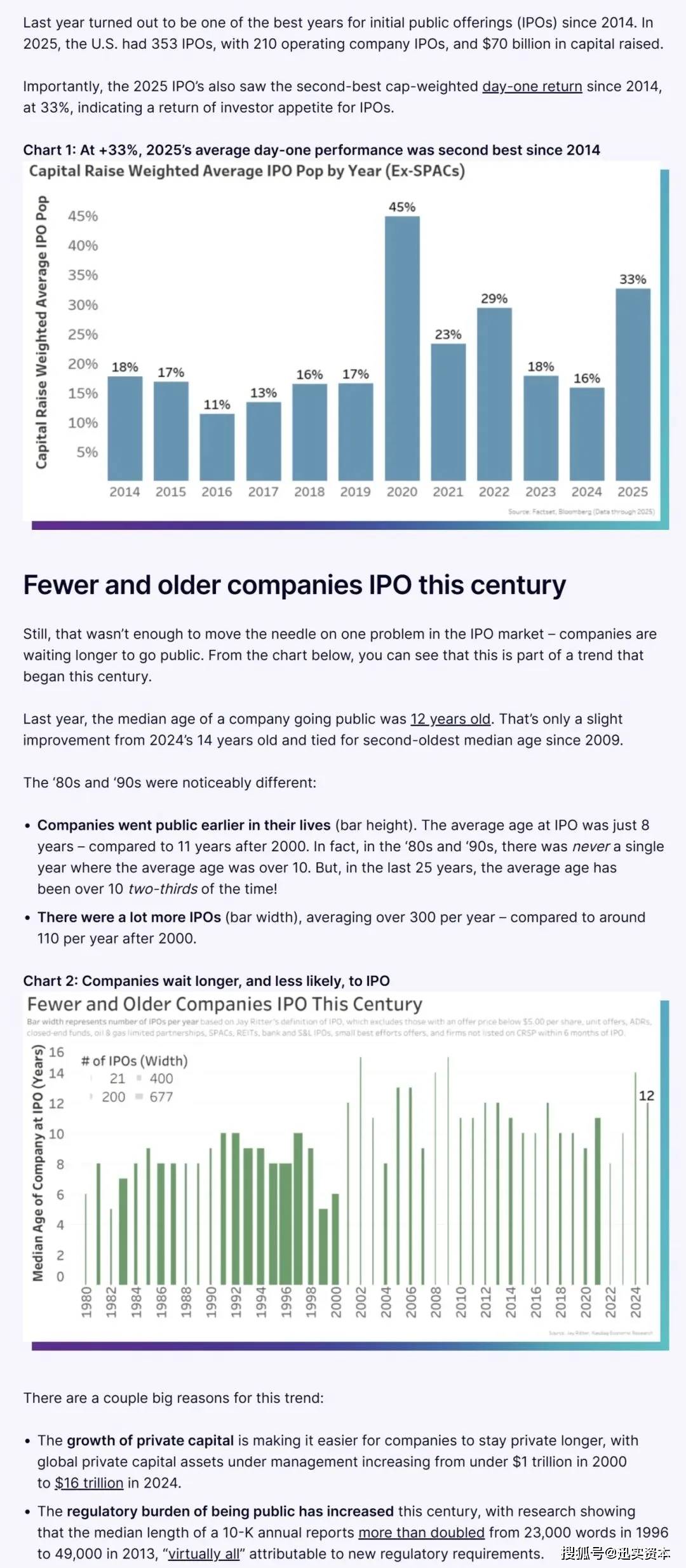
Group 1 - The U.S. IPO market in 2025 experienced a strong revival, with 353 IPOs and over $70 billion raised, marking the highest activity since 2014, alongside a weighted average first-day return of 33% [1][2] - The return of Chinese companies to the U.S. stock market is a significant highlight, driven by improved cross-border regulatory cooperation and the attractiveness of the U.S. market for globalizing Chinese enterprises [2][8] - The median age of newly listed companies reached 12 years, indicating a trend of delayed IPOs due to the abundance of private capital and rising compliance costs [8][13] Group 2 - The strategic value of IPOs has evolved beyond mere fundraising, serving as a platform for enhancing credibility, accelerating innovation, and attracting talent for companies, particularly for Chinese firms seeking to enhance their global competitiveness [13][29] - The outlook for 2026 is optimistic, with multiple factors such as regulatory improvements, pent-up market demand, and the potential listing of "super unicorns" expected to sustain IPO activity [29][28]