
Richemont

Search documents
珠宝需求增加 奢侈品公司历峰集团销售额高于预期
news flash· 2025-07-16 06:51
Core Viewpoint - The luxury goods company Richemont reported better-than-expected sales driven by increased demand for jewelry, particularly Cartier rings and bracelets, despite a generally sluggish luxury market [1] Group 1: Sales Performance - Richemont's jewelry segment saw a sales increase of 11% in the quarter ending June, surpassing analyst expectations of 8.6% [1] - Overall sales growth for the company was 6%, exceeding market forecasts [1] Group 2: Analyst Commentary - Analyst Jean-Philippe Bertschy from Vontobel noted that Richemont's performance is reassuring, especially compared to other luxury brands [1] - The company's strong growth and dominant position in the jewelry sector remain impressive [1]

X @Bloomberg
Bloomberg· 2025-07-16 05:58
Richemont quarterly sales rose as the Cartier owner proved resilient amid a wider demand downturn for luxury goods https://t.co/NCYKwalWIp ...
历峰集团第一财季按固定汇率计算的销售额同比增长6%,市场预期为增长5.34%。第一财季珠宝部门销售额按固定汇率增长11%,市场预期为8.55%。第一财季总销售额为54.1亿欧元,市场预期为54.4亿欧元。第一财季亚太地区销售额为17.3亿欧元,市场预期为16.9亿欧元。
news flash· 2025-07-16 05:40
Group 1 - The core viewpoint of the article highlights that Richemont Group's sales in the first fiscal quarter increased by 6% year-on-year at constant exchange rates, surpassing market expectations of 5.34% [1] - The jewelry segment of Richemont experienced a significant sales growth of 11% at constant exchange rates, exceeding market expectations of 8.55% [1] - The total sales for the first fiscal quarter amounted to €5.41 billion, slightly below market expectations of €5.44 billion [1] Group 2 - Sales in the Asia-Pacific region for the first fiscal quarter reached €1.73 billion, outperforming market expectations of €1.69 billion [2]
历峰集团:增长主要由珠宝推动。
news flash· 2025-07-16 05:38
Core Insights - The main driver of growth for Richemont Group is jewelry [1] Group 1 - The jewelry segment has significantly contributed to the overall revenue increase [1] - The company has reported strong sales performance in the jewelry category, indicating robust consumer demand [1] - Other segments may not have shown the same level of growth as jewelry, highlighting the importance of this category for the company's financial health [1]
历峰集团:宏观经济和地缘政治环境依然动荡不安。
news flash· 2025-07-16 05:38
Core Viewpoint - Richemont Group highlights the ongoing turbulence in the macroeconomic and geopolitical environment [1] Group 1 - The company emphasizes that the current economic landscape remains unstable, impacting overall market conditions [1] - Geopolitical tensions are contributing to the uncertainty faced by the luxury goods sector [1] - The company is closely monitoring these developments to adapt its strategies accordingly [1]
历峰集团第一季度销售额为54.1亿欧元,在固定汇率下增长6%。(分析师预计为54.7亿欧元)
news flash· 2025-07-16 05:34
Group 1 - The core sales figure for Richemont in the first quarter is €5.41 billion, reflecting a 6% growth at constant exchange rates [1] - Analysts had projected sales to be €5.47 billion, indicating a slight miss in expectations [1]
Richemont posts solid start to the year for its first quarter ended 30 June 2025
Globenewswire· 2025-07-16 05:30
Core Viewpoint - Richemont reported a solid start to the fiscal year 2025, with group sales increasing by 6% at constant exchange rates, driven by strong performance in Europe, the Americas, and the Middle East & Africa, despite challenges in Japan and the Asia Pacific region [2][4][5]. Summary by Region - **Europe**: Sales increased by 11% to €1,295 million, supported by robust local demand and positive tourist spending, particularly in Italy and Germany [3][5]. - **Asia Pacific**: Sales decreased by 4% to €1,731 million, with a notable 7% decline in China, Hong Kong, and Macau, offset by growth in other Asian markets [3][5]. - **Americas**: Sales rose by 17% to €1,335 million, driven by strong local demand across all business areas [3][5]. - **Japan**: Sales fell by 15% to €527 million, impacted by a high comparative from the previous year and reduced tourist spending [3][5]. - **Middle East & Africa**: Sales increased by 17% to €524 million, led by the UAE market and higher tourist spending [3][5]. Summary by Distribution Channel - **Retail**: Sales grew by 6% to €3,734 million, accounting for 69% of group sales, with growth across all regions except Japan [3][6]. - **Online Retail**: Sales increased by 6% to €323 million, reflecting robust growth across almost all regions [3][7]. - **Wholesale and Royalty Income**: Grew by 6% to €1,355 million, driven by solid group sales performance [3][6]. Summary by Business Area - **Jewellery Maisons**: Sales rose by 11% to €3,914 million, marking a third consecutive quarter of double-digit growth [3][8]. - **Specialist Watchmakers**: Sales decreased by 7% to €824 million, primarily due to declines in China, Hong Kong, and Macau [3][8]. - **Other (Fashion & Accessories)**: Sales declined by 1% to €674 million, with notable performances from brands like Peter Millar and Alaïa [3][8]. Financial Position - The group maintained a strong net cash position of €7.4 billion as of 30 June 2025, slightly up from €7.3 billion in the previous year, after accounting for a cash-out related to the sale of YNAP [6][9].


美元阴云笼罩欧股财报季:欧元升值13%重创欧企北美盈利,对冲策略成关键分水岭
智通财经网· 2025-07-15 08:24
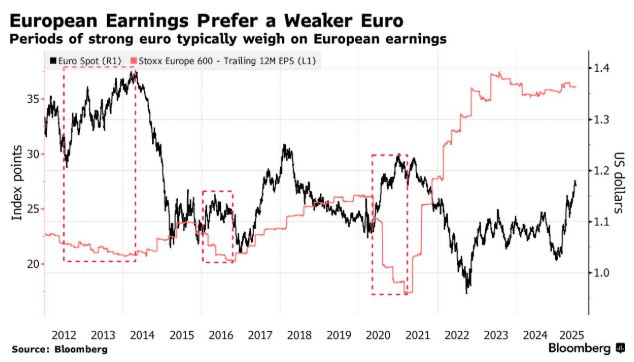
Group 1 - The weak US dollar is expected to negatively impact European companies' earnings, making currency fluctuations a key issue for the earnings season [1] - Since the beginning of 2025, the euro has appreciated nearly 13% against the dollar, while the British pound has risen about 8% [1] - Companies with over 25% of their revenue from North America may face significant impacts from currency fluctuations, especially those lacking effective hedging strategies [1][5] Group 2 - Analysts have generally lowered their expectations, predicting a decline in European corporate earnings, which could lead to further downward revisions if negative trends continue [7] - The Stoxx 600 index is expected to see a year-on-year decline in earnings per share of 3%, marking the largest drop in five quarters due to weak demand and a 3.5% increase in the euro trade-weighted index [9] Group 3 - Sectors most sensitive to currency fluctuations include healthcare, luxury goods, and technology, with companies like Argenx (84% North America exposure) and Fresenius Medical (66% North America exposure) being particularly vulnerable [4] - Companies with advanced hedging strategies tend to perform better, as seen with Brunello Cucinelli SpA, which reported double-digit growth without being affected by currency fluctuations [14]
Ralph Lauren: Demand From High-End Consumers Will Support Price Increases
PYMNTS.com· 2025-05-22 20:24
Core Viewpoint - Ralph Lauren plans to raise prices to offset tariff costs, supported by strong demand from high-end customers [1] Pricing Strategy - The company is assessing additional pricing actions for fall 2025 and spring 2026 to mitigate tariff impacts, building on proactive pricing already planned for 2025 in North America and Asia [2] - Ralph Lauren has increased its average unit retail (AUR) every quarter for the past eight years, with a high single-digit increase in AUR expected for the current quarter compared to the previous year [2] Brand and Quality Enhancement - The company has elevated its AUR by enhancing brand quality, adjusting geographic and channel mixes, reducing discounts, and selectively raising prices [3] - These strategies provide confidence in managing cost headwinds while maintaining strong pricing power [3] Consumer Resilience - Despite weakening consumer confidence in the U.S. and potential broader consumer pullback, Ralph Lauren's core consumers remain resilient [4] - The company has not observed changes in sales trajectories across its regions (APAC, EMEA, North America), with full-price sales continuing to grow [5] Market Context - The remarks from Ralph Lauren follow reports of soft demand from luxury conglomerate LVMH due to weaker consumer confidence in China and other markets [5] - In contrast, luxury group Richemont plans to limit price increases to avoid customer backlash seen by some competitors [6]

奢侈品全球化红利消退,历峰集团如何应对地缘政治风险和本土品牌崛起
2 1 Shi Ji Jing Ji Bao Dao· 2025-05-21 07:03
Core Insights - Richemont Group reported a 4% year-on-year increase in sales for the fiscal year ending March 31, 2025, reaching €21.399 billion, while operating profit slightly declined by 1% to €3.76 billion, resulting in a profit margin of 20.9% [1] - The jewelry segment remains the core growth driver for Richemont, with brands like Cartier and Van Cleef & Arpels generating €15.33 billion in revenue, an 8% increase year-on-year, and contributing over half of the group's revenue and 70% of its profit [1] - The watch segment, including brands like Jaeger-LeCoultre and Vacheron Constantin, saw a 13% decline in revenue and a significant 69% drop in profit [1] Market Performance - Other luxury brands faced challenges in the fiscal year 2024, with LVMH reporting a 2% decline in revenue to €84.683 billion and a 17% drop in net profit to €12.25 billion, while Kering's revenue fell by 12% to €17.194 billion and net profit decreased by 62% [2] - Hermès maintained strong performance with a 15% increase in revenue to €15.17 billion and a 7% rise in net profit to €4.603 billion [2] - Prada, after acquiring Versace, reported a 17% increase in revenue to €5.432 billion and a 25% rise in net profit to €0.839 billion, with Miu Miu's revenue soaring by 93.2% [2] Leadership Changes - Significant leadership changes occurred across major luxury brands, including Pierpaolo Piccioli taking over as creative director at Balenciaga and Demna moving to Gucci, indicating strategic shifts within Kering [3] - LVMH also saw notable changes, with Damien Bertrand appointed as LV's deputy CEO and Pierre-Emmanuel Angeloglou becoming the new CEO of Dior, reflecting the group's focus on retail and global expansion [3] - Richemont appointed Laurent Perves as CEO of Vacheron Constantin, replacing Louis Ferla, who moved to Cartier, showcasing internal restructuring efforts [3] Competitive Landscape - Traditional luxury brands are facing growth challenges, while independent brands are achieving rapid growth through precise positioning and product innovation [4] - The luxury sector is increasingly impacted by geopolitical risks and the rise of local brands, necessitating a new balance between institutional resilience and market insight [5] - The U.S. tariff policies have raised concerns within the luxury sector, particularly for Swiss brands, with Richemont's chairman expressing caution regarding future pricing and trade conditions [5][6] Local Market Dynamics - In the Chinese market, local brand Lao Pu Gold has shown remarkable growth, with a stock price increase of 495.56% in 2024, outperforming established luxury brands like Cartier and Tiffany in sales per store [7] - The competitive pressure from local brands is intensifying, prompting international luxury brands like Richemont to reconsider their strategies in response to changing consumer preferences [7]