ServiceNow

Search documents
2 Stocks to Buy for AI's Next Stage
Investor Place· 2026-02-08 17:00
Core Insights - The article discusses the shift in investment focus from hardware suppliers to experience-driven companies in the tech sector, particularly in the context of the iPhone and artificial intelligence [1][3][22] Group 1: iPhone Supplier Dynamics - Companies like Skyworks Solutions, Cirrus Logic, and Universal Display saw stock price surges when named as iPhone suppliers, but Apple often imposed low prices and high quality demands, leading to profitability challenges for these suppliers [2] - The real beneficiaries of the iPhone boom were companies providing services and experiences, such as Uber and ByteDance, which have outperformed traditional hardware suppliers [3] Group 2: Current AI Market Trends - A recent selloff in AI infrastructure companies, including chipmakers and data center developers, occurred due to concerns over profitability in a rapidly evolving industry [4] - Analyst Louis Navellier warns of a potential market dislocation for AI companies, suggesting that expectations for "Stage 1" infrastructure firms are overly optimistic [5] Group 3: Investment Opportunities in AI - A select group of "Stage 2" companies in the AI sector is believed to offer significant upside potential, with estimates of around 500% growth [6] - Thomson Reuters, with its established legal research platform, is expected to recover from a 60% selloff, as it combines AI with human expertise to maintain accuracy in legal research [9][14] - ServiceNow, which serves over 85% of Fortune 500 companies, is experiencing rapid growth with a 21% revenue increase in 2025 and projected 20% growth for the current year, driven by its AI capabilities [15][16] Group 4: Comparisons with 5G Technology - The article draws parallels between the 5G technology rollout and the current AI landscape, noting that the biggest winners are not the infrastructure providers but the companies leveraging these technologies for consumer experiences [20][21] - OpenAI's GPT-5 is highlighted as a significant advancement in AI, similar to the leap made by 5G, with the potential for "Stage 2" companies to dominate the market [22][23]



Northcoast Downgrades Fiserv (FISV) to Neutral
Yahoo Finance· 2026-02-08 10:21
Fiserv Inc. (NASDAQ:FISV) is one of the worst AI stocks to invest in according to Reddit. On February 2, Northcoast analyst Kartik Mehta downgraded Fiserv from Buy to Neutral. In other news, on January 28, ServiceNow and Fiserv announced an expanded commitment to accelerate AI-driven transformation within financial services. Fiserv will scale its use of ServiceNow Now Assist for Financial Services Operations and IT Service Management to enhance operations across its IT and customer service environments. T ...
“软件股末日论”点燃大变革! 恐慌抛售之后,市场将捧起AI时代的“软件基石”
美股IPO· 2026-02-07 00:35
Core Viewpoint - A portion of institutional funds is beginning to enter the market for "bottom-fishing" in software stocks that have recently experienced significant declines, agreeing with Jensen Huang's positive outlook on software stocks, suggesting that the market has misjudged strong software giants focused on "AI + core operational processes" [1][4] Group 1: Market Dynamics - The narrative of a "Software-mageddon" is gaining traction, with significant sell-offs in the software sector following the launch of new AI tools by Anthropic, leading to a notable drop in the S&P 500 Software & Services Index, which has fallen approximately 30% since its recent peak at the end of October [3][9] - The software sector faced its most severe sell-off since 2022, with the S&P 500 Software & Services Index experiencing a decline of over 5% in a single day, extending its losing streak to eight consecutive trading days [3][9] - Concerns about AI's impact on traditional SaaS business models have intensified, particularly following the introduction of Anthropic's AI tools, which are designed to handle complex workflows traditionally managed by SaaS providers [7][8] Group 2: Institutional Perspectives - Some institutional investors are starting to view the recent sell-off as an opportunity, believing that high-quality software companies embracing AI may soon experience a technical rebound [4][10] - Analysts from major financial institutions, including Goldman Sachs and Wedbush Securities, suggest that the selling pressure may have peaked, indicating potential for a market bottom and a return of institutional capital to the software sector [16][18] - Rick Sherlund, a prominent analyst, emphasizes that the software industry undergoes significant transformations every 10 to 15 years, and the current AI-driven changes may lead to a new bull market rather than a decline [20] Group 3: Long-term Outlook - Despite fears that AI could completely replace enterprise software, many analysts believe that AI will instead reshape the profitability trajectories of software companies, with a focus on enhancing existing platforms rather than replacing them [12][14] - The market's panic over AI's potential to disrupt software is viewed as exaggerated, with many analysts asserting that established companies with robust platforms, like SAP, will likely benefit from AI advancements [5][19] - The ongoing transition from consumer-facing AI applications to enterprise applications is expected to drive explosive growth in demand for reasoning and computational capabilities [20]

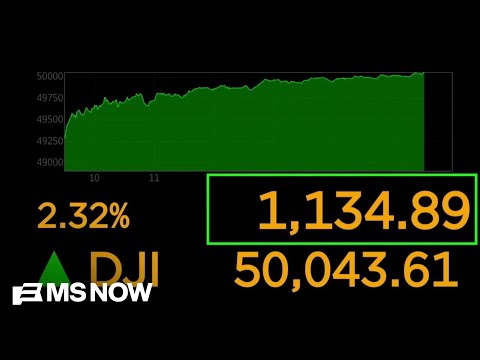
BREAKING: Dow soars above 50,000, new record
MSNBC· 2026-02-06 21:42
LOOK WHAT'S HAPPENING ON WALL STREET NOW, THE DOW HIT 50 ,000, YOU SEE IT RIGHT THERE FOR THE FIRST TIME EVER, WE'RE LIKELY GOING TO SET A NEW RECORD WHEN markets close in just about 30 minutes if it stays over 50. But this good news on Wall Street followed a sell-off this week with big techs losing a trillion dollars in market value through yesterday. And it's paired with bleak new labor supermarket data.108 ,000 jobs were cut last month, double the number of layoffs we saw at the start of last year. We ha ...
部分美国软件类股票跌幅扩大
Jin Rong Jie· 2026-02-06 15:38
Group 1 - Thomson Reuters listed stocks declined by 3% [1] - ServiceNow experienced a drop of 2.3% [1] - Adobe's stock fell by 0.9% [1] - Salesforce saw a decrease of 0.6% [1]
BetterInvesting™ Magazine Update on ServiceNow Inc. (NYSE: NOW) and Deckers Outdoors Corp. (NYSE: DECK)
Prnewswire· 2026-02-06 12:29
Group 1 - ServiceNow Inc. has been named "Stock to Study" by BetterInvesting Magazine for April 2026, indicating potential interest from investors regarding its stock valuation [1] - The fundamental data for ServiceNow, including sales, earnings, pre-tax profit, and return on equity, is accessible through the National Association of Investors Corp. [2] - A full report on ServiceNow will be published in the April 2026 issue of BetterInvesting Magazine, providing detailed insights for investors [2] Group 2 - The same April 2026 issue will also feature a fundamental review of Deckers Outdoor Corp., which is considered undervalued and worthy of further study [3] - The Editorial Advisory and Securities Review Committee of BetterInvesting consists of several CFA members, indicating a robust analytical framework for stock evaluation [3]


“软件股末日论”点燃大变革! 恐慌抛售之后,市场将捧起AI时代的“软件基石”
智通财经网· 2026-02-06 09:13
Core Viewpoint - The recent narrative of "Software-mageddon" has led to a significant sell-off in the software sector, particularly affecting SaaS stocks, following the launch of new AI tools by Anthropic, which are perceived as threats to traditional software business models [1][4][5]. Group 1: Market Reaction - The S&P 500 Software & Services Index has experienced a decline of approximately 30% since its recent peak at the end of October, marking the most severe sell-off since 2022 [1][6]. - Major software companies, including Thomson Reuters and Salesforce, have seen significant stock price drops, with some experiencing declines of up to 10% in a single day [5][6]. - The sell-off has been exacerbated by disappointing earnings guidance from major companies, including Microsoft, and heightened expectations for AI infrastructure spending [5][6]. Group 2: Institutional Response - Some institutional investors are beginning to enter the market to buy undervalued software stocks, believing that the market has overreacted to the AI threat [2][12]. - Analysts from firms like Goldman Sachs and Wedbush Securities suggest that the sell-off reflects an exaggerated "Armageddon scenario" and that companies will not abandon their existing software investments for new AI solutions [12][14]. Group 3: Expert Opinions - Rick Sherlund, a prominent technology analyst, argues that the software industry undergoes significant transformations every 10 to 15 years, and companies with strong fundamentals, like SAP, will likely benefit from AI rather than be replaced by it [3][16]. - Nvidia's CEO, Jensen Huang, emphasizes that AI will enhance existing software infrastructure rather than replace it entirely, countering the prevailing panic in the market [7][8]. Group 4: Long-term Outlook - Analysts believe that while AI may disrupt certain aspects of the software industry, it will also create new growth narratives, particularly for companies that can integrate AI into their existing platforms [9][10]. - The market is expected to see a bifurcation, where companies with strong data assets and integration capabilities, such as Microsoft and SAP, are likely to rebound more strongly than those with weaker competitive positions [11][15].
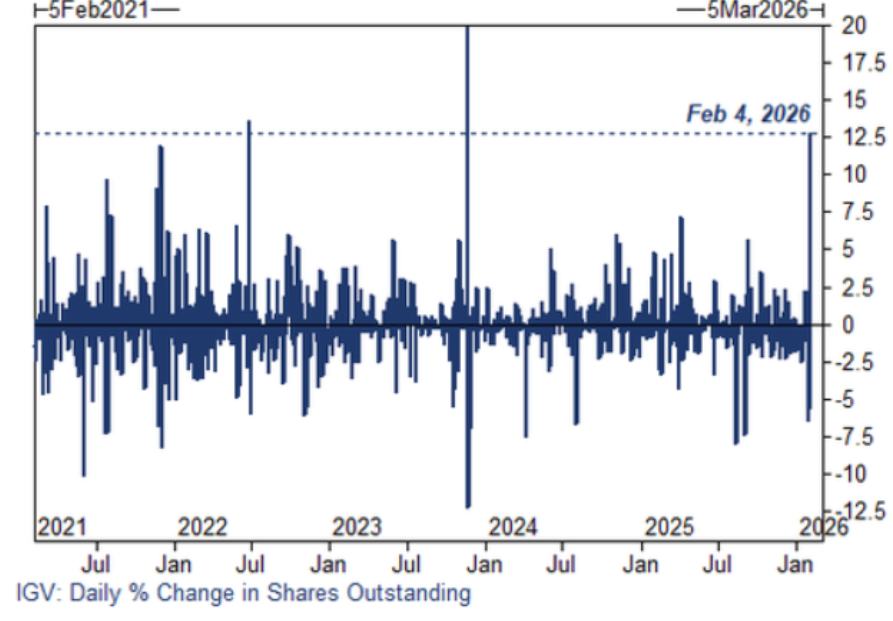
AI高支出疑虑加剧道指跌近600点,微软重挫近5%,白银暴跌逾一成
第一财经· 2026-02-05 23:25
Market Overview - The U.S. stock market experienced a broad decline, with major technology stocks under pressure, including Microsoft and Amazon, which fell over 4% due to ongoing concerns about massive capital expenditures related to artificial intelligence [2][4] - The Dow Jones Industrial Average dropped by 1.20% to 48,908.72 points, the S&P 500 fell by 1.23% to 6,798.40 points, and the Nasdaq Composite decreased by 1.59% to 22,540.59 points, marking a nearly 4% decline for the Nasdaq this week [4] Technology Sector Performance - Major tech stocks faced significant losses, with Microsoft down 4.95%, Amazon down 4.4%, and Nvidia down 1.33%. In contrast, Broadcom saw a slight increase of 0.80% [6][8] - The S&P 500 Software and Services Index has seen a seven-day consecutive decline, with a cumulative drop of 17.4%, the largest since March 2020 [9] Amazon's Financial Results - Amazon reported a significant drop of over 10% in after-hours trading following its earnings report, which showed Q4 2025 revenue at $213.4 billion, exceeding market expectations. However, the company projected Q1 operating profit between $16.5 billion and $21.5 billion, below prior expectations [8] - Amazon anticipates capital expenditures of approximately $200 billion for 2026, significantly higher than previous market forecasts, contributing to concerns about the long-term return on investment in AI [8] Labor Market Data - Recent labor market data indicated that initial jobless claims rose to 231,000, exceeding market expectations, while job openings fell to 6,542,000, the lowest in over five years [10][12] Precious Metals Market - The precious metals market experienced significant volatility, with gold prices falling by 1.8% to $4,872.83 per ounce, and silver prices plummeting by 12.1% to $77.36 per ounce, driven by margin pressure from investors facing stock market losses [14][15] - Analysts suggest that the extreme fluctuations in precious metals prices may take time to stabilize, with silver currently overvalued and likely to face corrections [16] Oil Market Dynamics - International oil prices fell nearly 3%, with Brent crude at $67.55 per barrel and West Texas Intermediate at $63.29 per barrel, as talks between the U.S. and Iran eased concerns over potential supply disruptions [17]


“AI杀死SaaS”论调引发全球抛售 软件的天塌了吗
2 1 Shi Ji Jing Ji Bao Dao· 2026-02-05 23:13
Core Viewpoint - The global capital markets are experiencing significant turbulence due to fears that AI may disrupt the SaaS industry, leading to a sharp sell-off in SaaS stocks following the release of an AI tool by Anthropic [1][3]. Group 1: Market Impact - On February 3, the combined market value of two S&P indices tracking software, financial data, and exchange stocks dropped by approximately $300 billion [1]. - The Hong Kong SaaS index fell by 6.39% on February 4, resulting in a total market value loss of nearly HKD 150 billion [1]. - Major SaaS stocks in Hong Kong, such as Kingdee International and Kingsoft, saw declines of 12.64% and 5.14%, respectively [1]. Group 2: Broader Market Reactions - The sell-off in the software sector affected the entire Hang Seng Tech Index, which dropped by 1.84%, with notable declines in Tencent (3.96%), Alibaba (0.93%), and NetEase (3.32%) [2]. - The A-share SaaS index also fell by 2.61%, with companies like Sangfor Technologies and Yonyou Network experiencing significant losses [2]. - The U.S. SaaS sector had already begun to decline on February 3, with a drop of 4.12% in the Wind U.S. SaaS index, leading to a total market value loss exceeding $30 billion [2]. Group 3: Causes of Market Sentiment - The catalyst for the sell-off was the introduction of an AI plugin by Anthropic, which automates various legal tasks, raising concerns about the potential obsolescence of traditional SaaS offerings [3][4]. - The term "SaaSpocalypse" was coined by traders to describe the market's reaction to the perceived threat posed by AI to the SaaS business model [3]. Group 4: SaaS Business Model Insights - SaaS operates on a subscription model, providing services like CRM and ERP, which contrasts with traditional software sales [6]. - The low entry barriers and integration of industry best practices are key advantages of SaaS, making it appealing to small and medium-sized enterprises [6]. - While AI can enhance SaaS offerings by providing personalized solutions, it also presents challenges, particularly for smaller businesses that may struggle with AI deployment [6]. Group 5: Future Outlook - The market may be overreacting, as SaaS still holds advantages in the SME sector, and a differentiation within the SaaS market is expected [7]. - Deloitte predicts that the SaaS business model may evolve, with a shift towards hybrid pricing models based on usage and outcomes by 2026 [7]. - Gartner forecasts that by 2030, at least 40% of enterprise SaaS spending will transition to usage-based or outcome-based pricing models [7].
ServiceNow: AI Demand Soars While Investors Fear The Wrong Risk
Seeking Alpha· 2026-02-05 11:56
Group 1 - ServiceNow (NYSE: NOW) stock is facing pressure along with the overall software sector due to investor concerns about AI technology potentially rendering software solutions obsolete across companies [1] - ServiceNow asserts that its software solutions are enhanced with AI capabilities, positioning itself as a leader in the evolving software landscape [1]