Adobe

Search documents
3年来估值最高的美股软件公司IPO,一文读懂Figma
Hua Er Jie Jian Wen· 2025-07-31 12:09
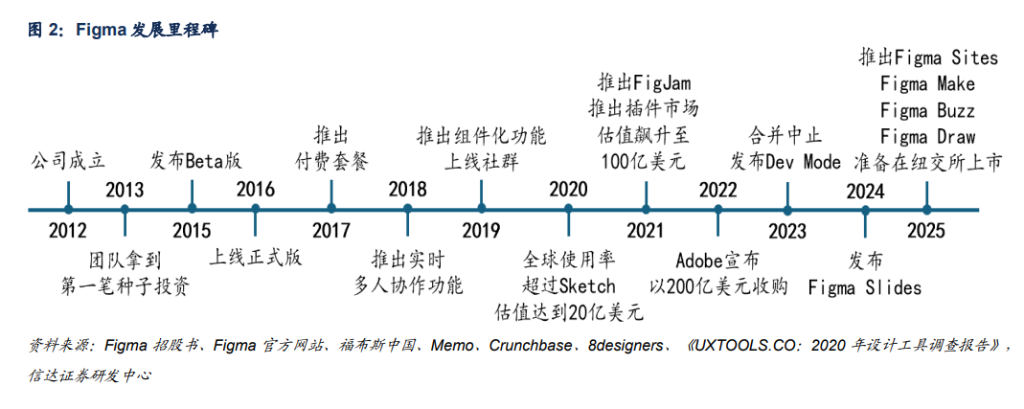
Core Insights - Figma's IPO on July 31, priced at $33 per share, achieved a valuation of $19.3 billion, marking it as the highest-valued enterprise software company to go public since the 2021 IPO boom [1][5] - The successful IPO is seen as a key indicator of a potential rebound in the IPO market and renewed interest in the "AI + design" sector amidst a backdrop of declining venture capital [1][15] Company Overview - Founded in 2012, Figma specializes in online UI design tools, known for real-time collaboration and a robust plugin ecosystem [2] - Adobe attempted to acquire Figma for $20 billion in 2022, but the deal fell through in 2023 due to regulatory challenges, resulting in a $1 billion breakup fee that Figma utilized to enhance its product and AI capabilities [2][5] Financial Performance - Figma reported Q1 2023 revenue of $228 million, a 46% year-over-year increase, with a net profit of $45 million and a gross margin of 91% [5] - The company anticipates revenue of $749 million by 2025, reflecting a projected growth rate of 48% [5] - Figma achieved a compound annual growth rate (CAGR) of 53% in revenue from 2021 to 2025, with a non-GAAP operating profit margin steadily increasing [5][10] User Engagement and Market Position - Figma currently has 13 million monthly active users and over 11,000 enterprise customers contributing more than $10,000 annually [9] - The company has penetrated 78% of the Forbes Global 2000 companies, with only 24% of customers paying over $100,000 annually, indicating significant potential for customer expansion [9] Product Development and AI Integration - Figma's integration of AI into its design processes has enhanced its product offerings, creating a comprehensive toolchain from ideation to development [6][7] - The platform's unique end-to-end design collaboration process differentiates it from traditional tools, leading to increased user retention and platform stickiness [6] Market Implications - Figma's strong IPO performance is expected to pave the way for other high-profile software IPOs, potentially revitalizing the IPO market [15] - The success of Figma is seen as a signal for other AI-driven B2B tech companies to enter the public market, indicating a shift in investor sentiment towards technology IPOs [16]


Figma prices IPO above expectations
CNBC Television· 2025-07-31 10:55
Welcome back to Squawk. Design software developer Figma pricing shares of its IPO at $33 each. That is above the expected range.The offering raising $1.2% billion with most of the proceeds going to existing stockholders. It values Figma at $19.3% billion. Now, the company, if you remember, had been agre had agreed to be acquired by Adobe for $20 billion.This was many years ago now, two or three years ago. Uh but that deal fell apart in 2023 following objections from regulators. The stock expected to debut t ...

新力量NewForce总第4827期
First Shanghai Securities· 2025-07-31 10:47
Group 1: Investment Rating - The report does not provide a specific investment rating for Deckers Outdoor Corp. (DECK) or Figma (FIG) [4][14]. Group 2: Core Insights - Deckers Outdoor Corp. reported Q1 2026 earnings that exceeded expectations, driven by strong growth in HOKA and UGG brands, with revenue increasing by 17% year-on-year to $965 million [8]. - The gross margin for Deckers was 55.8%, slightly down from 56.9% in the same period last year, while operating profit rose to $165 million from $133 million year-on-year [8]. - HOKA brand revenue grew by 20% to $653 million, and UGG brand revenue increased by 19% to $265 million, while other brands saw a decline of 19% [8]. - Figma is positioned as a significant IPO in the second half of the year, with an increased offering price range of $30-32, suggesting a market capitalization between $17.6 billion and $18.8 billion [14]. - Figma is seen as a disruptor to Adobe, with a focus on enhancing productivity through cloud-based collaboration tools, which contrasts with Adobe's traditional software model [15][16]. Group 3: Financial Summary - For Deckers, the forecast for Q2 2026 revenue is between $138 million and $142 million, with diluted earnings per share expected to be $1.55 [9]. - Historical and forecasted total revenue for Deckers is projected to grow from $4.288 billion in FY24 to $5.470 billion in FY26, reflecting an 18% increase in FY24 and a 16% increase in FY25 [10]. - Figma's revenue growth rate is anticipated to be between 45% and 50%, with a net dollar retention rate of 132% [18].
Add These 4 GARP Stocks to Your Portfolio to Receive Handsome Returns
ZACKS· 2025-07-30 14:55
Core Insights - The GARP (Growth at a Reasonable Price) strategy combines value and growth investing, focusing on undervalued stocks with solid growth prospects [1][2][7] GARP Strategy Overview - GARP investing aims to provide an ideal investment by utilizing features from both value and growth investing, targeting stocks priced below market value with strong cash flow and earnings potential [3][4] - Ideal growth rates for GARP investors are between 10% and 20%, focusing on stable growth rather than super-normal rates [3] Screening Parameters - Stocks selected under the GARP strategy must have a Zacks Rank of 1 (Strong Buy) or 2 (Buy), with last 5-year EPS and projected 3-5 year EPS growth rates between 10% and 25% [6] - A return on equity (ROE) greater than the industry average and P/E and P/B ratios less than the industry average are also key criteria [6] Promising GARP Stocks - GE Aerospace is experiencing strong demand for commercial engines and expects organic revenue growth in the low-double-digit range for 2025, with a year-to-date stock surge of 62.1% [9][10] - Autodesk is benefiting from new business growth and strong demand for its cloud-based products, with a year-to-date return of 3.7% [12][13] - Adobe's tools are gaining traction, with over 700 million monthly active users, although the stock has declined 16.6% year-to-date [14][16] - Sprouts Farmers Market is well-positioned in the natural and organic food market, planning to open at least 35 new stores in 2025, with a year-to-date return of 23.5% [17][18][19]




Figma is coming public at an expensive level, says Jim Cramer
CNBC Television· 2025-07-29 23:59
powerful as the power of us. >> Who later this week we got a big IPO coming. Figma, the design software company, is looking at an initial valuation in the neighborhood of 20 billion bucks, making this the largest enterprise software deal since 2021.Now, my gut says that this stock should be able to roar right out of the gate. But you know what. I'm hesitant to recommend it.Even though the underlying business is excellent because I'm betting it will quickly get way too expensive. Now, if I'm wrong. If I'm wr ...

X @TechCrunch
TechCrunch· 2025-07-29 13:04
AI Features in Photoshop - Adobe adds new AI-powered image editing features to Photoshop [1] Industry Focus - The article highlights Adobe's integration of AI into its flagship product, Photoshop, indicating a focus on enhancing image editing capabilities with artificial intelligence [1]
4 Must-Buy Stocks as S&P 500 Continues to Reach New Milestones
ZACKS· 2025-07-28 13:25
Market Overview - The S&P 500 rose 0.4% to close at 6,338.64 points, marking its fifth consecutive record close and the longest winning streak in over a year [1][3][9] - The index has rebounded significantly after nearly entering a bear market in April, recovering from an 18% drop earlier this year [5][9] Earnings and Investor Sentiment - Over one-third of S&P 500 companies have reported Q2 earnings, with 80% surpassing estimates, contributing to the positive market sentiment [6] - The recent rally is supported by trade developments and expectations of a major trade deal between the U.S. and the European Union [6][7] Key Companies with Growth Potential - **Adobe Inc. (ADBE)**: Expected earnings growth rate of 12% for the current year, with a Zacks Rank 2 [10] - **Microsoft Corporation (MSFT)**: Expected earnings growth rate of 13.1% for the current year, also holding a Zacks Rank 2 [12] - **Amazon.com, Inc. (AMZN)**: Expected earnings growth rate of 13.6% for the current year, currently rated Zacks Rank 1 [14] - **Meta Platforms, Inc. (META)**: Expected earnings growth rate of 7.8% for the current year, with a Zacks Rank 1 [16]

4 Artificial Intelligence (AI) Stocks That Could Soar in the Second Half of 2025
The Motley Fool· 2025-07-24 09:30
Core Viewpoint - Artificial intelligence (AI) investing remains a dominant theme in the market, with several AI stocks poised for significant growth in the latter half of 2025 [1] Group 1: Nvidia - Nvidia's stock has increased approximately 30% this year, and the market may not have fully accounted for recent developments [4] - The U.S. government revoked Nvidia's export license for H20 chips to China, impacting projected Q2 growth. Without this license, Nvidia expects 50% year-over-year growth, but with projected H20 sales of $8 billion, growth could rise to 77% [5] - Although H20 sales won't impact Q2 results, they could influence Nvidia's Q3 and Q4 guidance, potentially driving shares higher [6] Group 2: Alphabet and Adobe - Alphabet and Adobe are currently undervalued compared to the broader market, trading at significant discounts despite strong historical performance [7] - The S&P 500 is trading at 23.7 times forward earnings, while both companies are cheaper, with the market assuming generative AI will disrupt their businesses [9] - Despite potential long-term disruption, both companies are well-established and have delivered strong results, presenting a buying opportunity for investors [10] - Continued strong performance and positive guidance could lead to significant stock price increases in the latter half of the year [12] Group 3: Amazon - Amazon's investment potential lies primarily in its cloud computing segment, Amazon Web Services (AWS), which is the market leader and is experiencing rapid growth due to AI and cloud migration trends [13] - AWS contributes 63% of Amazon's operating profits while accounting for only 19% of revenue in Q1, with a growth rate of 17% in that quarter [13] - Continued growth in AWS is expected to drive Amazon's profits higher, potentially leading to further stock price increases throughout 2025 [14]

“拍卖式IPO”再现!Figma凸显美股IPO火爆程度
Hua Er Jie Jian Wen· 2025-07-23 01:25
Core Insights - Figma is adopting an auction-like IPO pricing mechanism, requiring potential investors to specify the number of shares and price they wish to purchase, aiming to maximize returns in its highly anticipated public offering [1][2] - The company seeks to raise up to $1.03 billion through this IPO, with a planned share issuance of approximately 37 million shares priced between $25 and $28 each, potentially leading to a post-IPO valuation of $16.4 billion [2][3] - The return of this pricing strategy indicates a resurgence in demand for high-quality tech stocks, as seen during the pandemic with companies like DoorDash and Airbnb [1][2] Pricing Mechanism - Figma's use of limit orders aims to provide more precise information on investors' valuation of the stock, contrasting with traditional IPOs where market orders can inflate perceived demand [2] - This strategy may help Figma approach the $20 billion valuation it had during a previous acquisition attempt by Adobe, which was abandoned due to regulatory concerns [2] Market Context - Figma's IPO is expected to be priced on July 30, with shares to be traded on the New York Stock Exchange under the ticker symbol FIG [3] - The strong underwriting team, including Morgan Stanley, Goldman Sachs, Allen & Co., and JPMorgan, reflects high market interest and anticipated demand for Figma's shares [3]
究竟什么样的产品会被AI颠覆?
Hu Xiu· 2025-07-23 00:24
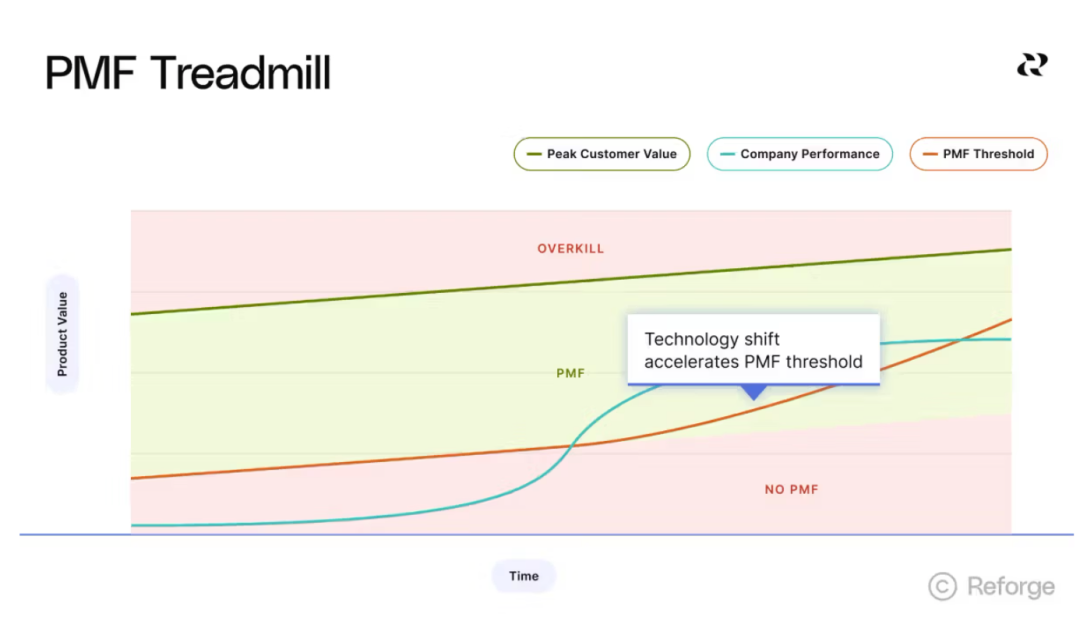
Core Insights - The emergence of AI is leading to a significant disruption in Product Market Fit (PMF), with established products facing unprecedented risks of obsolescence [6][10][54] - Companies must reassess their competitive strategies and understand the new dynamics introduced by AI technologies [3][54] Group 1: AI Disruption and PMF Collapse - The concept of Product Market Fit Collapse is introduced, indicating that traditional gradual improvements in PMF are being replaced by rapid shifts in customer expectations due to AI [6][10] - Examples like Chegg and Stack Overflow illustrate how established platforms can experience drastic declines in user engagement and market value due to AI alternatives [2][12] - The speed of AI adoption, exemplified by ChatGPT reaching 1 million users in just five days, highlights the urgency for companies to adapt [9][10] Group 2: Risk Assessment Framework - Ravi Mehta's AI Disruption Risk Assessment framework identifies four dimensions to evaluate a product's vulnerability to AI disruption: Use Case Risk, Growth Model Risk, Defensibility Risk, and Business Model Risk [15][47] - Each dimension encompasses specific factors that can help companies identify their weaknesses and develop strategies to mitigate risks [15][16] Group 3: Use Case Risk - Use Case Risk examines how AI affects user interactions with products, emphasizing the importance of whether a product serves as a primary workspace or an adjacent tool [18][19] - Products that deliver exceptional quality outputs are less vulnerable to AI disruption compared to those providing commodity outputs [20][21] - The shift from community-driven solutions to AI-driven assistance represents a fundamental change in problem-solving paradigms [14][19] Group 4: Growth Model Risk - Growth Model Risk focuses on how AI is reshaping product growth mechanisms, particularly through the disruption of distribution channels and growth loops [30][32] - Companies relying heavily on user-generated content may see their growth loops weakened as AI can generate similar content more efficiently [32][33] - Direct customer relationships provide a buffer against AI disruption, as seen in the comparison between Tripadvisor and Airbnb [34] Group 5: Defensibility Risk - Defensibility Risk assesses the barriers to competition, with proprietary data offering a significant advantage over publicly available information [36][37] - Emotional engagement in products can provide a stronger defense against AI disruption compared to purely functional utility [40][41] - Strong network effects based on genuine human interactions are more resilient to AI than those that can be easily replicated [42][43] Group 6: Business Model Risk - Business Model Risk highlights the need for companies to rethink their pricing strategies in light of AI's impact on value delivery and cost structures [47][48] - Companies with strong unit economics are better positioned to absorb the costs associated with AI, while those with thin margins face greater vulnerability [51][53] - The shift from per-seat pricing to value-based pricing reflects the changing landscape of how products are monetized in an AI-driven world [47][49] Group 7: Strategic Implications - Companies must urgently develop AI defense or transformation strategies, focusing on proprietary data collection, value-based pricing, and enhancing emotional connections with customers [59][60] - The evolution of competitive advantages in the AI era will increasingly depend on the ability to foster genuine human connections and unique data insights [56][59]