苏州银行

Search documents
股东高管密集出手 银行股增持潮涌
Bei Jing Shang Bao· 2025-09-14 17:06
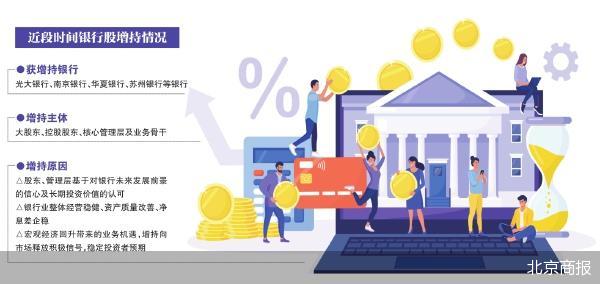
Core Viewpoint - The recent surge in share buybacks among A-share listed banks reflects confidence in their future development and the recognition of long-term investment value, supported by a stable banking industry fundamental and improved financial performance [1][5][6]. Group 1: Share Buyback Activities - Multiple listed banks, including Everbright Bank, Nanjing Bank, Huaxia Bank, and Suzhou Bank, have disclosed share buyback progress, involving major shareholders, core management, and key personnel [1][4]. - Everbright Bank's major shareholder plans to increase its stake by investing between 50 million to 100 million yuan, with a reported buyback of 13.97 million shares, amounting to approximately 51.66 million yuan [3]. - Nanjing Bank's major shareholder increased its stake by 5.68 million shares, raising its total holding from 12.56% to 13.02% [3]. Group 2: Financial Performance - In the first half of 2025, 42 listed banks in A-shares reported a total operating income of 2.92 trillion yuan and a net profit of approximately 1.1 trillion yuan, with over 60% of banks achieving growth in both metrics [1][7]. - The improvement in financial performance is accompanied by innovations in mid-term dividend mechanisms, enhancing the investment value of banks [7]. Group 3: Market Sentiment and Investment Value - The buybacks are seen as a positive signal to the market, reinforcing investor confidence in the banking sector's development [6]. - The banking sector is experiencing a valuation recovery, with banks previously trading at historical lows now showing signs of improvement in both valuation and performance [7][8]. - Long-term funds, including insurance and social security, are increasingly investing in bank stocks, further solidifying their investment value [8]. Group 4: Industry Transformation - The banking industry is undergoing a significant transformation, shifting from a scale-driven growth model to a more refined, quality-focused approach, which is expected to enhance capital efficiency and increase non-interest income [9]. - This transformation is crucial for investment strategies, as banks with low valuations, high dividends, and weak cyclical resilience will continue to play a vital role in asset allocation [9].





股东、高管密集“出手”,银行股增持潮涌动
Bei Jing Shang Bao· 2025-09-14 12:37
Core Viewpoint - The recent surge in share buybacks among A-share listed banks reflects confidence from major shareholders and management in the banks' future prospects and long-term investment value, supported by a stable banking industry fundamental and innovative mid-term dividend mechanisms [1][5][6]. Group 1: Share Buyback Activities - Multiple A-share listed banks, including Everbright Bank, Nanjing Bank, Huaxia Bank, and Suzhou Bank, have disclosed share buyback progress, with participation from major shareholders, core management, and key personnel [1][4]. - Everbright Bank's major shareholder plans to increase its stake by investing between 50 million to 100 million yuan, with a reported buyback of 13.97 million shares, accounting for 0.02% of total shares [3]. - Nanjing Bank's major shareholder increased its stake by 5.68 million shares, raising its total holding from 12.56% to 13.02% [3][4]. Group 2: Industry Fundamentals - The banking sector is experiencing a robust performance, with 42 listed banks reporting a combined operating income of 2.92 trillion yuan and a net profit of approximately 1.1 trillion yuan in the first half of 2025, with over 60% of banks achieving growth in both metrics [1][6]. - The banking industry's asset quality is improving, and net interest margins are stabilizing, contributing to a positive outlook for long-term investment in bank stocks [5][9]. Group 3: Dividend Mechanisms and Market Sentiment - The innovation and upgrade of mid-term dividend mechanisms among banks have further enhanced their investment value, with major banks announcing substantial dividend payouts [7]. - The introduction of new policies encouraging multiple dividend distributions is expected to strengthen value investment concepts and support the valuation recovery of bank stocks [7][8]. Group 4: Long-term Trends and Strategic Shifts - The valuation recovery of bank stocks is not a short-term trend but is closely linked to a deeper transformation in the banking industry's operating model, shifting from scale-driven growth to a focus on quality and resilience [9]. - This transformation is characterized by improved capital efficiency, deeper customer segmentation, and a steady increase in non-interest income, which will play a crucial role in investment strategies moving forward [9].

2025年8月金融数据点评:信贷迈向“效益优先”新周期,存款搬家仍在继续
Shenwan Hongyuan Securities· 2025-09-14 12:04
Investment Rating - The report maintains a positive outlook on the banking sector, indicating an "Overweight" rating for the industry, suggesting it will outperform the overall market [3][4]. Core Insights - The banking sector is transitioning from a "scale-first" approach to a focus on "efficiency-oriented" strategies, emphasizing balance between volume and pricing [4]. - In August, new loans increased by 590 billion RMB, but this represents a year-on-year decrease of 310 billion RMB, indicating a trend of stable but declining credit growth [4][5]. - The report highlights a shift in banks' assessment criteria from growth metrics to revenue and profit optimization, reflecting a more cautious lending environment [4]. - The report notes that the overall credit growth is expected to stabilize, with banks prioritizing loan structure optimization over market share [4]. Summary by Sections Credit Market Overview - In August, the total social financing (社融) was 2.57 trillion RMB, a year-on-year decrease of 463 billion RMB, with a stock growth rate of 8.8%, showing a slight decline [3][4]. - The new corporate loans in August totaled 540 billion RMB, a year-on-year increase of 240 billion RMB, while short-term loans saw a significant increase due to low base effects [4]. Retail Credit Analysis - Retail credit showed minimal growth, with a slight increase of 303 billion RMB in August, but still down 1,597 billion RMB year-on-year [4]. - The report mentions new policies aimed at stimulating consumer loans, which may provide short-term support for retail credit demand [4]. Government Debt and Financing - Government debt issuance in August was approximately 1.4 trillion RMB, down 2.52 trillion RMB year-on-year, indicating a potential decline in government support for social financing in the coming quarters [4]. - The report anticipates that the contribution of government debt to social financing will decrease as the year progresses [4]. Investment Recommendations - The report recommends focusing on banks with strong fundamentals and potential for valuation recovery, particularly emphasizing the value of mid-sized banks and quality city commercial banks [4]. - Specific stock recommendations include Industrial Bank, CITIC Bank, and China Merchants Bank for large banks, and Chongqing Bank, Suzhou Bank, and Hangzhou Bank for city commercial banks [4].




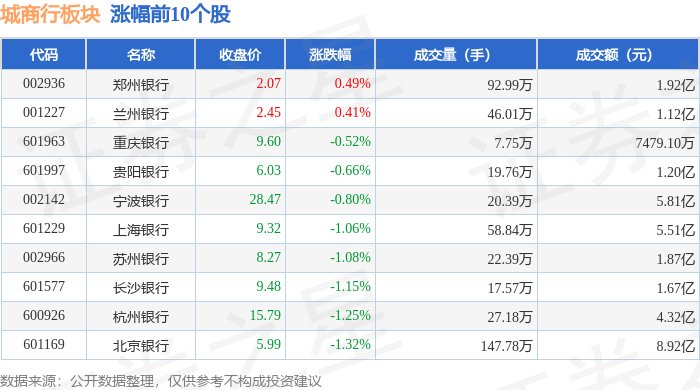
城商行板块9月12日跌1.78%,齐鲁银行领跌,主力资金净流出11.32亿元
Zheng Xing Xing Ye Ri Bao· 2025-09-12 08:38
Market Overview - The city commercial bank sector experienced a decline of 1.78% on September 12, with Qilu Bank leading the drop [1] - The Shanghai Composite Index closed at 3883.69, up 0.22%, while the Shenzhen Component Index closed at 12996.38, up 0.13% [1] Individual Bank Performance - Zhengzhou Bank closed at 2.07, up 0.49% with a trading volume of 929,900 shares and a transaction value of 192 million [1] - Qilu Bank closed at 5.69, down 1.90% with a trading volume of 508,000 shares and a transaction value of 291 million [2] - Xiamen Bank closed at 6.50, down 1.66% with a trading volume of 128,000 shares and a transaction value of 83.97 million [2] Capital Flow Analysis - The city commercial bank sector saw a net outflow of 1.132 billion in main funds, while retail funds had a net inflow of 535 million [2] - Qilu Bank had a main fund net inflow of 8.6045 million, but a net outflow of 14.4704 million from speculative funds [3] - Xiamen Bank experienced a significant main fund net outflow of 16.3414 million, with a retail net inflow of 15.2695 million [3]
再现“村并村”!年内已有百余起村镇银行整合
券商中国· 2025-09-12 06:11
Core Viewpoint - The article discusses the increasing trend of "village merging village" cases in the restructuring of rural banks in China, highlighting the recent merger proposal by Tai'an Hunan Commercial Village Bank to absorb two other village banks under the same parent bank, Shanghai Rural Commercial Bank [2][4]. Group 1: Recent Developments in Rural Bank Mergers - Tai'an Hunan Commercial Village Bank plans to hold a temporary shareholders' meeting on September 29 to review a merger proposal with Dongping Hunan Commercial Village Bank and Ningyang Hunan Commercial Village Bank [2]. - Over a hundred rural bank integration cases have occurred this year, with a notable increase in "village merging village" cases, particularly within the same parent bank [2][5]. - Shanghai Rural Commercial Bank, as a pioneer in establishing rural banks, has initiated this merger as part of a broader trend in the restructuring of rural banks [3][4]. Group 2: Background of Shanghai Rural Commercial Bank - Shanghai Rural Commercial Bank is the first provincial-level joint-stock commercial bank established on the basis of rural credit and has set up numerous rural banks since 2009 [3]. - The bank has established a total of 35 rural banks with a registered capital of 2.904 billion yuan and total assets of 34.132 billion yuan, with a significant portion of loans directed towards farmers and small enterprises [4]. Group 3: Implications of Mergers - The recent mergers reflect a shift in the role of parent banks, which are now acting as backup forces rather than just participants in the restructuring process [5][6]. - The merger of Jiangsu Shuyang Dongwu Village Bank with three other Dongwu banks illustrates this trend, as it will assume all assets, liabilities, and operations of the absorbed banks [6][7]. - In Guizhou, a similar merger involving Guiyang Yunyan Fumin Village Bank absorbing four other Fumin banks has been approved, expanding its operational area [8][9].

光大银行控股股东再增持 信心传递还是市场博弈?
Jing Ji Guan Cha Wang· 2025-09-12 04:18
Core Viewpoint - The recent shareholding increase by China Everbright Group in Everbright Bank reflects a potential recovery in market confidence towards the banking sector, despite the bank's stock price showing a slight decline [1][2]. Group 1: Shareholder Actions - Everbright Group has increased its stake in Everbright Bank by acquiring 13,970,000 A-shares, amounting to approximately 51.66 million yuan, which represents 0.02% of the total share capital [1][3]. - The ongoing shareholding increase is part of a broader trend in the banking industry, with several banks, including Postal Savings Bank and Huaxia Bank, also announcing similar plans [2][8]. - Everbright Group's total investment in Everbright Bank has exceeded 400 million yuan over multiple rounds of share purchases, raising its ownership from 47.19% to 47.42% [1][3]. Group 2: Market Performance and Valuation - As of September 12, Everbright Bank's stock price was 3.69 yuan, down 0.27%, with a price-to-earnings ratio of approximately 5.2 and a price-to-book ratio of about 0.45, indicating a cautious market sentiment towards bank valuations [1][4]. - The bank's revenue for the first half of 2025 was 65.9 billion yuan, a year-on-year decrease of 5.57%, while net profit increased slightly by 0.55% to 24.6 billion yuan [5]. Group 3: Strategic Intent and Market Signals - The shareholding increase by Everbright Group is not merely a financial investment but also reflects strategic intentions to strengthen its control and support for Everbright Bank amid a complex macroeconomic environment [6][10]. - The actions of significant shareholders like Citic Financial Asset Management indicate a recognition of Everbright Bank's investment value, despite its low price-to-book ratio [7][10]. - The trend of shareholder increases across various banks signals a collective confidence in the banking sector, which may help stabilize market sentiment during periods of volatility [9][10].
逾期率下降核销可控,苏州银行风控逻辑释放了哪些信号?
Zhong Guo Jing Ji Wang· 2025-09-12 01:48
Core Viewpoint - Suzhou Bank has demonstrated effective risk management by maintaining a low non-performing loan ratio and a stable write-off budget, signaling a successful transformation in risk control for city commercial banks [1][2][3] Group 1: Key Performance Indicators - As of June 2025, Suzhou Bank's non-performing loan ratio stands at 0.83%, with a provision coverage ratio of 437.91%, placing it among the top tier of listed banks [2] - The bank's overdue loan ratio decreased by 0.05 percentage points compared to the end of the previous year, indicating improved risk classification accuracy [2] - The proportion of attention-class loans, a precursor to non-performing loans, decreased by 0.13% year-on-year, reducing future asset quality deterioration pressure [2] Group 2: Risk Management Mechanisms - Suzhou Bank employs a "full-process control system" that integrates prevention and resolution, ensuring a closed-loop risk management approach [4] - The bank enhances its risk prevention through standardized approvals and regular reviews of problematic cases, minimizing human error and improving efficiency [4][5] - The collaboration between the business front, risk middle, and audit back ensures comprehensive risk management across all operations [5] Group 3: Efficiency and Responsiveness - The bank emphasizes both stringent controls and rapid responses, achieving a balance through regulatory collaboration, process optimization, and technological enhancements [6][7] - Suzhou Bank actively addresses risks by promptly identifying and managing potential issues, thereby preventing the escalation of asset deterioration [7] Group 4: Research and Technological Empowerment - The bank's risk management relies on a "smart brain" approach, combining research-driven risk prediction with technology to enhance efficiency [8][9] - The implementation of a new comprehensive credit system integrates various loan types, improving risk identification and processing speed [8] - The use of knowledge graph technology enhances risk monitoring and the identification of hidden correlations among risks [9] Group 5: Overall Implications - Suzhou Bank's robust risk management framework not only supports its own stable growth but also serves as a practical model for risk control transformation in the city commercial banking sector [9]
用“真金白银”投票!银行股获股东高管密集增持
Guo Ji Jin Rong Bao· 2025-09-11 15:58
Core Viewpoint - There has been a notable increase in share buybacks by shareholders and executives of listed banks, reflecting confidence in future growth and long-term investment value [1][3][5] Group 1: Shareholder and Executive Buybacks - Since September, banks such as Huaxia Bank and Suzhou Bank have announced share buybacks by their shareholders and executives [1][3] - Huaxia Bank's executives completed a buyback plan ahead of schedule, acquiring 4.22 million shares for approximately RMB 31.9 million, exceeding the planned minimum by 6.34% [3] - Suzhou Bank's executives plan to buy back at least RMB 4.2 million worth of shares between September 8 and December 31 [3][4] Group 2: Market Recognition and Performance - At least 16 banks have received financial support from shareholders and executives this year, indicating a positive market response [1][6] - Over half of the 42 A-share listed banks reported positive growth in both revenue and net profit in the first half of the year, with many initiating mid-term dividends [6][5] - The China Banking Index rose by 15.6% in the first half of the year, with 41 out of 42 banks seeing stock price increases, and 29 banks achieving double-digit growth [6][5] Group 3: Future Outlook - Analysts suggest that the trend of capital flowing into the banking sector will continue, driven by the search for safety in a low-interest environment [7] - The demand for high-dividend, low-valuation bank stocks is expected to persist, supported by policies that enhance dividends and a stable fundamental outlook [7]
上市银行频获董监高、重要股东增持,银行股后市继续看涨?
Mei Ri Jing Ji Xin Wen· 2025-09-11 13:36
Core Viewpoint - Multiple A-share listed banks have received substantial support from their directors, supervisors, and significant shareholders through share buybacks, reflecting confidence in their future development and long-term investment value [1][2][4]. Group 1: Share Buyback Plans - Huaxia Bank announced that its directors and senior management plan to buy back shares worth no less than RMB 30 million, with a total of 422.93 million shares purchased by September 9, amounting to RMB 31.90 million, exceeding the lower limit of the buyback plan by 106.34% [2]. - Suzhou Bank's board members and executives plan to buy back shares worth at least RMB 4.20 million from September 8 to December 31, with no price range set, based on confidence in the company's future [2]. - Chengdu Bank's major shareholders have increased their holdings by 477.55 million shares and 436.45 million shares, with total investments of RMB 87.01 million and RMB 79.59 million, respectively, and a planned total investment of between RMB 700 million and RMB 1.4 billion [3]. Group 2: Market Sentiment and Trends - Analysts suggest that the frequent buybacks by major shareholders and executives indicate a shift from defensive strategies to proactive market management, driven by expectations of economic recovery and stable interest margins [4]. - The banking sector has seen a 13% increase in stock prices in the first half of the year, leading the Shenwan primary industry index, with overall revenue and net profit growth of 1.0% and 0.8%, respectively [5]. - The low price-to-book (PB) ratios of bank stocks, combined with their high dividend characteristics, make them attractive to long-term investors, enhancing market confidence and alleviating investor concerns [4][5].
银行股震荡回调,多家上市银行股东、董监高“趁机”增持
Sou Hu Cai Jing· 2025-09-11 10:19
Core Viewpoint - Several major shareholders and executives of listed banks have taken the opportunity to increase their holdings during the recent stock price fluctuations, reflecting confidence in the banks' fundamentals and future prospects, as well as highlighting the long-term investment value of bank stocks at current valuations, particularly their high dividend yields [2][5]. Group 1: Shareholder Actions - Since August, multiple listed banks, including Huaxia Bank, Chengdu Bank, Suzhou Bank, Nanjing Bank, Qingdao Bank, and Shanghai Bank, have announced plans or progress regarding share buybacks by major shareholders or executives [2][5]. - For instance, Nanjing Bank's major shareholder, Zijin Group's subsidiary, increased its holdings by 56.78 million shares, accounting for 0.46% of the total share capital, between July 18 and September 10 [2]. - Huaxia Bank completed its buyback plan by acquiring 4.23 million shares for a total of 31.9 million yuan, after initially announcing a plan to buy back at least 30 million yuan worth of shares [3][4]. Group 2: Market Context - The banking sector index has experienced a significant decline since reaching a peak around July 10, with smaller banks facing even larger drops [3][4]. - The stock price of Huaxia Bank fell from a high of 8.72 yuan per share on July 10 to 7.28 yuan per share by September 9 [4]. - Chengdu Bank's buyback plan was delayed due to its stock price exceeding the set upper limit, but it resumed with a total investment of 170 million yuan over a short period [4]. Group 3: Investment Sentiment - Analysts suggest that the recent buybacks by major shareholders and executives signal their recognition of the banks' long-term investment value and confidence in future operations, which can help stabilize stock price expectations [5][6]. - The banking sector is viewed as a defensive investment during market downturns due to its low valuations and high dividend characteristics, providing relatively stable returns [6]. - The banking sector index has seen a 64% increase from December 2023 to July 2025, with a maximum drawdown of over 10% in 2023 [7]. Group 4: Institutional Investment Trends - Insurance funds have increasingly targeted undervalued, large-cap, low-volatility banks, with several banks experiencing multiple stake increases from these funds [7]. - Public funds have also shown a rising interest in bank stocks, with the proportion of active public funds in bank stocks reaching 4.9% by the end of Q2, the highest since Q2 2021 [8]. - Despite the inflow of funds, there are concerns regarding net interest margin pressures and potential asset quality issues due to the real estate downturn, leading to some portfolio adjustments [8].