易方达

Search documents
沪指冲击17连阳,费率低的A500ETF易方达(159361)涨超1%,市场成交放量,风险偏好回升
Sou Hu Cai Jing· 2026-01-12 06:00
Group 1 - The core viewpoint of the news highlights the strong performance of the A500ETF, which has attracted significant capital inflow, indicating a bullish market sentiment [1][2] - As of January 8, the A500ETF has accumulated a total of 9.5 billion yuan in capital over the past 20 trading days, reflecting its popularity among investors [1] - The A500ETF closely tracks the CSI A500 Index, which consists of 500 securities selected from various industries based on market capitalization and liquidity, representing the overall performance of major listed companies [1] Group 2 - The China Securities Regulatory Commission (CSRC) emphasized the importance of the "14th Five-Year Plan" for advancing financial modernization and strengthening regulatory frameworks [2] - The CSRC aims to enhance risk prevention, strengthen regulation, and promote high-quality development in the capital market, focusing on comprehensive reforms in investment and financing [2] - Market sentiment has improved post-New Year, with the Shanghai Composite Index reaching 4,100 points and recording a "16-day winning streak," supported by increased institutional capital from various sources [2]
又一机器人企业获得10亿融资;机器人ETF易方达(159530)盘中获净申购2100万份
Sou Hu Cai Jing· 2026-01-12 04:26
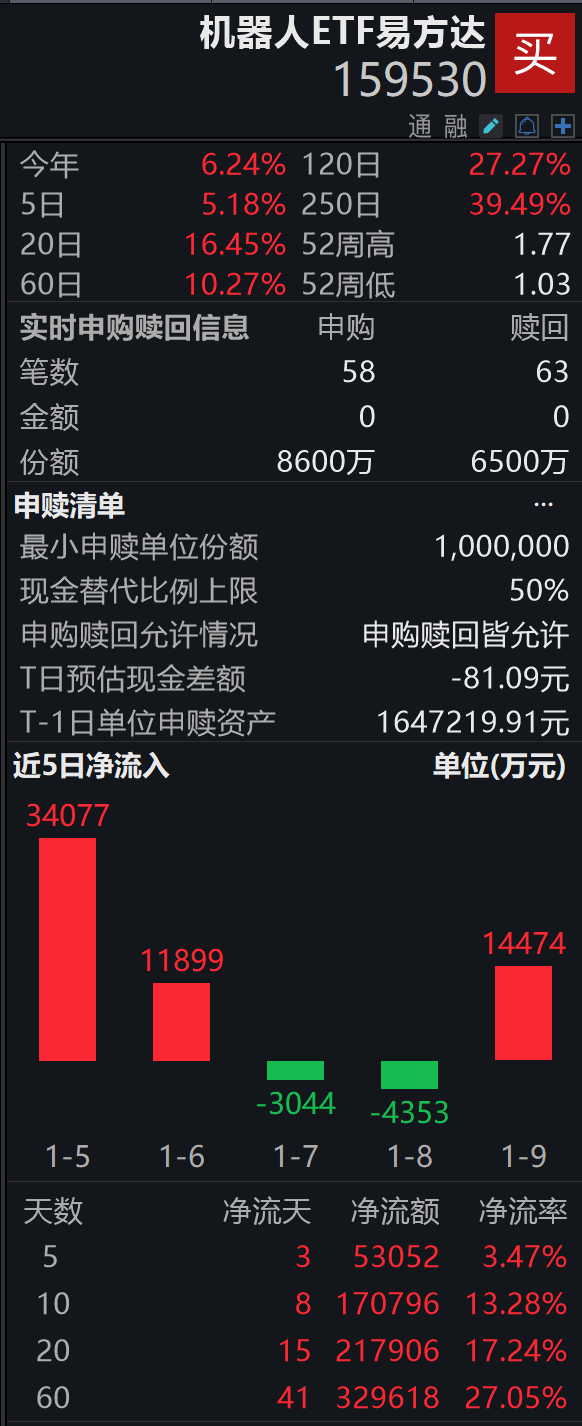
相关产品: 机器人ETF易方达(159530)通过跟踪国证机器人产业指数,为投资者提供一键布局机器人全产业链的 高效工具。 消息面上,自变量机器人已于近期完成10亿元A++轮融资。本轮融资由字节跳动、红杉中国、北京信息 产业发展基金、深创投、南山战新投、锡创投等顶级投资机构及多元地方平台联合投资。 华源证券认为,2026年人形机器人行业进入量产加速期,国内外路径呈现分化:特斯拉等海外龙头以工 厂内部验证为主,而优必选、宇树科技等国内厂商已实现千万级订单交付,率先进入商业化兑现阶段。 国证机器人产业指数特点鲜明:1.指数人形机器人含量居首:指数中人形机器人相关公司权重显著高于 同类指数;2.指数聚焦高成长龙头:前十大权重股占比约40%,涵盖汇川技术、科大讯飞、石头科技等 细分领域龙头,技术壁垒高、市场竞争力强。 截至中午收盘,国证机器人产业指数(980022)涨2.33%,成分股中,昊志机电涨12.11%、航天智装涨 10.41%、科大讯飞涨8.38%,震裕科技跌2.29%、奥比中光跌1.69%、拓普集团跌1.29%。 资金方面,机器人ETF易方达(159530)跟踪国证机器人产业指数,持续受资金青睐,近5日" ...


巨头出手!38只,集体更名
Zhong Guo Ji Jin Bao· 2026-01-12 03:24
Group 1 - On January 12, 38 ETFs under Huaxia Fund underwent a collective name change, adopting a new naming structure that includes "core elements of investment target + ETF + Huaxia" while keeping fund codes and other abbreviations unchanged [1] Group 2 - A comprehensive list of the renamed ETFs includes various categories such as broad-based, Hong Kong stocks, industry themes, and strategies, with each product now featuring "Huaxia" in its name [2][3] Group 3 - The renaming initiative aligns with regulatory efforts to standardize the ETF market, addressing issues of product homogeneity and improving investor recognition amidst the rapid growth of the ETF sector, which has surpassed 1,300 products [4] - The new naming convention aims to enhance the distinguishability of ETF products, allowing investors to quickly identify similar products from different fund companies by entering keywords related to the underlying index [4]
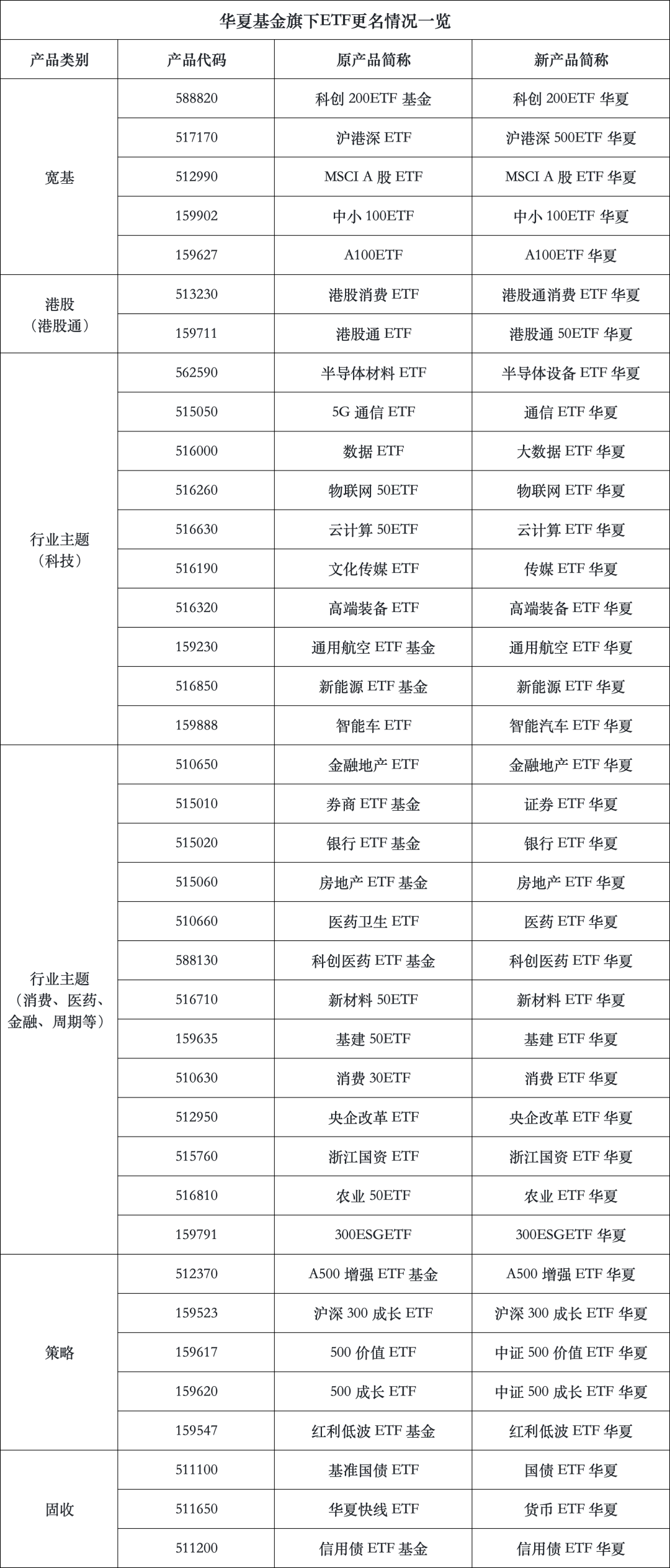
华夏基金旗下38只ETF集体更名
Xin Lang Cai Jing· 2026-01-12 03:20
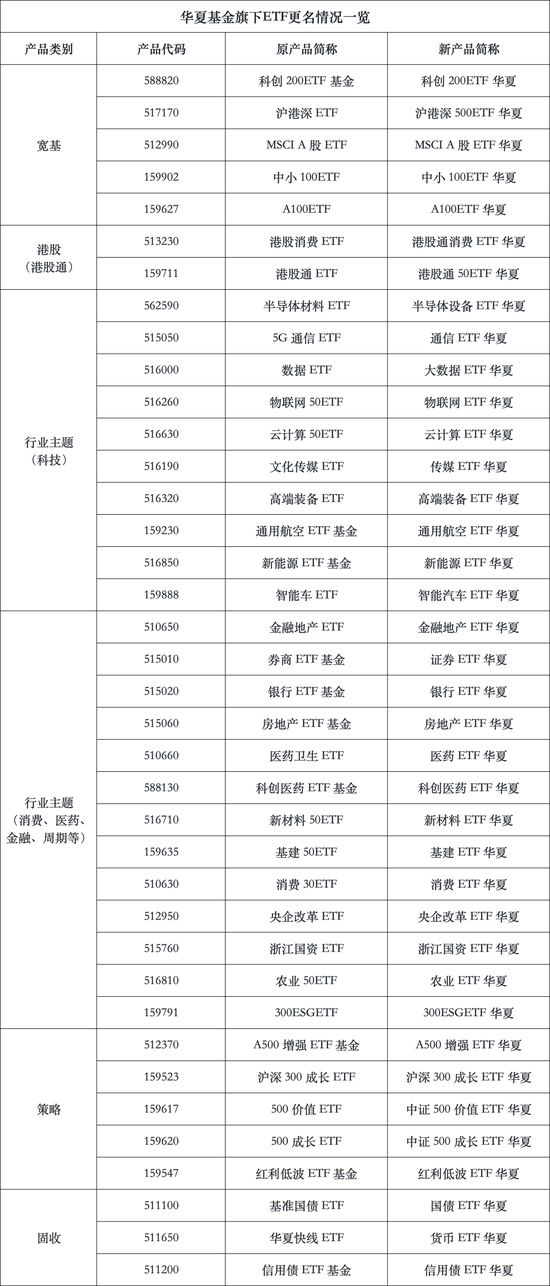
Core Viewpoint - On January 12, 38 ETFs under Huaxia Fund collectively changed their names to a standardized format, enhancing clarity and recognition in the ETF market [1][5]. Group 1: ETF Name Changes - The new naming structure for the 38 ETFs follows the format "Core Element of Investment Target + ETF + Huaxia," while the fund codes and other abbreviated names remain unchanged [1][5]. - A comprehensive list of the renamed ETFs includes various categories such as broad-based, Hong Kong stocks, industry themes, and fixed income, with specific examples like "MSCI A Share ETF Huaxia" and "New Energy ETF Huaxia" [2][6][7]. Group 2: Regulatory Context and Market Impact - The name changes are part of a broader initiative driven by regulatory authorities to standardize the ETF market, addressing issues of product homogeneity and confusion among investors [4][8]. - The rapid growth of the ETF market, with over 1,300 products, has led to challenges such as similar product names and unclear investment targets, which the new naming convention aims to resolve [4][8]. - Enhanced product recognition is expected to improve trading efficiency and investor decision-making, thereby promoting a healthier ETF market [4][8].
巨头出手!38只,集体更名
中国基金报· 2026-01-12 03:18
【导读】华夏基金旗下 38 只 ETF 集体更名 中国基金报记者 王思文 业内人士分析指出,在监管指引下完成更名后, ETF 产品的辨识度将显著提升。今后,投资 者只需输入标的指数关键词,即可快速区分不同基金公司发行的同类产品,这将极大提升交 易和配置效率,进一步推动 ETF 市场健康发展。 编辑:江右 从命名结构看, 38 只 ETF 扩位简称统一采用 " 投资标的核心要素 +ETF+ 华夏 " 的命名结 构,基金代码及其他名称简称均不变。 | | | 华夏基金旗下ETF更名情况一览 | | | --- | --- | --- | --- | | 产品类别 | 产品代码 | 原产品简称 | 新产品简称 | | 宽基 | 588820 | 科创 200ETF 基金 | 科创 200ETF 华夏 | | | 517170 | 沪港深 ETF | 沪港深 500ETF 华夏 | | | 512990 | MSCI A 股 ETF | MSCI A 股 ETF 华夏 | | | 159902 | 中小 100ETF | 中小 100ETF 华夏 | | | 159627 | A100ETF | A100ETF 华夏 ...

以均衡投资穿越波动,易方达平衡精选混合首发
Mei Ri Jing Ji Xin Wen· 2026-01-12 02:17
Core Viewpoint - E Fund Balanced Select Mixed Fund (025920) has launched its initial offering, featuring a new floating management fee model linked to holding period and annualized return performance, aimed at helping investors navigate market volatility [1] Group 1: Fund Management - The fund will be managed by Yang Jiawen, who has 14 years of experience in the securities industry, including 8 years in investment [1] - Yang Jiawen is known for a balanced investment style and contrarian strategies, focusing on company valuation and future growth potential to identify high-quality companies across various industries [1] - Currently, Yang manages four actively managed equity funds, all of which have outperformed their respective benchmarks during his tenure [1] Group 2: Historical Performance - The longest-managed fund, E Fund Keri, has shown a cumulative net value growth rate of 117.20% since Yang took over in December 2017, significantly outperforming the benchmark return of 22.47% [1] - The annualized return of E Fund Keri is 10.16%, with an annualized volatility of only 16.73% [1] Group 3: Investment Strategy - The A-share market has exhibited significant structural characteristics in recent years, prompting the fund to focus on balancing enterprise value and growth potential [1] - The investment strategy will emphasize both future growth opportunities and valuation assessments to select high-quality targets, aiming for sustainable excess returns while controlling risks [1]
以均衡投资穿越波动,易方达平衡精选混合(025920)首发
Mei Ri Jing Ji Xin Wen· 2026-01-12 01:50
Group 1 - The core viewpoint of the article is the launch of E Fund Balanced Select Mixed Fund (025920), which will adopt a new floating management fee model linked to holding period and annualized return performance [1] - The fund will be managed by Yang Jiawen, who has 14 years of experience in the securities industry, including 8 years in investment, known for a balanced style and contrarian strategy [1] - Yang Jiawen focuses on combining company valuation and future growth potential to identify high-quality companies with cost-effectiveness across various industries, aiming for sustainable excess returns [1] Group 2 - Yang Jiawen currently manages four actively managed equity funds, all of which have outperformed their respective benchmarks during his tenure [1] - For instance, the E Fund Keri, managed by Yang since December 2017, has achieved a cumulative net value growth rate of 117.20% by the end of 2025, significantly outperforming the benchmark return of 22.47% [1] - The fund aims to balance corporate value and growth, focusing on both future growth potential and valuation judgments to select quality investment targets while controlling risks [1]
新型浮动费率基金易方达平衡精选混合首发
Mei Ri Jing Ji Xin Wen· 2026-01-12 01:15
易方达平衡精选混合(025920)等新型浮动费率基金,通过对持有一定周期的投资者实现"千人千面"的差 异化收费,能够让投资者直观地感受到"多赚多付、少赚少付",有助于实现基金管理人与投资者之间利 益共担,同时在差异化费率设计中引入满足一定持有期限的条件,有利于引导投资者坚持长期投资。 近日,新型浮动费率基金易方达平衡精选混合(025920)启动首发,拟由基金经理杨嘉文掌舵,通过均衡 投资助力投资者穿越市场波动。基金合同显示,该产品将根据每笔份额的持有期限与持有期间年化收益 率确定管理费。若份额持有时间不足一年,管理费率为1.2%/年;若份额持有时间达到一年及以上,将 根据持有期间的年化超额收益水平,适用三档不同管理费率:持有期间年化收益率为正且跑赢业绩比较 基准超6%,管理费率为1.5%/年;持有期间年化收益率跑输业绩比较基准3%或更多,管理费率为0.6%/ 年;其他情形下,管理费率为1.2%/年。 ...
以均衡投资穿越波动 易方达平衡精选(025920)首发
Zhong Guo Ji Jin Bao· 2026-01-12 00:30
Core Viewpoint - The newly launched E Fund Balanced Select (025920) introduces a novel floating management fee model linked to the holding period and annualized return performance, aiming to help investors navigate market volatility through balanced investment strategies [1]. Group 1: Fund Structure and Fee Model - The fund employs a floating fee structure based on the holding period and annualized return, with three different management fee rates depending on performance: 1.5% per year for annualized returns exceeding the benchmark by over 6%, 0.6% per year for returns lagging the benchmark by 3% or more, and 1.2% per year for other scenarios [1]. - This differentiated fee structure allows investors to experience a "pay more for more earnings, pay less for less earnings" approach, fostering a shared interest between fund managers and investors [1]. Group 2: Fund Manager Profile - The proposed fund manager, Yang Jiawen, has 14 years of experience in the securities industry, with 8 years in investment, known for a balanced style and contrarian strategies [2]. - Yang manages four active equity funds, with top ten holdings concentrated between 30%-50%, indicating a broad industry coverage and balanced stock allocation [2]. - Historical performance shows that all four funds under Yang's management have outperformed their respective benchmarks, with the longest-managed fund, E Fund Keri, achieving a net value growth rate of 117.20% since December 2017, significantly surpassing the benchmark's 22.47% return [2]. Group 3: Investment Strategy - The fund will focus on balancing corporate value and growth potential, selecting high-quality targets while controlling risks to pursue sustainable excess returns [2].
基金经理,路越走越窄了
虎嗅APP· 2026-01-12 00:10
Core Viewpoint - The article discusses the contrasting performance and investor preferences between actively managed equity funds and ETFs in the context of a strong stock market in 2025, highlighting the challenges faced by active fund managers despite some impressive returns [4][5][6]. Group 1: Performance of Active Equity Funds - In 2025, the average annual return of actively managed equity funds reached 31.14%, a significant improvement compared to the previous four years [5]. - Over 70 funds achieved annual returns exceeding 100%, with the top-performing fund, managed by Ren Jie, yielding 233.69%, surpassing the previous record set by Wang Yawei in 2007 [5][6]. - Despite these gains, investor confidence in active equity funds remains low, as evidenced by a 5.7% quarter-over-quarter decline in overall fund shares in Q3 2025 [5][6]. Group 2: ETF Growth and Investor Preferences - ETFs saw a substantial growth of over 2 trillion yuan in 2025, reaching a total size of 6 trillion yuan, with stock ETFs alone accounting for 3.8 trillion yuan [6]. - The preference for ETFs over actively managed funds is evident, as even high-performing active funds did not attract significant inflows, with some funds having less than 10 million yuan in size despite impressive returns [6][7]. - The article emphasizes that the growth in active equity fund sizes is primarily due to net asset value increases rather than new subscriptions from investors [5][6]. Group 3: Investment Strategies and Market Dynamics - Active fund managers are increasingly focusing on niche sectors, particularly in technology and AI, to differentiate themselves from ETFs [9][14]. - The concentration of top-performing funds in specific sectors, such as communication and AI, has led to a high degree of overlap in holdings, making it difficult for investors to distinguish between different funds [16][19]. - The article notes that while active managers have the potential for higher returns through deep research and sector focus, many struggle to maintain consistent performance over time [32][33]. Group 4: Challenges Faced by Active Fund Managers - Many active fund managers face challenges in outperforming ETFs, particularly in sectors where ETFs have strong performance, such as communication [17][18]. - The article highlights that the strategies employed by many active managers are becoming increasingly homogenized, leading to a lack of differentiation in performance [16][19]. - The potential for active managers to capture excess returns is limited by their inability to adapt quickly to changing market conditions, particularly when sectors experience downturns [25][26].