
Stripe

Search documents
You’re just getting scraps from the stock market. Here’s where the big money is made.
Yahoo Finance· 2025-09-22 23:53
Group 1 - Venture capital and private equity are dominating the growth phases of companies, leaving retail investors with limited opportunities [6][4] - The number of publicly listed companies has decreased significantly, with less than 4,000 currently listed, down nearly 20% from a decade ago [3] - The IPO market is struggling as venture capital and private equity firms prefer to keep companies private for longer periods [4][6] Group 2 - The equity markets are not reflecting the full diversity of the economy, leading to less transparency and increased risk for ordinary investors [5] - Notable private companies like Stripe and Databricks are valued at $91 billion and $100 billion respectively, highlighting the opportunity deficit for retail investors [6] - Recent gains in the S&P 500 have been heavily influenced by a small number of companies, particularly the "Magnificent Seven" and the "three a(I)migos" (Nvidia, Microsoft, and Apple), which together account for over 20% of the index's market value [8]




是工业革命的序章,还是巨大泡沫的前夜?万亿美金烧出的AI未来待解
3 6 Ke· 2025-09-22 23:18
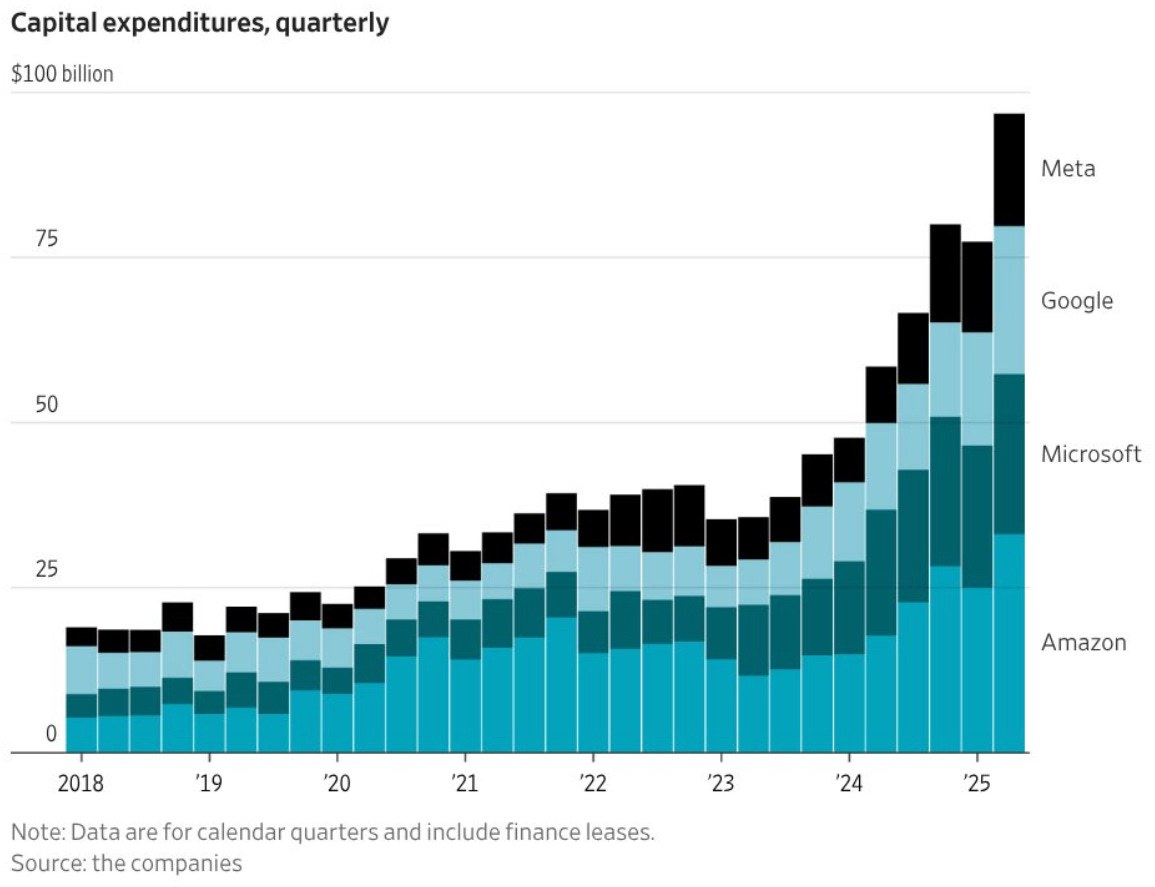
Group 1 - The U.S. economy is characterized by a duality, with a booming AI sector contrasted against a sluggish consumer economy [2][3] - AI-related spending has outpaced consumer spending, indicating that without AI, U.S. economic growth would be minimal [3] - Approximately 60% of stock market growth over the past two years has been attributed to AI-related companies such as Microsoft, Nvidia, and Meta [3] Group 2 - Major tech companies like Meta, Google, Microsoft, and Amazon have invested between $100 billion to $200 billion in AI infrastructure over the past six months [4] - This investment is the largest since the inception of the computer age in the 1960s or the peak of the railroad era in the 1880s [6] - Nvidia is expected to capture the highest share of market capital expenditure since IBM's peak in 1969, with AI capital expenditure surpassing levels seen during the internet bubble [7] Group 3 - The surge in AI infrastructure is fueled by unprecedented profits from leading tech companies, which have generated record free cash flow [12] - These companies are capable of investing hundreds of billions annually into AI-related R&D and infrastructure due to their existing business models [12] Group 4 - The stock market's peculiar performance is attributed to the dominance of the top ten companies in the S&P 500, which have significantly outperformed the rest of the market [15] - The majority of companies are experiencing cash depletion due to high spending on AI infrastructure, raising concerns about a potential historical infrastructure bubble [17] Group 5 - Generative AI tools are being adopted at a rapid pace, estimated to be twice as fast as the internet's adoption rate [19] - Over 50% of employees in information services and management roles are using AI technology, while adoption in traditional sectors remains low [22] Group 6 - AI is perceived to enhance productivity, particularly in repetitive tasks, with significant time savings reported by users [27] - A study indicates that AI agents are doubling the tasks they can complete every seven months, suggesting a rapid advancement in capabilities [29] Group 7 - Despite claims of productivity improvements, some studies indicate that the use of AI may actually increase task completion times for experienced developers [32] - The rise of large language models has transformed academic writing, with a notable increase in the use of AI-generated content in research papers [35]



Mastercard Incorporated (MA) Launches Mastercard Agent Pay in Collaboration With Stripe, Google, and Ant International’s Antom
Insider Monkey· 2025-09-22 22:41
Core Insights - Artificial intelligence (AI) is identified as the greatest investment opportunity of the current era, with a strong emphasis on the urgency to invest in AI technologies now [1][13] - The energy demands of AI technologies are highlighted, with data centers consuming as much energy as small cities, leading to concerns about power grid strain and rising electricity prices [2][3] Investment Opportunity - A specific company is presented as a critical player in the AI energy sector, owning essential energy infrastructure assets that are poised to benefit from the increasing energy demands of AI [3][7] - This company is characterized as a "toll booth" operator in the AI energy boom, collecting fees from energy exports and positioned to capitalize on the onshoring trend driven by tariffs [5][6] Financial Position - The company is noted for being debt-free and holding a significant cash reserve, amounting to nearly one-third of its market capitalization, which positions it favorably compared to other energy firms burdened by debt [8][10] - It also has a substantial equity stake in another AI-related company, providing investors with indirect exposure to multiple growth engines in the AI sector [9][10] Market Trends - The article discusses the broader trends of AI infrastructure development, the onshoring boom due to tariffs, and a surge in U.S. LNG exports, all of which are interconnected with the company's operations [14] - The influx of talent into the AI sector is emphasized, ensuring continuous innovation and advancements, which further supports the investment thesis in AI-related companies [12] Conclusion - The narrative concludes with a strong call to action for investors to engage in the AI market, highlighting the potential for significant returns within a 12 to 24-month timeframe [15][19]


X @Consensys.eth
Consensys.eth· 2025-09-22 19:59
Event Overview - The European Blockchain Convention (EBC11) is set to take place in Barcelona this October [1][2][3] - The event will feature speakers from banking and DeFi sectors, focusing on digital assets [1] Key Speakers & Focus Areas - Consensys' Managing Director will discuss expanding Ethereum adoption [1] - Bitcoin Strategy's Board Director will present on Bitcoin strategy at Europe's first BTC treasury company [2] - Stripe's Head of UK Public Policy will address fintech and crypto regulation in the UK [2] - Kadena's Capital Markets Lead will focus on RWA (Real World Asset) tokenization initiatives [2] - BNB Network's COO will manage operations at the world's largest publicly listed BNB treasury [2] - GK8 Security's Global Head of Partnerships will build global custody partnerships for institutions [3] - Assetera Global's CEO will lead the EU-regulated trading platform for securities and RWAs [3] - Prosegur Global's CEO will develop secure digital asset custody solutions [3]
Triple Triple, Double Double is D**d 💀
20VC with Harry Stebbings· 2025-09-22 14:13
Our aspirations in venture capital is to be the best seed firm in the world. I actually have a strong belief that venture capital can't scale and performance at the same time. I deeply believe that just because we have more money doesn't mean they're more on Patrick Collison's or Sam Alman's that are going to go build iconic companies.I lost the series A of Stripe of Samsara of Snap and the first one I won was a series A of Gusto. Triple triple double double is definitely dead. I I tell our investors don't ...

General Catalyst CEO, Hemant Taneja: Lessons Scaling GC to $40BN in AUM
20VC with Harry Stebbings· 2025-09-22 14:05
Hemant Taneja is the CEO and leader of General Catalyst, the firm he has scaled over the last decade into one of the largest with over $40BN in AUM. He has been one of the most influential investors of the past two decades, leading early bets in Stripe, Snap, Gusto, Samsara, Grammarly, and Canva. He also played a pivotal role in Livongo’s $18.5B merger with Teladoc, one of the largest digital health deals in history. ----------------------------------------------- Timestamps: 00:00 Intro 01:16 Is Hemant a C ...

a16z crypto-backed Shield raises $5M to help facilitate international business transactions in crypto
Yahoo Finance· 2025-09-22 14:00
Core Insights - Shield, a crypto neo-bank, has raised $5 million in a seed round led by Giant Ventures to enhance its payment services for cross-border transactions in US cryptocurrencies [1][6] - The company aims to address the challenges faced by trade businesses in regions like Latin America, Africa, and parts of Asia, which often experience delays and high fees in international transactions [4] Company Overview - Shield was launched in 2022 and pivoted to focus on payments in 2024, providing compliance screenings to mitigate risks such as sanctions and money laundering [1][4] - The company has processed over $100 million in payments since its inception, with $40 million processed in the last month alone [5] Leadership and Vision - Co-founder and CEO Emmanuel Udotong expressed disappointment with the mainstream use cases for crypto and the presence of "bad actors" in the space, motivating the creation of Shield [2][3] - The leadership team includes Udotong, his brother Isaiah, and college friend Luis Carchi, who aimed to leverage stablecoins for international payments [3] Market Context - The crypto industry has seen a resurgence, creating new unicorns and attracting significant investment after a challenging period [5] - Shield faces competition from numerous startups and established players like PayPal's Xoom and Stripe's Bridge [5] Funding and Future Plans - The recent funding will be utilized to secure additional banking partnerships and enhance compliance products, including transaction monitoring and fraud detection [7] - Shield has raised a total of $7 million to date, with strategic investments from notable entities such as Coinbase and Bank of America [6][7]
Digital Duct Tape Bleeding Billions From Corporate America
Forbes· 2025-09-22 11:54
Core Insights - Digital initiatives in corporate America are failing to meet expectations, leading to significant productivity losses estimated at 21% due to disconnected systems and excessive manual intervention [2][4][26] - Companies are struggling with complex financial infrastructures, often managing multiple applications and logins, which complicates financial oversight and increases operational inefficiencies [3][5][30] - The fragmentation of data assets is resulting in a massive loss of potential value, as companies are not compensated for the data they provide to AI systems, leading to a significant wealth transfer to AI companies [10][12][13] Group 1: Digital Friction and Productivity Loss - Fortune 500 companies operate on an average of 254 applications, with employees managing 47 passwords, contributing to a 21% productivity drain [2][3] - Financial teams at large corporations face challenges in data reconciliation, spending excessive time on manual processes rather than strategic cash flow management [5][30] - The complexity of cross-border payments results in companies incurring 3% to 5% in transaction fees due to multiple intermediaries, highlighting the inefficiencies in current systems [6] Group 2: Financial Infrastructure Challenges - A treasury executive reported managing $2 billion across 27 financial relationships monthly, with significant time lost in reconciling data formats [5] - McKinsey research indicates that two-thirds of large tech programs exceed budgets and timelines, often by 50% or more, underscoring the challenges in financial infrastructure [5] - Companies are exploring next-generation financial solutions to unify management across traditional and digital assets, but regulatory uncertainties hinder widespread adoption [9][10] Group 3: Data Asset Management - Major publishers are losing out on the value generated from their content, which is used to train AI models worth billions without receiving compensation [10][12] - Startups are emerging with blockchain-based solutions aimed at providing transparency and compensation for data contributions, but established AI companies resist these changes [13] - The current landscape reflects a significant wealth transfer occurring in real-time, as companies fail to monetize their data effectively [10][12] Group 4: Identity Management Issues - IT departments spend 30% of their time on password resets, indicating a significant inefficiency in identity management systems [14] - Employees often have fragmented digital identities across various platforms, complicating integration and data management [15][16] - Major identity providers benefit from maintaining silos, which creates challenges for companies trying to streamline their identity management processes [15] Group 5: Access Complexity - Routine business operations, such as currency conversion, are hindered by complex interfaces, leading to significant time losses [19][20] - Traditional financial service providers have little incentive to simplify processes, as complexity supports their pricing models [20] - Emerging platforms are attempting to simplify access to digital assets, but compliance and auditability remain critical factors for enterprise adoption [21][22] Group 6: Regulatory and Competitive Landscape - Upcoming regulatory deadlines, such as EU DORA compliance in January 2025, are reshaping competitive advantages in the industry [28] - Companies that view compliance as a burden may miss opportunities for efficiency improvements [28] - The smart money is moving towards simplifying operations, as evidenced by companies like American Airlines and Reddit optimizing their processes and monetizing data effectively [24][25]

Where Is Paypal Stock Headed?
Forbes· 2025-09-22 10:15
Core Insights - PayPal Holdings is a leading player in digital payments with over 434 million active accounts and a market capitalization of approximately $66 billion as of mid-September 2025 [2] - The company's stock price is around $68 per share, with a price-to-earnings ratio close to 15 and earnings per share at $4, indicating relative affordability compared to the tech sector [2] Financial Performance - The last two years have shown inconsistent financial performance, with solid profits and free cash flow allowing for share buybacks, but concerns over branded checkout volume weakness [3] - Increased competition from rivals like Apple Pay, Stripe, Adyen, and Block is raising market share concerns, alongside heightened regulatory scrutiny and pressures on transaction fees [3] Growth Initiatives - PayPal is pursuing growth through "PayPal World," a cross-border payments platform aimed at connecting various domestic payment systems and digital wallets, with partnerships established in key markets [3] - A multi-year partnership with Google aims to integrate AI-driven payment solutions into Google's ecosystem, enhancing PayPal's reach and competitive positioning [4] - Investment in AI tools for fraud detection and risk management is being prioritized, alongside improvements in crypto-enabled payment capabilities that could reduce cross-border transaction costs by up to 90% [5] Market Sentiment - Analysts have a mixed outlook, with consensus price targets around $83, suggesting a potential upside of 20-25%, while some forecasts reach as high as $120 [6] - Skeptics warn of potential declines into the low $60s if branded volume growth falters or if competitive and regulatory pressures increase [6] Key Metrics to Monitor - Important metrics for long-term investors include the adoption of PayPal World, traction in emerging markets, growth in crypto transactions, and the effectiveness of AI initiatives in reducing costs and enhancing margins [6]


OpenAI领衔!AI热潮下美国“七大科技初创”总估值达1.3万亿美元
智通财经网· 2025-09-21 02:59
Core Insights - The emergence of ChatGPT three years ago has sparked a continuous AI boom, significantly increasing the valuations of several U.S. tech startups, with OpenAI leading the charge [1] - The total valuation of the seven highest-valued private tech companies has reached $1.3 trillion, nearly doubling in the past year [1][2] - AI's impact extends beyond a few top startups, with 19 AI companies raising $65 billion this year, accounting for over 77% of all private capital [2] Valuation Highlights - OpenAI is valued at approximately $324 billion, followed by Anthropic at $178 billion and xAI at $90 billion [1] - Databricks, another company on the list, has reached a valuation of $100 billion due to significant investments in AI [2] - Other notable companies include SpaceX at $456 billion, Stripe at $92 billion, and Anduril at $53 billion [2] Market Dynamics - The surge in valuations reflects actual growth rather than mere speculation, with companies experiencing growth rates of 100% to 300% [2] - The ample funding available has reduced the motivation for these companies to go public, with regulatory factors being the only potential driver [3] Industry Impact - The private companies have significantly influenced the public market, as seen with Oracle's stock surging 36% after a major contract with OpenAI [3] - Companies like Broadcom and Microsoft have also benefited from partnerships and investments related to OpenAI [3] Future Outlook - Despite acknowledging a potential bubble in AI valuations, OpenAI's CEO Sam Altman remains optimistic about investing heavily in data centers, indicating a long-term vision [4] - Meta's CEO Mark Zuckerberg has expressed a similar commitment to investing in AI opportunities despite the risks [5]