
OpenAI

Search documents
Anthropic又“踢馆”!Sonnet 4.6操作电脑接近人类,性能堪比旗舰模型、定价仅1/5
华尔街见闻· 2026-02-18 04:33
Core Insights - Anthropic has launched Claude Sonnet 4.6, a new AI model that offers flagship-level performance at a mid-range price, significantly altering the pricing landscape in the AI industry [1][10] - The model's pricing remains the same as its predecessor Sonnet 4.5, at $3 per million tokens for input and $15 for output, while the flagship Opus model is priced five times higher [10][11] - The release comes amid Anthropic's aggressive push into the enterprise market, highlighted by a recent $30 billion funding round that doubled its valuation to $380 billion [2] Performance Enhancements - Claude Sonnet 4.6 has shown a fivefold improvement in computer operation capabilities over 16 months, achieving a score of 72.5% on the OSWorld benchmark, nearing human-level performance [3][5] - In programming tasks, developers preferred Sonnet 4.6 over Sonnet 4.5 in approximately 70% of cases, and it outperformed the flagship Opus 4.5 in 59% of scenarios [7][8] - The model's performance in various benchmarks is competitive with Opus 4.6, scoring 79.6% in SWE-bench Verified and 72.5% in OSWorld-Verified tests [8][9] Cost-Effectiveness - The cost-performance ratio of Sonnet 4.6 is transformative for enterprises making millions of API calls daily, eliminating the need to choose between lower-quality results and high-cost options [10][11] - Early testers reported that Sonnet 4.6's performance matched or exceeded that of the more expensive Opus models, making it a clear choice for many organizations [12][11] Strategic Capabilities - Sonnet 4.6 features a 1 million token context window, allowing it to handle extensive documents and perform long-term strategic planning effectively [12][13] - The model demonstrated a unique ability to develop novel strategies in a simulated business environment, significantly outperforming its predecessor in profitability [13][14] Competitive Landscape - The rapid release of Sonnet 4.6 reflects the intense competition in the AI industry, with Anthropic launching significant updates within a short timeframe [16] - Concerns have arisen among investors regarding the potential disruption of traditional software companies by AI advancements, as evidenced by recent stock market reactions [17][16] - Sonnet 4.6 has outperformed competitors like Google’s Gemini 3 Pro and OpenAI’s GPT-5.2 in several benchmarks, indicating its strong position in the market [19][20]


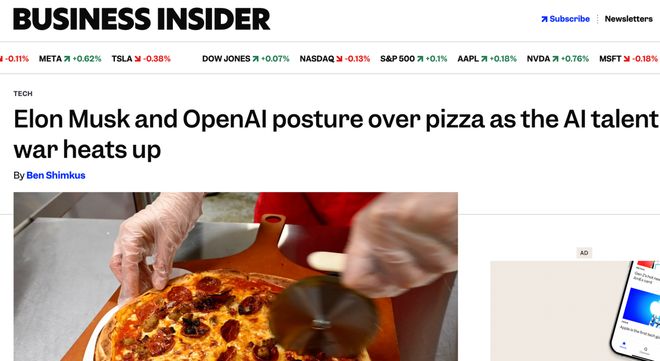
马斯克与OpenAI工程师“披萨之争”背后:xAI与OpenAI激战AI人才高地
Huan Qiu Wang Zi Xun· 2026-02-18 03:49
Core Insights - The "pizza rivalry" between Elon Musk and OpenAI engineers highlights the intense competition for AI talent in the industry [1][4] - The humorous exchange over pizza quality serves as a metaphor for the broader battle between xAI and OpenAI for attracting top AI researchers and engineers [4][5] Group 1: Talent Competition - The competition for AI talent has escalated, with companies like Meta, Microsoft, Amazon, and Anthropic increasing their investments [5] - Top AI talent is demanding nine-figure salaries and prioritizing access to GPU resources and minimal management burdens [4] Group 2: Company Culture and Benefits - Company culture and work environment are becoming critical differentiators in attracting talent, with perks like free meals and dedicated chefs gaining importance [4] - This trend occurs amidst a broader context of the tech industry reducing employee benefits, such as tightening remote work policies and ongoing layoffs [4]
为什么最懂AI的人在纷纷离职:“我凝视过无尽的黑夜”
虎嗅APP· 2026-02-18 03:38
Core Viewpoint - The article discusses the recent trend of AI professionals resigning from their positions, highlighting a sense of despair and foreboding regarding the future of AI and its implications for humanity. It suggests that these resignations are not merely job changes but a collective acknowledgment of the profound changes and challenges posed by advancing AI technologies [4][5][26]. Group 1: AI Resignation Phenomenon - In recent months, a notable trend has emerged where prominent AI researchers and executives are publicly resigning, often through lengthy letters that express deep concerns about the future of AI [12][20]. - The resignations are characterized by a tone of melancholy, with some individuals likening their farewell messages to writing a will rather than simply changing jobs [5][12]. - Key figures in the AI industry, such as Mrinank Sharma and Zoë Hitzig, have articulated their fears regarding the ethical implications and commercialization pressures within their companies, leading to their departures [15][18]. Group 2: The Concept of the Singularity - The article references the concept of the "Singularity," a point where machine intelligence surpasses human intelligence, which has been a topic of speculation for decades. Predictions about its arrival have become increasingly urgent, with some experts suggesting it could occur as early as 2026 [6][10]. - The narrative suggests that those at the forefront of AI development are beginning to feel that they may no longer be the most intelligent beings on the planet, raising existential questions about humanity's future [7][24]. Group 3: Insights from Resignation Letters - Resignation letters from AI professionals reveal three main concerns: the rapid advancement of AI capabilities, the erosion of safety measures in AI development, and a fundamental unease about humanity's place in a world increasingly dominated by intelligent machines [20][23][24]. - The first concern highlights the exponential growth in AI's ability to perform complex tasks autonomously, with reports indicating that AI's task complexity doubles approximately every four months [21][22]. - The second concern addresses the dismantling of safety protocols within AI companies, as commercial pressures take precedence over ethical considerations [23]. - The third concern reflects a deeper anxiety about the implications of AI on human identity and existence, with some resigning individuals expressing fears that AI could fundamentally alter what it means to be human [24][25]. Group 4: The Future of Work and Human Existence - The article discusses the potential for widespread unemployment due to AI advancements, suggesting that if job loss becomes a collective experience, it may not carry the same stigma as individual unemployment [32]. - It posits that individuals may need to redefine their lives and purposes in a world where machines outperform humans in cognitive tasks, leading to a shift in societal values and personal fulfillment [32][33]. - The narrative concludes that those resigning from AI companies are not merely escaping but are instead seeking to embrace a new way of living that acknowledges the changing landscape of work and existence in the age of AI [33].

苹果(AAPL.US)被曝:“AI三件套”要来了
Zhi Tong Cai Jing· 2026-02-18 03:02
(原标题:苹果(AAPL.US)被曝:"AI三件套"要来了) 知名苹果爆料人马克·古尔曼发文表示,苹果(AAPL.US)正在加快开发三款全新的可穿戴设备,作为其 向人工智能驱动硬件转型的一部分——这一新赛道同样吸引了OpenAI、Meta等公司的积极布局。 古尔曼援引知情人士的话称,苹果正在推进三类产品:智能眼镜、可夹在衣服上或当作项链佩戴的吊坠 设备,以及具备更强人工智能功能的AirPods。 三款设备都将围绕Siri数字助手打造,并依靠"视觉情境感知"来执行操作。古尔曼补充称,这些产品都 将与iPhone连接,并配备不同能力的摄像头系统。 其中,AirPods和吊坠的设计理念是较简洁的产品,配备低分辨率摄像头,主要用于辅助AI,而非拍照 或录像;眼镜的定位较为高端、功能也更为丰富。 在本月早些时候的全员大会上,库克暗示公司将大举进军AI设备领域,他称苹果正在研发由人工智能 赋能的全新"产品类别","我们对此非常兴奋"。 根据古尔曼的描述,苹果早期原型机通过线缆连接外置电池和 iPhone,但新版已将组件嵌入镜框,并 采用亚克力等高端材料提升质感。 该设备将配备两颗摄像头:一颗用于高分辨率成像,另一颗用于计 ...

苹果被曝:“AI三件套”要来了
财联社· 2026-02-18 02:35
知名苹果爆料人马克·古尔曼发文表示,苹果正在加快开发三款全新的可穿戴设备,作为其向人工智能驱动硬件转型的一部分——这一新赛 道同样吸引了OpenAI、Meta等公司的积极布局。 当时他还表示,公司正加大对新技术的投资,"世界正在迅速变化"。尽管iPhone销量仍然强劲,但苹果在AI领域仍处于追赶状态。Siri的升 级一直面临技术难题,多次推迟发布。 长期来看,AI预计将改变消费者使用手机的方式,更多功能会转移到外设设备上。当下,Meta的智能眼镜已取得部分成功,而 OpenAI也在 开发多款可穿戴设备。 苹果此前在新品类上的尝试——高价头显Apple Vision Pro ——并未获得市场广泛认可。因此,公司希望通过加速布局可穿戴设备,继续把 用户锁定在苹果生态系统内。 智能眼镜 古尔曼援引知情人士的话称,苹果正在推进三类产品:智能眼镜、可夹在衣服上或当作项链佩戴的吊坠设备,以及具备更强人工智能功能的 AirPods。 三款设备都将围绕Siri数字助手打造,并依靠"视觉情境感知"来执行操作。古尔曼补充称,这些产品都将与iPhone连接,并配备不同能力的 摄像头系统。 其中,AirPods和吊坠的设计理念是较简 ...

Anthropic又“踢馆”!Sonnet 4.6操作电脑接近人类,性能堪比旗舰模型、定价仅1/5
美股IPO· 2026-02-18 00:06
Core Insights - Anthropic has launched Claude Sonnet 4.6, a significant upgrade that offers near-flagship performance at a mid-tier price, reshaping the pricing landscape in the AI industry [3][12] - The model's pricing remains the same as its predecessor Sonnet 4.5, at $3 per million tokens for input and $15 for output, while providing performance comparable to the flagship Opus model priced at $15 per million tokens for input and $75 for output [3][12] Performance Improvements - Sonnet 4.6 has shown a fivefold improvement in computer operation capabilities over 16 months, achieving a score of 72.5% on the OSWorld benchmark, nearing human-level performance [5][10] - In early tests, developers preferred Sonnet 4.6 over Sonnet 4.5 in approximately 70% of cases, and in nearly 60% of cases, they favored it over the flagship Opus 4.5 [9][10] Benchmark Comparisons - Sonnet 4.6 scored 79.6% in the SWE-bench Verified coding tests, closely matching Opus 4.6's score of 80.8%, and outperformed it in office tasks with a score of 1633 compared to Opus 4.6's 1606 [10][11] - The model also excelled in financial analysis tasks, scoring 63.3%, surpassing Opus 4.6's score of 60.1% [10][11] Strategic Market Positioning - Anthropic's recent $30 billion funding round has doubled its valuation to $380 billion, indicating strong investor confidence as it accelerates its entry into the enterprise market [4] - The collaboration with Infosys to integrate Claude models into its Topaz AI platform for various industries highlights the model's applicability in real-world business scenarios [4][19] Cost Efficiency and Deployment - Sonnet 4.6's pricing strategy allows enterprises to achieve high performance without the need for more expensive models, effectively eliminating the trade-off between cost and quality [13][14] - The model's ability to handle a context window of 1 million tokens enables it to manage extensive data inputs, making it suitable for long-term strategic planning [15][16] Competitive Landscape - The rapid release of Sonnet 4.6, just two weeks after Claude Opus 4.6, reflects the intense competition in the AI sector, with concerns about potential disruptions to existing software businesses [18] - Sonnet 4.6 has outperformed competitors like Google’s Gemini 3 Pro and OpenAI’s GPT-5.2 in several benchmarks, indicating its strong position in the market [20][21]
Apple Bets on AI Wearables to Lock in iPhone Users
PYMNTS.com· 2026-02-17 23:33
Core Insights - Apple is accelerating the development of three AI-powered wearable devices: smart glasses, a pendant, and AirPods, with the aim of enhancing user experience within its ecosystem [1][2][6] - The pendant and AirPods with expanded AI capabilities could be released as early as this year, while the smart glasses are expected to launch in 2027 [2][6] Product Development - The new devices will be integrated with Apple's Siri digital assistant and linked to the iPhone, emphasizing the company's focus on AI technology [2][6] - Apple CEO Tim Cook highlighted the importance of AI as an operating system-level capability that enhances the overall value of the Apple ecosystem [7] Strategic Partnerships and Acquisitions - Apple acquired Q.ai, an Israeli startup specializing in AI technology for audio, which aligns with its focus on voice interaction and ambient computing [7][8] - A partnership with Google was announced, indicating that future iterations of Apple's Foundation Models will utilize Google's Gemini and cloud technology to enhance Siri and other tools [8] Market Context - The development of these devices comes at a time when competitors like Meta are successfully launching smart glasses, indicating a competitive landscape in the wearable technology market [6]

Stocks in AI's Crosshairs
Youtube· 2026-02-17 22:24
Core Insights - Wall Street is increasingly recognizing that AI may disrupt a wider range of industries more rapidly than previously anticipated, leading to sell-offs in various sectors beyond technology [1][2][12] Group 1: Market Reactions - Investors are shifting their focus from concerns about AI creating a bubble to fears that it will render many businesses obsolete [2][10] - The sell-off began in early February, triggered by the introduction of new AI products, such as a tax strategy tool from Altruist, which negatively impacted shares of wealth management companies [3][4] - Companies like Salesforce, Charles Schwab, and Blue Owl have seen stock declines as investors worry that AI could soon replicate their offerings [4][8] Group 2: Sector-Specific Impacts - There is a spillover effect affecting various sectors, including legal services, insurance, tax preparation, and financial services, as AI products are introduced [3][6] - Video game stocks have been impacted following the launch of Google Gemini, and real estate stocks are also experiencing sell-offs due to fears of AI disruption [8][9] Group 3: Investor Sentiment - Investors are increasingly concerned about AI risks and are seeking to invest in companies perceived as "AI winners" while avoiding those associated with risks [6][7] - There is a dichotomy in investor sentiment, with some worried about excessive spending on AI by tech companies and others fearing the obsolescence of numerous businesses due to AI [9][10] - The uncertainty surrounding future AI developments makes it difficult to predict market movements, leading to heightened caution among investors [11][12]

Masayoshi Son Cashes Out of Nvidia… Again
Yahoo Finance· 2026-02-17 21:30
Masayoshi Son Cashes Out of Nvidia… Again - Moby BREAKING NEWS SoftBank and Nvidia were over. We all knew it. Now, SEC filings are making it Instagram official. Documents show SoftBank had quietly sold its entire Nvidia stake in October, unloading $5.8 billion worth of shares to fund deeper bets on OpenAI. Clean break. Since that disclosure, Nvidia is down about 7% and heads into its February 26 earnings with analysts still modeling a 67% revenue surge, even as investors debate whether AI spending will e ...


Thrive raises $10B for new fund, its largest yet
Yahoo Finance· 2026-02-17 20:13
Fundraising Overview - Thrive Capital has raised $10 billion for its new fund, Thrive X, which is the largest fund the firm has ever raised and nearly double the size of its previous fund [2][3] - Of the total amount, $1 billion is allocated for early-stage investments, while the remaining funds are designated for growth-stage investments [2] Investment Strategy - The firm focuses on committing deeply to a small number of founders, emphasizing loyalty to the founders and missions they support [4] - Thrive Capital has a history of significant investments in high-profile companies such as OpenAI, Stripe, and SpaceX, which have seen substantial increases in value [3] Market Implications - The oversubscription of the latest fundraise indicates strong interest from investors, particularly in light of potential IPOs for companies like OpenAI and SpaceX, which could lead to significant capital returns for limited partners [3][5] - The firm has incubated 12 companies, with at least six achieving unicorn status, showcasing its successful track record in nurturing startups [3]