中信银行

Search documents
股份行AIC异军突起 聚焦战略性新兴产业
Shang Hai Zheng Quan Bao· 2026-01-08 16:49
Core Insights - The establishment of AICs (Asset Investment Companies) under joint-stock banks marks a shift from state-owned banks' dominance to a more diversified development model in the industry [3][4] Group 1: Investment Activities - Joint-stock bank AICs, including Xingyin Investment, Zhaoyin Investment, and Xinyin Jintou, have successfully launched their first projects since opening in late 2025, focusing on strategic emerging industries such as semiconductors and new energy [1][2] - Xingyin Investment has invested over 6 billion yuan, targeting high-growth sectors and employing a "equity + debt" model to address financing needs across different cycles [2] - The investment projects primarily cover semiconductor, photovoltaic, lithium mining, and engineering plastics industries, with a focus on high transparency and quality listed company subsidiaries [2] Group 2: Differentiation from State-Owned Banks - Joint-stock bank AICs are characterized by their flexibility and market sensitivity, allowing them to effectively fill the financing gap for technology-oriented SMEs [3][4] - The investment logic, industry focus, and operational mechanisms of joint-stock bank AICs differ significantly from those of state-owned banks, which tend to focus on large state-owned enterprises and risk-averse investments [3][4] Group 3: Challenges and Recommendations - Joint-stock bank AICs face challenges such as a lack of experience in equity investment and risk management, necessitating the establishment of a risk management mechanism aligned with equity investment [5] - Experts suggest adopting a "dual GP + dual partnership" model to enhance collaboration between banks and industry capital, as well as implementing a long-term assessment mechanism to improve risk tolerance [5] Group 4: Role in Financial Services - The role of bank-affiliated equity investment is still in its infancy, serving more as a supplementary channel for diversified funding rather than a dominant force in the market [6][7] - Joint-stock bank AICs typically act as general partners (GPs) in investment funds, allowing for deeper involvement in project selection and risk management, which is crucial given their relatively limited capital compared to state-owned banks [7]



中信银行大宗交易成交699.76万元
Zheng Quan Shi Bao Wang· 2026-01-08 15:12
1月8日中信银行大宗交易一览 | 成交量 | 成交金额 | 成交价 | 相对当日收盘 | | | | --- | --- | --- | --- | --- | --- | | (万 | (万元) | 格 | 折溢价(%) | 买方营业部 | 卖方营业部 | | 股) | | (元) | | | | | 105.07 | 699.76 | 6.66 | -10.12 | 中国银河证券股份有限公司南 | 中信证券股份有限 | | | | | | 京江东中路证券营业部 | 公司江苏分公司 | (文章来源:证券时报网) 中信银行1月8日大宗交易平台出现一笔成交,成交量105.07万股,成交金额699.76万元,大宗交易成交 价为6.66元,相对今日收盘价折价10.12%。该笔交易的买方营业部为中国银河证券股份有限公司南京江 东中路证券营业部,卖方营业部为中信证券股份有限公司江苏分公司。 证券时报·数据宝统计显示,中信银行今日收盘价为7.41元,上涨0.14%,日换手率为0.17%,成交额为 5.07亿元,全天主力资金净流入3380.76万元,近5日该股累计下跌2.76%,近5日资金合计净流入1.38亿 元。 两融数 ...
开源证券晨会纪要-20260108
KAIYUAN SECURITIES· 2026-01-08 14:45
Group 1: AI Chip Industry - The AI chip market in China is projected to grow from CNY 142.54 billion in 2024 to CNY 1,336.79 billion by 2029, driven by government support and technological advancements in the domestic AI industry [5][6]. - The domestic AI industry is categorized into three stages: the first focuses on self-sufficient AI computing, storage, and power chips; the second on chip manufacturing processes like wafer fabrication and packaging; and the third on foundational technologies such as materials and EDA [6][8]. - Key players in the AI chip market include Huawei, Cambricon, and Haiguang Information, with significant growth expected in AI storage and computing chips [6][7]. Group 2: Banking Sector - The banking sector is expected to see a steady growth of CNY 3.8 trillion in wealth management products by 2026, with a year-on-year increase of 11.46% [11]. - The demand for short-term wealth management products is rising, particularly non-current management products with a duration of less than one month, which are expected to yield annualized returns close to 3-year fixed deposit rates [12]. - Major banks like Citic Bank and Everbright Bank are recommended for their diversified product lines and strong research capabilities, while other banks such as SPDB and Bank of Beijing are also seen as beneficiaries [15]. Group 3: High-end Membrane Materials - The Chinese high-end membrane materials industry is poised for rapid growth due to geopolitical tensions and the shift of the global optoelectronic industry towards China, with a focus on breaking Japan's technological monopoly [19][20]. - Key domestic companies in this sector include Dongcai Technology and Jiemai Technology, which are expanding their production capacities and entering supply chains of major clients [20]. - The market for optical films and release films is characterized by high technical barriers, with significant opportunities for domestic manufacturers to capture market share from established foreign competitors [20][21]. Group 4: Semiconductor Equipment and Materials - The semiconductor materials and equipment sector is expected to accelerate its domestic capabilities due to increased geopolitical risks and supply chain security concerns, with a focus on self-sufficiency [29][30]. - Key areas for growth include photoresists and coating equipment, where domestic companies are beginning to establish a foothold in high-end markets [31][32]. - Beneficiaries in this sector include companies like Tongcheng New Materials and Changchuan Technology, which are positioned to capitalize on the growing demand for domestic semiconductor solutions [33]. Group 5: Animal Health Industry - The company is a leading player in the animal health sector, with a strong pipeline of vaccines, including the upcoming launch of a novel African swine fever vaccine, which is expected to significantly enhance profitability [34][36]. - The company has a robust R&D framework, with a focus on innovation and a diverse range of vaccine products, which positions it well for future growth [35]. - The anticipated market for the African swine fever vaccine could reach CNY 8.4 billion annually, providing a substantial growth opportunity for the company [36].

武汉蓝电:关于使用闲置募集资金进行现金管理的进展公告
Zheng Quan Ri Bao· 2026-01-08 13:10
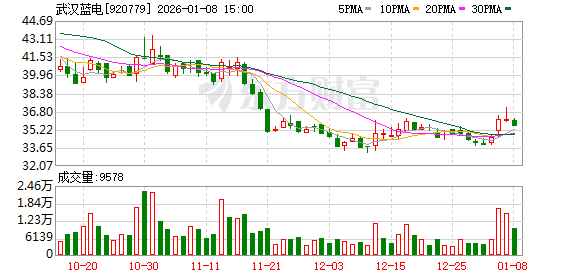
证券日报网讯 1月8日,武汉蓝电发布公告称,公司使用闲置募集资金22000万元购买浦发银行、兴业银 行、中信银行四笔结构性存款,期限23-29天,预计年化0.70%-2.10%,截至公告日尚未到期余额22000 万元,占最近一期经审计净资产42.53%。 (文章来源:证券日报) ...

银联Visa双标卡再迎调整,中信银行加快产品结构优化
Feng Huang Wang Cai Jing· 2026-01-08 11:33
Core Viewpoint - Citic Bank is upgrading its UnionPay-Visa dual-branded magnetic stripe credit cards, allowing eligible cardholders to exchange for chip cards starting February 8, 2026, reflecting a broader trend in the banking industry towards phasing out magnetic stripe cards [1][2]. Group 1: Upgrade Details - The upgrade targets previously issued UnionPay-Visa dual-branded magnetic stripe credit cards, including various co-branded and niche products that are no longer being issued [1]. - Cardholders are not required to exchange their cards but can choose to do so, allowing continued use of existing magnetic stripe cards during their validity [1]. - The new cards will feature dual-application chip design, supporting multiple payment methods, enhancing security compared to traditional magnetic stripe cards [1]. Group 2: Product and Policy Changes - After the card exchange, the billing due date will remain unchanged, but the product name, benefits, and annual fee policies will align with the new card standards, indicating a comprehensive shift in the product system [2]. - The settlement rules for domestic and international transactions will continue as before, with domestic transactions settled in RMB and international transactions processed through UnionPay and Visa networks [2]. Group 3: Industry Trends - The upgrade by Citic Bank is part of a broader industry trend where multiple banks are consolidating or discontinuing magnetic stripe and dual-branded card products in response to international security standards and the shift towards a more streamlined credit card product offering [2][3]. - The gradual phase-out of magnetic stripe cards is seen as a reflection of adjustments in the credit card business model, driven by stricter regulations, cost constraints, and changing customer demands [3].
10万亿中信银行继任行长路径选择猜想
Xin Lang Cai Jing· 2026-01-08 11:08
来源:今日行长 2025年12月30日,中信银行发布公告显示,芦苇因工作调整辞去行长职务,同时该行董事会审议通过, 由方合英代为履行行长职责。 方合英现任职务为中信集团党委委员、副总经理,同时也是中信银行董事长,1966年6月出生的他还有5 个月将满60周岁,或许意味着中信银行还将面临更深层次的重要人事调整。 较之与大多数股份制银行,中信银行背靠部级金融央企中国中信集团(下称"中信集团"),其董事长、 行长的选拔机制相对特殊(与中国光大集团、招商局集团、中国人寿集团较为相似)。从以往经验看, 中信银行的"两长"人事补位存在两条核心路径:一是回归传统,即集团董事长兼任银行董事长,集团副 总担任银行行长;二是延续现状,即集团副总经理出任银行董事长(如方合英),行长从银行内部或集 团同级子公司选拔。 另外,中信集团董事长奚国华系1963年12月生人,这或意味集团层面同样面临代际交接的窗口期……下 文《今日行长》将结合中信银行发展历程,为您拆解此次中信银行高层补位的几大可能路径。 01 路径一:回归传统,银行董事长由集团董事长兼任、行长从集团副总中选拔 纵观中信银行38年历史,"集团董事长兼任银行董事长"是延续最久的 ...

积存金走俏!投资门槛有变化
Zhong Guo Zheng Quan Bao· 2026-01-08 10:36
"趁着前两天金价稍微回调,我以每克大约980元的价格入了几克积存金。今天打开银行App一看,已经 有浮盈了。"来自北京的投资者小林告诉记者。近期,黄金投资热度不减,银行积存金备受关注。 从银行端看,一场有关业务风控的升级正在加速进行。1月12日起,工商银行(601398)将个人积存金 业务风险准入等级上调至C3(平衡型)及以上,此前,考虑到市场波动情况、投资者保护和产品风险 属性等因素,多家银行已调整评级准入门槛,达不到门槛的低风险投资者无法办理相关业务。 业内人士预计,随着金价波动持续,未来会有更多银行上调积存金投资准入门槛。 "一点一点攒金条" "最低1克即可入场,无需一次性投入大量资金,资金量有限的投资者进场无压力,投资者可以一点一点 攒金条。"光大银行(601818)一位客户经理表示,"积存金支持T+0交易,投资者在工作日的白天和晚 上都可以在手机银行实时进行交易,利用碎片时间就能进行操作管理。交易费定价清晰透明,也没有隐 性成本支出,长期持有一定期限还能获得利息。" 上述特性让积存金成为投资者投资黄金的一大选择。记者从多位银行业内人士处了解到,自2024年黄金 开启新一轮升浪以来,积存金业务变得更加 ...

港股通央企红利ETF天弘(159281)跌0.60%,成交额3906.00万元
Xin Lang Cai Jing· 2026-01-08 10:17
Core Viewpoint - The Tianhong CSI Hong Kong Stock Connect Central State-Owned Enterprises Dividend ETF (159281) experienced a slight decline of 0.60% in its closing price on January 8, 2025, with a trading volume of 39.06 million yuan [1]. Group 1: Fund Overview - The Tianhong CSI Hong Kong Stock Connect Central State-Owned Enterprises Dividend ETF was established on August 20, 2025, with an annual management fee of 0.50% and a custody fee of 0.10% [1]. - As of January 7, 2025, the fund's total shares stood at 355 million, with a total size of 355 million yuan, reflecting a 0.28% increase in shares and a 1.38% increase in size since December 31, 2025 [1]. Group 2: Liquidity and Performance - Over the past 20 trading days leading up to January 8, 2025, the cumulative trading amount for the ETF was 551 million yuan, with an average daily trading amount of approximately 27.56 million yuan [1]. - The current fund manager, He Yuxuan, has managed the fund since its inception, with a performance return of -0.81% during the management period [1]. Group 3: Top Holdings - The ETF's top holdings include COSCO Shipping Holdings (0.85%), Orient Overseas International (0.40%), China National Foreign Trade Transportation Group (0.33%), and China Petroleum & Chemical Corporation (0.32%) among others, with respective market values and share counts detailed [2].


中信银行今日大宗交易折价成交105.07万股,成交额699.76万元
Xin Lang Cai Jing· 2026-01-08 09:36
1月8日,中信银行大宗交易成交105.07万股,成交额699.76万元,占当日总成交额的1.36%,成交价6.66 元,较市场收盘价7.41元折价10.12%。 | 及景德国日记 | | | | | | | | | --- | --- | --- | --- | --- | --- | --- | --- | | 交易日期 | 证券简称 | 证券代码 | 成交价(元) 成交金额(万元) 成交量( *) 买入营业部 | | | 卖出营业部 | 是否为专场 | | 026-01-08 | 中信银行 | 601998 | 6.66 699.76 | 105.07 | #週間日時發盤 | 去筒纤雾劈纹高圆 | 190 | ...

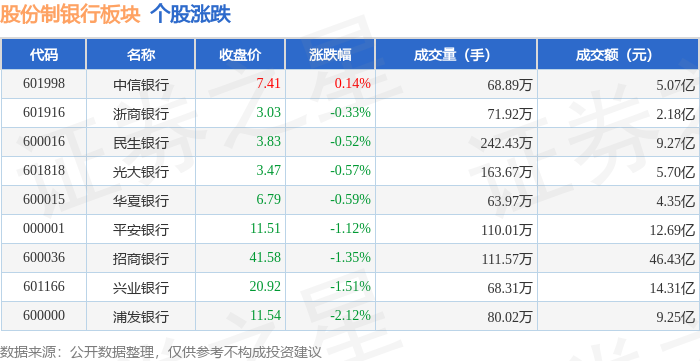
股份制银行板块1月8日跌1.16%,浦发银行领跌,主力资金净流出6.74亿元
Zheng Xing Xing Ye Ri Bao· 2026-01-08 08:56
Market Performance - The banking sector saw a decline of 1.16% on January 8, with Pudong Development Bank leading the drop [1] - The Shanghai Composite Index closed at 4082.98, down 0.07%, while the Shenzhen Component Index closed at 13959.48, down 0.51% [1] Individual Bank Performance - CITIC Bank closed at 7.41, with a slight increase of 0.14%, while other banks like Zhejiang Commercial Bank and Minsheng Bank experienced declines of 0.33% and 0.52% respectively [1] - The largest decline was seen in Pudong Development Bank, which fell by 2.12% to close at 11.54 [1] Trading Volume and Capital Flow - The banking sector experienced a net outflow of 674 million yuan from main funds, while retail investors saw a net inflow of 313 million yuan [1] - The trading volume for CITIC Bank was 688,900 shares, with a transaction value of 507 million yuan, while the total transaction value for the banking sector was significant [1] Capital Inflow Analysis - Industrial Bank had a net inflow of 67.52 million yuan from main funds, but also saw a net outflow from retail investors of 63.06 million yuan [2] - Huaxia Bank experienced a substantial net outflow of 89.46 million yuan from main funds, despite a net inflow of 66.32 million yuan from speculative funds [2]