易方达基金

Search documents
两市ETF两融余额增加35.1亿元丨ETF融资融券日报
2 1 Shi Ji Jing Ji Bao Dao· 2026-01-13 03:39
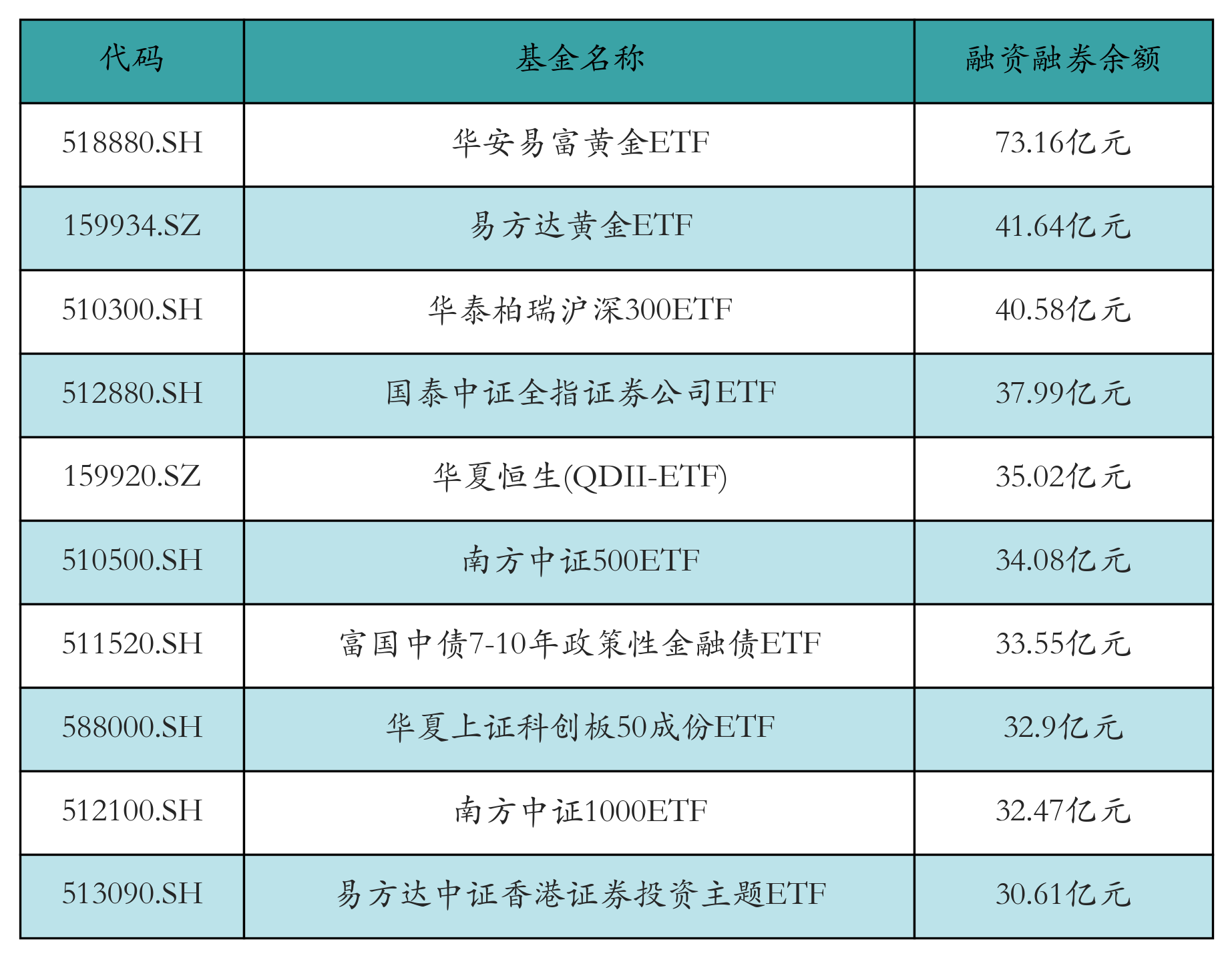
Market Overview - As of January 12, the total ETF margin balance in the two markets reached 122.95 billion, an increase of 3.51 billion from the previous trading day [1] - The financing balance was 114.98 billion, up by 3.24 billion, while the securities lending balance was 7.97 billion, increasing by 0.27 billion [1] - In the Shanghai market, the ETF margin balance was 86.99 billion, an increase of 2.50 billion, with a financing balance of 79.97 billion, up by 2.24 billion [1] - The Shenzhen market's ETF margin balance was 35.96 billion, increasing by 1.01 billion, with a financing balance of 35.01 billion, up by 0.99 billion [1] ETF Margin Balances - The top three ETFs by margin balance on January 12 were: - Huaan Yifu Gold ETF (7.32 billion) - E Fund Gold ETF (4.16 billion) - Huatai-PB CSI 300 ETF (4.06 billion) [2][3] ETF Financing Buy Amounts - The top three ETFs by financing buy amounts on January 12 were: - E Fund CSI Hong Kong Securities Investment Theme ETF (2.10 billion) - Hai Fu Tong CSI Short Bond ETF (1.97 billion) - Bosera CSI Convertible Bonds and Exchangeable Bonds ETF (1.31 billion) [4] ETF Financing Net Buy Amounts - The top three ETFs by financing net buy amounts on January 12 were: - Fuguo 7-10 Year Policy Financial Bonds ETF (681 million) - GF CSI Media ETF (437 million) - Hai Fu Tong CSI Short Bond ETF (208 million) [5] ETF Securities Lending Sell Amounts - The top three ETFs by securities lending sell amounts on January 12 were: - Huatai-PB CSI 300 ETF (51.19 million) - Huaxia CSI A500 ETF (39.12 million) - Southern CSI 500 ETF (24.49 million) [6]

华夏基金旗下非货ETF规模首次突破1万亿元
Xin Lang Cai Jing· 2026-01-13 03:21
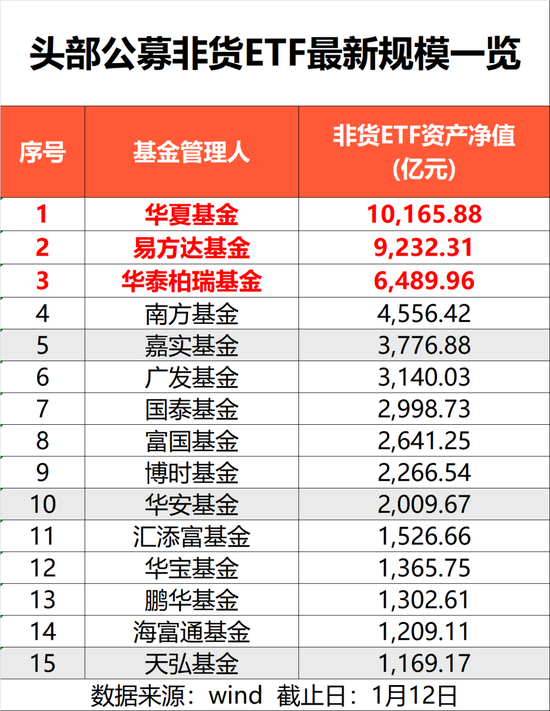
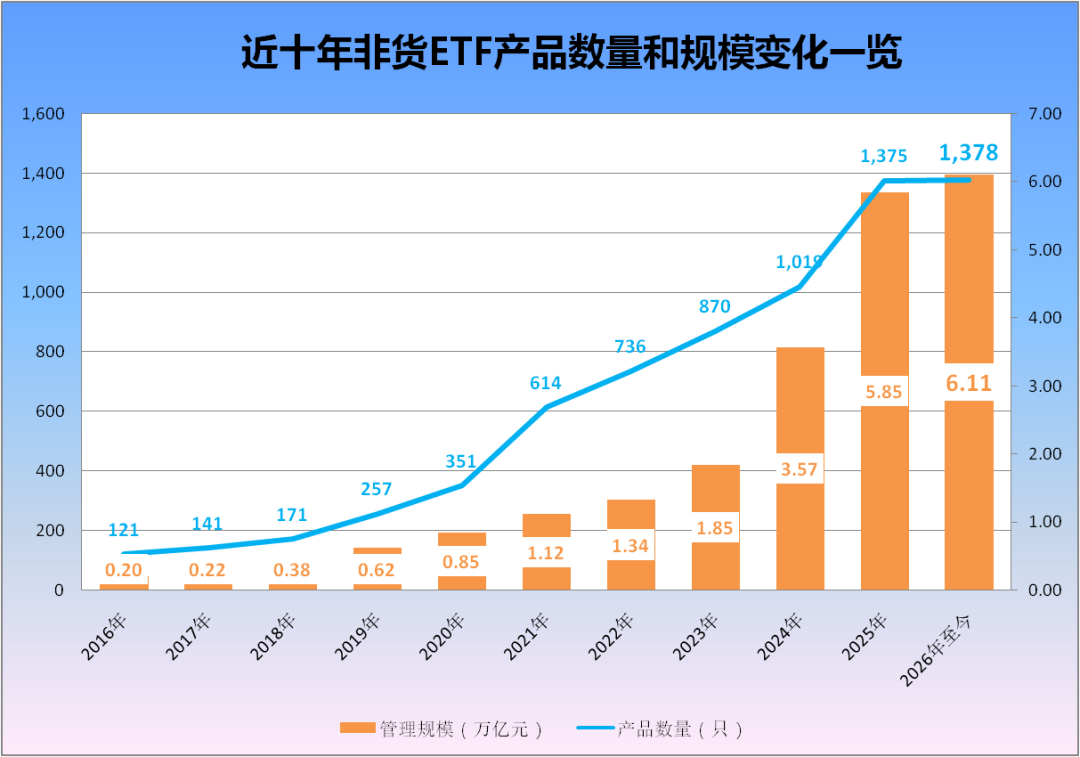
Core Insights - The ETF market in China has reached a significant milestone, with the non-cash ETF management scale of Huaxia Fund surpassing 1 trillion yuan for the first time, making it the first fund manager in the domestic public offering industry to achieve this feat [1][9]. Group 1: ETF Market Growth - The total management scale of non-cash ETFs in the market has reached 6.11 trillion yuan as of January 12, with an average growth rate of nearly 40% over the past decade, indicating a rapid expansion in this segment of public funds [6][15]. - Industry experts anticipate that the ETF market will continue to grow robustly, driven by regulatory support, market demand, and product advantages, entering a new phase of high-quality development [5][15]. Group 2: Huaxia Fund's Performance - As of January 12, Huaxia Fund's non-cash ETF management scale is reported at 10,165.88 billion yuan, followed by E Fund at 9,232 billion yuan and Hua Tai Pai Rui at nearly 6,500 billion yuan, showcasing the competitive landscape among top fund managers [2][11]. - Huaxia Fund has maintained the highest average scale in equity ETFs for 21 consecutive years, with 374 million clients holding its ETFs as of mid-2025, further solidifying its market leadership [4][13]. Group 3: Competitive Landscape - The competition among ETF products is expected to focus on tracking efficiency, fee levels, and niche market strategies, with products offering high liquidity and efficient investment tools likely to stand out [6][15]. - The management fee rates of Huaxia Fund's ETFs are among the lowest in the industry, with 83 products in the lowest fee tier, which helps to attract more investors [14].
见证历史!巨头大消息,首破万亿
Zhong Guo Ji Jin Bao· 2026-01-13 03:20
【导读】华夏基金旗下非货ETF规模首次突破1万亿元 随着权益市场回暖、被动投资理念的普及,刚刚站上6万亿元规模的ETF市场再迎里程碑事件。 最新数据显示,华夏基金旗下非货ETF管理规模已超1万亿元,首次突破1万亿元整数关口,成为国内公募行业首家非货ETF规模超万亿元的基金管理人。 业内人士表示,在监管支持、市场需求以及产品优势下,预计ETF市场仍将延续强劲增长势头,头部产品"强者恒强"的格局更为凸显,跟踪高效、费率更 优、流动性更好的产品未来有望脱颖而出。 华夏基金旗下非货ETF规模 首次突破1万亿元 数据显示,截至1月12日净值更新,华夏基金旗下非货ETF管理规模达10165.88亿元,首次突破1万亿元整数关口。 另外,易方达基金非货ETF最新规模已达9232亿元,实现规模快速增长;华泰柏瑞基金非货ETF规模接近6500亿元,跻身前三强。 最新数据还显示,南方基金非货ETF规模为4556亿元,嘉实、广发基金均超3000亿元,国泰、富国、博时基金等都超过2000亿元,汇添富、华宝、鹏华基 金等均跻身"千亿俱乐部"。 规模是市场认可最直观的体现。数据显示,华夏基金旗下权益类ETF年均规模连续21年稳居行业第一( ...
见证历史!巨头大消息,首破万亿
中国基金报· 2026-01-13 03:15
Core Viewpoint - The non-money ETF management scale of Huaxia Fund has surpassed 1 trillion yuan for the first time, marking a significant milestone in the domestic public fund industry [2][4]. Group 1: ETF Market Overview - The ETF market in China has reached a scale of 6 trillion yuan, with Huaxia Fund being the first public fund manager to exceed 1 trillion yuan in non-money ETF management scale [2][4]. - Other leading funds include E Fund with 923.2 billion yuan, Huatai-PB with nearly 650 billion yuan, and Southern Fund with 455.6 billion yuan [5][6]. Group 2: Growth Potential - The ETF market is expected to maintain strong growth momentum, driven by regulatory support, market demand, and product advantages [2][8]. - The average scale growth rate of non-money ETFs has approached 40% over the past decade, indicating a rapid increase in this segment of public funds [9]. Group 3: Competitive Landscape - The competition among ETF products will focus on tracking efficiency, fee levels, and niche market layouts, with efficient investment tools and good liquidity products likely to stand out [9]. - Huaxia Fund has established a comprehensive ETF ecosystem with 117 products covering various indices and strategies, maintaining the highest average scale in the industry for 21 consecutive years [7].

ETF前三管理人规模合计占比超40%
Zheng Quan Shi Bao Wang· 2026-01-13 02:41
人民财讯1月13日电,数据显示,截至1月13日全市场ETF总规模超过6.2万亿元,排名前三的管理人分 别是华夏基金、易方达基金和华泰柏瑞基金,管理分别为1.02万亿元、9243.16亿元和6490.23亿元。三 家公司ETF规模合计接近2.6万亿元,在全市场总规模中的占比超过40%。 ...
基金净值增长率排行榜:1月12日604只基金回报超5%
Zheng Quan Shi Bao Wang· 2026-01-13 02:05
Core Viewpoint - The stock and mixed funds achieved a positive return of 86.45% on January 12, with 604 funds returning over 5%, while 141 funds experienced a net value drawdown exceeding 1% [1][2]. Fund Performance Summary - On January 12, the Shanghai Composite Index rose by 1.09% to close at 4165.29 points, while the Shenzhen Component Index increased by 1.75%, the ChiNext Index by 1.82%, and the Sci-Tech 50 Index by 2.43% [1]. - Among the sectors, Media, Computer, and Defense & Military Industry led the gains with increases of 7.80%, 7.26%, and 5.66% respectively, while Oil & Petrochemicals, Coal, and Real Estate saw declines of 1.00%, 0.47%, and 0.29% respectively [1]. - The average net value growth rate for stock and mixed funds was 1.14%, with 86.45% of funds reporting positive growth [1]. Top Performing Funds - The top fund, Western Leading Technology Innovation Mixed A, achieved a net value growth rate of 14.17%, followed closely by Western Leading Technology Innovation Mixed C and Dongcai Excellent Growth Mixed A and C, with growth rates of 14.16% and 13.95% respectively [2]. - Among the funds with a net value growth rate exceeding 5%, 380 were index stock funds, 127 were equity funds, and 75 were flexible allocation funds [2]. Funds with Significant Drawdowns - The fund with the largest drawdown was Guolian An Technology Power Stock, with a net value decline of 2.13%. Other notable drawdowns included Agricultural Bank of China Healthcare Stock and Guolian An Preferred Industry Mixed, both with declines of 2.00% [2][4].
百亿ETF已多达百只!25家基金公司“招牌基”大比拼!
Sou Hu Cai Jing· 2026-01-13 01:49
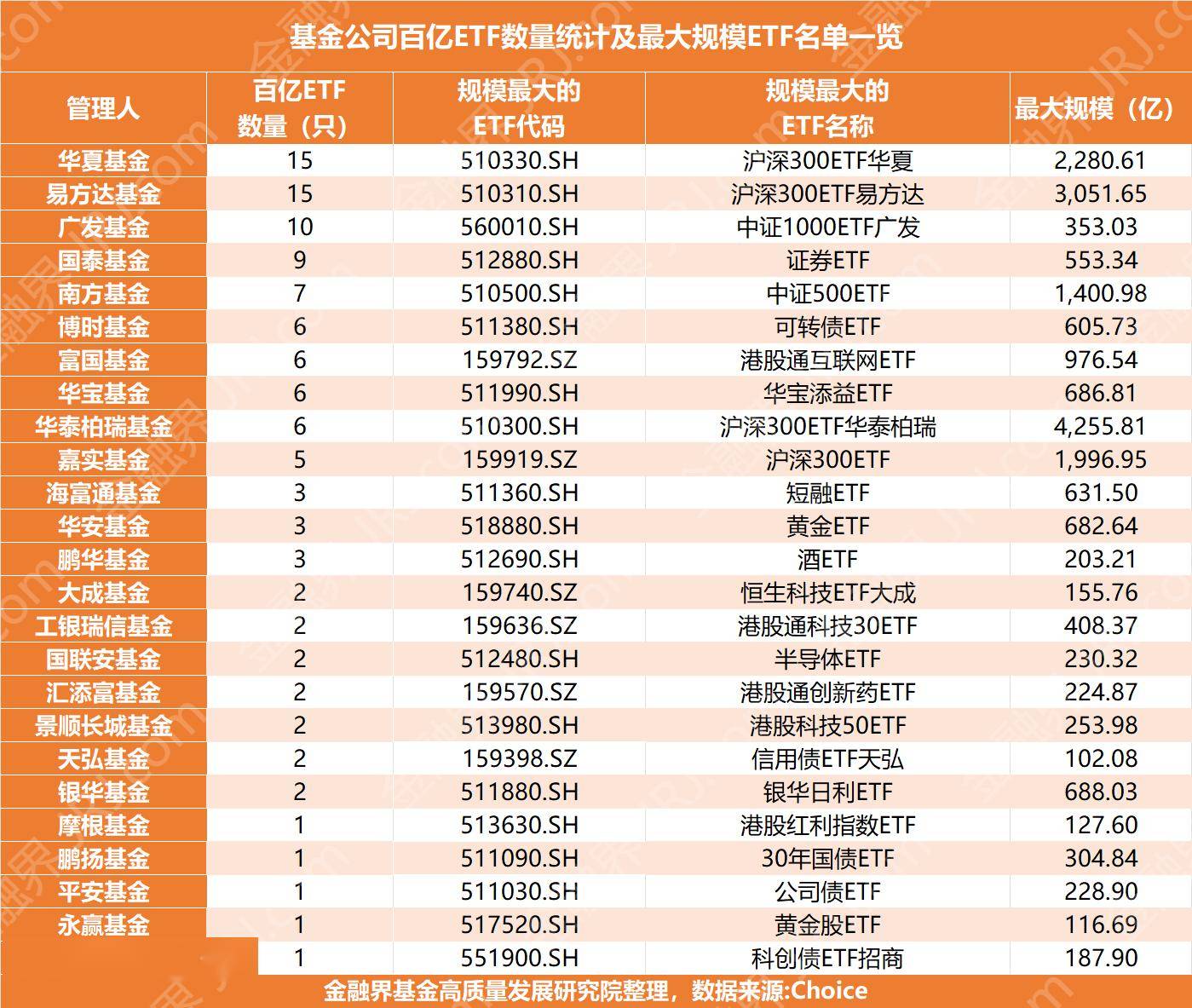
Group 1 - The total scale of ETFs in 2025 is projected to increase from 3.73 trillion yuan at the beginning of the year to 6.02 trillion yuan by year-end, representing a growth of over 2 trillion yuan [1] - As of January 9, 2026, the total scale of ETFs in the market has approached 6.2 trillion yuan, indicating continued market enthusiasm [1] - There are currently 113 ETFs with a scale exceeding 10 billion yuan, involving 25 fund management companies, with Huaxia Fund and E Fund each having 15 such ETFs [1] Group 2 - Huaxia Fund's total ETF management scale has surpassed 1 trillion yuan, with an increase of over 40 billion yuan within the year [1] - The largest ETFs by scale from various fund companies are primarily focused on broad-based indices, with Huaxia, E Fund, and Huatai-PineBridge having their flagship products as the CSI 300 ETF, each exceeding 100 billion yuan [2] - Other fund companies like GF Fund and Southern Fund also have their largest ETFs in broad-based categories, specifically the CSI 1000 ETF and CSI 500 ETF, respectively [2] Group 3 - Five fund managers have their largest ETFs focused on Hong Kong-themed sectors, covering technology growth areas such as internet and innovative pharmaceuticals [3] - The largest ETF from Silverhua is nearing 69 billion yuan, primarily investing in fixed-income assets [3] - Industry-focused ETFs from various fund managers include those from Huaan Fund (gold ETF), Penghua, Guolianan, and Yongying Fund, which focus on themes like liquor, semiconductors, and gold stocks [3]
这家公募巨头,率先迈入ETF“万亿俱乐部”
Sou Hu Cai Jing· 2026-01-13 00:55
Core Insights - The ETF market in China has reached a new milestone with the first fund management company, Huaxia Fund, surpassing 1 trillion yuan in ETF management scale, reaching 1,009.425 billion yuan [1][2][10] - Huaxia Fund's ETF scale has increased by over 50 billion yuan this year alone and nearly 380 billion yuan in the past year, showcasing remarkable growth [1][10] - The company has launched 117 ETF products, covering a wide range of indices and themes, establishing a comprehensive ETF ecosystem [1][4][11] Company Performance - Huaxia Fund's flagship product, the CSI 300 ETF, has a scale of 236.584 billion yuan, with significant growth of over 80 billion yuan in the past year [1][6] - The company has 18 ETF products with scales exceeding 10 billion yuan, indicating strong market presence [1][7] - Huaxia Fund has maintained the highest average scale in the industry for 21 consecutive years, with 3.74 million clients holding its ETFs [7][11] Market Trends - The overall ETF market in China has seen rapid growth, with the total scale reaching 6.24 trillion yuan as of January 12, 2026, and stock ETFs alone surpassing 4 trillion yuan [8][9] - The top ten fund companies account for 75% of the total ETF management scale, highlighting a significant concentration in the market [10] - The demand for low-cost, transparent, and broadly diversified index investment tools is driving the growth of the ETF market [11]

万亿之上:ETF双寡头的终局之战 10158.5亿 VS 9243.2亿
Xin Lang Cai Jing· 2026-01-13 00:31
Core Viewpoint - The Chinese public fund industry is undergoing a significant transformation, marked by the emergence of ETF giants like Huaxia Fund and E Fund, which have reached or are close to the trillion-yuan scale, indicating a shift from active investment strategies to passive investment models [4][5][38]. Group 1: Industry Transformation - The ETF market in China is evolving from a "craft" approach to a "heavy industry" model, with the focus shifting from active investment to passive strategies [6][39]. - Huaxia Fund's ETF has surpassed 1 trillion yuan, reaching 10,158.5 billion yuan, while E Fund follows closely with 9,243.2 billion yuan, together controlling nearly 20 trillion yuan in ETF assets, which is over one-third of the total market [4][5][38]. - The growth of these ETFs is not merely organic but has been significantly influenced by macroeconomic factors and institutional investments, particularly during market downturns [9][43]. Group 2: Competitive Landscape - Huaxia and E Fund have adopted different strategies; Huaxia focuses on a broad product structure while E Fund emphasizes a strong single product, the CSI 300 ETF, which contributes over one-third to its non-money market ETF assets [47][48]. - The concentration of assets among the top players is evident, with Huaxia's scale being nearly double that of the fourth-largest player, Southern Fund, highlighting a significant market disparity [50][51]. - The competitive environment is becoming increasingly challenging for smaller players, as the market is leaning towards a natural monopoly, making it difficult for new entrants to gain traction [52][56]. Group 3: Future Implications - The low fee structure of ETFs, averaging 0.15%, results in lower profit margins compared to traditional active funds, indicating a challenging profitability landscape for many public fund institutions [28][54]. - The focus for leading firms is not on immediate profits but on establishing a robust defensive position in the market, as ETFs are seen as essential infrastructure for capital markets [57][29]. - The battle for market share among the giants is not just about current rankings but also about securing long-term influence over the underlying assets of China's capital markets [30][57].

中国新增超20万颗卫星申请,两融新开户创近10年新高 | 财经日日评
吴晓波频道· 2026-01-13 00:30
Group 1: Government Investment Fund Regulations - The article discusses the introduction of a systematic regulation for government investment funds by multiple departments, focusing on investment direction, methodology, and management [2][3] - The new regulations emphasize supporting major strategies and key areas, promoting technological and industrial innovation, and encouraging long-term investments in hard technology [2] - The regulations aim to optimize fund assessment systems by considering industry uncertainties and integrating the concept of "due diligence exemption" into government investment funds [2][3] Group 2: Satellite Applications - China has submitted an application for 203,000 new satellites to the International Telecommunication Union, marking the largest frequency and orbit resource application in the country's history [4][5] - The application includes various entities beyond traditional satellite operators, indicating a strategic reserve for future satellite deployment [4] - The need for a large-scale satellite network is highlighted, as low-orbit satellites require extensive deployment to provide continuous service [5] Group 3: Robotic Vacuum Market - Chinese brands dominate the global robotic vacuum market, accounting for nearly 70% of total shipments, with significant growth in emerging markets [6][7] - The rapid transformation in the industry is attributed to technological advancements and competitive pressures that have led to innovation and cost control [6] - The entry of various tech companies into the robotic vacuum sector indicates that market competition is far from over [7] Group 4: Smartphone Market Trends - Global smartphone shipments are projected to grow by 2% in 2025, with Apple leading the market share at 20% [8][9] - The demand in emerging markets is a key driver for this growth, while high-end smartphone models are gaining popularity [8] - The article notes potential challenges in the smartphone market due to rising chip prices and the emergence of alternative electronic products [9] Group 5: ETF Dividend Announcement - Huatai-PB Fund announced a record cash dividend for its CSI 300 ETF, marking the first time the dividend exceeds 1 yuan per 10 shares [10][11] - The total dividend amount could reach 11 billion yuan, reflecting the growing trend of index ETFs and their increasing scale [10] - The article explains that ETF dividends do not change total asset value but allow for early realization of profits for investors [11] Group 6: A-share Margin Trading - In 2025, new margin trading accounts in A-shares reached 1.5421 million, the highest in nearly a decade, indicating strong market interest [12][13] - The total margin balance increased significantly, reflecting a robust demand for leveraged trading amid a rising market [12] - The article warns that while margin trading has surged, it remains below the peak levels seen in 2015, and brokers are taking precautionary measures [13] Group 7: Gold Price Surge - Spot gold prices have surpassed $4,600 per ounce for the first time, driven by global uncertainties and rising geopolitical risks [14][15] - The article attributes the price increase to various factors, including rising fiscal deficits and central banks' ongoing gold purchases [14] - While short-term price fluctuations may occur, the long-term outlook for gold remains bullish, with expectations for new highs [15] Group 8: Stock Market Performance - The stock market experienced a significant rally, with major indices rising over 1%, and trading volume reaching a historical high [16][17] - The surge was driven by strong performances in AI applications and commercial aerospace sectors, attracting substantial market interest [16] - The article notes that extreme market emotions can lead to corrections, but the strong start to the year may validate previous expectations for market performance [17]