赛力斯

Search documents
赛力斯2025年新能源汽车销量超47万辆 创历史新高
Ge Long Hui· 2026-01-05 10:05
Core Insights - Seres reported a significant increase in December 2025 sales, with 60,981 electric vehicles sold, marking a year-on-year growth of 63.40% and achieving a new annual sales milestone of 472,269 vehicles, up 10.63% from the previous year [1][3] - The company emphasizes a "software-defined vehicle" technology strategy and a "user-defined vehicle" market approach, focusing on high-end, intelligent, and green development [3][5] - Seres successfully listed on the Hong Kong Stock Exchange in November 2025, becoming the first luxury electric vehicle company to achieve dual listing, enhancing its global resource integration and brand value [6] Sales Performance - In December 2025, the Wanjie brand delivered over 57,000 new vehicles, setting a new monthly delivery record, with total annual deliveries exceeding 420,000, leading the high-end electric vehicle market [1][3] - Cumulative deliveries of the Wanjie brand surpassed 970,000 vehicles, showcasing rapid delivery speed in the Chinese electric vehicle market [3] - The Wanjie M9 has maintained its position as the best-selling luxury SUV above 500,000 yuan for 20 consecutive months, with over 260,000 units delivered since its launch [3] Product Development - Seres has developed a comprehensive product matrix, including the Wanjie M5, M7, M9, and M8, covering various segments of the luxury market [3] - The Wanjie M8 has quickly captured the high-end SUV market priced at 400,000 yuan, with over 150,000 units delivered in just eight months [3] - The Wanjie M7, launched in September 2025, has delivered over 370,000 units, becoming a preferred choice in the 300,000 yuan SUV segment [3] Technological Innovation - The company prioritizes technological innovation, investing heavily in R&D to advance electric and intelligent core technologies, including the Seres Magic Cube Technology Platform 2.0 and Seres Intelligent Safety [5] - These innovations are aimed at strengthening the company's competitive edge and establishing a robust "moat" for sustainable development [5] Capital Market Position - The dual listing on the Hong Kong Stock Exchange is expected to open new avenues for global resource integration and enhance the company's presence in international capital markets [6] - Seres' inclusion in the CSI A100 Index reflects its leading position in the A-share electric vehicle sector and indicates a step forward in capital influence and sustainable development [6] Future Outlook - Looking ahead, Seres aims to remain user-centric and technology-driven, focusing on the intelligent electric vehicle sector to create more competitive and influential global products [6]


赛力斯:2025年12月新能源汽车销量同比增63.40%
Bei Ke Cai Jing· 2026-01-05 10:04
新京报贝壳财经讯1月5日,赛力斯(601127)公告,2025年12月新能源汽车产量55970辆、销量60981 辆,同比增67.06%、63.40%;其中赛力斯汽车产量48606辆、销量53733辆,同比增89.76%、77.99%; 其他车型产量1812辆、销量2732辆,同比降69.35%、34.58%。当月合计产量57782辆、销量63713辆, 同比增46.60%、53.54%。2025年累计产量51.81万辆、销量51.69万辆,同比增4.37%、3.99%。 ...
赛力斯:12月新能源汽车销量同比增长63.4% 2025年累计销量同比增长10.63%
Xin Lang Cai Jing· 2026-01-05 09:50
Core Viewpoint - The company reported a significant increase in electric vehicle sales for December 2025, indicating strong growth in the electric vehicle market [1] Group 1: December Sales Performance - The total electric vehicle sales for December reached 61,000 units, representing a year-on-year growth of 63.4% [1] - The company's own vehicle sales in December amounted to 53,700 units, showing a remarkable year-on-year increase of 77.99% [1] Group 2: Cumulative Sales Performance - The cumulative electric vehicle sales for the year 2025 reached 472,300 units, reflecting a year-on-year growth of 10.63% [1] - The company's cumulative vehicle sales for 2025 totaled 430,400 units, with a year-on-year increase of 10.52% [1]
赛力斯(601127) - H股公告(股份发行人及根据《上市规则》第十九B章上市的香港预托证券发行人的证券变动月报表)
2026-01-05 09:45
股份發行人及根據《上市規則》第十九B章上市的香港預託證券發行人的證券變動月報表 截至月份: 2025年12月31日 狀態: 新提交 致:香港交易及結算所有限公司 公司名稱: 賽力斯集團股份有限公司 第 1 頁 共 10 頁 v 1.1.1 FF301 II. 已發行股份及/或庫存股份變動 呈交日期: 2026年1月5日 I. 法定/註冊股本變動 | 1. 股份分類 | 普通股 | 股份類別 | A | | | 於香港聯交所上市 (註1) | | 否 | | | --- | --- | --- | --- | --- | --- | --- | --- | --- | --- | | 證券代號 (如上市) | 601127 | 說明 | | | | | | | | | | | 法定/註冊股份數目 | | | 面值 | | | 法定/註冊股本 | | | 上月底結存 | | | 1,633,366,086 | RMB | | | 1 RMB | | 1,633,366,086 | | 增加 / 減少 (-) | | | | | | | RMB | | | | 本月底結存 | | | 1,633,366,086 | ...
赛力斯(601127) - 2025年12月份产销快报
2026-01-05 09:45
证券代码:601127 证券简称:赛力斯 公告编号:2026-001 赛力斯集团股份有限公司 赛力斯集团股份有限公司董事会 2026 年 1 月 6 日 单位:辆 产品名称 产量 销量 本月 本月同比 本年累计 累计同比 本月 本月同比 本年累计 累计同比 新能源汽车 55,970 67.06% 473,735 10.31% 60,981 63.40% 472,269 10.63% 其中:赛力斯汽车 48,606 89.76% 432,331 10.52% 53,733 77.99% 430,401 10.52% 其他车型 1,812 -69.35% 44,411 -33.69% 2,732 -34.58% 44,591 -36.41% 合计 57,782 46.60% 518,146 4.37% 63,713 53.54% 516,860 3.99% 赛力斯集团股份有限公司2025年12月份产销数据如下: 注:本表为产销快报数据,最终数据以2025年审计数据为准。 特此公告。 2025年12月份产销快报 本公司董事会及全体董事保证本公告内容不存在任何虚假记载、误导性陈述 或者重大遗漏,并对其内容的真实性、准 ...
赛力斯:12月新能源汽车销量60,981辆,同比增长63.4%
Ge Long Hui· 2026-01-05 09:40
Core Viewpoint - The report highlights the significant growth in sales for the company, particularly in the electric vehicle segment, indicating a strong market performance and potential for future growth [1] Group 1: Sales Performance - In December, the company's total sales of new energy vehicles reached 60,981 units, representing a year-on-year increase of 63.4% [1] - Cumulatively, the company sold 472,269 new energy vehicles in the year, marking a year-on-year growth of 10.63% [1] - The company's own brand vehicle sales in December amounted to 53,733 units, showing a remarkable year-on-year increase of 77.99% [1] - For the entire year, the company's cumulative sales of its own brand vehicles reached 430,401 units, with a year-on-year growth of 10.52% [1]
乘联分会:预计12月新能源乘用车厂商批发销量157万辆 同比增长4%
智通财经网· 2026-01-05 09:04
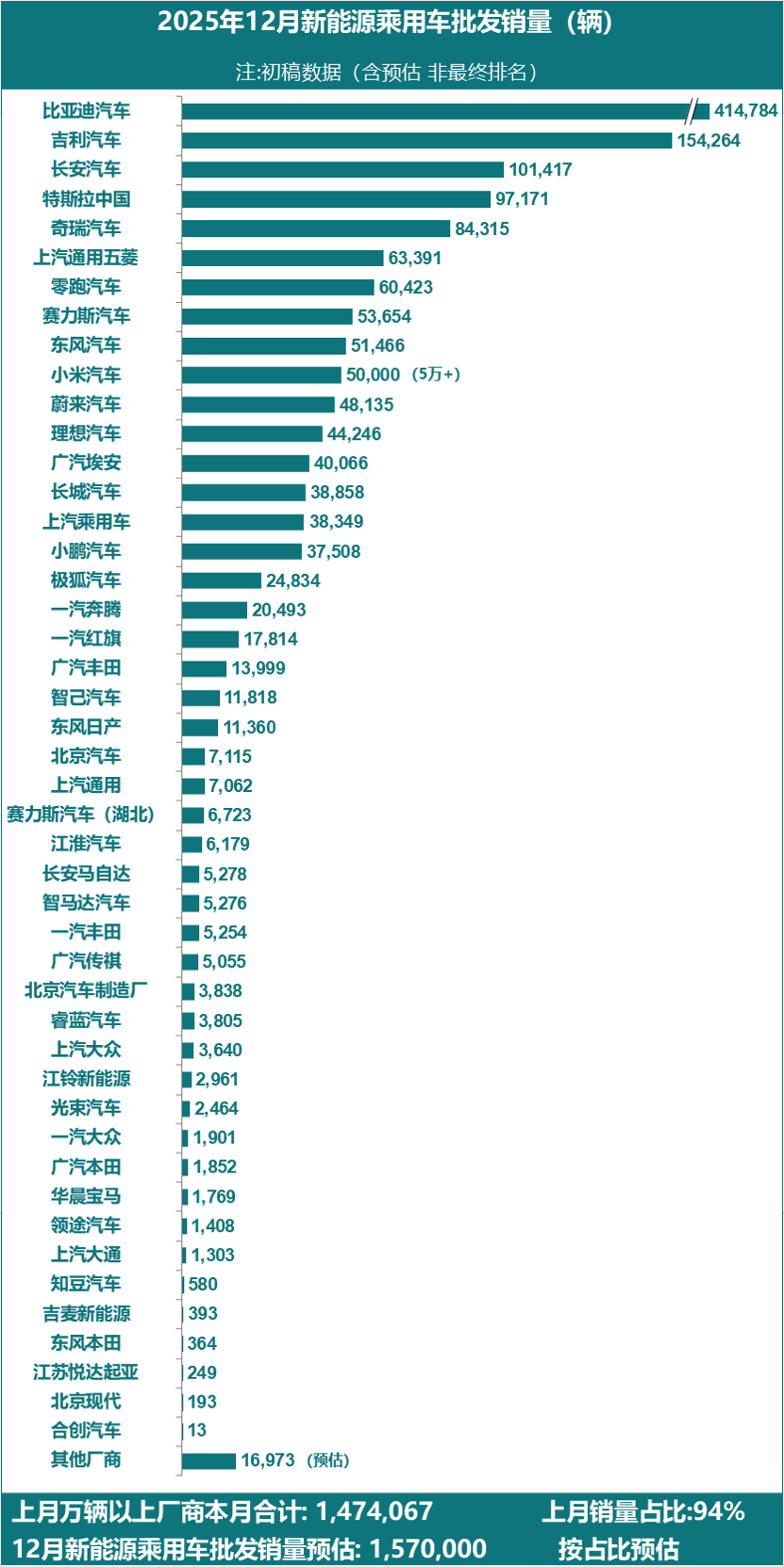
Core Insights - In December, the wholesale sales of new energy passenger vehicles in China reached 1.57 million units, marking a year-on-year growth of 4% but a month-on-month decline of 8% [1] - Cumulative wholesale sales of new energy passenger vehicles for 2025 are projected to be 15.33 million units, reflecting a year-on-year increase of 25% [1] Group 1: Market Dynamics - The expiration of the tax exemption policy for new energy vehicles at the end of the year has led to a year-end purchasing rush, although the market is experiencing significant differentiation due to adjustments in vehicle replacement and trade-in subsidies [1] - Consumer sentiment has been affected by deep adjustments in replacement and trade-in subsidies across most provinces, leading to a slowdown in the market [1] Group 2: Company Performance - Major automakers such as Tesla, Seres, NIO, and others achieved record high wholesale sales of new energy vehicles in December, contributing to structural growth in the market [1] - BYD exported 133,000 vehicles in December, a year-on-year increase of 75,000 units, significantly boosting the overall sales growth of new energy passenger vehicles by 4% [1] Group 3: Sales Data - The estimated wholesale sales of new energy passenger vehicles in December is 1,570,000 units, with major manufacturers contributing significantly to this total [2][4] - The report includes detailed sales figures for various manufacturers, indicating strong performance from companies like Changan Mazda and GAC Toyota among others [4]
乘用车板块1月5日跌0.02%,海马汽车领跌,主力资金净流出5.24亿元
Zheng Xing Xing Ye Ri Bao· 2026-01-05 08:59
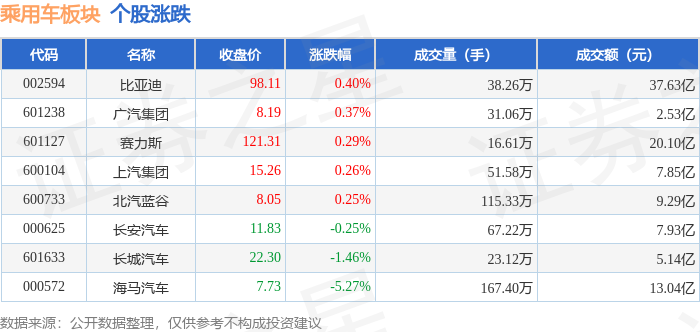
Market Overview - The passenger car sector experienced a slight decline of 0.02% on January 5, with Haima Automobile leading the drop [1] - The Shanghai Composite Index closed at 4023.42, up by 1.38%, while the Shenzhen Component Index closed at 13828.63, up by 2.24% [1] Individual Stock Performance - BYD (002594) closed at 98.11, with a gain of 0.40% and a trading volume of 382,600 shares, amounting to 3.763 billion yuan [1] - GAC Group (601238) closed at 8.19, up by 0.37%, with a trading volume of 310,600 shares, totaling 253 million yuan [1] - Seres (601127) closed at 121.31, increasing by 0.29%, with a trading volume of 166,100 shares, amounting to 2.010 billion yuan [1] - SAIC Motor (600104) closed at 15.26, up by 0.26%, with a trading volume of 515,800 shares, totaling 785 million yuan [1] - BAIC Blue Valley (600733) closed at 8.05, increasing by 0.25%, with a trading volume of 1.1533 million shares, amounting to 929 million yuan [1] - Changan Automobile (000625) closed at 11.83, down by 0.25%, with a trading volume of 672,200 shares, totaling 793 million yuan [1] - Great Wall Motors (601633) closed at 22.30, down by 1.46%, with a trading volume of 231,200 shares, totaling 514 million yuan [1] - Haima Automobile (000572) closed at 7.73, down by 5.27%, with a trading volume of 1.674 million shares, amounting to 1.304 billion yuan [1] Fund Flow Analysis - The passenger car sector saw a net outflow of 524 million yuan from institutional investors, while retail investors contributed a net inflow of 425 million yuan [1] - Notable fund flows for individual stocks include: - SAIC Motor: Institutional net inflow of 14.6084 million yuan, retail net outflow of 29.7881 million yuan [1] - GAC Group: Institutional net inflow of 5.9313 million yuan, retail net inflow of 503.72 million yuan [1] - Great Wall Motors: Institutional net inflow of 1.8031 million yuan, retail net outflow of 2.81908 million yuan [1] - BAIC Blue Valley: Institutional net outflow of 41.4566 million yuan, retail net inflow of 178.232 million yuan [1] - Changan Automobile: Institutional net outflow of 76.5608 million yuan, retail net inflow of 566.669 million yuan [1] - Seres: Institutional net outflow of 86.9124 million yuan, retail net inflow of 78.6812 million yuan [1] - BYD: Institutional net outflow of 131 million yuan, retail net inflow of 87.1496 million yuan [1] - Haima Automobile: Institutional net outflow of 211 million yuan, retail net inflow of 238 million yuan [1]






赛力斯(09927) - 截至二零二五年十二月三十一日止月份之股份发行人的证券变动月报表
2026-01-05 08:55
股份發行人及根據《上市規則》第十九B章上市的香港預託證券發行人的證券變動月報表 截至月份: 2025年12月31日 狀態: 新提交 致:香港交易及結算所有限公司 公司名稱: 賽力斯集團股份有限公司 呈交日期: 2026年1月5日 I. 法定/註冊股本變動 | 1. 股份分類 | 普通股 | 股份類別 | A | | | 於香港聯交所上市 (註1) | | 否 | | | --- | --- | --- | --- | --- | --- | --- | --- | --- | --- | | 證券代號 (如上市) | 601127 | 說明 | | | | | | | | | | | 法定/註冊股份數目 | | | 面值 | | | 法定/註冊股本 | | | 上月底結存 | | | 1,633,366,086 | RMB | | | 1 RMB | | 1,633,366,086 | | 增加 / 減少 (-) | | | | | | | RMB | | | | 本月底結存 | | | 1,633,366,086 | RMB | | | 1 RMB | | 1,633,366,086 | | 2. 股份分類 ...
新能源汽车指数上涨0.52%,磷酸铁锂平均报价持平丨行业周报
2 1 Shi Ji Jing Ji Bao Dao· 2026-01-05 05:18
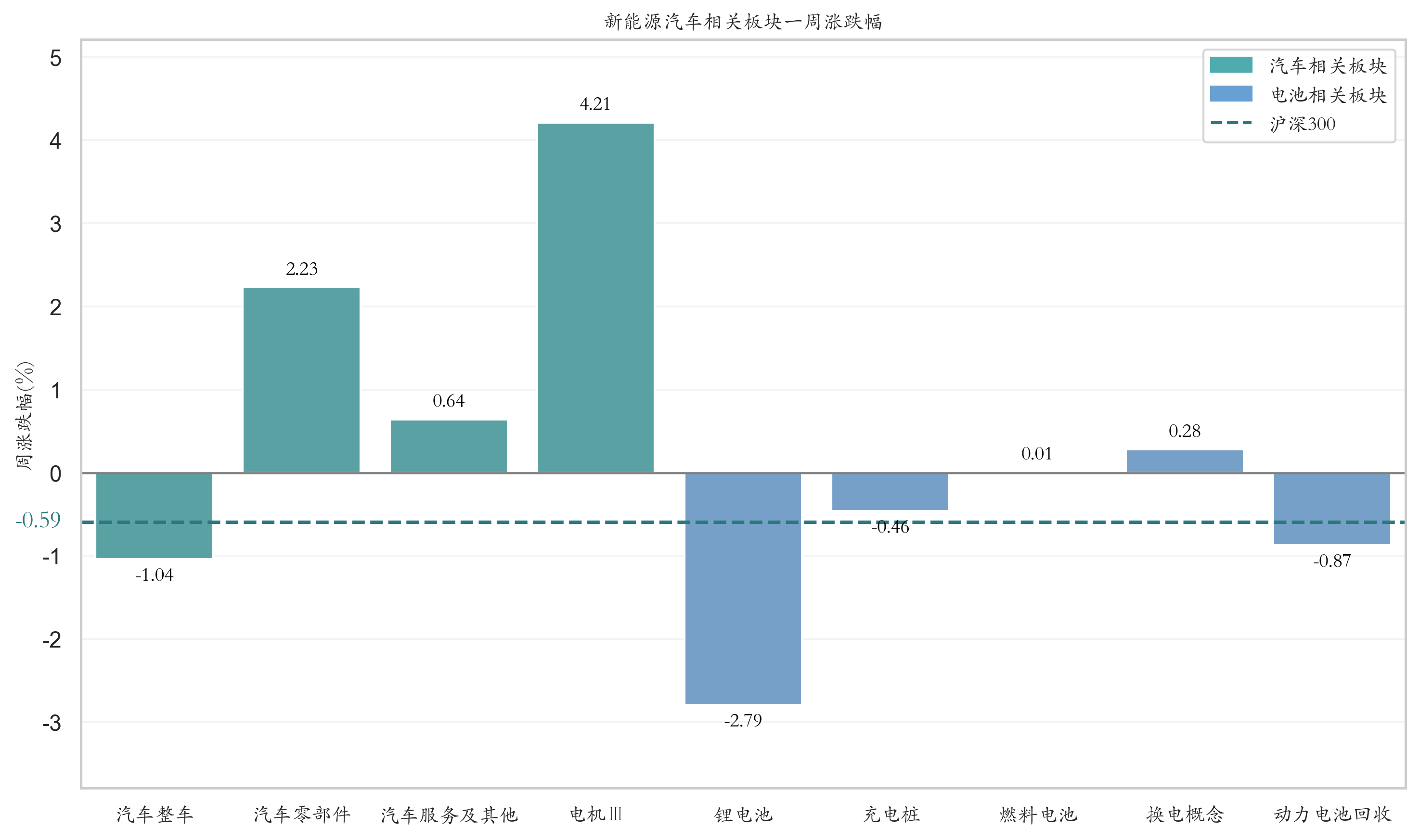
Market Performance - The New Energy Vehicle (NEV) index rose by 0.52% from December 29 to December 31, outperforming the CSI 300 index by 1.11% [1] - The best-performing sector within the automotive-related stocks was the Electric Motor III index, which increased by 4.21% [1] - Among battery-related sectors, the battery swapping concept index had a weekly increase of 0.28% [1] Company Stock Prices - Jianghuai Automobile closed at 49.5 CNY [4] - Seres closed at 120.96 CNY [4] - BYD closed at 97.72 CNY [4] - Great Wall Motors closed at 22.63 CNY [4] - Other notable companies include Changan Automobile at 11.86 CNY and BAIC Blue Valley at 8.03 CNY [4] Industry Data - In December 2025, Leap Motor delivered 60,423 vehicles, a month-on-month decrease of 14.08% but a year-on-year increase of 42.11% [37] - NIO delivered 48,135 vehicles, with a month-on-month increase of 32.69% and a year-on-year increase of 54.59% [37] - Li Auto delivered 44,246 vehicles, showing a month-on-month increase of 33.35% but a year-on-year decrease of 24.38% [37] - Other brands' performance included Aion with 40,066 vehicles and Xpeng with 37,508 vehicles [37] Material Prices - As of December 31, 2025, the average price of battery-grade lithium hydroxide was 114,700 CNY/ton, up by 7,100 CNY/ton from December 26 [13] - Battery-grade cobalt sulfate averaged 93,000 CNY/ton, increasing by 500 CNY/ton [15] - The price of battery-grade nickel sulfate was 27,050 CNY/ton, up by 150 CNY/ton [17] - Lithium iron phosphate remained stable at 45,100 CNY/ton [19] - The price of ternary precursor 811 was 111,500 CNY/ton, up by 1,000 CNY/ton [22] - The price of ternary materials 811 was 173,500 CNY/ton, increasing by 2,000 CNY/ton [25] - The price of dry separator film was stable at 0.42 CNY/sqm, while wet separator film increased by 0.03 CNY/sqm [28] - The price of lithium hexafluorophosphate remained at 180,000 CNY/ton [31]