郑州银行

Search documents
低价股一览 29股股价不足2元
Zheng Quan Shi Bao Wang· 2026-01-23 09:30
Group 1 - The average stock price of A-shares is 14.84 yuan, with 29 stocks priced below 2 yuan, the lowest being *ST Aowei at 0.73 yuan [1] - Among the low-priced stocks, 8 are ST stocks, accounting for 27.59% of the total [1] - In terms of market performance, 26 of the low-priced stocks increased in price, with *ST Changyao, *ST Lifang, and Yabo shares leading the gains at 19.48%, 13.91%, and 10.06% respectively [1] Group 2 - The stock price rankings of low-priced stocks show *ST Aowei at 0.73 yuan with a daily decline of 5.19%, while *ST Changyao and *ST Lifang have daily increases of 19.48% and 13.91% respectively [1] - The trading volume for *ST Changyao is notable with a turnover rate of 19.92%, while *ST Lifang has a turnover rate of 26.78% [1] - Other low-priced stocks include *ST Jinke at 1.49 yuan and Chongqing Steel at 1.54 yuan, with respective daily changes of 0.68% and 2.67% [1]




城商行板块1月23日跌1.01%,上海银行领跌,主力资金净流入1.48亿元
Zheng Xing Xing Ye Ri Bao· 2026-01-23 09:04
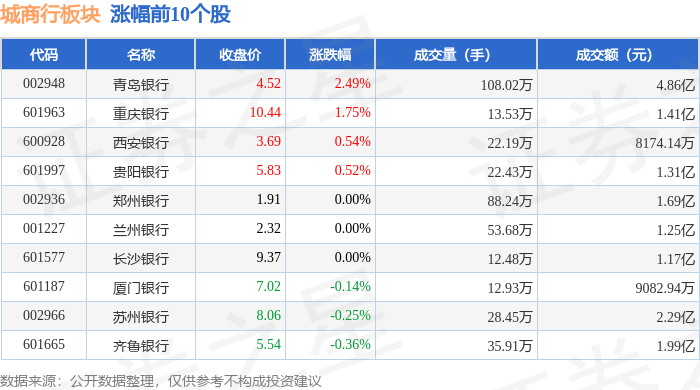
证券之星消息,1月23日城商行板块较上一交易日下跌1.01%,上海银行领跌。当日上证指数报收于 4136.16,上涨0.33%。深证成指报收于14439.66,上涨0.79%。城商行板块个股涨跌见下表: | 代码 | 名称 | 收盘价 | 涨跌幅 | 成交量(手) | 成交额(元) | | --- | --- | --- | --- | --- | --- | | 002948 | 青岛银行 | 4.52 | 2.49% | 108.02万 | 4.86亿 | | 601963 | 重庆银行 | 10.44 | 1.75% | 13.53万 | 1.41亿 | | 600928 | 西安银行 | 3.69 | 0.54% | 22.19万 | 8174.14万 | | 601997 | 豊阳银行 | 5.83 | 0.52% | 22.43万 | 1.31亿 | | 002936 | 郑州银行 | 1.91 | 0.00% | 88.24万 | 1.69亿 | | 001227 | 兰州银行 | 2.32 | 0.00% | 53.68万 | 1.25亿 | | 601577 | 长沙银行 | 9.37 | ...


1月20日贷款财政贴息四项政策点评:“一揽子”贷款财政贴息政策影响几何?
EBSCN· 2026-01-21 11:17
Investment Rating - The report maintains a "Buy" rating for the banking industry, indicating an expected investment return exceeding the market benchmark index by more than 15% over the next 6-12 months [29] Core Insights - The "package" loan interest subsidy policies aim to stimulate consumption and investment, focusing on enhancing effective domestic demand through financial and fiscal collaboration [2][7] - The new policies are expected to significantly increase the scale of interest subsidies compared to previous measures, with a projected subsidy scale of approximately 1000 to 2000 billion yuan for 2026 [17][19] Summary by Sections Loan Subsidy Policies - The policies include four main areas: subsidies for small and micro enterprises, equipment updates, service industry operators, and personal consumption loans, with a focus on key industries such as new energy vehicles and medical equipment [4][6] - The subsidy rate for small and micro enterprise loans is set at 1.5 percentage points, with a maximum loan amount of 50 million yuan per entity, potentially providing up to 150,000 yuan in subsidies [4][6] - The equipment update loan subsidy has been increased from 1% to 1.5%, expanding the scope to include technology innovation loans and related fields [4][6] - The personal consumption loan subsidy has removed previous restrictions, allowing for broader eligibility and a maintained subsidy rate of 1% [5][6] Economic Impact - The policies are designed to alleviate financial burdens on small and micro enterprises, encouraging investment and job stability, particularly in high-tech and essential service sectors [7][8] - The expected increase in loan demand from these sectors is anticipated to support the overall credit recovery in the economy, particularly for retail and service industries [7][8] Market Outlook - The report suggests that the coordinated fiscal and monetary policies will positively impact the banking sector's loan volume and pricing, particularly benefiting banks focused on small and micro enterprises and retail finance [23] - The banking sector has seen a decline in stock performance, and the new policies are expected to act as a catalyst for recovery, especially in the context of the "opening red" period for banks [23]
城商行板块1月21日跌0.55%,重庆银行领跌,主力资金净流入5.08亿元
Zheng Xing Xing Ye Ri Bao· 2026-01-21 08:54
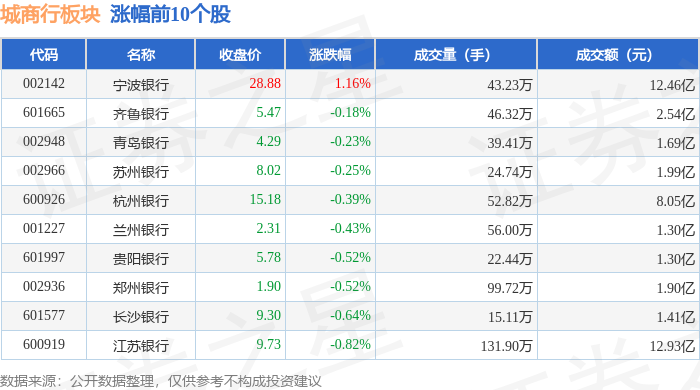
Market Overview - The city commercial bank sector experienced a decline of 0.55% on January 21, with Chongqing Bank leading the drop [1] - The Shanghai Composite Index closed at 4116.94, up 0.08%, while the Shenzhen Component Index closed at 14255.12, up 0.7% [1] Individual Stock Performance - Ningbo Bank closed at 28.88, with an increase of 1.16% and a trading volume of 432,300 shares, amounting to a transaction value of 1.246 billion [1] - Chongqing Bank closed at 10.25, down 1.82%, with a trading volume of 106,800 shares and a transaction value of 110 million [2] - Other notable performers include Xiamen Bank, which closed at 7.13, down 1.66%, and Chengdu Bank, which closed at 15.72, down 1.38% [2] Capital Flow Analysis - The city commercial bank sector saw a net inflow of 508 million from institutional investors, while retail investors experienced a net outflow of 566 million [2] - The capital flow for individual stocks indicates that Hangzhou Bank had a net inflow of 158 million from institutional investors, while it faced a net outflow of 86.5 million from retail investors [3] - Shanghai Bank also saw a net inflow of 107 million from institutional investors, with a net outflow of 121 million from retail investors [3]



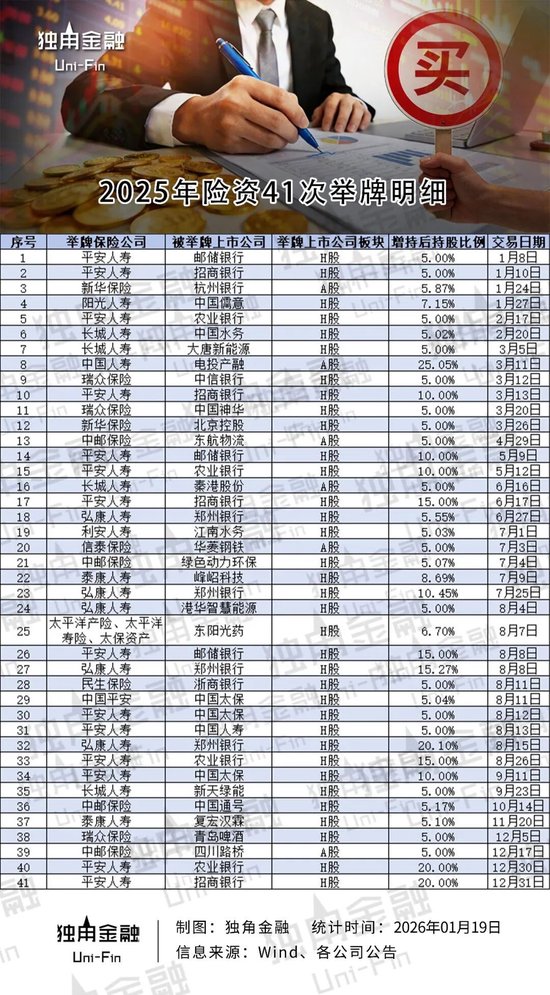
狂揽港股!险资一年41次举牌背后的资本盛宴
Xin Lang Cai Jing· 2026-01-19 12:23
Core Viewpoint - Insurance capital is transitioning from a "barbarian at the gate" to a "strategist in the boardroom," with a focus on long-term investments rather than short-term financial gains, as evidenced by a record 41 public shareholding increases in 2025, the highest in nearly a decade [1][16][19] Group 1: Investment Trends - In 2025, insurance capital engaged in 41 public shareholding increases, more than double the average of recent years, indicating a significant shift in investment strategy [2][16] - The majority of these shareholding increases (over 85%) occurred in H-shares, driven by their substantial valuation discounts and smoother acquisition mechanisms [1][19] - Insurance companies are increasingly focusing on financial stocks, particularly banks, as they seek certainty, safety, and valuation flexibility in a complex market environment [1][9] Group 2: Regulatory Environment - Recent regulatory changes have opened up opportunities for insurance capital in equity investments, shifting from restrictions to encouragement of long-term investments [4][18] - The optimization of solvency regulatory standards has expanded the space for equity investments, allowing insurance companies to better match their long-term liabilities with asset returns [4][18] Group 3: Financial Performance - Insurance companies have reported significant increases in investment income, with 11 companies showing positive growth in 2025, including a remarkable 687.16% increase for New China Life [11][26] - The overall investment yield for major insurers has risen, with Ping An Life and China Life reporting increases exceeding 400% in investment income [12][26] Group 4: Strategic Focus - Insurance capital is not only focusing on traditional financial sectors but is also investing in high-tech fields such as renewable energy, advanced manufacturing, and biotechnology, reflecting a strategic alignment with national economic transformation [9][23] - The long-term nature of insurance capital aligns well with companies that have solid fundamentals and stable cash flows, allowing insurers to share in corporate growth and dividends [3][17]




“豫字号”能源航母扬帆启航(开局就是奋斗 起步就要奋进)
He Nan Ri Bao· 2026-01-16 22:47
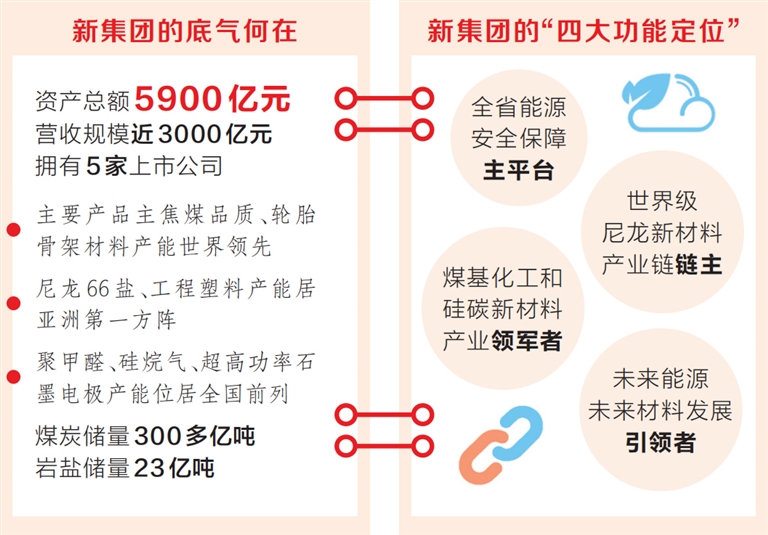
Core Viewpoint - The establishment of China Pingmei Shenma Group marks a significant strategic restructuring in the Henan energy sector, aiming to enhance resource integration and address industry challenges [3][5]. Group 1: Company Overview - The newly formed China Pingmei Shenma Group has total assets of 590 billion yuan and an annual revenue scale of nearly 300 billion yuan, with five listed companies under its umbrella [4][8]. - The group possesses over 28 billion tons of coal reserves and is a leader in various product categories, including high-quality coking coal and nylon 66 salt production [8]. Group 2: Strategic Objectives - The restructuring aims to create a major platform for energy security in Henan, lead the nylon new materials industry, and position itself as a leader in coal-based chemicals and silicon-carbon materials [6]. - The strategic focus includes enhancing the coal and chemical industries, promoting clean energy development, and integrating wind, solar, and storage solutions [5][6]. Group 3: Market Response and Collaborations - Following the restructuring, the group has secured over 23 billion yuan in new credit lines from various financial institutions, indicating strong market confidence [7]. - Collaborations with local enterprises in energy, chemical, and equipment manufacturing sectors are being established to foster regional economic growth [7]. Group 4: Green Transition Initiatives - The restructuring emphasizes green transformation, with significant investments in projects aimed at enhancing safety and environmental technology [7]. - The group is actively developing a "green mine" and "green factory" initiatives, contributing to low-carbon practices and gaining international attention [7].
中国平煤神马集团揭牌 近6000亿元规模能源化工“新航母”启航
Shang Hai Zheng Quan Bao· 2026-01-16 18:40
Core Viewpoint - The establishment of China Pingmei Shenma Group marks a significant milestone in the strategic restructuring of Henan Energy Group and Pingmei Shenma Group, creating a new energy and chemical industry giant with an asset scale of nearly 600 billion yuan and an annual revenue of approximately 300 billion yuan [1][2]. Group 1: Restructuring Overview - The restructuring is the largest competitive enterprise asset restructuring in Henan's history, aimed at resource integration and overcoming industrial development bottlenecks [1][2]. - The merger combines Henan Energy Group's focus on coal and gasification with Pingmei Shenma Group's coal coking industry, creating a complementary industrial structure [1][2]. Group 2: Financial and Operational Details - Post-restructuring, the total assets of China Pingmei Shenma Group reach 590 billion yuan, with a revenue scale of about 300 billion yuan, and it controls five A-share listed companies [2]. - The group has significant market positions in various sectors, including leading quality in main coking coal, nylon 66 salt, and engineering plastics, with coal reserves exceeding 30 billion tons [2]. Group 3: Governance and Strategic Direction - The governance structure of China Pingmei Shenma Group has been established, with key leadership appointments made, including Li Mao as Chairman and Yang Heng as General Manager [3]. - The company will focus on energy and functional materials, emphasizing smart empowerment, green transformation, and integrated innovation, with plans to develop special nylon fibers, hydrogen energy, and new energy storage [4].
城商行板块1月16日跌1.27%,江苏银行领跌,主力资金净流出2.29亿元
Zheng Xing Xing Ye Ri Bao· 2026-01-16 08:56
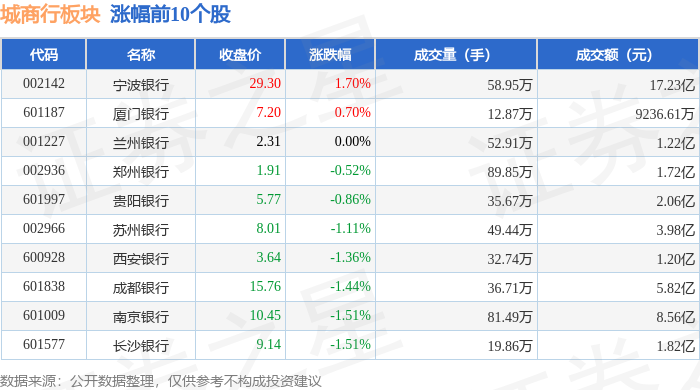
Core Viewpoint - The city commercial bank sector experienced a decline of 1.27% on January 16, with Jiangsu Bank leading the drop. The Shanghai Composite Index closed at 4101.91, down 0.26%, while the Shenzhen Component Index closed at 14281.08, down 0.18% [1]. Group 1: Stock Performance - Ningbo Bank closed at 29.30, up 1.70% with a trading volume of 589,500 shares and a transaction value of 1.723 billion [1]. - Xiamen Bank closed at 7.20, up 0.70% with a trading volume of 128,700 shares and a transaction value of 92.3661 million [1]. - Jiangsu Bank closed at 9.76, down 2.69% with a trading volume of 2,061,300 shares and a transaction value of 2.033 billion [2]. - Shanghai Bank closed at 9.64, down 2.43% with a trading volume of 961,200 shares and a transaction value of 933.3 million [2]. Group 2: Capital Flow - The city commercial bank sector saw a net outflow of 229 million from main funds, while speculative funds had a net inflow of 716 million, and retail investors experienced a net outflow of 487 million [2]. - Hangzhou Bank had a main fund net inflow of 153 million, while retail investors saw a net outflow of 113 million [3]. - Nanjing Bank recorded a main fund net inflow of 70.5 million and a retail net outflow of 131 million [3].

郑州银行:公司将加强与各类科技型企业的业务合作
Zheng Quan Ri Bao Wang· 2026-01-15 11:43
Core Viewpoint - Zhengzhou Bank (002936) aims to enhance its financial service capabilities in technological innovation and strengthen business cooperation with various technology enterprises to provide robust financial service support [1] Company Summary - Zhengzhou Bank is committed to improving its financial services by focusing on technological innovation [1] - The bank plans to collaborate with different technology companies to ensure effective financial service delivery [1]
城商行板块1月15日跌0.59%,青岛银行领跌,主力资金净流入2.21亿元
Zheng Xing Xing Ye Ri Bao· 2026-01-15 08:59
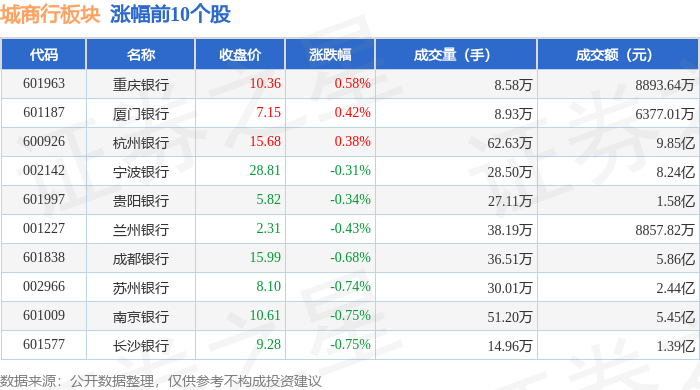
Market Performance - The city commercial bank sector declined by 0.59% on January 15, with Qingdao Bank leading the decline [1] - The Shanghai Composite Index closed at 4112.6, down 0.33%, while the Shenzhen Component Index closed at 14306.73, up 0.41% [1] Individual Stock Performance - Chongqing Bank closed at 10.36, up 0.58% with a trading volume of 85,800 shares and a transaction value of 88.94 million [1] - Xiamen Bank closed at 7.15, up 0.42% with a trading volume of 89,300 shares and a transaction value of 63.77 million [1] - Hangzhou Bank closed at 15.68, up 0.38% with a trading volume of 626,300 shares and a transaction value of 9.85 billion [1] - Ningbo Bank closed at 28.81, down 0.31% with a trading volume of 285,000 shares and a transaction value of 824 million [1] - Chengdu Bank closed at 15.99, down 0.68% with a trading volume of 365,100 shares and a transaction value of 586 million [1] Capital Flow Analysis - The city commercial bank sector saw a net inflow of 221 million from institutional investors and a net inflow of 296 million from speculative funds, while retail investors experienced a net outflow of 517 million [2] - Hangzhou Bank had a net inflow of 123 million from institutional investors, accounting for 12.51% of its total [3] - Shanghai Bank had a net inflow of 97.02 million from institutional investors, representing 20.87% of its total [3] - Nanjing Bank had a net inflow of 37.40 million from institutional investors, making up 6.86% of its total [3]