PDVSA

Search documents
Holiday Markets Eye War Risks but Oil Refuses to Break Out
Yahoo Finance· 2025-12-30 15:30
Group 1: Venezuela Oil Production - Venezuela's state oil company PDVSA is beginning to shut down wells in the Orinoco Belt due to the impact of Donald Trump's maximum pressure strategy, which has led to swelling inventories and ongoing tanker seizures [3] - PDVSA plans to reduce output in the Orinoco Belt by at least 25% to 500,000 barrels per day (b/d), which could reduce Venezuela's total liquids production by approximately 15% [4] - Venezuela's oil production had been growing, with a November average of 1.165 million b/d representing a 20% year-over-year increase [3] Group 2: Market Movements - Woodside Energy signed a 9-year LNG supply deal starting from 2030 to deliver around 5.8 billion cubic meters of liquefied gas from its Louisiana LNG project [6] - Chevron has reported first oil from its South N'dola project offshore Angola, aiming for a peak output of 25,000 b/d of crude and 50 million cubic feet per day of natural gas [6] - Russia's government has extended the deadline for ExxonMobil to sell its 30% stake in the Sakhalin-I project by another year, indicating a potential re-integration of the US oil major into the new shareholding structure post-conflict [7] Group 3: Geopolitical Influences - Ongoing geopolitical tensions, including the Russia-Ukraine conflict, are affecting oil prices, with ICE Brent capped at $62 per barrel amid stalled peace talks [9] - An all-out war in Yemen could introduce new geopolitical risks to oil, although the physical impact remains uncertain [9] Group 4: Saudi Arabia's Pricing Strategy - Saudi Aramco is expected to cut its formula prices for February-loading cargoes to Asia by up to 30 cents per barrel, continuing to lower prices despite having reached a 5-year low last month [10]
Venezuela Starts Cutting Oil Production Amid U.S. Blockade
Yahoo Finance· 2025-12-30 07:30
Venezuela has begun shutting wells that pump extra-heavy crude in the Orinoco Belt, as the U.S. blockade is squeezing shipments and filling up storage space, sources with knowledge of the plans of state oil firm PDVSA told Bloomberg. PDVSA, the key handler of Venezuela’s crude exports, mostly to China, began disabling producing wells in the Orinoco Belt two days ago, following a decision taken on December 23, according to Bloomberg’s anonymous sources. The state oil firm will look to shut in about 15% ...
National Oil Companies Quietly Set The Pace For The Next Decade
Yahoo Finance· 2025-12-27 00:00
Core Insights - The article highlights a significant shift in the strategies of national oil companies (NOCs) in Asia, particularly PetroChina, which is diversifying into transition materials and securing long-term supply deals in LNG to hedge against future energy demands [1][2][3] Group 1: NOCs Strategies - Asian NOCs are not reducing their focus on hydrocarbons but are tightening control over critical supply chain segments such as gas, chemicals, and metals, with PetroChina leading the way by investing more in downstream and gas [3][4] - OPEC's medium-term outlook indicates that most incremental supply growth will come from state-backed producers, emphasizing the importance of NOCs for long-cycle investments [5][6] - National oil companies are outspending major listed companies and securing supply chains more effectively due to political backing and lower costs [7] Group 2: Regional Developments - In the Middle East, NOCs are expanding low-cost supply and increasing integration across refining, petrochemicals, and LNG, with ADNOC planning significant expansions in gas and LNG capacity by 2035 [12][14][16] - Latin American NOCs like Petrobras are focusing on maintaining production while managing tight budgets, with Petrobras planning $109 billion in investments primarily in pre-salt output [18][20] - African NOCs are pushing for more control over local projects, with Nigeria's NNPC achieving its highest output in over 30 years and other countries like Mozambique and Senegal focusing on gas projects for export income [22][23][24] Group 3: North America as a Strategic Market - North America is becoming a key market for foreign NOCs to diversify risk and secure stable cash flows, with Gulf producers like ADNOC using equity positions in U.S. gas and LNG as part of their long-term strategy [26][28][29] - The region is viewed as a stable environment for long-life assets, making it attractive for NOCs to invest and broaden their portfolios [28][30]

【沥青日报】沥青BU震荡徘徊3000附近,美国表态对委油实施隔离
Xin Lang Cai Jing· 2025-12-25 23:10
Market Performance - The BU 2602 contract experienced intraday fluctuations, closing at 2995 with a gain of 0.17%, reaching a high of 3010 and a low of 2983, with a cumulative increase of 3.6% over the past week [2][29] - The next month contract 2603 saw a slight decline of 0.03%, maintaining a contango structure with lower near-term prices compared to longer-term prices [2][29] Spot Market - The price of heavy asphalt in Shandong remained stable at 2920 yuan/ton, with no change week-on-week and a cumulative increase of 0% over the past week [2][29] - In East China, the heavy asphalt price was 3090 yuan/ton, also unchanged, while the basis in Shandong was -75 yuan/ton, down 101 yuan/ton over the past week [2][29] Crack Spread Changes - The BU-Brent spread recorded -189 yuan/ton, with a cumulative increase of 1 yuan/ton over the past week, while the BU main contract rose by 0.17% and Brent remained unchanged [2][29] - Oil prices are influenced by geopolitical disturbances in Venezuela, leading to short-term price stabilization but with ongoing uncertainty [2][29] Fundamental Changes - Recent developments regarding Venezuelan oil exports remain a key risk factor, with U.S. military orders for a two-month "quarantine" on Venezuelan oil, following a comprehensive blockade initiated by Trump [3][30] - Venezuela's oil exports are hindered by sanctions, forcing oil to be stored on tankers, with China being the primary destination for approximately 80% of Venezuelan oil exports, indicating a high dependency of Chinese refineries on Venezuelan crude [3][30] Supply and Inventory - The dilution asphalt discount widened, with Malaysia's dilution asphalt discount recorded at -14.46 USD/barrel as of December 24, compared to -13.46 USD/barrel a week earlier [4][31] - Total social and domestic inventory data recorded 642,000 tons, reflecting a 0.9% increase week-on-week, indicating a slow inventory reduction [4][31] Short-term Outlook - Asphalt prices have slightly increased since early December, fluctuating around 3000, with significant volatility observed [5][32] - Downstream road demand is in a seasonal lull, maintaining a weak price outlook, constrained by reduced demand and inventory pressures, with attention on winter storage trends [5][32] Strategy - The recommended strategy is to adopt a wide-ranging single-sided trading approach [6][33]


沥青BU尾盘高位回落,短期多头交易委油制裁题材
Xin Lang Cai Jing· 2025-12-24 23:21
Market Performance - The BU 2602 contract experienced intraday fluctuations, closing at 2996 with a gain of 0.27%, reaching a high of 3004 and a low of 2975, accumulating a 1.3% increase over the past week [2][32] - The next month contract 2603 saw a slight increase of 0.13%, maintaining a contango structure with near low and far high prices [2][32] Spot Market - The price of Shandong heavy asphalt remained stable at 2920 CNY/ton, with a 7-day cumulative change of 0% [2][34] - In East China, heavy asphalt is priced at 3090 CNY/ton, also unchanged, with a basis of 94 CNY/ton, reflecting a 7-day cumulative decrease of 93 CNY/ton [2][34] Crack Spread Changes - The BU-Brent spread recorded -71 CNY/ton, with a 7-day cumulative increase of 46 CNY/ton [2][34] - The main BU contract rose by 0.27%, while Brent increased by 0.2%, indicating a stable oil price influenced by geopolitical disturbances in Venezuela [2][34] Fundamental Changes - Venezuela's oil export issues remain a key risk, with sanctions causing oil to be stored on tankers. Chevron is allowed limited operations, but the majority of oil is supplied by PDVSA to China, which imports about 80% of Venezuela's crude [3][33] - Disruptions in Venezuelan supply could impact China's heavy oil and asphalt supply, potentially tightening regional availability and supporting asphalt prices [3][33] Inventory and Price Trends - The dilution asphalt discount widened to -14.03 USD/barrel as of December 23, compared to -13.46 USD/barrel a week earlier [4][34] - Total social and domestic inventory data recorded 642,000 tons, reflecting a 0.9% week-over-week increase, indicating a slow destocking trend [4][34] Strategy - The current strategy suggests a wide-ranging single-sided fluctuation in asphalt prices [6][35]
Oil Prices Hold Gains as Markets Focus on Supply Fears and Economic Strength
Yahoo Finance· 2025-12-24 06:14
Group 1: Oil Price Movements - Oil prices have stabilized after recent gains, with Brent crude at $62.46 and West Texas Intermediate at $58.48, both up over 4.5% in the last five trading days due to geopolitical risks [1] - Robust U.S. economic data has supported the rally, with the economy growing at its fastest pace in two years in Q3, driven by strong consumer spending and rebounding exports [2] Group 2: Supply and Inventory Dynamics - Preliminary data indicates a build in U.S. crude stocks, with a rise of about 2.4 million barrels reported by the American Petroleum Institute [3] - Venezuela's legislature has passed a law criminalizing actions against its shipping, which may impact supply dynamics amid U.S. sanctions enforcement [4] - Multiple vessels carrying Venezuelan crude are currently anchored offshore due to onshore tank storage filling up, indicating a growing export bottleneck that could tighten supply flows [5] Group 3: Geopolitical Risks - Ongoing Russian attacks on Ukraine continue to create uncertainty, with fading optimism over peace talks potentially leading to higher oil prices if Russian supply does not return to the market [6] - Despite supply risks, there are persistent concerns about excess crude inventories and a structural surplus, with long-term forecasts suggesting global oil inventories may continue to rise through 2026, potentially exerting downward pressure on prices [7]
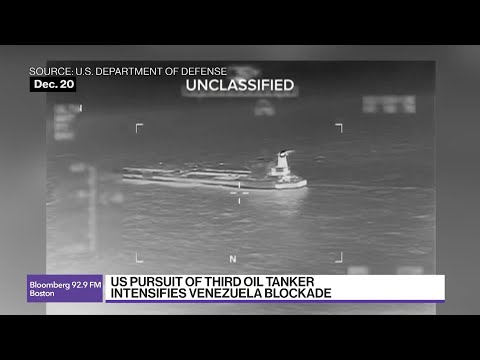
US Pursuit of Third Oil Tanker Deepens Venezuela Blockade
Bloomberg Television· 2025-12-22 20:17
Venezuela Situation & US Policy - The US administration's strategy towards Venezuela is unclear, specifically how to transition from current pressure to desired outcomes [2][3] - The US is employing "maximum pressure" tactics, including boarding tankers and targeting alleged drug boats in the Caribbean and Eastern Pacific [4][5] - The legality of seizing tankers, especially those not officially sanctioned, is questionable, with the focus potentially shifting to the oil cargo itself [6][7] - Despite sanctions, some legal oil tankers continue to operate out of Venezuela, with approximately one-fifth of Venezuelan oil still processed in the US by companies like Chevron [8] - Shippers are increasingly hesitant to transport Venezuelan oil due to the risks involved [9] - Chevron operates in Venezuela under a general license, processing the country's "sour" and "sludgy" oil, which is difficult to refine elsewhere [8][10] - The US is calling its actions a "quarantine" rather than a "blockade" to avoid the implications of an act of war [11] Greenland & US Interests - President Trump has not abandoned the idea of acquiring Greenland and continues to pressure the issue [15][16] - The appointment of Louisiana Governor Jeff Landry as a special envoy related to Greenland raises questions about the administration's intentions [13] - The administration's focus on Greenland may or may not be a distraction from other issues [14]
US Pursuit of Third Oil Tanker Deepens Venezuela Blockade
Youtube· 2025-12-22 20:17
Group 1: U.S. Policy on Venezuela - The U.S. administration views Maduro as an obstacle to Venezuela's future, with some officials explicitly stating that he must go [2][4] - There is ongoing pressure on Venezuelan tankers and strikes on alleged narco-traffickers, but the overall strategy remains unclear [3][4] - The administration is employing a "maximum pressure" approach, which has been a key term in U.S. foreign policy [4] Group 2: Legal and Operational Challenges - The legality of actions against tankers is under scrutiny, as the administration pushes the boundaries of acceptable legal practices [6][7] - Despite sanctions, a significant portion of Venezuelan oil is still processed in the U.S., with Chevron continuing operations in partnership with PDVSA [8][10] - Many shippers are turning their tankers around due to perceived risks associated with transporting Venezuelan oil [9][12] Group 3: Greenland and U.S. National Security - The appointment of Jeff Landry as a special envoy for Greenland indicates the administration's ongoing interest in the territory, which is tied to national security [13][15] - There is speculation about whether the focus on Greenland is a distraction from other issues or a genuine policy initiative [14][16] - The administration's persistent interest in Greenland suggests that it remains a strategic priority, despite mixed reactions from Republicans [15][16]
石油市场周报:壁垒后的原油 -委内瑞拉与俄罗斯-Oil Markets Weekly_ Barrels behind barriers—Venezuela and Russia
2025-12-22 14:29
Summary of Key Points from the Conference Call Industry Overview - The conference call primarily discusses the oil markets, focusing on Venezuela and Russia, and the implications of U.S. sanctions on their oil exports [1][2][3]. Core Insights and Arguments - **Sanctions on Venezuela**: The recent drop in WTI oil prices to $55/bbl has prompted the Trump administration to consider enforcing sanctions on Venezuelan oil exports. The administration may monitor Venezuelan tankers or implement stricter sanctions, but the extent of enforcement remains uncertain [1][2][4]. - **Quantitative Impact of Sanctions**: The term "sanctioned" in Trump's statement limits the blockade's impact to approximately 0.4 million barrels per day (mbd) of Venezuela's heavy crude exports and 0.1 mbd of product exports, primarily fuel oil [1][5]. - **U.S. Military Presence**: An increased U.S. military presence in the Caribbean is noted, which may influence oil futures and suggests a potential political transition in Venezuela [1][7]. - **Russian Oil Exports**: Despite sanctions, Russian crude exports are estimated at around 3.5 mbd in December, only slightly below previous highs. Product exports have also recovered to approximately 2.1 mbd, supported by refinery throughput of 5.3–5.4 mbd [1][21]. - **Sanctions' Effect on Trading Structures**: Sanctions have altered trading structures rather than significantly reducing export volumes. Exports are being rerouted through new intermediaries, which increases transaction costs and clearance times [1][22][28]. - **Economic Pressure on Russia**: Russia's upstream sector is experiencing declining gross profits, dropping from about $57/bbl at the start of 2025 to below $30/bbl now. This trend may have more significant long-term implications than the sanctions themselves [1][34]. Additional Important Insights - **Potential for Venezuelan Production Recovery**: In a post-Maduro scenario, production could initially drop by up to 50% due to operational disruptions but may rebound to around 1.2 mbd within months if political stability is restored [1][11][16]. - **Investment Opportunities**: The return of former partners, including Chinese companies, could lead to increased production levels in Venezuela, contingent on political changes and new investments [1][15]. - **Long-term Outlook**: The oil supply and demand balance for 2025 and beyond indicates a potential increase in global oil supply, with Venezuela representing a significant upside risk if political conditions improve [1][37][38]. This summary encapsulates the critical points discussed in the conference call, highlighting the current state of the oil markets concerning Venezuela and Russia, the implications of U.S. sanctions, and potential future developments in the industry.

Chevron Keeps Venezuelan Oil Flowing Despite Rising U.S. Pressure
ZACKS· 2025-12-22 14:01
Core Insights - Chevron Corporation (CVX) continues to operate in Venezuela, successfully loading shipments despite U.S. sanctions and geopolitical tensions [1][2][3] - The company has a U.S. license allowing it to extract and export crude oil from Venezuela, which has some of the largest oil reserves globally [2][6] - Venezuela's crude oil production has significantly declined, with output estimated at 860,000 barrels per day in November, down from over 1 million barrels per day in September [4][9] Chevron's Operations - CVX has loaded cargo onto the vessels Searuby and Minerva Astra, with one shipment set to export 1 million barrels of crude oil [1][9] - The company maintains compliance with U.S. regulations and sanctions, allowing it to continue operations without legal repercussions [6][12] - CVX's ability to navigate international regulations has enabled it to maintain a foothold in Venezuela's oil industry, unlike other companies facing stricter sanctions [7][12] Venezuela's Oil Industry Challenges - Venezuela's oil production is hindered by aging infrastructure, financial difficulties, and a lack of foreign investment [4][16] - U.S. sanctions have significantly impacted Venezuela's ability to sell oil internationally, contributing to the production decline [5][10] - The activation of a U.S. naval blockade has further complicated Venezuela's oil exports, forcing many tankers to avoid Venezuelan waters [10][11] Future Outlook - Despite current challenges, there is potential for recovery in Venezuela's oil industry if international investment can be attracted and sanctions circumvented [16][17] - CVX's strategic approach may serve as a model for other companies looking to engage with Venezuela's oil sector [15][17]