同花顺

Search documents
互联网券商“三剑客”业绩大比拼
2 1 Shi Ji Jing Ji Bao Dao· 2025-11-06 23:10
Core Insights - The internet brokerage firms known as the "Three Musketeers" (Dongfang Caifu, Tonghuashun, and Dazhihui) have all reported increases in both revenue and net profit for the third quarter of this year, benefiting from a resurgence in market trading activity [1][3][4] Financial Performance - In the first three quarters of the year, the average daily trading volume in the stock market reached 18,723 billion yuan, a year-on-year increase of 108.6%, with new account openings totaling 20.15 million, up 50% year-on-year [3] - Dongfang Caifu led in revenue with 11.589 billion yuan, which is over 3.5 times that of Tonghuashun (3.261 billion yuan) and over 20 times that of Dazhihui (564 million yuan) [4] - Revenue growth rates for the three firms were 58.67% for Dongfang Caifu, 39.67% for Tonghuashun, and 8.78% for Dazhihui [4] - Net profits for the three firms were 9.097 billion yuan for Dongfang Caifu, 1.206 billion yuan for Tonghuashun, and a loss of 29.562 million yuan for Dazhihui, with year-on-year growth rates of 50.57%, 85.29%, and 85.30% respectively [4] Quarterly Performance - In the third quarter alone, Dongfang Caifu, Tonghuashun, and Dazhihui achieved revenues of 4.733 billion yuan, 1.481 billion yuan, and 185 million yuan respectively, with year-on-year growth rates of 100.65%, 56.72%, and 0.73% [5] - Net profits for the third quarter were 3.530 billion yuan for Dongfang Caifu, 704 million yuan for Tonghuashun, and a loss of 26.092 million yuan for Dazhihui, with year-on-year growth rates of 77.74%, 144.50%, and 58.85% respectively [5] Business Models - Dongfang Caifu's revenue is primarily derived from securities-related businesses, with nearly 80% of its income coming from this sector, including significant contributions from commission and interest income [7][8] - Tonghuashun's revenue is concentrated in internet financial information services, with growth driven by value-added telecommunications services and advertising [8][9] - Dazhihui's revenue relies on traditional financial information services, with a focus on VIP products and advertising, but it has not yet achieved profitability [10] AI Development - The "Three Musketeers" are focusing on AI as a new strategic area, with each company launching its own AI products [2][12] - Dongfang Caifu has developed the "Miaoxiang" model, which integrates AI capabilities into its core products, while Tonghuashun has launched the "Tongchuang Intelligent Agent Platform" [12][13] - Dazhihui is pursuing a differentiated strategy in AI, focusing on quantitative investment tools accessible to non-programmers [13]



互联网券商三剑客日赚超4500万
2 1 Shi Ji Jing Ji Bao Dao· 2025-11-06 14:56
Core Insights - The article discusses the performance of three major internet brokerages in China, known as the "Three Musketeers," which are Dongfang Caifu, Tonghuashun, and Dazhihui, highlighting their revenue and profit growth amid a recovering market [2][4]. Performance Overview - All three brokerages reported increases in both revenue and net profit for the first three quarters of the year, with a combined daily profit of approximately 45.74 million yuan [4][6]. - Dongfang Caifu led in revenue with 11.589 billion yuan, significantly outperforming Tonghuashun at 3.261 billion yuan and Dazhihui at 564 million yuan [4]. - Revenue growth rates were 58.67% for Dongfang Caifu, 39.67% for Tonghuashun, and 8.78% for Dazhihui, indicating a clear performance disparity [4]. - In terms of net profit, Dongfang Caifu achieved 9.097 billion yuan, while Tonghuashun and Dazhihui reported 1.206 billion yuan and a loss of 29.56 million yuan, respectively [4][5]. Business Models - Dongfang Caifu's revenue is primarily derived from securities-related businesses, with nearly 80% of its income coming from this sector, reflecting a traditional brokerage model [8][9]. - Tonghuashun focuses on value-added services and advertising, showcasing a high gross margin and a light asset model [9][10]. - Dazhihui relies on traditional information services and has not yet fully transitioned from its previous business model, resulting in slower growth [11]. AI Development Focus - All three brokerages are increasingly investing in AI technology as a strategic priority, despite a slight decrease in R&D spending [14]. - Dongfang Caifu has launched its "Miaoxiang" AI model, integrating it into various products for enhanced user experience [14][15]. - Tonghuashun introduced the "Tongchuang Intelligent Agent" platform and aims to establish industry standards through open-source initiatives [15]. - Dazhihui is focusing on quantitative investment tools to democratize access to advanced trading strategies for retail investors [15].


互联网券商三剑客日赚超4500万
21世纪经济报道· 2025-11-06 14:48
Core Viewpoint - The article discusses the performance of three leading internet brokerages, known as the "Three Musketeers" (东方财富, 同花顺, 大智慧), highlighting their revenue and profit growth amid a recovering market and increasing retail investor participation [1][3]. Performance Overview - All three brokerages achieved revenue and net profit growth in the first three quarters of the year, with a combined daily profit of approximately 45.74 million yuan [2][6]. - 东方财富 led in both revenue and net profit, with 11.589 billion yuan in revenue, followed by 同花顺 with 3.261 billion yuan, and 大智慧 with 564 million yuan [5]. - Revenue growth rates were 58.67% for 东方财富, 39.67% for 同花顺, and 8.78% for 大智慧, with net profit growth rates of 50.57%, 85.29%, and 85.30% respectively [5][6]. Business Models - Each brokerage has a distinct business model contributing to its performance: - 东方财富 relies heavily on securities-related business, with nearly 80% of its revenue coming from this sector, including significant income from brokerage fees and interest [9][10]. - 同花顺 focuses on internet financial information services, with revenue driven by value-added services, advertising, and digital collaborations with other brokerages [11]. - 大智慧's revenue is primarily from traditional financial information services, struggling to transition effectively and still in a loss position despite reducing its losses significantly [12]. AI Development Focus - The "Three Musketeers" are increasingly focusing on AI technology as a strategic growth area, with each company launching AI-related products: - 东方财富 introduced the "妙想" model, integrating AI capabilities into its ecosystem for investment research and analysis [14][15]. - 同花顺 launched the "同创智能体平台" and upgraded its AI applications to enhance user interaction and service delivery [15]. - 大智慧 is targeting quantitative investment with its "慧问" feature, aiming to democratize access to quantitative tools for retail investors [15].

非银金融行业2025年三季报综述:“慢牛”持续验证,板块重估延续
Changjiang Securities· 2025-11-06 13:42
Investment Rating - The report maintains a "Positive" investment rating for the non-bank financial sector [2] Core Insights - The "slow bull" market continues to validate the sector's revaluation, with significant growth in insurance, securities, and financial IT sectors, indicating a favorable investment environment [7][9] Summary by Sections Insurance - The insurance sector showed significant growth in Q3 2025, with net profit reaching CNY 4,260 million, a 33.5% increase year-on-year. New premium income also rose to CNY 6,002 million, up 14.9% [15] - The traditional perception of insurance investment being limited to dividends has been challenged, as high returns were achieved despite a growth-oriented equity market [9][14] - The sector's profitability is expected to improve in the medium to long term, driven by enhanced return on equity (ROE) and a focus on high-quality companies such as Xinhua Insurance and China Life [9][35] Securities - The securities sector experienced robust performance in Q3 2025, with total revenue reaching CNY 4,196.08 million, a 16.9% increase year-on-year, and net profit of CNY 1,684.50 million, up 62.8% [44] - The growth in brokerage and proprietary trading businesses was significant, with brokerage income increasing by 74.3% [58] - The report highlights the importance of focusing on leading firms with quick recovery in profitability and attractive valuations, as the industry is expected to see continued concentration [9][39] Financial IT - Financial IT companies demonstrated high profit elasticity in Q3 2025, benefiting from a strong market environment, particularly in trading-related services [9][10] - The report suggests that companies with growth logic in market share may enjoy valuation premiums in the long term [9][10] Investment Recommendations - The report recommends a balanced allocation within the non-bank financial sector, emphasizing high-elasticity companies and quality leaders. Specific recommendations include Xinhua Insurance, China Life, and China Pacific Insurance in the insurance sector, and Jiufang Zhitu, Tonghuashun, and CICC in the securities and financial IT sectors [9][35]



日进斗金超4500万!互联网券商“三剑客”业绩大比拼
2 1 Shi Ji Jing Ji Bao Dao· 2025-11-06 12:32
Core Insights - The internet brokerage firms known as the "Three Musketeers" (Dongfang Caifu, Tonghuashun, and Dazhihui) have all reported increases in both revenue and net profit, benefiting from a vibrant market environment [1][3][5] - Dongfang Caifu leads in both revenue and net profit, while Tonghuashun shows strong profit growth, and Dazhihui is still in a loss position but has reduced its losses significantly [1][4][5] Revenue Performance - Dongfang Caifu reported a revenue of 11.589 billion yuan, which is over 3.5 times that of Tonghuashun (3.261 billion yuan) and over 20 times that of Dazhihui (564 million yuan) [3] - Revenue growth rates for the three firms are as follows: Dongfang Caifu at 58.67%, Tonghuashun at 39.67%, and Dazhihui at 8.78% [3] Profit Performance - Dongfang Caifu's net profit reached 9.097 billion yuan, while Tonghuashun and Dazhihui reported net profits of 1.206 billion yuan and a loss of 29.562 million yuan, respectively [4] - The net profit growth rates are: Dongfang Caifu at 50.57%, Tonghuashun at 85.29%, and Dazhihui at 85.30% [4] Third Quarter Highlights - In Q3, Dongfang Caifu, Tonghuashun, and Dazhihui achieved revenues of 4.733 billion yuan, 1.481 billion yuan, and 185 million yuan, respectively, with year-on-year growth rates of 100.65%, 56.72%, and 0.73% [5] - Net profits for Q3 were 3.530 billion yuan for Dongfang Caifu, 704 million yuan for Tonghuashun, and a loss of 26.092 million yuan for Dazhihui, with growth rates of 77.74%, 144.50%, and 58.85% [5] Business Models - Dongfang Caifu's revenue is primarily derived from securities-related businesses, with nearly 80% of its income coming from this sector [6] - Tonghuashun focuses on internet financial information services, with revenue driven by value-added services and advertising [8] - Dazhihui relies on traditional financial information services and has not yet fully transitioned to a more modern business model [9] AI Development - The AI sector is becoming a focal point for the "Three Musketeers," with each company launching AI products to enhance their service offerings [10][11][12] - Dongfang Caifu has introduced the "Miaoxiang" model, which integrates AI capabilities into its core products [10] - Tonghuashun has launched the "Tongchuang Intelligent Agent Platform," while Dazhihui is focusing on quantitative investment tools [11][12]
26.13亿主力资金净流入,同花顺果指数概念涨2.31%
Zheng Quan Shi Bao Wang· 2025-11-06 10:10
Core Insights - The Tonghuashun Fruit Index concept rose by 2.31%, ranking 8th among concept sectors, with 17 stocks increasing in value, led by Dongshan Precision, which hit the daily limit, and other notable gainers including Lens Technology and Changying Precision [1][2] Market Performance - The top-performing concept sectors today included Phosphate Chemicals (+3.92%), National Big Fund Holdings (+2.67%), and PVDF Concept (+2.50%), while sectors like Hainan Free Trade Zone (-3.77%) and Duty-Free Shops (-2.28%) saw declines [2] - The Tonghuashun Fruit Index concept attracted a net inflow of 2.613 billion yuan, with 15 stocks receiving net inflows, and 5 stocks exceeding 100 million yuan in net inflows, led by Dongshan Precision with 1.069 billion yuan [2] Stock Performance - Key stocks in the Tonghuashun Fruit Index concept included: - Dongshan Precision: +10.00% with a net inflow ratio of 14.05% [3][4] - Lens Technology: +9.60% with a net inflow ratio of 14.61% [3][4] - Industrial Fulian: +1.30% with a net inflow ratio of 3.93% [3][4] - Changying Precision: +7.00% with a net inflow ratio of 5.93% [3][4] - Stocks with significant declines included Wentai Technology (-4.78%) and Lantech (-1.33%) [1][4]




业绩回暖未掩“弱弱联合”底色,湘财股份大智慧抱团难复制东财神话
Sou Hu Cai Jing· 2025-11-06 09:13
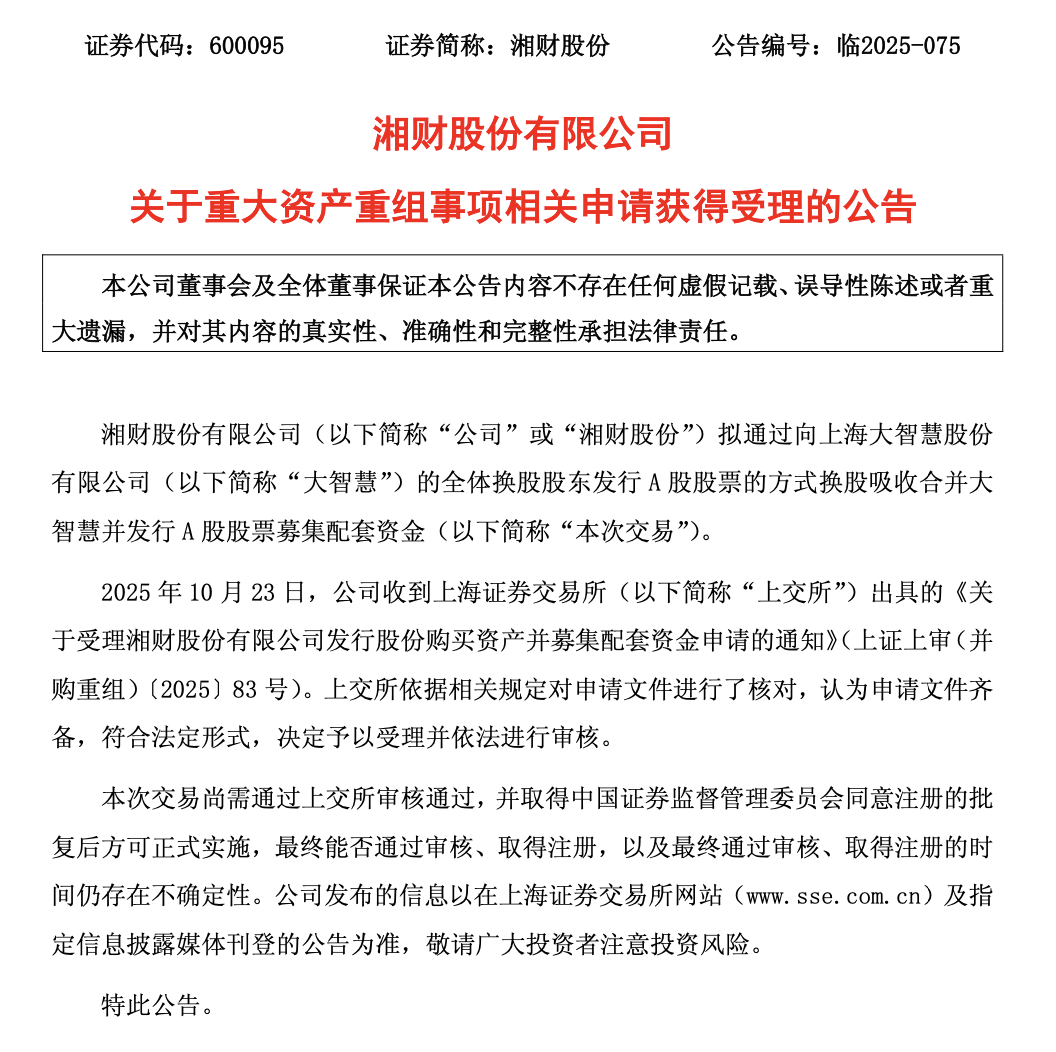
Core Viewpoint - The merger between Xiangcai Co. and Dazhihui is seen as a "weak union," with both companies showing improved profits but still facing significant challenges in revenue decline, cash flow pressure, and ongoing losses [1][4][11]. Financial Performance - Xiangcai Co. reported a net profit of 442 million yuan for the first three quarters of 2025, a year-on-year increase of over 200% [1][4]. - Dazhihui's revenue for the first three quarters was 564 million yuan, an increase of 8.78%, but it still recorded a net loss of 29.56 million yuan [6][7]. - Xiangcai Co.'s total revenue for Q3 was 655 million yuan, up 43.77%, while its operating income fell by 71.49% to 27 million yuan due to a reduction in trading activities [5][6]. Merger Implications - The merger aims to create a larger entity that could potentially rank as the second-largest internet brokerage, but it still falls significantly short compared to industry leader Dongfang Caifu [1][9]. - The combined revenue of Xiangcai Co. and Dazhihui is only 23.63 billion yuan, compared to Dongfang Caifu's 115.89 billion yuan, highlighting a substantial gap in market position [9][12]. Market Position and Competition - The current market landscape is dominated by established players like Dongfang Caifu, which has a user base and revenue far exceeding that of the combined entity of Xiangcai Co. and Dazhihui [9][10]. - The competition is intensifying with other brokerages rapidly adopting AI technologies, making it challenging for the merged entity to establish a competitive edge [10][12]. Integration Challenges - The merger faces internal integration challenges, particularly in aligning corporate cultures and decision-making processes between the two companies [11]. - Regulatory approval is still pending, adding uncertainty to the merger's future and operational timeline [11].


博时市场点评11月6日:沪指重返4000点,创业板涨1.84%
Xin Lang Ji Jin· 2025-11-06 08:56
Market Overview - The Shanghai Composite Index has returned to 4000 points, with the Shenzhen Component and ChiNext Index both rising over 1.7% [1] - The trading volume in the two markets has exceeded 2 trillion yuan, indicating increased market activity [1] - Despite tightening liquidity in the US market affecting global risk appetite, a liquidity crisis is not currently anticipated [1] US-China Agricultural Trade - China's Vice Minister of Commerce, Li Chenggang, met with a US agricultural trade delegation, emphasizing the importance of bilateral agricultural trade [2] - The fluctuations in agricultural trade this year are attributed to unilateral tariff measures from the US [2] - The meeting signals a potential stabilization in US-China economic relations and highlights the complementary strengths of both countries in agriculture [2] Industrial 5G Standard - The International Electrotechnical Commission (IEC) has released the world's first international standard for industrial 5G, co-developed by China and Germany [3] - This standard fills a gap in the industrial 5G field and enhances China's international influence in the integration of new information technology and manufacturing [3] New Energy Storage Capacity - As of September, China's new energy storage capacity has surpassed 100 million kilowatts, growing over 30 times since the end of the 13th Five-Year Plan [4] - China now holds over 40% of the global energy storage capacity, leading the world [4] - The significant increase in capacity supports renewable energy consumption and enhances grid safety, marking a new phase in the development of the energy storage industry [4] A-Share Market Performance - On November 6, the A-share market saw all three major indices rise, with the Shanghai Composite Index closing at 4007.76 points, up 0.97% [5] - The electronic, communication, and non-ferrous metal sectors led the gains, while media and retail sectors experienced declines [6] - The market's trading volume reached 20,761.59 billion yuan, indicating a rise from the previous trading day [7]

互联网券商业绩亮眼,金融科技ETF(516860)红盘向上,格尔软件涨停
Sou Hu Cai Jing· 2025-11-06 06:16
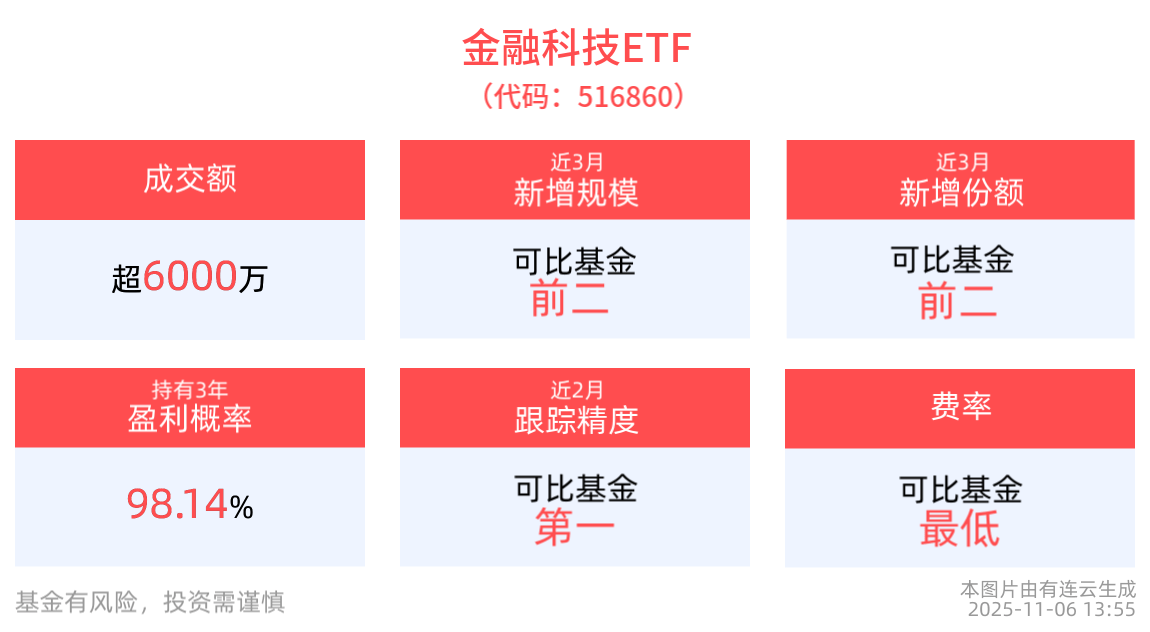
Core Viewpoint - The financial technology sector is experiencing growth, with significant increases in both revenue and profit for brokerage firms, indicating a positive market sentiment and investment opportunities in the sector [3][4]. Group 1: Financial Technology Index Performance - As of November 6, 2025, the China Securities Financial Technology Theme Index rose by 0.41%, with notable increases in constituent stocks such as Geer Software (up 9.99%) and Geling Deep Vision (up 3.31%) [3]. - The Financial Technology ETF (516860) increased by 0.61%, with a latest price of 1.49 yuan, and has seen a cumulative increase of 0.54% over the past two weeks, ranking 3rd out of 7 comparable funds [3]. - The ETF's trading volume was 65.2242 million yuan, with a turnover rate of 2.77%, and an average daily trading volume of 160 million yuan over the past year, ranking 2nd among comparable funds [3]. Group 2: Brokerage Industry Performance - In the first three quarters, the brokerage sector achieved a total operating revenue of 117.483 billion yuan, a year-on-year increase of 30.05%, and a net profit of 50.914 billion yuan, up 77.15% year-on-year [3]. - For instance, Dongfang Fortune, a leading internet brokerage, reported over 50% year-on-year growth in both operating revenue and net profit, with Q3 revenue and profit growth rates of 100.65% and 77.74%, respectively [3]. Group 3: Market Outlook and Investment Opportunities - CITIC Securities suggests that internet brokerages have not lost their "bull market leader" status, emphasizing the need for investors to focus on timing and stock selection to align with brokerage performance [4]. - CICC believes that the capital market's fundamentals are beginning to improve, with high-quality development expected to create growth opportunities, supported by macro policies and market reforms [4]. - The financial technology ETF has seen a significant growth of 754 million yuan in scale over the past three months, ranking 2nd among comparable funds, and a share increase of 45.9 million shares, also ranking 2nd [4].

沪指重返4000点!创业板50ETF(159949)年内回报近57%领涨,机构看好AI与新能源共振机遇
Xin Lang Ji Jin· 2025-11-06 04:39
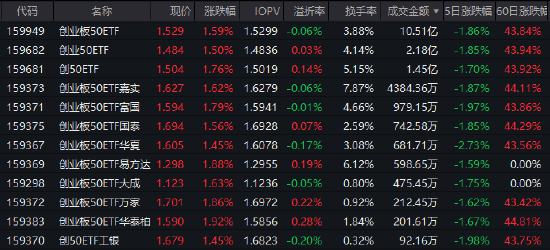
Group 1 - The A-share market showed strength on November 6, with major indices rising, including the Shanghai Composite Index returning to the 4000-point mark and the ChiNext Index and Shenzhen Component Index both increasing by over 1% [1] - The ChiNext 50 ETF (159949) rose by 1.59% to 1.529 yuan, with a turnover rate of 3.88% and a trading volume of 1.051 billion yuan [1][2] - All top ten holdings of the ChiNext 50 ETF saw gains, with notable increases from companies such as Ningde Times (1.67%), Zhongji Xuchuang (2.51%), and Sunshine Power (3.67%) [2][3] Group 2 - Multiple securities firms expressed positive outlooks on the solid-state battery sector, highlighting traditional lithium battery equipment manufacturers' advantages in technology and resources, which may extend into solid-state battery development [3] - The ETF inflow is expected to further drive the valuation recovery of the ChiNext, with a significant net inflow of 227.9 billion yuan into non-broad-based ETFs from June to August, marking a key factor in market recovery [4] - The ChiNext 50 ETF (159949) has achieved a year-to-date return of 56.88%, outperforming its benchmark and ranking 227th among 2833 similar products [4]