国家电网

Search documents
国家电网“小伙伴”,来了!
中国基金报· 2025-07-13 07:36
Group 1: Key Points on Jiyuan Group - Jiyuan Group is the largest global supplier of HMB raw materials, focusing on the research and development of dietary nutritional supplements [3][4] - The company has a total issuance of 50.01 million shares, with an online issuance of 12 million shares at an issuance price of 10.88 CNY per share and a P/E ratio of 25.51 [4] - In recent years, over 90% of Jiyuan Group's revenue has come from overseas markets, with projected revenues of 1.02 billion to 1.12 billion CNY for the first half of 2025, representing a year-on-year growth of 8.56% to 19.20% [5][13] Group 2: Financial Performance of Jiyuan Group - The company's revenue for 2022, 2023, and 2024 was 947 million, 892 million, and 1 billion CNY respectively, with net profits of 142 million, 160 million, and 174 million CNY [10] - The total assets are projected to reach 1.186 billion CNY in 2024, with a debt-to-asset ratio of 20.23% [11] - The company has maintained a consistent R&D investment ratio of around 4.96% of its revenue [11] Group 3: Key Points on Shanda Electric - Shanda Electric's issuance code is 301609, with an issuance price of 14.66 CNY per share and a P/E ratio of 19.57 [16] - The company primarily serves the State Grid and Southern Power Grid, with approximately 80% of its revenue derived from electric grid enterprises, 70% of which comes from the State Grid [18] - Shanda Electric's revenue for 2022, 2023, and 2024 was 478 million, 549 million, and 658 million CNY respectively, with net profits of 76.99 million, 103 million, and 127 million CNY [20] Group 4: Financial Performance of Shanda Electric - The total assets of Shanda Electric are expected to reach 1.127 billion CNY in 2024, with a debt-to-asset ratio of 45.37% [21] - The company anticipates a revenue of 280 million to 300 million CNY for the first half of 2025, reflecting a year-on-year growth of 13.55% to 21.66% [22]

7月12日晚间央视新闻联播要闻集锦
Yang Shi Xin Wen Ke Hu Duan· 2025-07-12 13:09
Group 1 - The Chinese government has increased fiscal investment in the livelihood sector this year to address urgent public concerns and improve the policy framework for people's well-being [1][3] - The emphasis is on enhancing the social security system and ensuring equitable access to basic public services [3] Group 2 - The State Grid and Southern Power Grid will implement normalized cross-grid electricity trading to support the establishment of a unified national electricity market [6][9] - This mechanism allows registered entities in one region to conduct trading activities flexibly across both grids [9] Group 3 - During the 14th Five-Year Plan period, China's grassland ecological quality has significantly improved, with an average reduction of 5 million acres of degraded grassland per year [5][8] - The annual fresh grass output has exceeded 600 million tons [5] Group 4 - The global first intelligent unmanned docking system has been put into operation at Lanzhou Airport, enhancing operational efficiency by 65% [17] - This system allows for remote, unattended operation of all boarding bridges at the airport [17] Group 5 - The China Agricultural Development Bank issued over 500 billion yuan in green loans in the first half of the year, focusing on ecological protection and infrastructure upgrades [16]
创投| 未可知 x AdventureX: 张孜铭担任黑客松评委, 与Z时代点燃创新风暴
未可知人工智能研究院· 2025-07-12 12:08
Core Viewpoint - The article highlights the emergence of Generation Z as a transformative force in technology, exemplified by the AdventureX global hackathon, which showcases their creativity and technical skills [2][4]. Group 1: AdventureX Overview - AdventureX, initiated by two high school students, has grown into a significant innovation platform, attracting nearly 4,500 participants from 182 countries in its inaugural event [5]. - The event has successfully secured over one million yuan in sponsorship and invited top-tier guests from the tech and investment sectors [5]. - This year, AdventureX has expanded its scale and upgraded its venue, drawing even more global talent [5]. Group 2: Significance of Hackathons - Hackathons, like AdventureX, serve as crucial incubators for innovation, where diverse young talents collaborate to develop projects within a limited timeframe [13]. - Many successful products, including Siri and Instagram, originated from hackathons, indicating their importance in the tech ecosystem [13]. - AdventureX has garnered attention from numerous tech companies, providing young developers with broader opportunities [13]. Group 3: Future of Generation Z - AdventureX is positioned as a platform for Generation Z to challenge norms and redefine technological possibilities through their creativity and passion [16]. - The event is expected to unveil innovative projects and highlight the potential of young developers in shaping the future of artificial intelligence [9][16]. - The anticipation surrounding AdventureX reflects the growing recognition of Generation Z's capabilities in the tech industry [17].
重磅!西部电直送东部常态化
21世纪经济报道· 2025-07-12 04:11
Core Viewpoint - The article discusses the approval of a new cross-grid electricity trading mechanism in China, which aims to enhance the efficiency of electricity distribution from renewable sources across different regions, particularly from the northwest to the eastern load centers [2][3]. Summary by Sections Cross-Grid Electricity Trading Mechanism - The National Development and Reform Commission and the National Energy Administration have approved a new trading mechanism that allows for long-term, green, and spot electricity trading across different grid operating areas [2][3]. - This mechanism is a significant step towards breaking down barriers between the State Grid and Southern Grid, facilitating better resource allocation nationwide [3]. Current Infrastructure and Transactions - Currently, there are two established interconnection channels between the State Grid and Southern Grid, with ongoing construction of additional channels [5]. - In 2023, pilot cross-regional electricity transactions have already taken place, including significant transfers of green electricity to major cities [6]. Trading Rules and Structure - The new mechanism outlines various trading rules for different types of electricity transactions, including long-term, green, and spot trading [7][8]. - It introduces a "two trading, two scheduling" model, which involves collaboration between multiple trading centers to ensure technical feasibility under physical constraints of the grid [7]. Green Electricity Trading - The mechanism emphasizes green electricity trading, allowing companies to purchase renewable energy more easily and market-driven [11][12]. - Specific rules for green electricity transactions include entry conditions, trading methods, and the transfer of green certificates [11][13]. Future Goals and Developments - The plan sets short-term, medium-term, and long-term goals, including pilot projects for electricity trading and green electricity transactions by 2025 [9]. - It aims to enhance the utilization of transmission channels and balance demand across the grid, addressing the needs of high-energy-consuming industries [9][14]. Market Dynamics and Challenges - The article highlights the increasing demand for green electricity driven by national policies and global trends towards decarbonization [11][12]. - Challenges include price formation mechanisms and the need for a transparent green certificate market to facilitate trading [14].
方案批复!国网南网获准建设全国性“网上电力商城”,跨经营区电力交易如何收取通道费、该收多少?专家详细解读
Mei Ri Jing Ji Xin Wen· 2025-07-11 15:33
Core Viewpoint - The approval of the "Cross-Grid Normalized Electricity Trading Mechanism Plan" by the National Development and Reform Commission and the National Energy Administration marks a significant step towards establishing a unified national electricity market, allowing for the free flow of electricity resources across different grid operating areas [1][2]. Group 1: Mechanism Overview - The new mechanism creates a "national online electricity mall," enabling electricity trading between the State Grid and Southern Grid under a unified set of rules, facilitating the free flow of electricity resources nationwide [2]. - Approximately 40,000 power generation enterprises will be able to sell electricity across the country, enhancing the overall electricity supply and supporting domestic circulation [6][7]. Group 2: Green Electricity Trading - The plan emphasizes "green electricity trading," addressing the mismatch between green electricity supply in regions like Northwest China and demand in economically developed eastern regions [3][5]. - The establishment of cross-regional green electricity trading is seen as a crucial solution to the supply-demand imbalance of green electricity in China [3]. Group 3: Operational Details - The cross-grid electricity trading will be organized by various entities, including the Beijing Power Trading Center and the Southern Power Grid's dispatch control center, ensuring accurate matching of electricity purchase and sale demands [6][8]. - The trading process will initially involve grid companies acting on behalf of local users to participate in cross-grid electricity purchases, with future plans to include distributed energy generation enterprises [7]. Group 4: Transmission and Costs - The plan outlines the transmission costs for cross-regional transactions, with a specific rate of 2.56 cents per kilowatt-hour for transactions not involving Fujian and Guangdong provinces, ensuring fair cost distribution [10]. - The existing transmission channels, such as "Jiangcheng DC" and "Min-Guang DC," are currently utilized for significant electricity transactions, ensuring reliable supply during peak demand periods [8][9]. Group 5: Future Considerations - The electricity grid companies are encouraged to monitor supply and demand dynamics closely and consider cross-regional electricity purchases when local supply is insufficient [11]. - There is a need for enhanced management and technical support systems to ensure the safe and stable operation of the electricity grid and to facilitate market participation for various stakeholders [11].
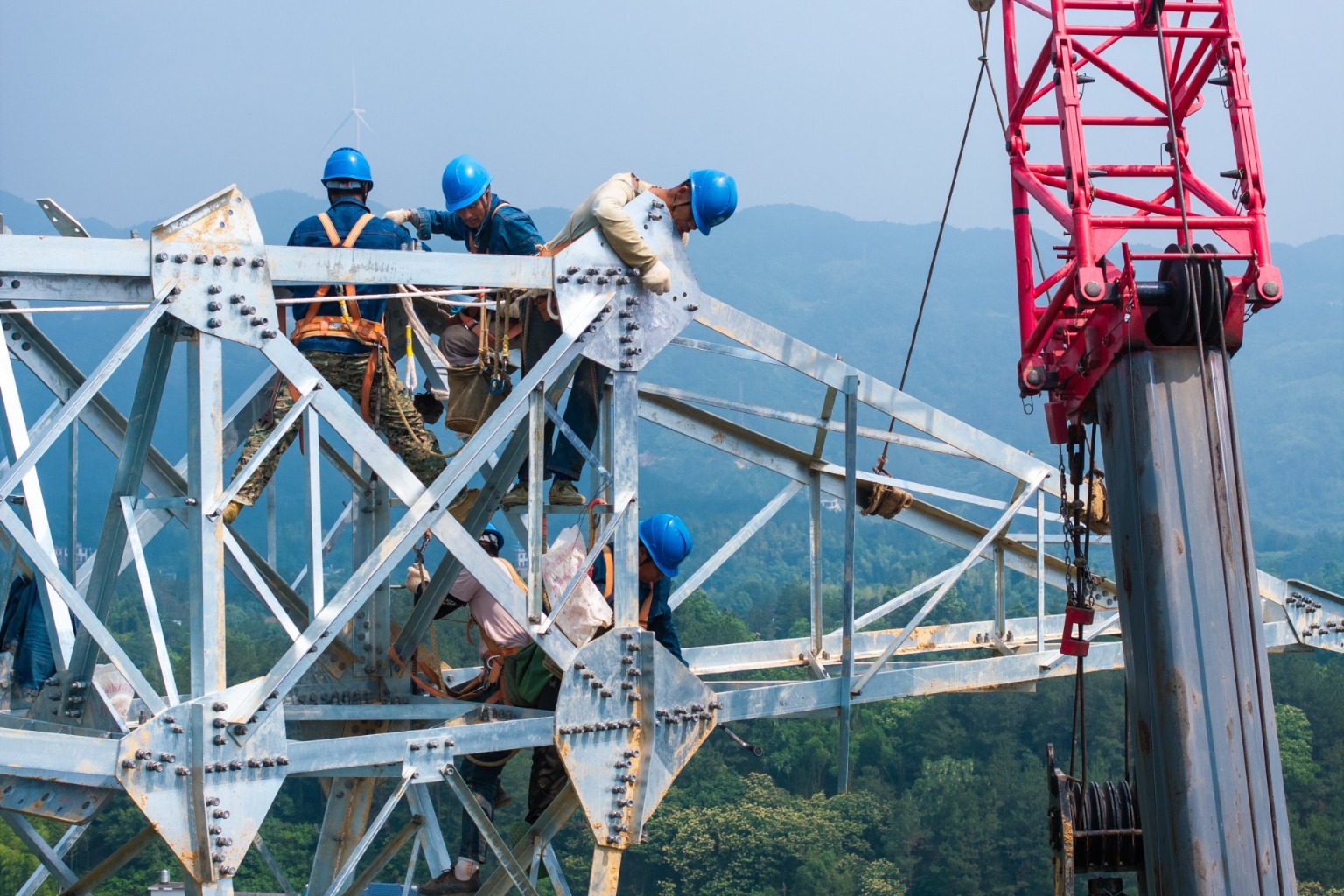
国家电网:上半年新增新能源并网超2亿千瓦
news flash· 2025-07-11 14:53
Core Viewpoint - The company has accelerated the construction of new energy transmission channels and improved supporting projects and grid connection services, leading to significant growth in renewable energy capacity [1] Group 1 - In the first half of the year, the company added 203 million kilowatts of wind and solar renewable energy capacity, representing a year-on-year increase of 108.7% [1]
电力跨经营区交易常态化,绿电全国流动按下“加速键”
2 1 Shi Ji Jing Ji Bao Dao· 2025-07-11 13:31
Core Viewpoint - The newly approved cross-grid electricity trading mechanism aims to enhance the efficiency of electricity distribution from renewable sources in Xinjiang and other regions to major consumption centers like Guangdong and Shanghai, marking a significant step towards a unified national electricity market system [1][2]. Group 1: Mechanism Overview - The State Development and Reform Commission and the National Energy Administration have jointly approved a plan for cross-grid electricity trading, which includes rules for medium- and long-term electricity transactions, green electricity trading, and spot trading [1][4]. - The plan addresses the historical barriers between the State Grid and Southern Grid, allowing for more flexible and larger-scale electricity transactions across regions [2][3]. Group 2: Trading Capacity and Infrastructure - Currently, there are two established interconnection channels between the State Grid and Southern Grid, with ongoing construction of additional channels to enhance trading capacity [3]. - A significant cross-regional electricity transaction has been initiated, involving over 2 billion kilowatt-hours of electricity from Guangdong, Guangxi, and Yunnan to be delivered to Shanghai, Zhejiang, Anhui, and Fujian [3]. Group 3: Trading Rules and Structure - The trading structure will be organized by multiple entities, including the Beijing Power Trading Center and the Guangzhou Power Trading Center, ensuring collaborative transaction results and settlements [4]. - The plan specifies different trading scenarios, such as large-scale direct current projects and flexible power supply between adjacent provinces, to ensure market integrity and balance [5][6]. Group 4: Green Electricity Trading - The plan emphasizes green electricity trading, allowing renewable energy projects to participate as individual trading units, thus facilitating easier access for power users to purchase green electricity [7][8]. - Various trading methods, including centralized bidding and bilateral trading, are outlined, along with a clear process for green certificate transfer to ensure traceability and market integrity [7][9]. Group 5: Future Goals and Implementation - The plan sets short-term, medium-term, and long-term goals, including pilot projects for demand-based trading and green electricity transactions by the end of 2025 [6][10]. - Continuous improvements in channel construction, transaction processes, and market coordination are planned to transition from sporadic trading to a fully normalized trading environment [10].
覆盖全国的“网上电力商城” 4大亮点带你看懂跨电网经营区常态化交易
Yang Shi Xin Wen· 2025-07-11 10:56
Key Points - The new trading mechanism breaks down barriers, allowing electricity trading to occur freely across operational zones, enhancing market operations for various types of transactions including medium to long-term, green electricity, and spot trading [1] - The mechanism introduces a "one registration, shared by all" approach, enabling market participants to register in one location and access resources nationwide, eliminating institutional and technical barriers [1] - Green electricity trading is facilitated, with individual renewable energy projects recognized as basic trading units, allowing for easier transactions between regions [3][4] - The trading mechanism does not impose transaction fees for cross-grid trading, and electricity prices will fluctuate based on market conditions, providing more choices for market participants [5] - The establishment of this trading mechanism enhances the overall electricity supply capacity, creating a nationwide "online electricity marketplace" that improves resource utilization and strengthens the grid's ability to respond to regional and seasonal shortages [6]
全国统一电力市场体系筑基能源新时代
Zhong Guo Dian Li Bao· 2025-07-11 09:12
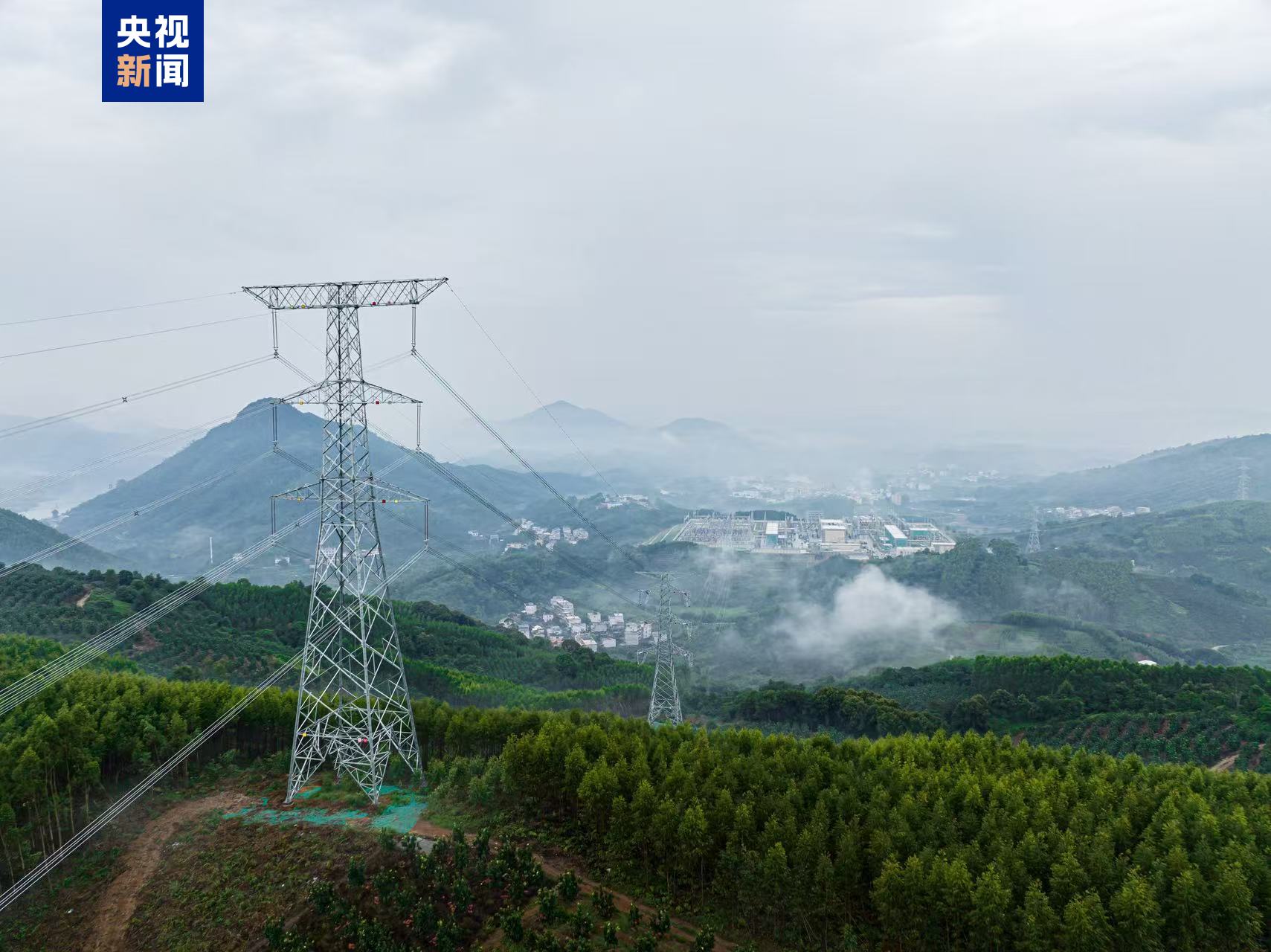
Core Viewpoint - The establishment of a nationwide unified electricity market system in China marks a significant transformation in the allocation of electricity resources, enhancing market efficiency and supporting the country's energy transition goals [1][5]. Market Mechanism and Structure - The basic market mechanism has been established, with a unified "1+N" rule system being developed, including long-term, spot, green electricity, and green certificate trading rules [1][2]. - A multi-level market framework has formed, covering various regions and timeframes, and including different trading products such as electricity and ancillary services [2][3]. Market Growth and Transactions - The scale of market transactions has seen substantial growth, with cross-provincial market transactions expected to reach 1.4 trillion kilowatt-hours in 2024, a tenfold increase since 2016 [2][4]. - The total market transaction volume increased from 1.1 trillion kilowatt-hours in 2016 to 6.2 trillion kilowatt-hours [2]. Regional Market Developments - The construction of provincial electricity spot markets has accelerated, with 22 regions now covered, and several provinces transitioning to formal operations [3][4]. - The Southern Regional Electricity Market has achieved significant milestones, moving towards a unified market and competitive bidding [3]. Cross-Regional Trading Mechanisms - A breakthrough in cross-regional electricity trading has been achieved, with normalized operations between the State Grid and Southern Grid, marking a key advancement in the unified electricity market [4]. - By 2024, market-based electricity transactions are projected to account for 63% of total electricity consumption, highlighting the growing role of market mechanisms in resource allocation [4][5]. Integration of Renewable Energy - The integration of renewable energy into the electricity market is accelerating, with market transactions for renewable energy expected to exceed 1 trillion kilowatt-hours in 2024 [5]. - The unified electricity market system is crucial for supporting China's energy structure transformation and achieving carbon neutrality goals [5].
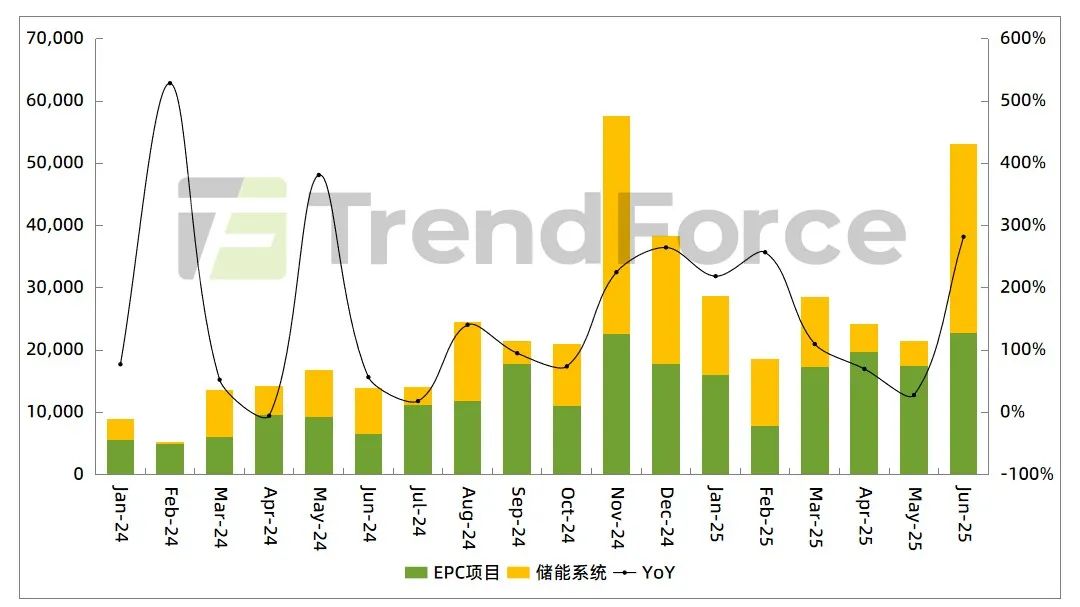
TrendForce集邦咨询:6月中国储能新增招标量达53.19GWh 创下年内新高
智通财经网· 2025-07-11 06:54
Core Insights - The Chinese energy storage bidding market experienced explosive growth in June 2025, with a monthly bidding volume reaching 53.19 GWh, marking a new high for the year and showing significant year-on-year and month-on-month increases [1][2][3] Bidding Volume and Trends - In June 2025, the newly added bidding volume exceeded 50 GWh, with a total of 9.05 GW/53.19 GWh, representing a year-on-year increase of 58% and 282%, and a month-on-month increase of 23% and 147% [2] - The average energy storage duration for the month was 5.9 hours, indicating a trend towards longer-duration storage solutions [2] Project Types and Distribution - EPC projects dominated the bidding landscape, with a newly added bidding volume of 7.71 GW/22.81 GWh, showing year-on-year increases of 193% and 248% [5] - Large-scale projects of 800 MWh and above were concentrated in regions such as Xinjiang, Guangdong, and Ningxia [5] - Framework and centralized procurement projects accounted for 53% of the total energy capacity, highlighting a shift towards these project types [6] Major Players and Market Share - The top three bidding entities in June 2025 were China Energy Engineering Group (25.54 GWh), Electric Equipment Group (7.248 GWh), and Xinjiang Energy Group (4 GWh) [9][22] - China Energy Engineering Group led the market due to its significant procurement of 25 GWh of energy storage systems [9] Winning Bids and Pricing Trends - The total newly awarded contracts in June reached 5.33 GW/17.2 GWh, with EPC projects being the majority [11] - The average bidding price for 2-hour energy storage systems was 0.51 yuan/Wh, reflecting a downward trend [14][15] - The bidding price range for 2-hour energy storage systems was between 0.46 and 0.72 yuan/Wh, with a weighted average of 0.51 yuan/Wh, indicating an 8% decrease month-on-month [15][17] Leading Companies in Energy Storage Systems - Ganfeng Lithium led the energy storage system bidding with a total of 1.2 GWh, followed by BYD with 600 MWh and State Grid with 240 MWh [19] - The leading EPC bidders included China Electric Power Construction Group and its consortium, State Power Investment Corporation, and China State Construction Engineering Corporation [22]