上海银行

Search documents
银行推出多重购车福利
Jin Rong Shi Bao· 2026-02-12 02:03
Core Viewpoint - Banks are intensifying their promotional efforts in the auto finance market by offering low-interest loans and various subsidies to attract consumers during the year-end shopping season, particularly with the upcoming Spring Festival [1][2]. Group 1: Low-Interest Loan Promotions - Multiple banks are launching low-interest car purchase subsidies, with some offering up to 3,000 yuan in consumer loan subsidies to ease monthly payment burdens [2]. - Ping An Bank has introduced a special car loan subsidy for new car buyers, allowing for annual interest rates as low as 0% and loan amounts up to 5 million yuan [2]. - SPDB has also launched promotional activities, offering annual interest rates as low as 0.49% for specific Tesla models, with monthly payments starting at 1,788 yuan [2]. Group 2: Extended Loan Terms - Many banks are extending the loan terms for low-interest car loans from a maximum of 5 years to 7 years, aiming to reduce monthly payment amounts for consumers [4]. - Huishang Bank has introduced a loan product with a maximum amount of 1 million yuan and an interest rate as low as 3.0%, with a repayment period of up to 7 years [4]. - The extension of loan terms is seen as a strategy to stimulate demand for mid-to-high-end vehicles, particularly those priced above 200,000 yuan [6]. Group 3: Credit Card Incentives - Banks are leveraging credit card programs to boost auto consumption, with activities such as offering points for test drives and financing options [3]. - Shanghai Bank is providing discounts for new credit card holders who apply for auto financing, enhancing the overall consumer experience [3]. Group 4: Risks and Challenges - The combination of low-interest rates and extended loan terms presents challenges such as complex risk pricing and potential asset depreciation over long repayment periods [7]. - Consumers are advised to be cautious of the hidden risks associated with low monthly payments, including the potential for negative equity in vehicles due to rapid technological advancements [7]. - Industry experts suggest that banks should shift from price competition to value-driven strategies, focusing on product innovation and risk management [8].
银行开卷春节新钞,有的还能“送钞上门”!10元、20元小面额紧俏
Xin Lang Cai Jing· 2026-02-12 00:48
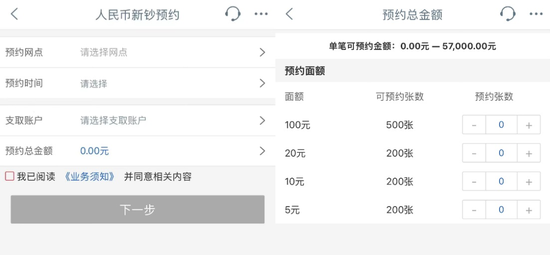
Core Viewpoint - The demand for new banknotes is increasing as the Spring Festival approaches, with many banks offering convenient online reservation services for new currency, making it easier for the public to obtain cash without long queues [1][2][4]. Group 1: Online Reservation Services - Multiple banks, including major state-owned and joint-stock banks, provide online reservation services for new banknotes through their apps, allowing users to select the branch, time, and amount for pickup [1][2]. - For example, the Industrial and Commercial Bank of China (ICBC) app allows users in Beijing to reserve up to 57,000 yuan in a single transaction, with specific limits on the number of banknotes for different denominations [2][3]. - The Agricultural Bank of China has introduced a "door-to-door" delivery service for new banknotes in Shenzhen, where users can reserve up to 20,000 yuan and receive the cash at home [6]. Group 2: Demand for Small Denominations - There is a notable shortage of small denomination banknotes, particularly 10 yuan and 20 yuan notes, while 100 yuan notes are relatively more available [4][8]. - Bank staff have indicated that while larger denominations are sufficient, smaller ones are in high demand, prompting recommendations for customers to reserve in advance through mobile banking [8]. Group 3: Special Products for the Spring Festival - Several banks are launching special products and services themed around "lucky money" for the Spring Festival, such as the "Freedom Card" from Guangfa Bank, which aims to help manage and allocate "lucky money" effectively [9]. - Beijing Rural Commercial Bank has introduced a dedicated savings product for children, offering various fixed-term savings options with competitive interest rates [10]. - Many banks are also targeting year-end bonuses with tailored financial products, including wealth management services and promotional activities to attract customers [11][12].

人保中证港股通互联网指数型 证券投资基金基金合同、招募说明书及基金产品资料概要提示性公告
Zhong Guo Zheng Quan Bao - Zhong Zheng Wang· 2026-02-11 22:42
Core Viewpoint - The announcement details the launch of the "PICC CSI Hong Kong Stock Connect Internet Index Fund," which is set to be publicly offered from March 2 to March 13, 2026, with a focus on attracting various types of investors [3][17]. Group 1: Fund Overview - The fund is classified as a contractual open-end stock fund, managed by PICC Asset Management Co., Ltd., with Shanghai Bank as the custodian [4][41]. - The fund's initial share value is set at 1.00 RMB, and it is designed for individual and institutional investors, including qualified foreign institutional investors [14][15]. - The fund received approval for fundraising from the China Securities Regulatory Commission (CSRC) on December 31, 2025 [3]. Group 2: Subscription Details - The subscription period for the fund is from March 2 to March 13, 2026, with the possibility of extension based on subscription conditions [17]. - Investors can subscribe through direct sales or authorized distribution platforms, with a minimum initial subscription amount of 1 RMB for most channels, and 10,000 RMB for direct sales at the counter [5][23]. - The fund allows multiple subscriptions during the fundraising period, but once accepted, subscription applications cannot be withdrawn [25]. Group 3: Fund Management and Operations - The fund management commits to managing assets with integrity and diligence but does not guarantee profits or minimum returns [13]. - The fund's performance is linked to the Hong Kong stock market, and it may face specific risks associated with the Stock Connect mechanism [10][12]. - The fund's total subscription must reach at least 200 million RMB and 200 investors for the fundraising to be successful [40]. Group 4: Investor Information - Investors are encouraged to read the fund's contract and prospectus for detailed information on risks and returns before making investment decisions [7][12]. - The fund's management will provide customer service support through a dedicated hotline for inquiries related to subscriptions [12][41]. - The fund's assets will be held in a dedicated account during the fundraising period, and any interest accrued will be converted into fund shares for the investors [37][38].

上海银行股份有限公司董事会2026年第二次会议决议公告
Shang Hai Zheng Quan Bao· 2026-02-11 19:11
Core Viewpoint - Shanghai Bank's board of directors held its second meeting in 2026, where key resolutions were made, including the appointment of a new Chief Compliance Officer and the approval of the 2026 branch construction plan [1][3]. Group 1: Board Meeting Details - The board meeting took place on February 11, 2026, via video conference, with all 16 directors present, complying with relevant laws and regulations [1]. - The meeting was chaired by Chairman Gu Jianzhong, and all resolutions were passed unanimously with 16 votes in favor, 0 against, and 0 abstentions [4]. Group 2: Appointment of Chief Compliance Officer - Mr. Shi Hongmin was appointed as the Chief Compliance Officer of Shanghai Bank, with his qualifications and background detailed in an attached resume [2]. - Mr. Shi holds a master's degree in engineering from Tsinghua University and has extensive experience in various roles within the banking sector, including positions at China Construction Bank and Shanghai Bank [6]. Group 3: Branch Construction Plan - The board approved the 2026 annual branch construction plan, which is expected to enhance the bank's operational capabilities and market presence [3][4].
上海银行:聘任施红敏为首席合规官
Bei Jing Shang Bao· 2026-02-11 11:20
Core Viewpoint - Shanghai Bank has appointed Shi Hongmin as the Chief Compliance Officer, highlighting a significant leadership change within the organization [1] Group 1: Appointment Details - The board of Shanghai Bank approved the appointment of Shi Hongmin during its second meeting in 2026 [1] - Shi Hongmin has an extensive background in finance and compliance, having held various positions in China Construction Bank and other financial institutions [1] Group 2: Background of Shi Hongmin - Shi Hongmin was born in October 1968 and graduated from Tsinghua University with a master's degree in engineering [1] - He currently serves as the Deputy Secretary of the Party Committee, Vice Chairman, President, and Chief Financial Officer of Shanghai Bank [1] - His previous roles include positions in financial planning and management at China Construction Bank, as well as leadership roles in several financial organizations [1]
上海银行(601229) - 上海银行董事会2026年第二次会议决议公告
2026-02-11 11:15
证券代码:601229 证券简称:上海银行 公告编号:临2026-006 可转债代码:113042 可转债简称:上银转债 上海银行股份有限公司 董事会 2026 年第二次会议决议公告 上海银行股份有限公司(以下简称"公司")董事会及全体董事保证本公告 内容不存在任何虚假记载、误导性陈述或者重大遗漏,并对其内容的真实性、准 确性和完整性承担法律责任。 公司董事会 2026 年第二次会议于 2026 年 2 月 11 日以视频接入方式召开, 会议通知已于 2026 年 2 月 6 日以电子邮件方式发出。本次会议应出席董事 16 人,实际出席董事 16 人。本次会议的召开符合《中华人民共和国公司法》《上 海银行股份有限公司章程》《上海银行股份有限公司董事会议事规则》的规定。 本次会议由顾建忠董事长主持,会议经审议并通过以下议案: 一、关于聘任首席合规官的议案 表决情况:同意 16 票,反对 0 票,弃权 0 票。 1 附件: 施红敏先生简历及相关信息 公司董事会提名与薪酬委员会已事先审议通过本议案,并一致同意提交公司董 事会审议。公司独立董事一致同意本议案。 会议决定聘任施红敏先生为上海银行首席合规官(简历及相关信 ...
2025年四季度货币政策执行报告点评:从流动性总量视角看待“存款搬家”
GUOTAI HAITONG SECURITIES· 2026-02-11 11:12
Investment Rating - The report assigns an "Accumulate" rating for the banking sector, indicating a potential increase of over 15% relative to the CSI 300 index [2][12]. Core Insights - The central bank will continue to implement a moderately loose monetary policy, integrating both incremental and stock policies to enhance effectiveness [3]. - New loan interest rates have decreased, with the weighted average interest rate for new loans in December at 3.15%, down 10 basis points from September. The rates for general loans, corporate loans, bill financing, and mortgage loans are 3.55%, 3.10%, 1.14%, and 3.06%, respectively [4]. - The growth of asset management products is impacting the structure of bank deposits, with total assets of asset management products reaching 120 trillion yuan, a year-on-year increase of 13.1% [4]. - The central bank and the Ministry of Finance have announced a package of policy measures aimed at supporting small and micro enterprises and boosting consumption [4]. - A one-time credit repair policy will support individuals in improving their credit status by removing overdue debt records if paid off by March 31, 2026 [4]. Summary by Sections Loan Market - The report highlights a continued optimization in financing structure, with significant year-on-year growth in technology loans (11.5%), green loans (20.2%), inclusive loans (10.9%), elderly care industry loans (50.5%), and digital economy loans (14.1%) [4]. Asset Management Products - The rapid expansion of asset management products has led to a shift in the deposit structure, with a notable increase in non-bank deposits from small and medium banks [4]. - Over 80% of asset management products are allocated to fixed-income assets, primarily in interbank deposits and certificates of deposit, indicating that funds remain within the banking system [4]. Investment Recommendations - The report suggests focusing on three main lines for investment in the banking sector: 1. Identifying banks with expected growth in performance, recommending Ningbo Bank, China Merchants Bank, and Nanjing Bank [4]. 2. Considering banks with convertible bond expectations, recommending Chongqing Bank and Changshu Bank, with Shanghai Bank as a related target [4]. 3. Continuing the dividend strategy, recommending Bank of Communications, Jiangsu Bank, Chongqing Rural Commercial Bank, and Shanghai Rural Commercial Bank [4].



2026张江科创金融沙龙在沪举行
Zhong Guo Jing Ji Wang· 2026-02-11 08:11
Group 1 - The 2026 Zhangjiang Sci-Tech Financial Salon was held in Shanghai Zhangjiang Science City, focusing on enhancing Zhangjiang's role as a core engine for global innovation and capital aggregation [1] - Zhangjiang Science City is concentrating on three key sectors: artificial intelligence, biomedicine, and integrated circuits, with significant financing achievements in 2025 [1] - In 2025, 210 companies in Zhangjiang completed 237 financing events, totaling 27.8 billion yuan, with a 30% increase in the number of financing events and an 18% increase in disclosed amounts year-on-year [2] Group 2 - Zhangjiang accounted for 65% of the total financing events in the Pudong district and contributed 25% of the total corporate financing in Shanghai [2] - A total of 512 investment institutions participated in Zhangjiang's financing activities, indicating a more diversified capital structure [2] - The financing for the leading sectors (biomedicine, artificial intelligence, and integrated circuits) reached 91% of the total, up from 82% in 2024 [2] Group 3 - The financing stages in Zhangjiang showed a clear characteristic of "early, mid, and late-stage collaboration," with early-stage financing accounting for 64% of total financing [3] - 273 companies were awarded for their financing impact in 2025, covering the core sectors of artificial intelligence, biomedicine, and integrated circuits [3] - Zhangjiang aims to align with national strategies and enhance its innovation ecosystem to contribute to China's technological self-reliance and strength [3]
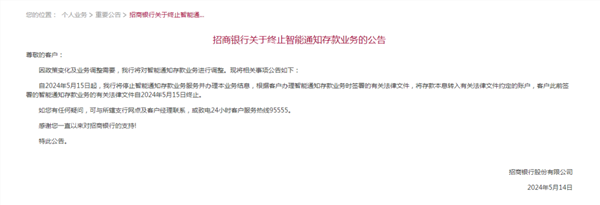
招行也宣布了!银行智能通知存款正在大面积退场
Zhong Guo Ji Jin Bao· 2026-02-11 06:34
Group 1 - The core point of the news is that several banks, including China Merchants Bank, are terminating their smart notice deposit services due to policy changes and business adjustments, effective from May 15, 2024 [3][4] - China Merchants Bank will stop the smart notice deposit service and transfer the principal and interest to the designated accounts as per the legal documents signed by customers [3] - Other banks such as Postal Savings Bank, Bank of Communications, and several others have also announced the termination of their smart notice deposit products around the same date [4] Group 2 - The net interest margin (NIM) of listed banks has been under pressure, with a decline to 1.47% in Q1 2023, down 14 basis points from the end of 2023 [5] - Banks are actively managing their interest margins by adjusting asset structures, controlling interest rates, and reducing high-interest liabilities [5][6] - Institutions predict that deposit rates may further decrease, with expectations of a reduction in deposit costs and a potential narrowing of NIM declines in 2024 [7]


多家银行官宣“年中红包”!六大行数额亮了
Guo Ji Jin Rong Bao· 2026-02-11 06:34
Core Viewpoint - Increasing number of banks are adopting mid-year dividend plans, with 17 A-share listed banks planning to implement mid-year dividends for 2024, reflecting a shift towards more frequent cash distributions to investors [1][2][3] Group 1: Mid-Year Dividend Plans - CITIC Bank has expressed its intention to implement a mid-year dividend for 2024, following the lead of Minsheng Bank, marking it as the second shareholding bank to announce such plans [2] - As of July 4, 2023, 17 out of 42 A-share listed banks have decided to implement mid-year dividends for 2024, with six major state-owned banks already having made arrangements [2][3] - The mid-year dividend plans are part of a broader trend among banks to enhance investor returns and improve liquidity [1][4] Group 2: Regulatory Influence - The Chinese government has introduced policies to strengthen cash dividend regulations, encouraging companies to adopt stable and predictable dividend policies, including multiple distributions within a year [4][5] - The new regulations aim to enhance the frequency of dividends, aligning domestic banks with international practices where dividends are distributed more frequently [5] Group 3: Impact on Investor Sentiment - Increased dividend frequency is expected to enhance investor confidence and attract more investments, as it reflects banks' profitability and commitment to shareholder returns [3][5] - Analysts suggest that mid-year dividends can serve as a sign of banks' confidence in their earnings and can improve investor sentiment towards bank stocks [3][5] Group 4: Considerations for Banks - Banks need to balance dividend payouts with their profitability, capital adequacy, and risk management capabilities to ensure sustainable operations [5][6] - There is a need for banks to improve internal governance and operational efficiency to better serve the real economy while managing dividend policies [6]