
沪农商行

Search documents
观察丨“卫星+银行”,改写传统风控逻辑
券商中国· 2026-02-02 09:32
Core Viewpoint - The recent successful launches of satellites by China Merchants Bank and Shanghai Pudong Development Bank signify a strategic move by domestic commercial banks to leverage satellite technology for smart risk control and to gain a competitive edge in financial technology [1][2]. Group 1: Satellite Launches and Applications - China has seen three commercial banks successfully launch satellites, marking a significant step in the integration of satellite technology into the banking sector [1]. - The application of satellite remote sensing technology is expected to transform traditional credit risk management practices in banking, particularly in rural finance [2][3]. Group 2: Challenges in Traditional Banking - Traditional banking heavily relies on real estate as collateral, making it difficult to assess and manage risks associated with movable assets like agricultural products and commercial inventories [3]. - The challenges in rural finance include personnel shortages, remote locations, and lengthy processes, which hinder large-scale credit operations [3]. Group 3: Innovations in Rural Finance - The application of satellite remote sensing technology in rural finance began with the need to address agricultural monitoring challenges, leading to the development of digital asset assessments for farmers [4][5]. - In 2020, Ant Bank launched the "Dashanque" system, utilizing satellite imagery and AI to evaluate farmers' assets, thereby facilitating credit provision [4]. Group 4: Broader Applications of Satellite Technology - The use of satellite remote sensing technology is expanding beyond agriculture, with banks exploring its application in various sectors, including forestry and renewable energy projects [6][9]. - Major banks like Industrial and Commercial Bank of China and Bank of China are focusing on post-loan management using satellite technology to enhance risk prevention capabilities [7]. Group 5: Future Prospects and Market Potential - The integration of satellite remote sensing with IoT technology opens new avenues for monitoring movable assets, potentially addressing long-standing challenges in asset financing [10][12]. - The recent policy measures in Beijing indicate a growing recognition of the commercial satellite remote sensing data market, which could be worth trillions [11].


农商行板块2月2日跌1.94%,沪农商行领跌,主力资金净流入1.15亿元
Zheng Xing Xing Ye Ri Bao· 2026-02-02 09:15
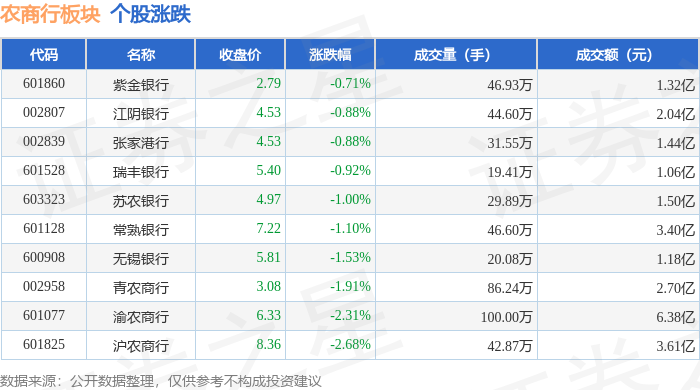
Market Overview - The agricultural commercial bank sector experienced a decline of 1.94% on February 2, with the Shanghai Agricultural Commercial Bank leading the drop [1] - The Shanghai Composite Index closed at 4015.75, down 2.48%, while the Shenzhen Component Index closed at 13824.35, down 2.69% [1] Individual Stock Performance - Key stocks in the agricultural commercial bank sector showed the following closing prices and changes: - Zijin Bank: 2.79, down 0.71% - Jiangyin Bank: 4.53, down 0.88% - Zhangjiagang Bank: 4.53, down 0.88% - Ruifeng Bank: 5.40, down 0.92% - Sunong Bank: 4.97, down 1.00% - Changshu Bank: 7.22, down 1.10% - Yuanxi Bank: 5.81, down 1.53% - Qingnong Bank: 3.08, down 1.91% - Yunnan Agricultural Bank: 6.33, down 2.31% - Shanghai Agricultural Bank: 8.36, down 2.68% [1] Capital Flow Analysis - The agricultural commercial bank sector saw a net inflow of 115 million yuan from main funds, while retail funds experienced a net outflow of 52.86 million yuan [1] - The following table summarizes the capital flow for individual stocks: - Yunnan Agricultural Bank: 92.03 million yuan net inflow from main funds, -11.7 million yuan from retail funds - Shanghai Agricultural Bank: 32.16 million yuan net inflow from main funds, -22.14 million yuan from retail funds - Changshu Bank: 19.96 million yuan net inflow from main funds, -31.03 million yuan from retail funds - Sunong Bank: 5.13 million yuan net inflow from main funds, -14.29 million yuan from retail funds - Qingnong Bank: 3.28 million yuan net inflow from main funds, -18.58 million yuan from retail funds - Jiangyin Bank: -4.47 million yuan net outflow from main funds, -3.44 million yuan from retail funds - Wuxi Bank: -5.97 million yuan net outflow from main funds, 0.13 million yuan from retail funds - Ruifeng Bank: -7.41 million yuan net outflow from main funds, 1.42 million yuan from retail funds - Zhangjiagang Bank: -7.44 million yuan net outflow from main funds, 6.66 million yuan from retail funds - Zijin Bank: -12.72 million yuan net outflow from main funds, 3.51 million yuan from retail funds [2]




卫星扎堆“上天”,银行风控卷出“新高度”
3 6 Ke· 2026-02-02 07:23
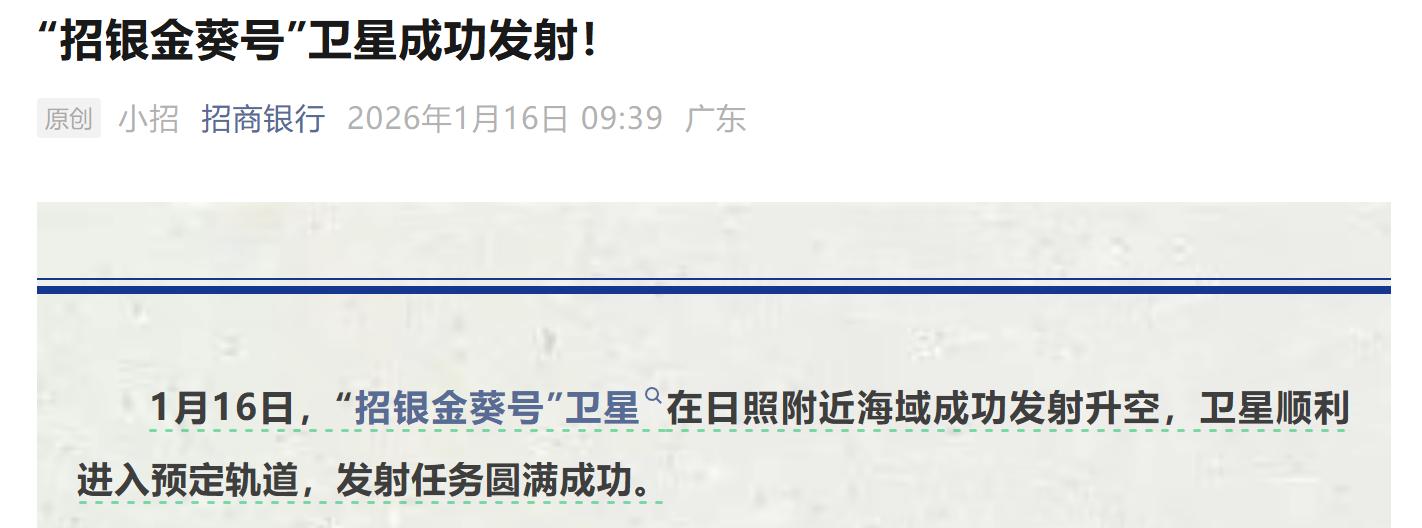
Core Viewpoint - The commercial aerospace sector is experiencing a surge in interest and investment, particularly from banks, driven by supportive policies and the potential for innovative applications of satellite technology in financial services [1][2][22]. Group 1: Policy and Industry Trends - Beijing has issued measures to promote the development and utilization of commercial satellite remote sensing data from 2026 to 2030, encouraging companies to build differentiated satellite constellations with clear commercial value and application prospects [1]. - Various industries, including traditional banking, are actively engaging in the commercial aerospace sector, with banks launching their own satellites [2][3]. Group 2: Bank Initiatives in Satellite Launches - On January 16, 2024, China Merchants Bank's "Zhaoyin Jinkui" and Shanghai Pudong Development Bank's "Pudong Digital" satellites were successfully launched [4]. - Both satellites are part of China's first global low-orbit satellite IoT constellation, "Tianqi Constellation" [5]. - The "Zhaoyin Jinkui" satellite is designed for high-precision monitoring of construction progress for first-hand mortgage properties, while the "Pudong Digital" satellite aims to enhance smart risk control and provide critical financial services during natural disasters [8]. Group 3: Evolution of Risk Control - The trend of banks launching satellites signifies a shift from traditional ground-based data reliance to a "heaven and earth collaboration" model for risk control [11][22]. - Satellite technology addresses the core pain point of information asymmetry in traditional risk management, providing banks with stable and objective data [13][14]. - For instance, the "Zhaoyin Jinkui" satellite can improve construction monitoring accuracy to over 95%, significantly enhancing post-loan inspection efficiency [14]. Group 4: Future Implications and Opportunities - The integration of satellite technology into banking operations not only enhances risk management but also opens new avenues for financing in the commercial aerospace sector, which has been traditionally challenging due to high barriers and lack of collateral [19][20]. - Banks' active participation in satellite launches may lead to deeper due diligence and value discovery in the commercial aerospace industry [20][21]. - The collective move of banks into the aerospace sector represents a critical leap in enhancing their core competitiveness and addressing inclusive finance challenges [22][23].


信用债市场周观察:关注CRMW一级发行定价机会
Orient Securities· 2026-02-02 03:43
Report Industry Investment Rating - Not mentioned in the provided content Core Viewpoints of the Report - In the second half of 2025, CRMW products were issued intensively in conjunction with private enterprise science and technology innovation bonds, with obvious cost - reduction and credit - enhancement effects. Currently, there is little room for participation in the secondary market. It is recommended to focus on the pricing opportunities during the primary issuance of new products. The "underlying bond + CRMW" combination under the strong guarantee of large - scale national and joint - stock banks has valuation advantages, and institutions with stable liability ends such as proprietary trading can hold them until maturity [5]. - When classified by creation entities, special attention should be paid to CRMW created by joint - stock banks [5]. Summary According to Relevant Catalogs 1. Credit Bond Weekly Viewpoint: Focus on the Pricing Opportunities of CRMW Primary Issuance - CRMW is an important credit - enhancement product. In 2025, over a hundred CRMW were created by various institutions, a slight reduction from 2024. Nearly 40% of the protected underlying bonds were science and technology innovation bonds, and the protected issuers were mostly technology - based private enterprises. Commercial banks are the mainstream creation institutions, while securities companies have rarely participated since 2024, and guarantee companies such as Zhongyu Guarantee and Zhongzhai Zengxin have been active [9]. - It is difficult to participate in the secondary market of CRMW. The focus should be on the primary issuance, especially the CRMW created by joint - stock banks. The average maturity of recently issued underlying bonds is about 2 years, and the maturity considering the exercise right is generally no more than 3 years, which meets the preferences of mainstream institutions [15]. - By creation entity types: - State - owned banks: Since 2024, the frequency of state - owned banks creating CRMW has declined. The credit spread of the "CRMW + underlying bond" investment portfolio created by state - owned banks is generally low, with most spreads around 40bp since Q4 2025, and there is no excess return compared to mainstream urban investment/industrial bonds [15][17]. - Joint - stock banks: Banks such as China Zheshang Bank have created a relatively large number of CRMW. The credit spread of the "CRMW + underlying bond" investment portfolio is around 70bp, and the absolute return can exceed 2.4%, which is very attractive in a low - return environment. The higher return mainly comes from the higher coupon rate of the protected underlying bonds, and there is sufficient safety margin under the strong guarantee of CRMW [25]. - City commercial banks: Banks such as Dongguan Bank and Qingdao Bank are the main creation institutions. The returns of their "CRMW + underlying bond" portfolios are more differentiated, and the recent returns are mainly in the range of 2.1% - 2.2%, with limited attractiveness [25]. - Rural commercial banks: Only Shanghai Rural Commercial Bank participates, and the overall return of the portfolio is not high due to the strong credit quality of the credit - enhancement subject [25]. - Guarantee companies: Zhongyu Guarantee and Zhongzhai Zengxin have created a small number of CRMW in the past two years. The returns are scattered, and the "underlying bond + CRMW" portfolio has a slightly higher return due to weak liquidity, which is suitable for institutions with stable liability ends and high - risk preferences to hold until maturity [23][26]. - Secondary market opportunities are mainly concentrated in the "underlying bond + CRMW" portfolio with a maturity of less than 1 year. The primary market is the main way to participate, while the secondary market has weak liquidity. The short - term portfolio with a maturity of less than 1 year and a return of over 2.1% created by state - owned banks and strong joint - stock banks has cost - effectiveness [28]. 2. Credit Bond Weekly Review: The Enthusiasm for Medium - Term Bond Mining Continues 2.1 Negative Information Monitoring - There were no bond defaults, overdue payments, downgrades of issuer or bond ratings, or overseas rating downgrades during the week from January 26 to February 1, 2026. However, there were significant negative events for companies such as Sunshine City Group, Country Garden Real Estate Group, and Rongqiao Group [31][33]. 2.2 Primary Issuance: Net Financing Remains High, and Financing Costs Fluctuate Narrowly - The new issuance scale of credit bonds remained high, the maturity volume decreased, and the net financing remained high. From January 26 to February 1, 2026, the primary issuance of credit bonds was 307.4 billion yuan, a slight decrease from the previous period. The total repayment was 151.7 billion yuan, a 19% decrease from the previous period, and the net financing was 155.7 billion yuan [34]. - The number and scale of cancelled or postponed bond issuances remained at a low level. The financing costs of medium - and high - grade bonds fluctuated slightly. The average coupon rates of AAA and AA+ grades were 2.12% and 2.24% respectively, with a month - on - month increase of 9bp and a decrease of 7bp [35]. 2.3 Secondary Trading: Valuations Fluctuated Slightly, and 3 - year Bonds Outperformed Relatively - The valuations of credit bonds of various grades and maturities were mostly flat compared to the previous period, except for a 3bp decline in the 3 - year medium - and low - grade bonds. The risk - free interest rate fluctuated slightly, and the credit spreads were mostly flat. The term spreads of 3Y - 1Y and 5Y - 1Y of various grades almost all narrowed, with an average of about 2bp, and the AA - grade 3Y - 1Y narrowed by up to 4bp. The AA - AAA grade spread of the 3 - year bond narrowed by 4bp [37][40]. - The credit spreads of urban investment bonds in various provinces narrowed slightly, with an average narrowing of about 2bp, and the spreads in Heilongjiang and Yunnan narrowed the most. The credit spreads of industrial bonds fluctuated within ±1bp, significantly underperforming urban investment bonds, and the real estate sector widened by 3bp [42][43]. - The weekly turnover rate decreased by 0.18 percentage points to 1.85%. The issuers of the top - ten turnover bonds were mostly central and state - owned enterprises. The issuers of credit bonds with a discount of more than 10% in trading were mainly related to Country Garden, Vanke, and AVIC Industry Finance [45]. - The distribution of urban investment bonds with the largest narrowing or widening of spreads was scattered. Among industrial bonds, the top five issuers with widening spreads were mostly real - estate companies, including Times Holdings, Rongqiao, Yuzhou Hongtu, and Greenland [47][48].
银行周报(2026/1/26-2026/1/30):战略投资者拟扩围,利好银行长期资本补充
GUOTAI HAITONG SECURITIES· 2026-02-01 02:45
股 票 研 究 股票研究 /[Table_Date] 2026.02.01 战略投资者拟扩围,利好银行长期资本补充 [Table_Industry] 商业银行 本报告导读: 证监会拟扩大可参与定增的战略投资者类型,并明确最低持股比例要求,利好上市 银行长期资本补充、金融机构合作深化,以及银行理财多元资产投资转型。 投资要点: [Table_Report] 相关报告 商业银行《银行快报陆续披露,25A 业绩稳健增 长》2026.01.25 商业银行《全年增量 3.34 万亿元,公募基金配置 占比提升 2.1pct 至 5.1%》2026.01.25 商业银行《国有大行投放力度较大,不良压力或 企稳》2026.01.23 商业银行《主动基金环比持平,被动基金增持》 2026.01.23 商业银行《利息净收入增速转正,业绩延续改善 趋势》2026.01.19 证 券 研 究 报 告 请务必阅读正文之后的免责条款部分 行 银行周报(2026/1/26-2026/1/30) | [姓名table_Authors] | 电话 | 邮箱 | 登记编号 | | --- | --- | --- | --- | | 马婷婷(分析 ...




银行周报(2026/1/26-2026/1/30):战略投资者拟扩围,利好银行长期资本补充-20260201
国泰海通· 2026-02-01 02:29
股 票 研 究 股票研究 /[Table_Date] 2026.02.01 战略投资者拟扩围,利好银行长期资本补充 [Table_Industry] 商业银行 银行周报(2026/1/26-2026/1/30) | [姓名table_Authors] | 电话 | 邮箱 | 登记编号 | | --- | --- | --- | --- | | 马婷婷(分析师) | 021-23185608 | matingting@gtht.com | S0880525100001 | | 刘源(分析师) | 021-38677818 | liuyuan2@gtht.com | S0880521060001 | 本报告导读: 证监会拟扩大可参与定增的战略投资者类型,并明确最低持股比例要求,利好上市 银行长期资本补充、金融机构合作深化,以及银行理财多元资产投资转型。 投资要点: [Table_Report] 相关报告 商业银行《银行快报陆续披露,25A 业绩稳健增 长》2026.01.25 商业银行《全年增量 3.34 万亿元,公募基金配置 占比提升 2.1pct 至 5.1%》2026.01.25 商业银行《国有大行投放力度 ...
沪农商行:制定更为积极的信贷投放目标
Zheng Quan Ri Bao Zhi Sheng· 2026-01-30 15:13
证券日报网1月30日讯 ,沪农商行在接受调研者提问时表示,2026年,公司以守住风险底线为前提,制 定更为积极的信贷投放目标,进一步优化信贷结构。对公信贷投放方面,重点对接市区重大项目、城市 更新城中村项目、重点区域基础设施项目等,积极推进绿色低碳转型,如园区节能改造,以及制造业转 型、现代服务业升级等领域,同时公司将凭借本土银行优势,继续深耕镇村和三农根据地,稳住基本 盘,实现结构优化。零售信贷投放方面,公司按揭贷款作为零售信贷基石,预计保持平稳增长态势。按 揭贷款坚持公私一体化经营与客户综合化经营的"双经营"驱动,坚持深挖对公业务场景,赋能个人客户 金融服务,实现双向引流与价值共赢;坚持以客户为中心,为房产交易客户提供一站式综合金融服务, 共建"房产+金融"生态圈。 (编辑 姚尧) ...
沪农商行:2025年中期分红比例为33.14%
Zheng Quan Ri Bao Zhi Sheng· 2026-01-30 12:20
证券日报网1月30日讯 ,沪农商行在接受调研者提问时表示,公司高度重视股东回报,希望投资者能分 享沪农商行发展的成果。公司2025年中期分红比例为33.14%,较去年的中期分红比例小幅提升,同时 2024年度分红率为33.91%,展望后续,公司将在保持稳健经营和高质量发展的基础上,增强分红政策 的持续性、稳定性和可预期性,充分考虑资本规划、财务状况、股东意愿等情况,平衡业务持续发展与 股东综合回报之间的关系,合理确定分红频次和水平,公司有意愿、有能力、更有底气给资本市场投资 者带来稳定可靠的投资回报。 (编辑 姚尧) ...
沪农商行:着力于稳健运营、控制风险、加强投研
Zheng Quan Ri Bao Zhi Sheng· 2026-01-30 12:20
Core Viewpoint - The company plans to adopt a cautious investment strategy based on its macroeconomic outlook for 2026, focusing on stable operations, risk control, and enhanced research and investment capabilities [1] Investment Strategy - The company will primarily focus on bond investments through allocation, with supplementary gains from tactical operations, emphasizing refined strategy management to optimize scale, duration, spread, and variety [1] - The company will closely monitor market fluctuations and adhere to strict trading discipline while flexibly utilizing derivatives and hedging tools to ensure overall account risk remains controllable [1] - The company aims to deepen macro and industry research to enhance the ability to identify high-yield assets in favorable sectors and regions, while dynamically optimizing asset allocation and duration [1] - The company is exploring the application of advanced technologies such as bond trading robots, AI model strategy development, and machine learning for research report analysis to improve automation in quoting, trading execution, and enhance operational efficiency in investment decision-making and quantitative strategy development [1]
沪农商行:构建以稳健为特色的产品体系
Zheng Quan Ri Bao Wang· 2026-01-30 12:14
证券日报网1月30日讯,沪农商行(601825)在接受调研者提问时表示,公司围绕"以客户为中心、以价 值创造为导向"的经营理念,不断强化经营思维,构建以稳健为特色的产品体系,实施精细化的分层分 类客户经营,持续提升客群规模和价值贡献,公司财富管理业务将着重关注以下几方面内容:一是深化 专业经营,财富客户实现"一类一策",提高经营质效,提升财富业务收入;二是提供多元化的财富产品 和服务,同时利用金融科技手段,提升客户财富资产配置体验,实现客户金融资产量质齐升;三是持续 以资产配置为基石,持续做好保障类产品配置,提升财富中收长期收入。 ...