Booking Holdings Inc.

Search documents
银子都被抢没了...
Ge Long Hui· 2026-01-20 12:36
Group 1 - The core issue revolves around Ctrip facing antitrust complaints from the Yunnan Homestay Association, which accuses the platform of high commissions and unfair pricing practices [1] - The homestay business is struggling, with a significant decline in occupancy rates due to changing consumer preferences, leading to a competitive and price-sensitive market [1] - Prior to 2019, China's tourism industry experienced annual revenue growth of around 15%, but it has stagnated around 0% in recent years, increasing competition among platforms [1] Group 2 - Without platforms like Ctrip, most homestays would struggle to survive due to a lack of customer acquisition channels [2] - Ctrip's commission rate for hotel bookings is approximately 9%, which is lower than the 14.3% commission rate of its U.S. counterpart, Booking.com, indicating that Ctrip's rates are not excessively high by international standards [3] - The intense competition in the domestic market makes it difficult for homestays to absorb even a 9% commission, leading to concerns about sustainability [4] Group 3 - Ctrip's customer service plays a crucial role in advocating for consumer rights, which can sometimes conflict with the interests of hotels [5] - The platform's ability to negotiate on behalf of customers enhances the travel experience, particularly for affluent users who value certainty in their travel arrangements [5] - The balance between protecting consumer interests and the impact on hotel profitability raises questions about the overall fairness of the platform's practices [6]

Earnings Preview: What To Expect From Booking Holdings' Report
Yahoo Finance· 2026-01-19 15:28
Core Insights - Booking Holdings Inc. (BKNG) has a market capitalization of $164.9 billion and operates major brands like Booking.com, Priceline, Agoda, KAYAK, and OpenTable, providing services in accommodation, transportation, activities, and dining reservations [1] Financial Performance - The company is expected to announce its fiscal Q4 2025 results soon, with analysts predicting an adjusted EPS of $48.59, reflecting a 16.9% increase from $41.55 in the same quarter last year [2] - For fiscal 2025, analysts forecast an adjusted EPS of $226.86, which represents a growth of 21.3% from $187.10 in fiscal 2024 [3] - Booking Holdings reported a stronger-than-expected Q3 2025 adjusted EPS of $99.50, with revenue reaching $9.01 billion, surpassing Wall Street expectations due to steady travel demand and increased bundling of reservations [5] Stock Performance - Over the past 52 weeks, shares of Booking Holdings have increased by 5.2%, underperforming the S&P 500 Index's return of 16.9% and the State Street Consumer Discretionary Select Sector SPDR ETF's gain of 8.2% [4] - Analysts maintain a cautiously optimistic consensus on BKNG stock, with a "Moderate Buy" rating; among 37 analysts, 24 recommend "Strong Buy," 2 suggest "Moderate Buy," and 11 indicate "Hold" [6] - The average analyst price target for Booking Holdings is $6,179.14, indicating a potential upside of 20.8% from current levels [6]

三星请来微软前高管 应对欧盟数字监管挑战
Sou Hu Cai Jing· 2026-01-19 10:24
欧盟是三星的核心市场,其营收约占三星全球年营收的 17%,即约 50.1 万亿韩元(IT之家注:现汇率 约合 2375.74 亿元人民币)。然而,随着欧盟不断出台更严苛的监管法规与贸易保护措施,三星的担忧 正持续加剧。 其中,影响最为深远的法规当属《欧盟数字市场法案》。该法案将特定大型企业列为"守门人",并通过 施加特殊义务来遏制其滥用市场支配地位的行为。2023 年,三星勉强未被划入"守门人"名单。 目前,共有七家企业被该法案列为"守门人",分别是苹果、Alphabet、亚马逊、Meta、微软,以及的字 节跳动和总部位于荷兰的缤客(Booking.com)。 【来源:IT之家】 46 岁的罗利森已入职三星驻欧盟政策核心枢纽布鲁塞尔的欧洲对外关系团队。他曾在微软供职十余 年,长期负责欧盟政府关系与政策事务。 随着欧盟监管环境日趋复杂,三星有望借助罗利森在人工智能、云服务政策及网络安全领域的专业经 验,以及他在布鲁塞尔的人脉网络,更好地应对相关挑战。 罗利森毕业于美国弗吉尼亚州里士满大学,后于法国巴黎政治学院取得欧洲研究硕士学位。他的职业生 涯始于诺基亚,2014 年加入微软,负责欧盟对外关系事务,离职前担任微 ...


智能代理时代:在线旅游与智能代理 AI-将如何重塑旅游分销格局-The Age of Agents Online travel and Agentic AI - how will it shake up travel distribution
2026-01-16 02:56
Summary of Key Points from the Conference Call on Agentic AI in Travel Industry Overview - The focus is on the online travel industry and the impact of agentic AI on travel distribution [2][4][7] - The current landscape is dominated by intermediaries like Google and OTAs (Online Travel Agencies) which take a significant share of industry profitability [2][17] Core Insights - **Intermediary Role**: Travel distribution relies heavily on intermediaries to manage fragmented supply and provide visibility to suppliers [2] - **AI Integration**: AI-powered property management systems (PMS) are emerging, necessitating AI agents to handle increased personalization and complexity in bookings [3][29] - **Agentic AI Evolution**: The key question is which AI agent will dominate the travel space, with current players like OpenAI and Google forming partnerships with major OTAs [4][8] - **Disruption of Current Models**: The shift to agentic AI is expected to disrupt existing OTA models, which currently leverage a funnel dominated by Google [5] Financial Metrics - **OTA Take Rates**: OTAs charge between 5% and 20% on travel bookings, with an overall take rate of approximately 13-14% for Booking and Expedia [17] - **Market Performance**: - Booking (BKNG): Current Price $5,187.02, Target Price $5,407.00, Adjusted EPS for 2024A $187.09 - Airbnb (ABNB): Current Price $132.79, Target Price $162.00, Adjusted EPS for 2024A $4.11 - Expedia (EXPE): Current Price $290.76, Target Price $256.00, Adjusted EPS for 2024A $12.10 [6] Investment Implications - **Revenue Models**: The revenue models of generalized AI agents will significantly impact OTAs, with user-funded models posing the greatest risk of disintermediation [7] - **Market Dynamics**: OTAs may face increased competition and pricing pressure as AI agents optimize for user objectives, potentially leading to unsold high-take-rate inventory [64][65] Opportunities and Risks - **Consumer Demand**: There is a strong consumer demand for AI agents to handle the administrative burden of travel planning [13][14] - **Operational Efficiencies**: AI can improve customer service and operational workflows within travel businesses, as seen in the positive impacts reported by Booking and Expedia [52][53] - **Disintermediation Risks**: General-purpose AI agents could bypass OTAs, commoditizing their services and reducing their market share [56][58] - **Security Concerns**: The integration of AI agents raises questions about liability, consent, and security risks associated with sensitive personal information [92][93] Conclusion - The travel industry is on the brink of a significant transformation driven by agentic AI, with both opportunities for enhanced personalization and risks of disintermediation for existing players. The evolution of AI agents will be crucial in determining the future landscape of travel distribution [7][60]


German AI startup Parloa triples valuation to $3 billion in latest fundraise
Yahoo Finance· 2026-01-15 13:51
Company Overview - Parloa, a German startup, has raised $350 million in a Series D funding round, tripling its valuation to $3 billion in less than a year [1] - The total funds raised by the company now exceed $560 million, including a previous $120 million Series C round in July 2025, where it was valued at $1 billion [2] Business Model and Clients - Parloa develops an AI platform that automates customer service for large enterprises with minimal coding, handling tasks like tracking packages and processing returns [2] - Notable clients include Microsoft, Accenture, KPMG, and Booking.com, with annual recurring revenue surpassing $50 million [2] Market Trends - The demand for AI-powered customer service solutions has surged as businesses seek to reduce costs and manage increasing customer inquiries [3] - The positive return on investment from AI in customer service has been recognized by the market, leading to increased investor interest [3] Future Plans - Parloa intends to use the new funding to expand its operations in Europe and the U.S., with plans to open new offices in San Francisco and Madrid [4] - The company aims to increase its workforce from 380 to 600 by the end of 2026, focusing on hiring developers and sales staff [5]
Trip.com Group Ltd (NASDAQ:TCOM) Faces Antitrust Probe Amidst Citigroup's Confidence
Financial Modeling Prep· 2026-01-14 22:00
Group 1 - Trip.com Group Ltd (NASDAQ: TCOM) is a leading travel service provider, offering a range of services including hotel reservations, transportation ticketing, and packaged tours, primarily operating in China with a global presence [1] - Citigroup maintains a "Buy" rating for TCOM despite an ongoing antitrust probe by China's business regulator, which is focused on a suspected monopoly [2][6] - The stock experienced a significant decline, falling 16% to $63.59, marking its largest single-day percentage loss since November 8, 2018 [3][6] Group 2 - The current stock price is $62.10, reflecting a decrease of 17.94% with a change of $13.58, and it has fluctuated between a low of $61.40 and a high of $64.84 [4] - Over the past year, TCOM has reached a high of $78.99 and a low of $51.35, with a market capitalization of approximately $40.85 billion [4] - Options traders are showing increased bearish sentiment, with a 50-day put/call volume ratio of 1.05, indicating growing concern about the potential impact of the antitrust probe on Trip.com's future performance [5][6]
携程的问题决不能罚酒三杯了事
Xin Lang Cai Jing· 2026-01-14 12:48
Core Viewpoint - The article highlights the issue of price discrimination in the travel industry, particularly focusing on Trip.com Group (携程), which utilizes algorithms to set prices based on individual user profiles rather than market demand, leading to significant profit margins and potential legal risks [2][5][12]. Financial Performance - Trip.com Group reported a net revenue of 53.3 billion RMB and a net profit of 17.2 billion RMB for 2024, resulting in a net profit margin of approximately 32% [2][11]. - In comparison, domestic competitor Tongcheng Travel reported a revenue of approximately 17.34 billion RMB with an adjusted net profit of about 2.79 billion RMB, yielding a net profit margin of 16.1% [3][11]. - Internationally, Booking Holdings generated approximately 23.739 billion USD in revenue with a net profit of about 5.882 billion USD, resulting in a net profit margin of around 24.8%, while Expedia reported 13.691 billion USD in revenue and a net profit of 1.234 billion USD, with a net profit margin of 9% [3][11]. Market Position - Trip.com Group holds a dominant market share in the hotel and travel sector, with a GMV (Gross Merchandise Volume) exceeding 1.2 trillion RMB, representing a market share of 56%, compared to 15% for Tongcheng and 13% for Meituan [6][15]. - The concentration of market power allows Trip.com to operate with less competitive pressure, leading to practices that may exploit consumer trust [6][15]. Pricing Strategy - The pricing model employed by Trip.com is characterized as "big data killing familiarity," where prices are tailored based on user data, leading to potential unfair pricing practices [4][13]. - The article emphasizes that the core issue is not the high prices themselves but the lack of transparency and fairness in how prices are determined, which can be seen as an invisible tax on consumers [4][12]. Regulatory Environment - Recent signals from regulatory bodies indicate concerns over algorithmic pricing, price fraud, and abuse of market dominance by travel platforms, with Trip.com specifically being called out for unreasonable restrictions on pricing [5][14]. - The article suggests that if investigations confirm the use of algorithms for unfair pricing, penalties should be substantial, including the confiscation of illegal profits and significant fines [7][16]. Consumer Trust - The article discusses how consumer trust is being monetized, with a significant percentage of users reporting experiences of unfair pricing, yet many choose not to pursue legal action due to the difficulty of proving such cases [6][15]. - The erosion of trust could lead to long-term consequences for platforms like Trip.com, as consumers may eventually withdraw their loyalty if they feel exploited [8][17].
2026年互联网展望:2026年上半年热门主题与股票-Year-Ahead 2026_ Top themes and stocks for 1H‘26
2026-01-13 11:56
Summary of Key Points from the Conference Call Industry Overview - **Dominant Theme**: AI is expected to remain the dominant theme in 2026, with significant stock performance improvements noted for Alphabet following the Gemini launch and TPU deals. The peak optimism for AI may not occur until highly visible AI decacorns go public [1][10] - **Top AI Sector Themes for 2026**: Key themes include AI capex returns, Agentic AI adoption, Open Internet traffic disruption, and OpenAI's ad ramp. The most significant event anticipated is Meta's Avocado LLM launch, with Agentic AI traction being a major theme for Google, OpenAI, and Amazon [1] Macro Economic Outlook - **GDP Growth Projections**: BofA economists forecast global growth at 3.2% and US growth at 2.4% for 2026. Key macro trends include potential impacts from US tax refunds, a K-shaped economy, and lower interest rates positively affecting valuations [2][25] - **Consumer Spending Dynamics**: Consumer and online media spending are positively correlated with GDP growth. The report highlights a K-shaped economy where higher-income households are expected to see better spending growth compared to lower-income households [37][45] Valuations and Market Performance - **Sector Valuations**: Internet sector valuations are currently below historical averages, with a forward year EV/EBITDA of 12x compared to a 5-year average of 16x. The P/E ratio for the sector is at 23x for 2027, also below the 5-year average of 34x [4][17] - **Stock Performance**: In 2025, larger caps outperformed small caps, with a 29% increase for large caps compared to a 9% decrease for small caps. Online travel and media sectors are expected to perform well in 1H'26 [5][12] Key Stocks and Recommendations - **Top Stock Picks for 1H'26**: - **Large Cap**: Amazon (benefits from cloud acceleration and AI deals) - **Travel and Transportation**: Expedia (expected bookings upside) - **Small Cap**: Wayfair (gains from tax refunds and logistics adoption) - **Gaming & Ad Networks**: AppLovin and Roblox [5][9] AI Revenue Opportunities - **Projected AI Revenue Growth**: The report estimates over $1 trillion in revenue opportunities driven by AI across cloud, digital advertising, and subscriptions. Specific projections include $500 billion in incremental cloud revenue, $400 billion in digital advertising, and over $200 billion in AI subscriptions [52][53] - **Enterprise AI Subscription Market**: The enterprise AI subscription market is expected to grow significantly, with estimates suggesting it could reach $100 billion by 2030 [67] Risks and Challenges - **Sector Risks**: Potential risks include poor returns on capex spending, AI business model disruptions, and increasing pressure on consumer spending. The report warns of a possible overbuild in sector capacity leading to lower ROI on capex [9][52] - **K-Shaped Economy Impact**: Companies with higher exposure to lower-income consumers, such as eBay and Carvana, may face growth slowdowns due to diverging spending patterns [45][46] Conclusion - The report emphasizes the importance of AI in shaping the future of the internet sector, with significant revenue opportunities and challenges ahead. Investors are advised to consider macroeconomic factors, sector valuations, and individual stock performance when making investment decisions [9][52]



Why SoundHound AI Stock Lost 39% Last Month
The Motley Fool· 2026-01-08 03:10
Core Viewpoint - SoundHound AI's stock experienced a significant decline of 39.4% in December 2025, primarily influenced by market sentiment rather than the company's actual performance [1]. Company Performance - SoundHound AI reported a 68% year-over-year revenue growth in its Q3 2025 earnings, indicating a strong growth trajectory despite the stock's poor performance in December [5]. - The company has a market capitalization of $4.7 billion and operates with $269 million in debt-free cash reserves [2][4]. Market Sentiment - The overall market shifted away from unprofitable growth stocks in mid-December, impacting SoundHound AI, which is categorized as a higher-risk investment due to its recent revenue generation from long-term contracts [4]. - The trading volume for SoundHound AI decreased by 48% over three months, suggesting a transition from a meme stock to a more stable growth stock narrative [6]. Strategic Partnerships - SoundHound AI formed a significant partnership with Booking Holdings' subsidiary OpenTable, integrating its restaurant booking systems and adding over 60,000 restaurant locations to its platform [2]. Competitive Landscape - The company faces competition from larger rivals like Microsoft and Apple, which could threaten its market position if it fails to deliver high-quality AI systems [7]. - The management team, including CEO Keyvan Mohajer, has strong industry connections, such as receiving business advice from Nvidia's CEO Jensen Huang [7]. Investment Outlook - There is a belief that SoundHound AI presents a viable investment opportunity, especially for those looking to enter early in the AI tools market [8].


连华尔街都看腻了AI!美股资金正悄悄流向标普500其余493家公司
智通财经网· 2026-01-07 12:57
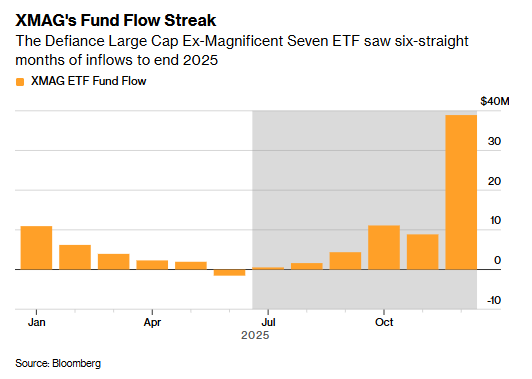
Core Viewpoint - The AI concept stocks have dominated the U.S. stock market over the past three years, leading to a cumulative increase of 78%, but investor enthusiasm is waning as concerns grow about the sustainability of this growth and the potential for a market shift away from the "Magnificent Seven" stocks [1] Group 1: Market Trends - A market style shift has begun, with the "Magnificent Seven" index down 2% since October 29, while the remaining 493 stocks in the S&P 500 have risen by 1.8% [2] - Funds are moving from high-growth stocks to more defensive and reasonably valued sectors, as evidenced by the Defiance Large Cap Ex Magnificent Seven ETF, which saw a threefold increase in net inflows in December compared to November [2] Group 2: Future Outlook - The performance of the remaining 493 S&P 500 stocks is expected to be "remarkable" in 2025, with high profit margins maintained despite economic challenges [5] - If economic conditions improve, cyclical and growth-oriented sectors may also benefit, providing opportunities for investors looking to move away from tech giants [5] - Historical examples suggest that once the dominance of the "Magnificent Seven" ends, the overall market may experience volatility [6] Group 3: Investment Sentiment - There is a growing sentiment of "AI fatigue," with warnings from various analysts about the potential end of the tech giants' dominance [7] - Goldman Sachs predicts that the contribution of the "Magnificent Seven" to S&P 500 earnings growth will decline from 50% in 2025 to 46% in 2026, while the growth rate for the remaining stocks is expected to rise from 7% to 9% [7] - Value investors are finding the remaining 493 stocks attractive due to significant valuation disparities and favorable macroeconomic conditions [7]