
重庆银行

Search documents
银行集体喊话,下半年风控不放松
Zheng Quan Shi Bao· 2025-09-08 00:10
Core Viewpoint - The overall asset quality of the banking industry has remained stable and improved, with a decrease in non-performing loan (NPL) ratios for many listed banks, although risks in certain sectors, particularly corporate real estate and retail personal loans, have increased [1][2]. Group 1: Asset Quality Overview - As of mid-year, the overall asset quality of the banking industry is stable and shows further improvement, with 20 listed A-share banks reporting a decrease in NPL ratios compared to the beginning of the year [1][3]. - Among these banks, Xian Bank, Qilu Bank, and Chongqing Bank saw their NPL ratios decrease by 12, 10, and 8 basis points respectively, while 15 banks maintained their NPL ratios [3][5]. - Conversely, some banks, including Guiyang Bank and Minsheng Bank, reported an increase in their NPL ratios compared to the beginning of the year [3][5]. Group 2: Specific Bank Performance - Xian Bank's NPL ratio decreased to 1.60%, the largest decline among listed banks, while Qilu Bank and Chongqing Bank followed with ratios of 1.09% and 1.17% respectively [5]. - State-owned banks like Bank of Communications and Agricultural Bank of China also reported slight decreases in their NPL ratios, while Postal Savings Bank's ratio increased slightly to 0.92% [5]. - Notably, Guiyang Bank's NPL ratio rose from 1.58% to 1.70%, marking a significant increase [5]. Group 3: Sector-Specific Risks - The real estate sector continues to pose risks, with Qingnong Bank's real estate NPL ratio increasing significantly by 14.15 percentage points to 21.32% [7]. - Guiyang Bank also reported a rise in its real estate NPL ratio by 70 basis points to 1.75% [7]. - In retail lending, 8 out of 14 banks reported an increase in credit card NPL ratios, with Chongqing Bank's ratio rising to 4.19% [8][9]. Group 4: Management Responses - Bank executives have emphasized the importance of risk management, with many banks planning to enhance their risk control measures and digital risk management capabilities [10][12]. - Beijing Bank's president highlighted the need for increased provisioning to strengthen future development, while Industrial and Commercial Bank of China expects a slowdown in the deterioration of personal consumption loans [11][12]. - Other banks, such as Industrial Bank, are focusing on risk resolution in real estate and credit card sectors, indicating a shift from high incidence to a more controlled environment [12].

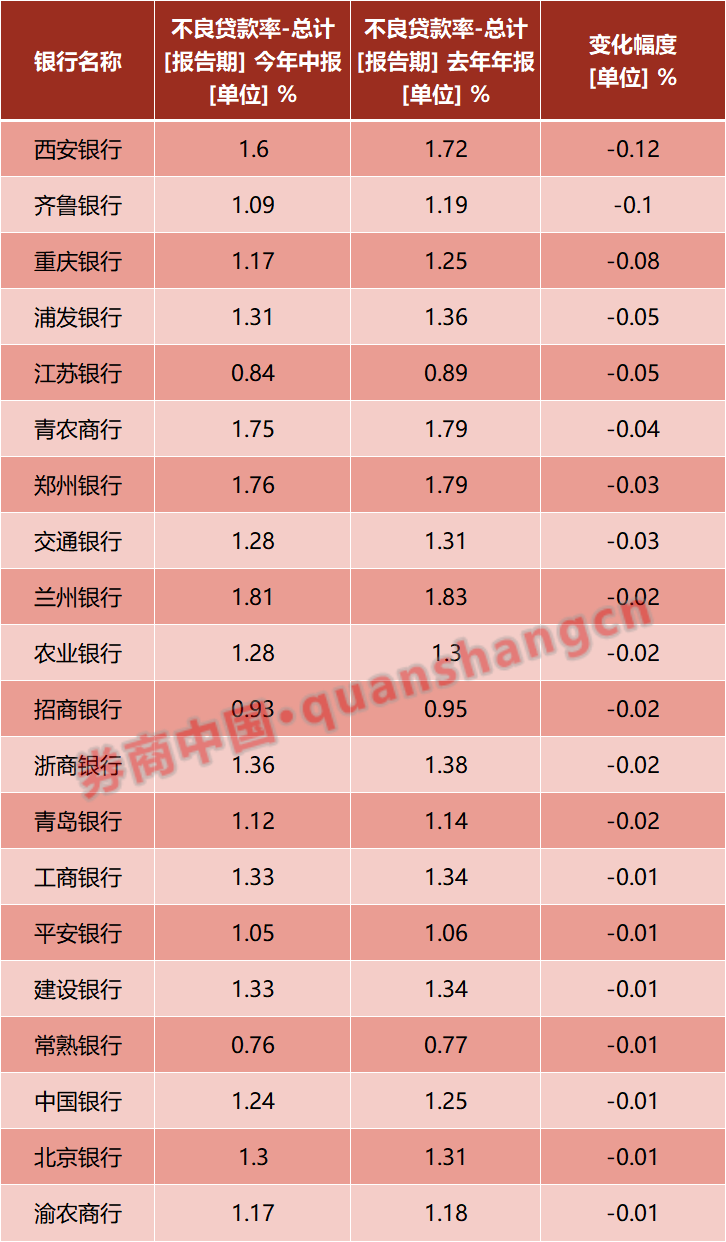
银行集体喊话!下半年风控不放松!
券商中国· 2025-09-07 23:32
Core Viewpoint - The overall asset quality of the banking industry has remained stable and improved, with a focus on risk management and control in the second half of the year [1][2]. Group 1: Asset Quality Overview - As of mid-year, the overall asset quality of the banking industry is stable and has further improved, with 20 A-share listed banks showing a decrease in non-performing loan (NPL) ratios compared to the beginning of the year [2][3]. - Among the listed banks, Xian Bank, Qilu Bank, and Chongqing Bank reported the most significant reductions in NPL ratios, with decreases of 12, 10, and 8 basis points, respectively [4][5]. - Conversely, some banks, including Guizhou Bank and Minsheng Bank, experienced increases in their NPL ratios compared to the beginning of the year [6]. Group 2: Sector-Specific Risks - There is a notable upward trend in NPL ratios in specific sectors, particularly in corporate real estate and retail personal loans [7][8]. - Qingnong Bank reported a significant increase in its real estate NPL ratio, rising by 14.15 percentage points to 21.32%, with real estate NPLs now comprising 61.54% of its total NPLs [8]. - Guizhou Bank also saw a rise in its real estate NPL ratio, which increased by 70 basis points to 1.75% [8]. Group 3: Retail Credit Concerns - In the retail credit sector, there has been an increase in NPL ratios for personal consumption loans and credit cards, with 8 out of 14 banks reporting higher NPL ratios for credit card receivables compared to the beginning of the year [9][10]. - Chongqing Bank's credit card NPL ratio increased by 1.15 percentage points to 4.19%, while Lanzhou Bank's rose by 1.06 percentage points to 2.85% [9]. - Among 12 banks disclosing personal consumption loan NPL ratios, 7 reported increases, with notable rises from China Merchants Bank and Lanzhou Bank [10]. Group 4: Risk Management Strategies - Banks are increasingly prioritizing risk management, with several executives emphasizing the need for enhanced risk control measures and digital risk management capabilities [11][12]. - Beijing Bank plans to strengthen its provisioning efforts and improve the management of new NPLs, while ICBC expects a slowdown in the deterioration of personal consumption loans due to supportive economic policies [11]. - Industry leaders, including those from Industrial Bank and China Merchants Bank, are focusing on risk mitigation in real estate and credit card sectors, indicating a shift from high incidence to a more controlled environment [12].



上市银行资产质量大扫描: 地产风险持续出清 零售贷款承压
Zheng Quan Shi Bao· 2025-09-07 18:27
Core Viewpoint - The overall non-performing loan (NPL) ratio of listed banks in China remains at an excellent level in the first half of 2025, with most banks showing stable or improved asset quality, while some retail loan segments are experiencing increased pressure on asset quality [1][7]. Group 1: Non-Performing Loan Ratios - Among A-share listed banks, 20 banks reported a decrease in NPL ratios, with declines ranging from 0.01 to 0.12 percentage points, while 15 banks maintained stable NPL ratios [2]. - Sixteen listed banks have NPL ratios below 1%, with Chengdu Bank reporting the lowest at 0.66% [2]. - Xi'an Bank achieved the largest reduction in NPL ratio, decreasing by 0.12 percentage points to 1.6% by the end of June [2][3]. Group 2: Risk Management Trends - The risk management trends highlighted by bank executives include the ongoing clearance of risks in real estate and local government financing platforms, while retail sectors like personal loans are under pressure [1][4]. - Agricultural Bank of China reported a 0.05 percentage point decrease in the NPL ratio for real estate loans by the end of June [4]. - The overall NPL ratio for state-owned banks averaged 1.21%, outperforming the industry average by 0.28 percentage points [3]. Group 3: Retail Loan Quality Concerns - Several banks, including Huaxia Bank and Chongqing Rural Commercial Bank, have seen increases in personal loan NPL ratios compared to the beginning of the year [7]. - Industrial and Commercial Bank of China noted that retail loan asset quality is generally declining due to market conditions, but expects improvements as economic policies take effect [7][8]. - Credit card transactions and personal loans are facing significant challenges due to consumption downgrades and adjustments in the real estate market, as stated by China Merchants Bank [7]. Group 4: Future Outlook - Analysts from Huatai Securities believe that the asset quality of corporate loans is improving, particularly in the real estate sector, with expectations for continued improvement in the second half of the year [6]. - Despite the overall stability in NPL ratios, there are concerns about the underlying asset quality, particularly in retail loans, which may face pressure from the actual economic conditions [8].
上市银行资产质量大扫描:地产风险持续出清 零售贷款承压
Zheng Quan Shi Bao· 2025-09-07 18:26
Core Viewpoint - The overall non-performing loan (NPL) ratio of listed banks in China remains at an excellent level in the first half of 2025, with most banks showing stable or improved asset quality, while some retail loan segments are experiencing increased pressure on asset quality [1][7]. Group 1: Non-Performing Loan Ratios - 20 out of 42 listed banks reported a decrease in NPL ratios compared to the beginning of the year, with declines ranging from 0.01 to 0.12 percentage points [2]. - 16 banks have NPL ratios below 1%, with Chengdu Bank having the lowest at 0.66% [2]. - Xi'an Bank saw the largest reduction in NPL ratio, decreasing by 0.12 percentage points to 1.6% by the end of June [2]. Group 2: Risk Management Trends - The risk management landscape is characterized by two main trends: ongoing risk clearance in real estate and local government financing platforms, and rising pressure on retail loans such as personal business and consumer loans [1][4]. - Agricultural Bank of China reported a 0.05 percentage point decrease in the NPL ratio for real estate loans by the end of June [4]. Group 3: Retail Loan Quality Concerns - Several banks, including Huaxia Bank and Chongqing Rural Commercial Bank, have reported increases in personal loan NPL ratios compared to the beginning of the year [7]. - Industrial and Commercial Bank of China acknowledged a general decline in retail loan asset quality due to market conditions, but expects improvements as economic policies take effect [7][8]. - Challenges in retail banking are attributed to consumption downgrades and adjustments in the real estate market, impacting credit card transactions and personal loans [7].
银行业周报(20250901-20250907):1H25商业银行资产质量表现如何?-20250907
Huachuang Securities· 2025-09-07 12:45
Investment Rating - The report maintains a "Recommended" investment rating for the banking sector, expecting the sector index to outperform the benchmark index by over 5% in the next 3-6 months [4][24]. Core Insights - The overall asset quality of commercial banks has improved in the first half of 2025, with a slight decrease in the non-performing loan (NPL) ratio to 1.49% [7][8]. - Retail loan asset quality remains under pressure, particularly in specific areas such as credit cards and personal business loans, due to ongoing economic recovery challenges [8]. - The report emphasizes the importance of long-term capital inflows and public fund reforms, suggesting that banks with high dividend yields and solid asset quality present good investment opportunities [8][9]. Summary by Sections Corporate Sector - The corporate lending sector shows improved asset quality, driven by government policies aimed at stabilizing growth, with a focus on high-tech manufacturing and key policy-supported areas [3]. - The NPL ratio in the corporate real estate sector has increased by 10 basis points to 3.59%, but the peak risk exposure phase is considered to have passed [3][8]. Retail Sector - Retail loan quality is closely linked to employment, income expectations, and consumer confidence, with the NPL ratio for mortgages, credit cards, and consumer loans showing increases of 10bp, 9bp, and 6bp respectively [8]. - The report highlights that the recovery of household balance sheets may take longer, impacting the retail loan sector's performance [8]. Investment Recommendations - The report suggests a diversified investment strategy focusing on state-owned banks and robust regional banks with high provisioning coverage, such as China Merchants Bank and CITIC Bank [8][9]. - It also recommends attention to undervalued joint-stock banks with potential for return on equity (ROE) improvement, specifically mentioning浦发银行 (Shanghai Pudong Development Bank) [8]. Performance Metrics - The banking sector's absolute performance over the past month is reported at 5.0%, with a 17.3% increase over six months and 17.7% over twelve months [5]. - The report provides earnings per share (EPS) and price-to-earnings (PE) ratios for key banks, indicating a positive outlook for banks like 宁波银行 (Ningbo Bank) and 招商银行 (China Merchants Bank) [10].



本周聚焦:2025上半年银行确认了多少金融资产处置收益?OCI浮盈有多少?
GOLDEN SUN SECURITIES· 2025-09-07 08:20
Investment Rating - The report maintains an "Increase" rating for the banking sector, indicating a positive outlook for the industry [1]. Core Insights - In the first half of 2025, the contribution of financial asset disposal gains from AC and OCI accounts to revenue reached 5.2%, an increase of 2.9 percentage points compared to 2024 [1][2]. - The investment income growth rate for 42 listed banks was 23.6%, with AC, OCI, and TPL gains showing year-on-year growth rates of 134.7%, 79.0%, and -8.4% respectively [1]. - The report highlights that the increase in disposal gains does not necessarily indicate a significant increase in asset disposal scale, as market conditions and strategies vary among banks [2]. Financial Asset Disposal Gains - The contribution of AC and OCI financial asset disposal gains to revenue was 5.2%, up 2.9 percentage points from 2024, with AC asset disposal gains contributing 2.6% [2]. - Among different types of banks, rural commercial banks had the highest contribution from AC and OCI disposal gains, reaching 11.0%, an increase of 6.2 percentage points from 2024 [2]. - Specific banks such as Jiangyin Bank, Sunong Bank, and Zijin Bank had high disposal gain ratios relative to their revenue, at 28.9%, 26.7%, and 22.7% respectively [2]. OCI Floating Profit Situation - The overall OCI floating profit decreased compared to the end of the previous year, accounting for 12.6% of the estimated profit for 2025 [3]. - Major state-owned banks like CCB and ABC reported significant OCI floating profits, with balances exceeding 30 billion [3]. - The average contribution of OCI floating profits to profits for city and rural commercial banks was notably high, with Ningbo Bank's ratio reaching 35% [3][6]. Sector Trends - The banking sector is expected to benefit from expansionary policies aimed at stabilizing the economy, with a focus on real estate and consumer spending [7]. - The report suggests a focus on banks with improving fundamentals, such as Ningbo Bank, and those with dividend strategies like Jiangsu Bank and Chengdu Bank [7]. - Attention is also drawn to banks with potential convertible bond conversion expectations, including Shanghai Bank and Industrial Bank [7].





重庆银行第一大股东及其一致行动人持股比例降至21.95%
Jing Ji Guan Cha Wang· 2025-09-06 03:36
Group 1 - The announcement by Chongqing Bank regarding the completion of a share transfer involving 52 million A-shares, which has led to a change in the shareholding ratio of the largest shareholder and its concerted parties [1] - The transaction was approved by the Chongqing State-owned Assets Supervision and Administration Commission, allowing Chongqing Real Estate Group Co., Ltd. to acquire shares from Chongqing Water Investment (Group) Co., Ltd., a concerted party of the largest shareholder [1] - The share transfer was completed on September 3, 2025, through a block trade, with Chongqing Water Investment Group selling 52 million shares at a price of 10.70 yuan per share, totaling no more than 580 million yuan [1] Group 2 - Following the transfer, the combined shareholding ratio of Chongqing Yufu Capital and its concerted parties decreased from 23.45% to 21.95%, triggering a disclosure threshold of 1% for equity changes [1]
重庆银行股份有限公司 关于股东权益变动事项的进展公告(重庆渝富及其一致行动人)
Zhong Guo Zheng Quan Bao - Zhong Zheng Wang· 2025-09-06 00:11
Core Viewpoint - Chongqing Bank announced a significant change in shareholder equity due to the transfer of shares by Chongqing Water Investment Group, impacting the ownership structure of the bank [2][3][6]. Group 1: Shareholder Equity Changes - Chongqing Water Investment Group transferred 52,000,000 A-shares of Chongqing Bank at a price of 10.70 CNY per share, representing 1.50% of the total share capital [3][6][8]. - Following the transfer, the shareholding percentage of Chongqing Water Investment Group decreased from 8.50% to 7.00%, while the shareholding of its associated party, Chongqing Yufu Capital, decreased from 23.45% to 21.95% [3][6][8]. Group 2: Regulatory Approvals and Announcements - The transfer was approved by the Chongqing State-owned Assets Supervision and Administration Commission, allowing Chongqing Real Estate Group to acquire the shares from Chongqing Water Investment Group [2][12]. - The announcement regarding the equity change was made on September 6, 2025, confirming the completion of the share transfer [4][5][11].
重庆银行股份有限公司关于股东通过大宗交易方式转让股份结果公告
Shang Hai Zheng Quan Bao· 2025-09-05 21:01
Core Points - Chongqing Water Investment Group reduced its stake in Chongqing Bank by transferring 52 million A-shares, representing 1.50% of the total share capital, at a price of 10.70 yuan per share [2][3][7] - Following the transfer, Chongqing Water Investment Group's ownership decreased from 8.50% to 7.00% [2][3] - The transaction was completed on September 3, 2025, and was part of a broader plan approved by the Chongqing State-owned Assets Supervision and Administration Commission [6][11] Shareholder Information - Before the transfer, Chongqing Water Investment Group held 295,335,802 shares of Chongqing Bank, accounting for 8.50% of the total share capital [2] - The transfer was executed as part of a strategic decision by Chongqing Water Investment Group to meet its development needs [2][6] Transaction Details - The shares were sold through a block trade, and the total transaction value did not exceed 5.8 billion yuan [6][10] - The transfer was consistent with the previously disclosed plan, and the minimum reduction target was achieved [4][5] Impact on Shareholding Structure - After the transfer, the shareholding percentage of Chongqing Water Investment Group fell to 7.00%, triggering a 1% threshold change in equity [3][7] - The transaction also affected the shareholding of Chongqing Real Estate Group and its concerted actions, increasing their stake from 5.10% to 6.60% after acquiring the same number of shares [11]
重庆银行(01963) - 海外监管公告 -关於股东权益变动事项的进展公告(重庆地產及其一致行动人)
2025-09-05 10:41
香港交易及結算所有限公司及香港聯合交易所有限公司對本公告的內容概不負責,對其 準確性或完整性亦不發表任何聲明,並明確表示,概不就因本公告全部或任何部分內容 而產生或因倚賴該等內容而引致的任何損失承擔任何責任。 BANK OF CHONGQING CO., LTD.* 重慶銀行股份有限公司* ( 於 中 華 人 民 共 和 國 註 冊 成 立 的 股 份 有 限 公 司 ) (股份代號:1963) 海外監管公告 本公告乃重慶銀行股份有限公司*(「本行」)根據香港聯合交易所有限公司證券上市規則第 13.10B條而作出。 茲載列本行在上海證券交易所網站刊發之《關於股東權益變動事項的進展公告(重慶地產 及其一致行動人)》,僅供參閱。 代表董事會 重慶銀行股份有限公司* 董事長 楊秀明 於本公告刊發日期,本行的執行董事為楊秀明先生、高嵩先生及侯曦蒙女士;本行的非 執行董事為黃漢興先生、郭喜樂先生、吳珩先生、付巍先生、周宗成先生及余華先生; 本行的獨立非執行董事為朱燕建先生、劉瑞晗女士、汪欽琳女士、曾宏先生及陳鳳翔先 生。 * 本行經中國銀行業監督管理機構批准持有B0206H250000001號金融許可證,並經重慶市市 ...