
成都银行

Search documents
银行业行情复盘2005:从顺周期到红利
Huafu Securities· 2025-07-29 11:57
Investment Rating - The industry investment rating is "Outperform the Market" (maintained) [1] Core Viewpoints - The banking sector has experienced six distinct phases of absolute and relative returns from 2005 to 2025, with four phases driven by cyclical factors and two by dividend factors [2][3] - The current market trend has shifted from a dividend-driven logic to a return on equity (ROE)-driven logic as of 2025 [106] Summary by Sections Historical Performance Analysis - From November 2005 to November 2007, the banking sector was characterized by absolute returns during a period of rapid economic growth and a bull market in A-shares [2] - The period from January 2009 to July 2009 saw initial absolute returns followed by relative returns due to macroeconomic recovery and liquidity easing post-financial crisis [25] - The phase from December 2012 to February 2013 was marked by a marginal improvement in economic expectations, leading to a rebound in banking valuations [37] - Between October 2014 and January 2015, the banking sector experienced a recovery driven by policy support and a decline in risk premiums, resulting in a rise in valuations [56] - The period from February 2016 to September 2018 was characterized by a recovery in the banking sector driven by macroeconomic stabilization, although regulatory tightening affected relative returns [76] - Since October 2022, the banking sector has seen a recovery after nearly four years of adjustment, with high dividend yields and a shift in market focus from large banks to smaller banks [2][106] Current Market Dynamics - As of October 2022, the banking sector's price-to-book (PB) ratio was at 0.49, reflecting a pessimistic outlook on risks and profitability [95] - The current market is witnessing a decline in dividend yields, driven by falling risk premiums and interest rates, which is crucial for the ongoing market rally [101] - The market is seeing a shift in focus from large state-owned banks to smaller banks, with high dividend strategies gaining traction [102] - The demand for banking stocks is being driven by passive funds and institutional investors, leading to increased allocation in the sector [108]
6325.94亿,A股42家上市银行分红全部到账,工行、建行千亿领跑
3 6 Ke· 2025-07-29 11:22
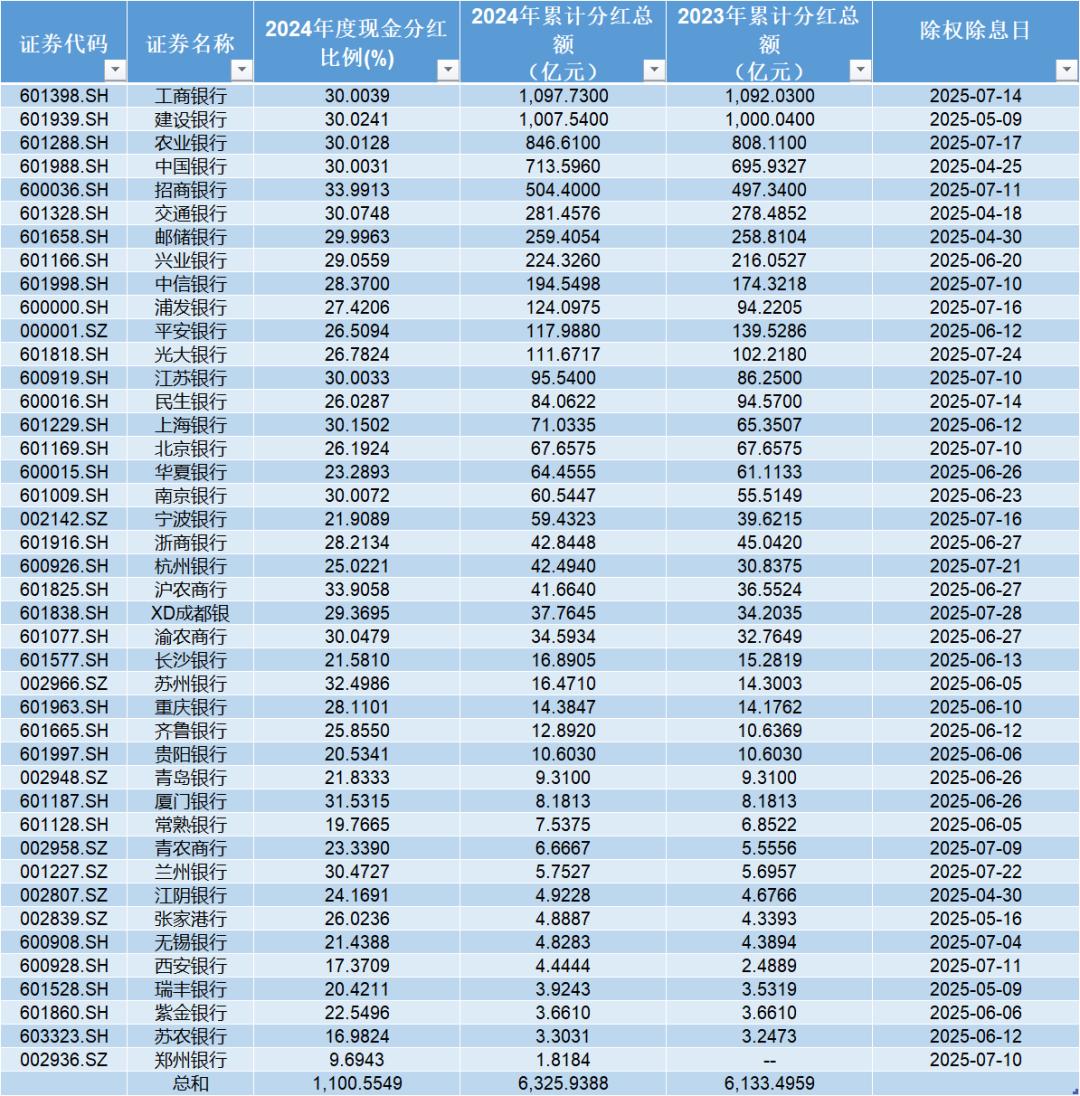
随着成都银行发放现金红利,A股上市银行的"分红季"迎来收官。 7月22日,成都银行(601838.SH)发布2024年年度权益分派实施公告。根据公告,本次利润分配以总股本42.38亿股为基数,每股派发现金红利0.891元 (含税),合计派发现金红利约37.76亿元。股权登记日为7月25日,除权(息)日及现金红利发放日均为7月28日。 在成都银行股吧中,不少股民表示分红已经到账。 时代周报记者注意到,截至7月28日,在A股42家上市银行中,所有银行2024年年度现金"红包"已全部派发到账。 从2024年度累计分红总额来看,42家A股上市银行派发"红包"共计6325.94亿元,相较去年度增加近200亿元,同比增长3.14%。 具体来看,42家A股上市银行中,仅3家银行2024年度累计分红金额较2023年下滑,分别是浙商银行、民生银行和平安银行;5家银行去年度分红金额与 2023年持平,分别是北京银行、贵阳银行、青岛银行、厦门银行和紫金银行;分红总额上涨的银行共34家,占比超八成。 在今年的业绩会上,招商银行董事长缪建民表示,该行自2013年起就把保持30%以上的分红率写入了公司章程。去年现金分红比例达到了35.3 ...






银行股回调倒车接人?专家认为仍被低估
3 6 Ke· 2025-07-29 10:36
Core Viewpoint - The A-share banking sector experienced a rise and subsequent pullback, with the Wind banking index showing a slight increase of 0.06% at the close on July 28, despite a notable decline of over 5% from July 11 to 28 [1][2]. Summary by Sections Market Performance - The Wind banking index rose nearly 1% in the morning of July 28, with individual banks like Qilu Bank and Qingdao Bank seeing increases of over 4% and 3% respectively, before the gains narrowed by midday [1]. - From July 11 to 28, the banking sector saw a decline of over 5%, contrasting with the broader A-share market, which reached new highs during the same period [2][3]. Dividend Distribution - The 2024 annual dividend distribution for A-share listed banks concluded on July 28, with Chengdu Bank being the last to issue dividends totaling 3.776 billion yuan. The total dividends for 42 listed banks reached 632.504 billion yuan for 2024 [1]. - Mid-term dividends for 2025 are set to begin, with banks like Hangzhou Bank and Changshu Bank planning to implement them [1]. Valuation and Investment Outlook - The Shenyin Wanguo banking index's price-to-book ratio is at 0.61, indicating that bank stocks are significantly undervalued, suggesting potential for future price increases [2]. - The banking sector has been a strong performer this year, with a 16% increase from the low on April 7 to the high on July 11, but has since faced a correction [2]. Individual Bank Performance - Among the 42 listed banks, only Ningbo Bank and Agricultural Bank saw stock price increases from July 11 to 28, while 40 banks experienced declines, with 28 banks dropping over 5% [3]. - The dividend yield for some banks has risen to around 5%, with Huaxia Bank leading at 4.98% [3]. Financial Results - As of July 28, four banks have reported their half-year results, all showing increases in both revenue and net profit, with Qilu Bank reporting a net profit growth of 16.48% [6][7]. - Qilu Bank's net interest margin has stabilized, with a 13.57% increase in net interest income for the first half of 2025 [6]. Asset Quality - As of June 30, 2025, Ningbo Bank and Hangzhou Bank maintained a non-performing loan ratio of 0.76%, while Qilu Bank and Changshu Bank reported ratios of 1.09% and 0.76%, respectively, showing slight improvements [7].


33家银行上榜《财富》中国500强 成都银行排名提升35位
Jing Ji Guan Cha Wang· 2025-07-29 09:01
Core Insights - The 2025 Fortune China 500 list shows a significant increase in the number of commercial banks, rising from 28 to 33, marking a record high [1] - Regional banks are demonstrating strong performance, reflecting the deep empowerment of China's regional economic development strategies [2] - State-owned and joint-stock banks remain the backbone of the banking sector, with total revenues of approximately $1.33 trillion and profits exceeding $266.2 billion, accounting for about 35% of the overall profits of the Fortune 500 [3] Commercial Banks Performance - The total revenue of the 33 commercial banks in the list reached approximately $1.33 trillion, with a combined profit of over $266.2 billion [3] - Major state-owned banks like ICBC, ABC, and CCB maintained stable rankings, with ICBC leading at $221.46 billion in revenue [3][4] - Joint-stock banks showed mixed results, with China Merchants Bank improving its ranking to 49th with $70.39 billion in revenue [3][4] Regional Banks Highlights - Regional banks such as Jiangsu Bank, Beijing Bank, and Ningbo Bank performed well, with Jiangsu Bank ranking 162nd with $21.88 billion in revenue [5] - Chengdu Bank emerged as the "progress king" in the banking sector, climbing 35 places to rank 324th with $6.56 billion in revenue [6][7] - New entrants like Guangzhou Rural Commercial Bank and Chengdu Rural Commercial Bank made notable debuts, ranking 354th and 383rd respectively [7] Strategic Insights - The performance of regional banks is attributed to their ability to align with local economic strategies, providing ample credit demand and diverse opportunities [2][7] - Continuous improvement in corporate governance and a focus on differentiated services are essential for regional banks to achieve long-term value growth [7]


银行行业今日跌1.19%,主力资金净流出11.19亿元
Zheng Quan Shi Bao Wang· 2025-07-29 08:53
沪指7月29日上涨0.33%,申万所属行业中,今日上涨的有16个,涨幅居前的行业为通信、钢铁,涨幅 分别为3.29%、2.59%。跌幅居前的行业为农林牧渔、银行,跌幅分别为1.36%、1.19%。银行行业位居 今日跌幅榜第二。 | 002948 | 青岛银行 | -1.62 | 1.27 | -921.52 | | --- | --- | --- | --- | --- | | 601963 | 重庆银行 | -1.65 | 0.68 | -707.37 | | 603323 | 苏农银行 | -1.45 | 1.49 | -406.31 | | 601998 | 中信银行 | -0.73 | 0.12 | -361.06 | | 002807 | 江阴银行 | -0.84 | 1.04 | -239.26 | | 601665 | 齐鲁银行 | -1.43 | 1.64 | -209.53 | | 001227 | 兰州银行 | -0.80 | 2.09 | -160.32 | | 600015 | 华夏银行 | -1.48 | 0.28 | -74.97 | | 601818 | 光大银行 | -0.98 ...
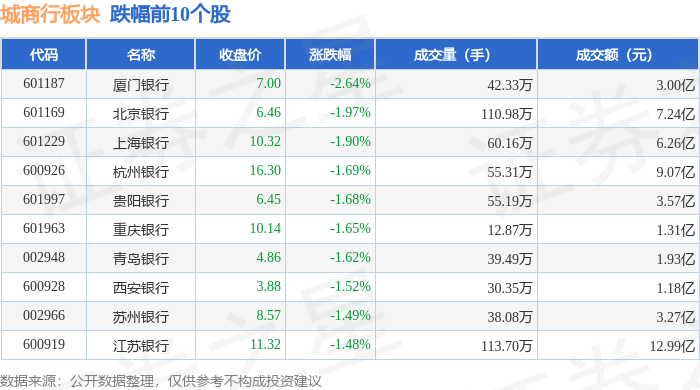
城商行板块7月29日跌1.48%,厦门银行领跌,主力资金净流出2.1亿元
Zheng Xing Xing Ye Ri Bao· 2025-07-29 08:48
证券之星消息,7月29日城商行板块较上一交易日下跌1.48%,厦门银行领跌。当日上证指数报收于 3609.71,上涨0.33%。深证成指报收于11289.41,上涨0.64%。城商行板块个股涨跌见下表: | 代码 | 名称 | 主力净流入(元) | 主力净占比 游资净流入(元) | | 游资净占比 散户净流入(元) | | 散户净占比 | | --- | --- | --- | --- | --- | --- | --- | --- | | 600009 | 南京银行 | 6680.57万 | 13.82% | -263.61万 | -0.55% | -6416.96万 | -13.28% | | 601838 | 成都银行 | 1405.65万 | 3.19% | 283.88万 | 0.64% | -1689.53万 | -3.83% | | 002966 苏州银行 | | 1033.19万 | 3.16% | 3763.59万 | 11.50% | -4796.78万 | -14.65% | | 002936 郑州银行 | | 637.86万 | 1.99% | -1146.12万 | -3.57% | ...
湘财证券晨会纪要-20250729
Xiangcai Securities· 2025-07-28 23:30
Industry Overview - In June 2025, China's newly installed photovoltaic capacity was approximately 14.4GW, a year-on-year decrease of 38.4% [2] - Cumulative newly installed photovoltaic capacity from January to June 2025 reached about 212.2GW, representing a year-on-year growth of 107.1% [2] - The decline in June's installation was attributed to the uncertainty in project profitability following the new pricing mechanism introduced in February 2025 [2] - Despite the June decline, the overall annual growth in photovoltaic installations is expected to remain robust, supported by new technologies and a recovery in upstream equipment demand [2] Mechanical Industry - In the first half of 2025, China's industrial enterprises saw a revenue growth of 2.5% year-on-year, with manufacturing revenue growing by 3.5% [4] - Industrial profits decreased by 1.8% year-on-year, but the decline was less severe than in previous months, indicating a gradual policy effect [4] - The manufacturing sector's profit growth was 4.5% year-on-year, suggesting potential for continued recovery in equipment demand as policies take effect [4] Investment Recommendations - The mechanical industry is rated as "buy," with a focus on photovoltaic processing equipment and general equipment sectors benefiting from manufacturing recovery [5] - Companies to watch include Jing Sheng Mechanical and Aotai Wei in the photovoltaic sector, and Haomai Technology in the general equipment sector [5] Banking Sector - By the end of Q2 2025, the total balance of RMB loans from financial institutions reached 268.56 trillion yuan, a year-on-year increase of 7.1% [7] - Corporate loans were the main driver of credit growth, with a balance of 182.47 trillion yuan, up 8.6% year-on-year [7] - The growth in loans for small and micro enterprises and the real estate sector showed signs of recovery, indicating a stable credit environment [8] Investment Recommendations for Banking - The banking sector is rated as "overweight," with recommendations to focus on high-dividend and regionally growing banks, including major state-owned banks and select regional banks [9] Food and Beverage Sector - The food and beverage industry saw a slight increase of 0.74% from July 21 to July 25, 2025, underperforming compared to broader market indices [19] - White liquor exports surged, with a 30.9% increase in export value in the first half of 2025, indicating strong international demand [20] - The industry is adapting to changing consumer behaviors, with a focus on instant retail channels and digital integration [21] Investment Recommendations for Food and Beverage - The food and beverage sector is rated as "buy," with a focus on stable demand leaders and companies innovating in new products and channels [22] Real Estate Sector - Recent policy changes in Chengdu aim to stimulate the real estate market by optimizing loan policies and reducing restrictions on property sales [24][25] - New housing transaction volumes are under pressure, with significant declines in both new and second-hand home sales reported [26][27] - The outlook for the real estate market remains cautious, with expectations for further policy support to stabilize demand [28] Investment Recommendations for Real Estate - The real estate sector is rated as "buy," with a focus on leading developers with strong land acquisition capabilities and active real estate agencies [28] Pharmaceutical Industry - The pharmaceutical sector saw a 1.9% increase in market performance, with significant gains in drug manufacturing and raw materials [29][30] - Recent policy optimizations in drug procurement are expected to improve competitive dynamics in the market [30] - The industry is entering a new growth cycle driven by innovation and improved market conditions [31] Investment Recommendations for Pharmaceuticals - The pharmaceutical sector is rated as "buy," with a focus on innovative drug companies and those benefiting from policy improvements in generic and raw material drugs [32]
年内多家上市银行披露董监高或股东增持计划
Zheng Quan Ri Bao· 2025-07-28 16:52
Core Viewpoint - Shanghai Bank's executives and supervisors have collectively purchased 440,000 shares of the bank's A-shares, reflecting confidence in the bank's future development and long-term investment value [1][2]. Group 1: Executive Purchases - A total of 10 executives at Shanghai Bank bought shares between July 23 and July 25, with prices ranging from 10.46 to 10.70 yuan per share [2]. - The executives committed to lock the purchased shares for two years, indicating a strong belief in the bank's fundamentals [2]. - The bank's stock price has seen a year-to-date increase of over 17% as of July 28, despite a nearly 3% decline during the purchase period [2]. Group 2: Market Trends - There has been a noticeable increase in executive and major shareholder purchases across various listed banks this year, compared to the previous year [3]. - Many of these purchase plans were disclosed in April, with Suzhou Bank announcing two separate plans totaling over 1.2 billion yuan [4]. Group 3: Implementation Challenges - Some banks, like Chengdu Bank and Huaxia Bank, have faced challenges in executing their purchase plans due to stock prices exceeding the set purchase limits [5]. - Despite recent stock price corrections, many institutions believe there is still room for valuation recovery in the banking sector, maintaining its appeal for investors seeking stable returns [5].
非银、银行带头反弹,平安上证红利低波指数投资机会凸显
Xin Lang Cai Jing· 2025-07-28 02:43
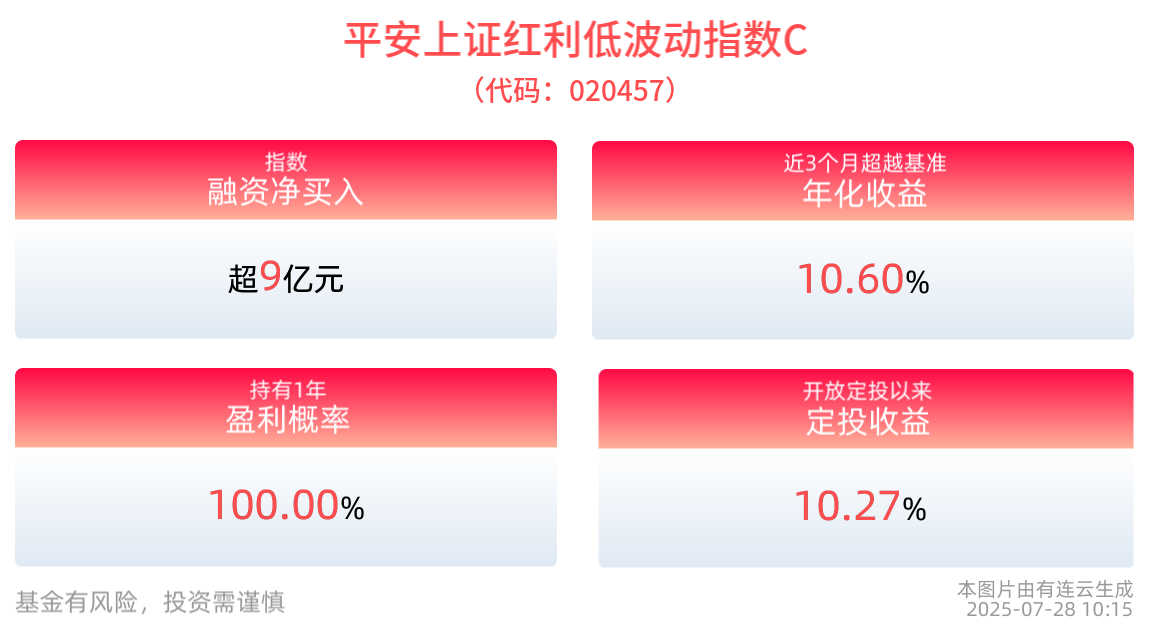
Core Insights - The Ping An SSE Dividend Low Volatility Index C (020457) has shown strong performance, with a year-to-date maximum drawdown of 5.36% and a relative benchmark drawdown of 0.53% [4] - The index has achieved an annualized return of 10.60% over the past three months, outperforming its benchmark [4] - The fund has a management fee rate of 0.50% and a custody fee rate of 0.10%, totaling a fee rate of 0.60% [4] Fund Performance - As of July 25, 2025, the Ping An SSE Dividend Low Volatility Index C has a Sharpe ratio of 1.11 over the past year [4] - The fund has a historical one-year profit probability of 100.00% and an average monthly return of 3.94% [3][4] - The fund's longest consecutive monthly gain was two months, with a maximum monthly return of 11.12% [3] Fund Composition - The Ping An SSE Dividend Low Volatility Index C closely tracks the SSE Dividend Low Volatility Index, which selects 50 securities with good liquidity, continuous dividends, moderate dividend payout ratios, positive growth in earnings per share, and high dividend yields with low volatility [5] - As of June 30, 2025, the top ten holdings of the fund include COSCO Shipping Holdings, Chengdu Bank, Industrial Bank, Sichuan Road & Bridge, and Daqin Railway, accounting for a total weight of 17.41% [5][7] Capital Flow - As of July 25, 2025, the Ping An SSE Dividend Low Volatility Index has attracted a total of 9.61 billion yuan in capital over the past five trading days, with an average daily net inflow of 1.92 billion yuan [3] - The financing net purchase for the index reached 40.51 billion yuan over the past week, with a latest financing balance of 804.61 billion yuan [3] Market Position - The trading congestion level of the Ping An SSE Dividend Low Volatility Index C, as of July 25, 2025, is at the 19.28th percentile since its inception, indicating lower trading activity compared to 80.72% of its historical performance [3]
通胀与反内卷,利好银行
2025-07-28 01:42
Summary of Conference Call Records Industry Overview - The banking industry is currently benefiting from moderate inflation, which is expected to expand interest margins, alleviate debt pressure, and promote corporate profitability and household income growth, thereby driving economic recovery and enhancing collateral value, which reduces asset risks for banks [1][2][3]. Key Points and Arguments - Recent financial reports from commercial banks have shown positive performance, reflecting market optimism regarding their growth. Social loan growth is around 7% to 8%, and social financing growth is approximately 8%, indicating rapid business expansion. If interest margins remain stable and bad debts do not worsen, profit growth is expected to match the business expansion rate, potentially reaching around 8% [1][4]. - High-quality small banks may achieve even higher growth rates, with some expected to exceed 20% [4]. - The valuation of bank stocks should consider price-to-earnings (P/E) ratios and dividend yields. Currently, the average P/E ratio for bank stocks is about 7 times, with a dividend yield of approximately 4%. If banks can achieve higher growth, their valuations should increase accordingly [5]. - Historical data shows that bank stocks perform well during economic recovery and rising inflation phases. For instance, the rise in Chinese bank stocks at the end of 2022 was primarily due to a decrease in bad debt ratios [6][7]. Important Insights - The experience of Japan, the United States, and India indicates that a decline in bad debts typically leads to significant increases in bank stock prices, often outperforming their respective market indices. High inflation and rapid economic growth are particularly favorable for the financial sector [8][10]. - In China, the current decline in bad debt ratios since the end of 2022 suggests that if inflation rises and economic recovery occurs, city commercial banks will have greater growth potential. Notable banks to watch include Hangzhou Bank, Jiangsu Bank, Chengdu Bank, and Ningbo Bank [11][12]. - Qilu Bank's latest performance report shows a revenue increase of 5.76% and a net profit growth of 16.48%, with improvements in net interest income and attention loan ratios, indicating a positive outlook for its future development [13]. Additional Considerations - The overall performance of other listed banks in the first half of 2025 has been satisfactory, with many exceeding expectations. The industry’s net profit growth has slightly declined, primarily due to bond market impacts, but bad debt ratios remain stable [16]. - The investment by CITIC Financial Assets in Everbright Bank, which has led to significant improvements in its financial statements, highlights the potential for stable returns through strategic investments [17][18]. - In the current environment, banks with a cyclical focus may present more opportunities, especially those with high non-interest income ratios, as inflation and internal circulation logic begin to reflect in the data [19].