坤维科技

Search documents
成立创新中心和数据采集训练中心江苏具身智能机器人产业“加速跑”
Xin Hua Ri Bao· 2025-12-11 23:12
江苏省具身智能机器人产业联盟2025年度总结会议暨江苏省具身智能机器人标准化技术委员会成立 会议日前在苏州召开,江苏省具身智能机器人创新中心和江苏省具身智能机器人数据采集训练中心正式 授牌。 当前,江苏具身智能机器人产业集聚态势愈发明显——南京拥有较好的工业机器人、软件产业基础 以及省内较多的高校院所,埃斯顿酷卓、蔚蓝科技、南京天创等具备较大发展潜力;苏州在具身智能机 器人整机及关键零部件领域拥有魔法原子、绿的谐波等优势企业,苏州吴中区是全省首批未来产业(人 形机器人)先行集聚发展试点,已发布多款100%"苏州造"人形机器人;无锡近几年引进和培育了优奇 智能、软通天擎、巨蟹智能等行业领先的整机及零部件企业,正加快建设多个人形机器人产业园;常州 集聚了鼎智科技、坤维科技、富兴电机等成长性较强的关键零部件制造企业。 省工业和信息化厅相关负责人表示,将以更大力度推进产业规划、短板攻关、平台建设、推广应 用、产业活动等工作,指导联盟在促进产业对接、打响活动品牌、做好人才和金融服务、推进标准统一 等方面下更大功夫,推动我省具身智能机器人产业迈上新的台阶。 会上,来自苏州大学、上海机器人产业技术研究院、苏州职业技术大学、 ...

年产6万台,国标驱动六维力传感器量产破局
机器人大讲堂· 2025-12-09 10:17
Core Viewpoint - The establishment of the National Standardization Committee for Humanoid Robots in China marks a significant shift from technical exploration to standardized development in the humanoid robot industry, emphasizing the need for core component standardization, particularly in multi-dimensional force sensors [2][10]. Group 1: Standardization and Market Dynamics - The introduction of national standards is expected to resolve the chaos in the market caused by the absence of standardized testing and evaluation methods for six-dimensional force sensors, which are critical for robot performance [4][10]. - Prior to the establishment of standards, the market was characterized by misleading claims and a lack of scientific measurement, leading to confusion among manufacturers and a race to the bottom in terms of product quality [5][6]. - The new standards will help shift the competition from price wars to value-based competition, focusing on genuine performance, reliability, and long-term stability [13][19]. Group 2: Technical Specifications and Innovations - The GB/T 43199-2023 standard mandates that six-dimensional force sensors must be calibrated under "six-dimensional combined loading" conditions, which is crucial for accurately identifying crosstalk errors that significantly affect sensor accuracy [10][11]. - Companies like Kunwei Technology are leveraging their aerospace heritage to develop advanced sensor technologies that meet and exceed the new standards, achieving precision levels of 0.3% FS, which is below the national military standard [14][16]. - Kunwei has established the only six-dimensional calibration laboratory among private enterprises in China, enabling rapid and reliable sensor calibration and testing, with a projected annual production capacity of 60,000 units by early 2026 [16][19]. Group 3: Market Positioning and Future Outlook - The demand for humanoid robots is driving the need for sensors that ensure safety and economic viability, with Kunwei's HRS series sensors being specifically designed to address these requirements in dynamic environments [17][19]. - Kunwei's collaboration with leading humanoid robot companies, such as Xiaomi and UBTECH, creates a robust ecosystem that facilitates continuous product iteration and enhances competitive advantages [19][20]. - The company's focus on integrating advanced materials and electronic technologies positions it well to meet future demands for smaller, more intelligent humanoid robots, ensuring a deepening technological moat over time [20][22].


国产六维力传感器市场进一步集中,头部厂商市占率已超70%
Huan Qiu Wang· 2025-11-28 01:00
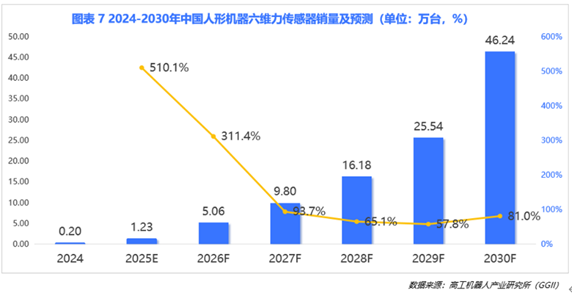
Core Insights - The humanoid robot industry in China is experiencing rapid growth, particularly in the six-dimensional force sensor market, which is crucial for real-time precision force control [1][2] - By 2025, the shipment volume of six-dimensional force sensors in China is expected to reach 12,300 units, representing a year-on-year increase of 510.1% [2] - The market is becoming increasingly concentrated, with leading companies capturing over 70% of the market share [2] Industry Overview - The six-dimensional force sensor is considered a top-tier product in the force sensor field, essential for humanoid robots to achieve precise force control [5] - These sensors are primarily installed in the wrists and ankles of humanoid robots to facilitate delicate operations and stable movement on uneven surfaces [5] - Future developments may see these sensors integrated into the fingertips of dexterous hands to enhance fine motor skills [5] Market Dynamics - Domestic companies are becoming market leaders due to their high cost-performance ratio, customization capabilities, and rapid response services [5] - Key players in the six-dimensional force sensor market include companies like Blue Dot Touch, Keli Sensor, Kunwei Technology, and Amperon, with Blue Dot Touch holding a market share of 72.6% in the first three quarters of 2025 [5] - The industry has seen eight financing events since 2025, indicating strong interest from the capital market in this sector [5] Future Projections - The shipment volume of six-dimensional force sensors is projected to grow approximately 40 times by 2030, exceeding 460,000 units [2] - Optimistically, the market could reach a scale of over 100 billion yuan by 2035 as humanoid robots penetrate consumer scenarios [2] - According to Morgan Stanley, the number of human-like robots could surpass 1 billion by 2050, with China aiming to solidify its leading position in this field [2]

2025宝山·智能机器人产业大会暨嘉年华启动在即
机器人圈· 2025-11-10 11:30
Core Viewpoint - The article discusses the upcoming "2025 Baoshan Intelligent Robot Industry Conference and Carnival," which aims to explore the future development directions of the intelligent robot industry and how to build a collaborative ecosystem across the entire industry chain [1][3]. Event Overview - The conference will take place from November 21 to 22, 2025, in the Zhihui Bay Science and Technology Park, organized by various governmental and academic institutions [3]. - It is described as an annual celebration of the intelligent robot industry, bringing together key players from academia, industry, and investment sectors to create a new blueprint for development in the AI era [3]. Collaborative Efforts - Baoshan District is committed to creating a comprehensive support system for the robot industry through deep collaboration among government, industry, academia, application scenarios, and finance [4]. - The event will unveil a three-year action plan for robotics and a series of service platforms aimed at providing one-stop solutions for technology breakthroughs, application scenarios, and capital connections [4]. Forum Structure - The event will feature a main forum and three thematic forums covering top-level design, embodied intelligence technology, core components, and talent ecology, providing a comprehensive insight into the industry [6]. - Notable speakers include academicians and leaders from prominent robotics companies, who will discuss breakthroughs and development paths in intelligent robotics [6]. Project Roadshow - A project roadshow will focus on early-stage projects with cutting-edge technology and high growth potential, facilitating connections for technology cooperation, application scenarios, and industry funds [8]. - This initiative aims to promote the transition of innovative results from laboratories to the market, injecting vitality into the industry ecosystem [8]. Exhibition Highlights - The event will showcase top products from the intelligent robot industry, including humanoid robots, legged robots, wheeled robots, and various core components [10]. - Featured products include the Kepler K2 "Bumblebee" and Magic Atom's robot "Family Portrait," highlighting the technological strength of the industry [10]. Interactive Experience - The conference will offer immersive interactive experiences, allowing attendees to engage with various robot projects, enhancing the connection between technology and the future [12]. - This platform is designed for industry professionals, developers, and investors to establish deep connections and explore collaboration opportunities [12].

工业机器人力传感器市场调研报告-主要企业、市场规模、份额及发展趋势
Sou Hu Cai Jing· 2025-10-31 09:42
Core Insights - The industrial robot force sensor market is projected to grow from approximately $24.4 million in 2024 to $117.8 million by 2031, with a CAGR of 24.3% from 2025 to 2031 [1] - The six-dimensional force sensor is crucial for enhancing automation by providing robots with tactile feedback, enabling them to perform tasks previously reserved for skilled artisans [1][2] Market Overview - In 2024, global sales of industrial robot six-dimensional force sensors are expected to reach nearly 55,000 units, with China accounting for about 16,000 units, reflecting a year-on-year growth of over 40% [2] - By 2031, global market sales are projected to reach 430,000 units, with China's sales expected to hit 160,000 units, indicating a CAGR of 34.38% from 2025 to 2030 [2] Competitive Landscape - The high-end market for six-dimensional force sensors is currently dominated by foreign brands such as ATI Industrial Automation and Epson, although their market share has been declining [2] - Domestic manufacturers like Yuli Instruments, Kunwei Technology, and Xinjingcheng are gaining market share, with several companies beginning to develop and research industrial robot six-dimensional force sensors [2][5] Product Types and Applications - Strain gauge sensors are the most widely used type, accounting for over 80% of the total force sensor market [3] - Industrial robot force sensors are extensively applied in assembly robots, polishing robots, and collaborative robots, with assembly robots representing over 40% of the application share in 2024 [3] Regional Insights - The Asia-Pacific region holds the largest market share for industrial robot force sensors and exhibits the highest growth rate, with China showing particularly strong performance [3] - The demand for high-precision automation in industries such as automotive, electronics, and aerospace is driving significant growth in the industrial robot force sensor market [3]
具身智能撬动千亿“感知市场”传感器打响国产替代与技术突围战
Zheng Quan Shi Bao· 2025-10-22 17:24
Core Insights - The application value of general-purpose robots largely depends on their upper limb operational capabilities, which are tied to their sensory abilities and the enhancement of sensory hardware and software [1] - The emerging consensus in the industry is that the embodied intelligent robot market is driving significant growth in China's sensor market, creating new downstream applications beyond traditional consumer and automotive electronics [1] - The rise of the Chinese robotics industry is accelerating the growth and technological breakthroughs of domestic sensor manufacturers [1] Sensor Market Dynamics - The humanoid robot industry is becoming a new engine for the growth of the sensor market, with sensors accounting for approximately 20% of the cost in robotic systems [4] - China's sensor market is projected to exceed 406.12 billion yuan in 2024, with a year-on-year growth of 11.4%, and is expected to reach 579.34 billion yuan by 2027 [4] - The high-end sensor market has been dominated by international giants, with the top five foreign manufacturers holding 88% of the market share in IMU sensors [4] Technological Advancements - The "Tiangong" humanoid robot, developed by the Beijing Humanoid Robot Innovation Center, won the 100-meter race at the World Humanoid Robot Games, showcasing its advanced sensory capabilities [2] - The robot's performance is attributed to its use of inertial sensors that provide real-time motion data, enabling it to maintain balance and navigate complex environments [2] - Domestic companies are demonstrating strong technological capabilities, with examples like Daimeng Robotics creating the world's first mass-producible millimeter-thick tactile sensors [4] Domestic Sensor Industry Growth - The demand from the humanoid robot industry is driving an increase in the market share of domestic sensor products, with a reported 1100% year-on-year increase in the shipment of six-dimensional force sensors in the humanoid robot sector [6] - The domestic localization rate of these sensors has risen from 19% four years ago to 57.8% [6] - However, challenges remain for domestic manufacturers, including insufficient chip manufacturing capabilities and the need to overcome established customer barriers set by foreign competitors [6]
熊琳:我被“忽悠”离职创业,钱却最终没到账,从航天到人形机器人,六维力传感器终“破圈”
机器人大讲堂· 2025-10-17 09:37
Core Insights - The article discusses the journey of Kunwei Technology, led by CEO Xiong Lin, from its inception to becoming a leader in the domestic six-dimensional force sensor market, driven by a background in aerospace technology and a focus on robotics applications [1][2][4]. Group 1: Entrepreneurial Origin - Kunwei Technology was founded after Xiong Lin's realization at a robotics conference in 2018 that aerospace six-dimensional force sensors could be adapted for robotics, leading to the establishment of the company in 2019 [5][6]. - The initial investment of 2 million yuan was made by the founding team despite setbacks, demonstrating their commitment to the core focus on multi-dimensional sensors for robotics [1][6]. Group 2: Technology Transformation - The company faced challenges in transitioning from aerospace to mass production, including batch production, cost control, and market education [7][8]. - The aerospace background provided a significant advantage, allowing Kunwei to leverage decades of technology development in precision and reliability for their sensors [8]. Group 3: National Standards Promotion - Kunwei Technology spearheaded the development of national standards for six-dimensional force sensors to address market confusion caused by misleading one-dimensional metrics [10][11]. - The new standards emphasize the importance of "six-dimensional joint loading" for accurate sensor calibration and performance evaluation, aiming to enhance market transparency and product reliability [12][13]. Group 4: Humanoid Robot Market Positioning - The demand for six-dimensional force sensors in humanoid robots is primarily focused on safety and cost-effectiveness, as these robots are still in the data collection and basic testing phase [14][15]. - Kunwei has established significant production capacity, with plans to increase output to 500 units per day by January 2026, positioning itself as a key supplier in the humanoid robot market [15][16]. Group 5: Competitive Strategy and Industry Support - The company has adopted a product tiering strategy to avoid unhealthy competition, offering a range of sensors tailored to different applications and price points [18][19]. - Strategic partnerships with industry stakeholders like Xiaomi and Huichuan provide not only financial backing but also access to supply chain resources and market insights, enhancing Kunwei's competitive edge [19]. Group 6: Long-term Vision - Kunwei aims to expand beyond six-dimensional force sensors into various fields, including food processing, non-standard automation, and sports biomechanics, aspiring to become a comprehensive provider of mechanical sensing solutions [20][21]. - The company emphasizes continuous investment in materials, chips, and processes to improve performance and reduce costs while supporting existing and emerging clients in the robotics sector [21][22].

港城大等团队突破连续体机器人控制难题,让柔性臂实现毫米级精准定位!
机器人大讲堂· 2025-09-04 11:23
Core Viewpoint - Continuous robots exhibit great potential in fields such as robotic surgery and narrow space detection, but precise control remains a significant challenge. Recent breakthroughs by research teams from City University of Hong Kong and Hefei University of Technology have applied Kalman filtering technology to enhance the online control precision of these robots [1][2]. Group 1: Continuous Robots and Control Challenges - Continuous robots possess infinite degrees of freedom and adaptability, making them difficult to control accurately due to their deformable nature, akin to controlling a cooked noodle [4]. - Traditional rigid-link robots have simpler control mechanisms, while continuous robots face challenges from large deformations, friction effects, and inherent non-linear characteristics [4][5]. - The research team designed a lightweight robot with a complex internal structure, consisting of three flexible segments, each with five spacer disks and one drive disk, weighing only 8.4 grams [5]. Group 2: Control Methodology - The team utilized a piecewise constant curvature (PCC) model for initial control, which, while computationally efficient, resulted in position errors exceeding 1.6 mm and angle errors over 1.4 degrees, unacceptable for high-precision applications [7]. - Instead of developing a more complex model, the team innovatively employed the Kalman filter to allow the robot to self-correct during motion, estimating and compensating for errors in real-time [8][9]. - The control system operates at a frequency of 20 Hz, integrating steps such as obtaining end pose, calculating model Jacobians, estimating and compensating for Jacobian errors, and generating control commands [11]. Group 3: Experimental Validation - The research team conducted three trajectory tracking experiments and two disturbance resistance tests, demonstrating the effectiveness of the new method [12]. - In the first experiment, the root mean square error (RMSE) in the x-direction improved from 1.6 mm to 1.1 mm, and in the y-direction from 2.3 mm to 2.1 mm, showcasing significant enhancements in tracking precision [12][14]. - The second experiment focused on attitude control, achieving a reduction in RMSE from 2.1 degrees to 1.5 degrees, while maintaining position accuracy [14]. - The robustness of the method was further validated through disturbance tests, where the robot maintained performance even under significant load changes [15]. Group 4: Innovation and Future Prospects - The research combines model-driven and data-driven approaches, leveraging the strengths of both to enhance control precision while maintaining computational efficiency [17]. - The method's advantages include no need for offline data collection, high computational efficiency, and robustness against external disturbances, indicating strong potential for practical applications [17]. - Future research directions include incorporating dynamic effects and expanding to three-dimensional motion to improve estimation accuracy and applicability [17].
价格降至百元级、需求暴涨11倍,人形机器人带动传感器“狂飙”
财联社· 2025-08-31 06:30
Core Viewpoint - The humanoid robot sensor market is rapidly expanding, driven by advancements in sensor technology and increasing demand for humanoid robots, particularly in tactile, torque, and visual sensing areas [1][10]. Group 1: Market Trends and Developments - Recent exhibitions, such as the 2025 Chengdu Auto Show and the 2025 Guizhou Digital Expo, have highlighted the importance of sensors in humanoid robots, showcasing their role as the "nervous system" and "senses" of these machines [1]. - The humanoid robot sensor market is expected to grow significantly in the coming years, with tactile sensors and electronic skin likely becoming mainstream configurations [1][10]. - The demand for six-dimensional force sensors and joint torque sensors is particularly notable, with six-dimensional sensors projected to account for over 40% of the overall sensor market by 2030 [10]. Group 2: Technological Insights - Six-dimensional force sensors are crucial for dynamic balance and precise operations in humanoid robots, with a typical robot requiring four of these sensors [3][10]. - Various types of sensors, including RGB cameras, IMUs, and laser radars, are essential for the autonomous navigation systems of humanoid robots, enabling them to perform complex tasks [5][6]. - The integration of multiple sensors is necessary for humanoid robots to function effectively, but challenges remain in achieving cost-effective mass production and ensuring reliable performance [11][12]. Group 3: Investment and Financing Landscape - The sensor industry is experiencing a surge in investment, with significant funding rounds reported for companies like Blue Dot Touch and Kunwei Technology, indicating strong market interest [15][16]. - Government-backed funds are increasingly focusing on sensor technology as a key investment area, providing a safety net and attracting market capital [16]. - The financing landscape is becoming more concentrated, with investors favoring early-stage companies that possess original technologies capable of addressing engineering challenges [16].

2025年中国人形机器人六维力传感器市场调研报告
Sou Hu Cai Jing· 2025-08-04 08:10
今天分享的是:2025年中国人形机器人六维力传感器市场调研报告 报告共计:26页 六维力传感器作为力/力矩传感器中维度最高的类型,能同时精确测量三维空间坐标系中相互正交的三个力分量(Fx,Fy,Fz)和三个力矩 分量(Mx,My,Mz),在综合测量精度上优势显著,核心性能指标包括精度/误差、重复精度、量程等。其主流采用应变片式技术路线, 因成熟度高、工艺标准化、综合精度优异、成本较低以及稳定性和可靠性突出而被广泛运用,主要厂商有国际的ATI、SCHUNK,国内 的蓝点触控、坤维科技等。2024年中国六维力传感器整体出货量约1.45万台,同比增长53%,下游应用集中在人形机器人、普通多关节 机器人和协作机器人领域,其中人形机器人出货增长最快,出货量超2000台,同比增长1100%。预计2025年,六维力传感器在人形机器 人领域出货占比将超30%,蓝点触控出货量市场份额约占62%,预计2025年超70%。从长远看,2027 - 2030年将成为六维力传感器规模化 商用关键期,年出货量预计突破百万台,主要受人形机器人于2027年左右步入规模化落地阶段,以及AI技术发展推动更广泛柔性化装配 需求的双重驱动,届时市场前 ...