ByteDance

Search documents
Top China Tech Plays in the US That Could Boost Returns in 2026
ZACKS· 2026-02-09 16:56
An updated edition of the Dec. 12, 2025, article.Chinese technology stocks, including Agora (API) , Kingsoft Cloud (KC) , Tencent (TCEHY) and XPeng (XPEV) , entered 2026 with strategic momentum as the extended U.S.-China trade détente provides operational stability through November. With tariff rates stabilized at 31% and rare earth export controls suspended for another year, Chinese technology companies are leveraging this window to accelerate innovation across semiconductors, artificial intelligence, elec ...



2 Stocks to Buy for AI's Next Stage
Investor Place· 2026-02-08 17:00
Core Insights - The article discusses the shift in investment focus from hardware suppliers to experience-driven companies in the tech sector, particularly in the context of the iPhone and artificial intelligence [1][3][22] Group 1: iPhone Supplier Dynamics - Companies like Skyworks Solutions, Cirrus Logic, and Universal Display saw stock price surges when named as iPhone suppliers, but Apple often imposed low prices and high quality demands, leading to profitability challenges for these suppliers [2] - The real beneficiaries of the iPhone boom were companies providing services and experiences, such as Uber and ByteDance, which have outperformed traditional hardware suppliers [3] Group 2: Current AI Market Trends - A recent selloff in AI infrastructure companies, including chipmakers and data center developers, occurred due to concerns over profitability in a rapidly evolving industry [4] - Analyst Louis Navellier warns of a potential market dislocation for AI companies, suggesting that expectations for "Stage 1" infrastructure firms are overly optimistic [5] Group 3: Investment Opportunities in AI - A select group of "Stage 2" companies in the AI sector is believed to offer significant upside potential, with estimates of around 500% growth [6] - Thomson Reuters, with its established legal research platform, is expected to recover from a 60% selloff, as it combines AI with human expertise to maintain accuracy in legal research [9][14] - ServiceNow, which serves over 85% of Fortune 500 companies, is experiencing rapid growth with a 21% revenue increase in 2025 and projected 20% growth for the current year, driven by its AI capabilities [15][16] Group 4: Comparisons with 5G Technology - The article draws parallels between the 5G technology rollout and the current AI landscape, noting that the biggest winners are not the infrastructure providers but the companies leveraging these technologies for consumer experiences [20][21] - OpenAI's GPT-5 is highlighted as a significant advancement in AI, similar to the leap made by 5G, with the potential for "Stage 2" companies to dominate the market [22][23]



Ripple Is Now Ranked the 9th Largest IPO Candidate at $50B: What Would That Mean for XRP?
Yahoo Finance· 2026-02-08 14:38
Quick Read Ripple’s valuation climbed 25% from $40B to $50B within months despite leadership denying IPO plans. Ripple spent nearly $4B on acquisitions including Hidden Road ($1.25B) and GTreasury ($1B) since 2025. Evernorth is going public via SPAC merger to raise over $1B for building the largest public XRP treasury. Investors rethink 'hands off' investing and decide to start making real money Ripple's ranking as the ninth-largest IPO candidate at a $50 billion valuation changes the conversatio ...
中国互联网行业展望 - 回应投资者关切:聚焦 AI 投资策略、监管与政策等核心领域-Navigating China Internet_ Addressing investor questions_focus areas around AI investment strategies, regulations and policies
2026-02-05 02:22
5 February 2026 | 7:58AM HKT Equity Research NAVIGATING CHINA INTERNET Addressing investor questions/focus areas around AI investment strategies, regulations and policies Since the publication of our 2026 China Internet Outlook, where we highlighted our expectations for 2026 to be a pivotal year of higher AI investments and the defending of core positionings by China Internet mega caps, investor focuses and questions have centered around: (+/-) the intensified contest of consumer AI super apps amongst mega- ...

Qualcomm(QCOM) - 2026 Q1 - Earnings Call Transcript
2026-02-04 22:47
Qualcomm (NasdaqGS:QCOM) Q1 2026 Earnings call February 04, 2026 04:45 PM ET Company ParticipantsAkash Palkhiwala - CFOAlex Rogers - PresidentBen Reitzes - Managing Director and Head of Technology ResearchC.J. Muse - Senior Managing DirectorCristiano Amon - President and CEOMauricio Lopez-Hodoyan - VP of Investor RelationsRoss Seymore - Managing DirectorTimothy Arcuri - Managing DirectorConference Call ParticipantsJoshua Buchalter - Managing Director - Senior Analyst, Semiconductors Equity ResearchSamik Cha ...

Qualcomm(QCOM) - 2026 Q1 - Earnings Call Transcript
2026-02-04 22:45
Financial Data and Key Metrics Changes - The company reported record revenues of $12.3 billion and non-GAAP earnings per share (EPS) of $3.50 for fiscal Q1 2026, with non-GAAP EPS at the high end of guidance [5][17] - QCT revenues reached a record $10.6 billion, with strong year-over-year growth across automotive and IoT segments [17] - Licensing business revenues were $1.6 billion, with an EBT margin of 77%, driven by higher units and favorable mix [17] Business Line Data and Key Metrics Changes - QCT handset revenues reached a record $7.8 billion, benefiting from recently launched flagship smartphones [17] - QCT IoT revenues grew 9% year-over-year to $1.7 billion, driven by demand across consumer and networking products [17] - QCT Automotive revenues grew to $1.1 billion, up 15% year-over-year, reflecting increased demand for Snapdragon Digital Chassis platforms [17] Market Data and Key Metrics Changes - Global consumer demand for handsets, particularly in the premium and high-tier segments, exceeded expectations, with healthy sell-through observed [5] - The handset industry is expected to face constraints due to memory availability and pricing, particularly DRAM, as suppliers redirect capacity to meet AI data center demand [5][6] Company Strategy and Development Direction - The company is focused on expanding its presence in the premium and high-tier smartphone segments, with a dual flagship product strategy that has seen broad OEM adoption [6][7] - The company is also investing in AI-native smartphones and intelligent wearables, positioning Snapdragon platforms as the choice for the industry [7][8] - In automotive, the company aims to reinforce its technology leadership with multiple design wins and collaborations with major automakers [10][11] Management's Comments on Operating Environment and Future Outlook - Management expressed confidence in the fundamentals of the handset business despite near-term challenges related to memory supply and pricing [19] - The company anticipates returning to prior growth trajectories for QCT handset revenues once memory supply normalizes [19] - Management remains optimistic about the long-term growth potential in automotive and IoT, with expectations for continued revenue acceleration [21] Other Important Information - The company completed the acquisition of Alphawave Semi, enhancing its high-speed wire connectivity technologies [15] - The company is actively engaging with leading hyperscalers and cloud service providers to develop data center solutions [14] Q&A Session Summary Question: What factors are driving the weakness in handset outlook beyond memory pricing? - Management indicated that the weakness is entirely related to memory availability, with strong microeconomic indicators and handset demand observed [26][27] Question: Is the automotive revenue growth driven by ADAS wins? - Management confirmed that the automotive pipeline continues to translate into revenue, with new car launches contributing to record revenues [29][30] Question: How is the company managing the memory supply situation? - Management clarified that they do not purchase memory directly but work closely with customers who do, ensuring flexibility with various memory providers [69][70] Question: What is the outlook for the data center business? - Management stated that progress is on track, with positive feedback from engagements with hyperscalers and cloud service providers [35][36] Question: How does the company view the impact of memory shortages on the overall handset market? - Management emphasized that the size of the handset market will be determined by memory availability, with expectations for premium and high-tier segments to remain resilient [40][76]
Exclusive: Nvidia's AI chip sale to ByteDance hinges on conditions set by Trump administration
Reuters· 2026-02-04 22:11
The Trump administration is willing to allow China's ByteDance to buy Nvidia's H200 chips, but the AI chipmaker has not agreed to proposed conditions for their use, according to a person familiar with the matter. ...

Exclusive-Nvidia's AI chip sale to ByteDance hinges on conditions set by Trump administration
Yahoo Finance· 2026-02-04 22:11
By Karen Freifeld Feb 4 (Reuters) - The Trump administration is willing to allow China's ByteDance to buy Nvidia's H200 chips, but the AI chipmaker has not agreed to proposed conditions for their use, according to a person familiar with the matter. The U.S. said it would approve the license about two weeks ago, the person said, but Nvidia has not accepted the U.S. government's Know-Your-Customer (KYC) requirement as now drafted - to ensure China's military does not access the chips - among other condit ...
CNBC's The China Connection newsletter: For Chinese businesses, it's not about which AI is the smartest
CNBC· 2026-02-04 06:21
Core Insights - The competition between the U.S. and China in the artificial intelligence (AI) sector is a significant concern for investors, with Chinese companies focusing on cost-effective AI tools to navigate economic challenges [2][3] Cost Factors - OpenAI's gpt-oss model and DeepSeek are the most affordable AI models at $0.30 per 1 million tokens, while Google's Gemini 3 Pro costs $4.50 and Anthropic's Claude Opus 4.5 costs $10 [3] - Chinese companies are increasingly opting for open-source models to control costs, as highlighted by Movitech's CEO, who serves clients like Starbucks and Unilever [4] Usage Differences - U.S. companies primarily utilize AI for coding, while Chinese firms apply AI for specific operational improvements, such as enhancing production processes and compliance for state-owned enterprises [5] - AI has become a crucial productivity tool for Chinese businesses, especially in a sluggish domestic market, allowing companies to maintain competitive pricing [6] AI Model Preferences - Chinese companies prioritize reliability, control over AI outputs, and integration capabilities over the intelligence of the AI models [9] - AI has significantly improved productivity, with reports indicating that 10 employees can accomplish the work of 20 to 30 employees [10] Global Interest in Chinese AI - Chinese AI models are gaining traction internationally, with increased usage of models like OpenClaw and DeepSeek, which ranked third and fourth in usage respectively [11][12] - Moonshot AI's K2.5 model has seen its revenue from outside China surpass domestic revenue, indicating a growing global interest [12] Investment Trends - Moonshot's valuation increased by at least $500 million following the successful listings of its competitors, reflecting investor interest in Chinese AI companies [13] - Anticipation is building for further AI advancements from DeepSeek, especially as the Lunar New Year approaches [13][14] Innovation and Market Dynamics - The ability of Chinese companies to innovate in AI is linked to their capacity to offer competitive pricing, which is essential for business usability [15] - The Chinese private sector's ability to generate profit is crucial for maintaining innovation in AI, as noted by WisdomTree's director [15]

2026年最值得关注的资本浪潮:赴美IPO中概股的黄金跃迁
Sou Hu Cai Jing· 2026-02-04 05:22
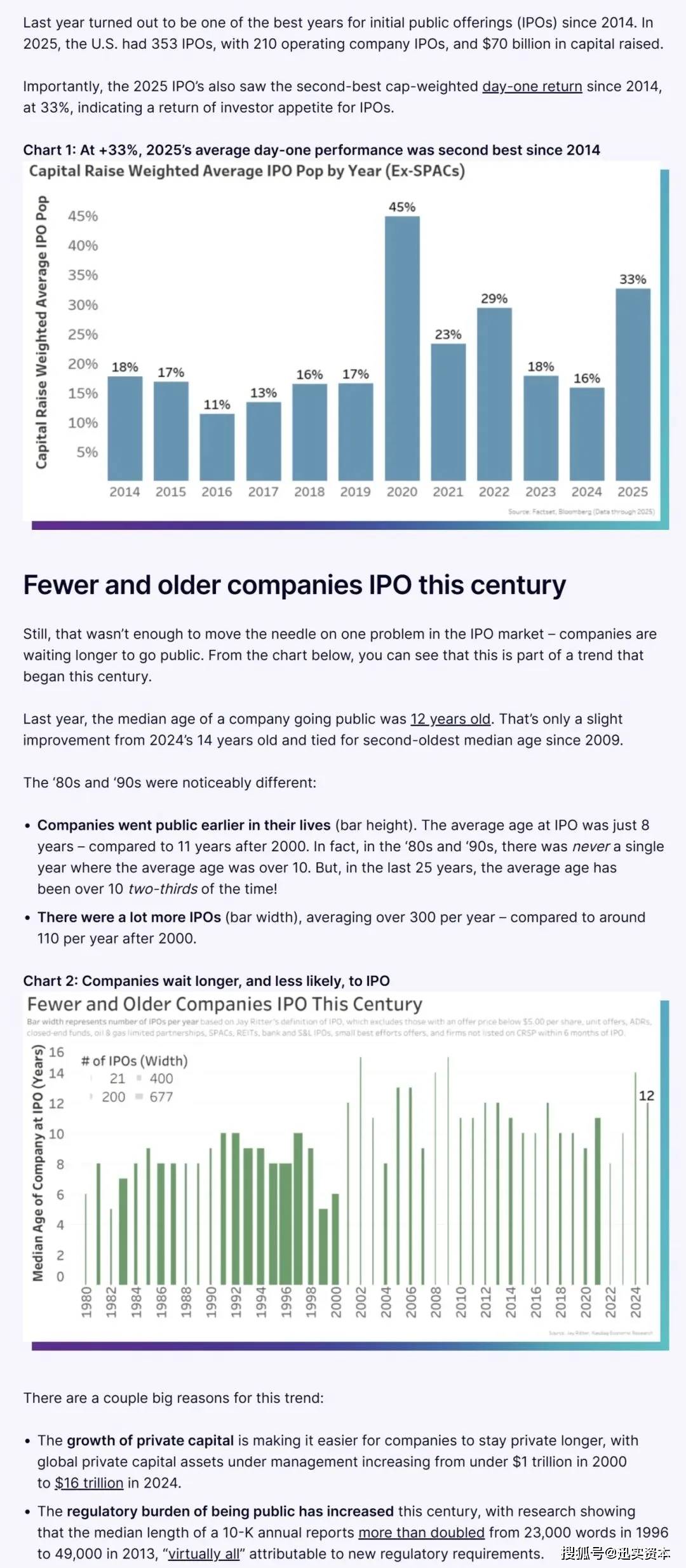
2025年的美国首次公开募股(IPO)市场以一场火爆开局,宣告其自2014年以来最强劲年份的回归。全年353起IPO、超过700亿美元的总募资额,以及高 达33%的加权平均首日回报率,无不点燃了全球投资者的热情。 在这场资本盛宴中,一个尤为引人注目的现象是中概股的显著回归,标志着在经历一段时期的政策适应与市场观望后,众多中国企业重新将美股视为重要 的全球化融资平台。 壹、市场全面回暖,中概股成亮点 2025年美股IPO市场的复苏是全方位的。不仅募资规模巨大,市场热烈的认购情绪更直接体现在首日回报率上。在这一波浪潮中,中概股的回归构成了关 键篇章。 这既得益于跨境监管合作的持续推进与美国市场环境的边际改善,也源于美股市场本身的高流动性、成熟投资者基础及品牌效应对寻求全球化发展的中国 企业的持续吸引力。对于诸多中国新经济公司而言,重返美股是拓宽资本渠道、提升国际形象的战略选择。 贰、上市周期演进背后的资本新生态 尽管市场热度攀升,但企业上市时间普遍推迟的趋势依然明显。2025年新上市公司的中位年龄达到12岁,远高于数十年前的水平。这背后是两大结构性变 化: 其一,私募资本空前繁荣,大量资金在企业成长早期就已介入, ...