GlobalX

Search documents
《K-Pop猎魔女团》热播带动韩流热潮持续 GlobalX韩流音乐及文化ETF提供独特投资机会
Zhi Tong Cai Jing· 2025-07-23 04:22
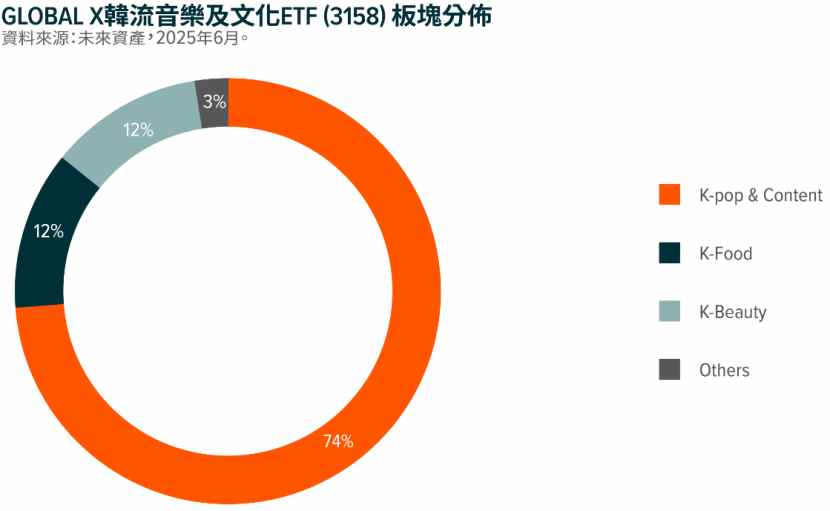
Core Insights - The animated film "K-Pop Monster Hunters," produced by Sony Pictures Animation and released on Netflix, has dominated international charts since its release on June 20, showcasing the ongoing global influence of Korean cultural waves [1][2] - The film's success is expected to create a halo effect for Korean products, particularly in cosmetics and packaged foods, providing unique investment opportunities through the GlobalX K-Pop and Culture ETF (03158) [1] Group 1 - "K-Pop Monster Hunters" ranked first in 26 countries during its opening week and entered the top 10 in 93 countries, indicating strong audience engagement not only in Asia but also in the U.S. and European markets [2] - The film's portrayal of Korean culture is anticipated to boost exports of Korean products, including food and beauty items, as seen with the potential increased interest in Samyang Foods' spicy noodles and Nongshim's Shin Ramyeon, both of which are components of the GlobalX K-Pop and Culture ETF (03158) [2] - The characters' styling and makeup in the film may spark consumer interest in Korean beauty products, further benefiting Korean cosmetics companies as global exposure increases [2]

新兴市场获青睐!美国投资者踏空?
Jin Shi Shu Ju· 2025-05-23 12:31
Core Insights - Emerging market equity funds have outperformed global markets this year, driven by low valuations, years of underweight positioning, and easing economic pressures [1] - Latin America and emerging Europe equity funds have seen a year-to-date increase of 24%, while broad emerging market equity funds rose by 9.3% [1] - Single-country equity funds in Morocco, Colombia, Greece, Brazil, and Portugal have all exceeded 30% returns, contrasting with a mere 0.17% increase in U.S. equity funds and a 6.8% rise in global equity funds [1] Fund Flows and Valuation - In the first five months of this year, emerging market equity funds experienced a net inflow of $10.6 billion, a 43% year-on-year increase [1] - U.S. investors currently allocate only 3%-5% to emerging markets, significantly lower than the MSCI global index weight of 10.5% and the actual global market capitalization of approximately 25% for emerging markets [1] Fundamental Improvements - Analysts highlight improvements in fundamentals, with Latin American countries less affected by U.S. trade deficits due to tariffs, and Asian economies shifting towards domestic demand [2] - JPMorgan upgraded its rating on emerging market equities from "neutral" to "overweight," anticipating that all developing economy central banks, except Brazil, will enter a monetary easing cycle, boosting economic vitality and market attractiveness [2] Sector-Specific Insights - The rebound in tech stocks has revitalized the Chinese mainland and Hong Kong markets, with foreign investors returning to favor AI and low-cost tech companies [2] - The consumer theme in China is currently seen as highly attractive, with good prospects, while Indian markets may be overbought, though opportunities remain in power companies and non-bank financial institutions [2] Valuation Comparisons - As of the end of last month, the forward P/E ratio for the MSCI Emerging Markets Index was 11.96, slightly below the ten-year average of 12.1; in contrast, the MSCI U.S. and global indices stood at 20.5 and 18.1, respectively, significantly above their historical averages [2]
美股落欧股升?“让欧洲再次伟大”交易渐入佳境
智通财经网· 2025-03-31 13:45
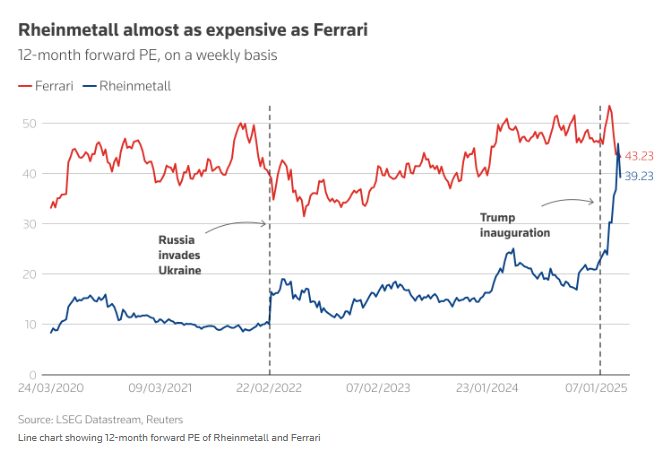
Group 1: Defense Sector Opportunities - The EU plans to allocate up to €800 billion (approximately $866 billion) for rearmament, indicating significant potential in the defense sector despite previous stock price increases since the Russia-Ukraine conflict [2][5] - The European aerospace and defense stock index has risen by 33% this year, with valuation multiples exceeding those of U.S. counterparts, reaching levels comparable to luxury goods or technology sectors [2] - Companies like Rheinmetall are experiencing high valuations, with a price-to-earnings ratio of 44, reflecting investor willingness to pay a premium for long-term trends in defense [2] Group 2: Bond Market Developments - A larger pool of AAA-rated bonds is forming, supporting the euro's reserve currency status, with Germany's historic spending potentially exceeding €1 trillion in new debt [10] - The EU plans to jointly borrow up to €150 billion to support member states in increasing defense spending, indicating a shift towards more regular borrowing practices [10][11] Group 3: Banking Sector Outlook - The European banking index has risen by 26% year-to-date, marking its best quarterly performance since 2020, driven by improved economic prospects from fiscal stimulus [13] - Analysts express optimism for the banking sector, anticipating that higher growth expectations will steepen the yield curve, benefiting banks and stimulating credit growth [14] Group 4: Opportunities in Peripheral Markets - Stocks in Spain and Italy are considered undervalued compared to core European countries, presenting potential for growth, particularly as they are less affected by U.S. tariffs [17] - Factors such as Germany's debt brake rules and the growth of nominal GDP in Europe are expected to positively impact the banking sector, especially in peripheral countries [17] Group 5: Renewable Energy Potential - Europe's commitment to energy independence since 2022 is expected to benefit renewable energy companies and utilities, with the EU proposing plans to accelerate project approvals and increase support for clean industries [20] - Germany plans to allocate €100 billion for climate and economic transition, with solar power projected to account for 11% of the EU's electricity mix by 2024, surpassing coal [20]